When she opened her eyes again, her supervisor, Mr. Amos, was standing over her with fire in his face.
“So you are sleeping while others work?” he shouted.
Sophie jumped to her feet, disoriented. “I’m sorry, sir. I didn’t mean to—”
“You are lazy!” he barked. “Get out. You are finished here.”
She dropped to her knees immediately.
“Please, sir. Please don’t send me away. I need this job.”
But he had already turned his back.
“You will not get one more naira from me,” he said as he walked off.
Sophie stayed there for several seconds, staring at the dust where his shoes had been, before she slowly rose and made her way home with tears slipping silently down her cheeks.
That evening, she and Caleb sat in their one-room home in total silence.
He did not ask for food.
She did not pretend to have an answer.
When he finally lifted his eyes toward the leaking roof and whispered, “Mama… Papa… we are suffering,” Sophie joined him in prayer without words. Her tears were prayer enough.
The next day, Sophie left early and wandered into a richer part of town, asking for work anywhere she could. Rejections came one after another. Some people barely looked at her. Others looked at her too much and saw only poverty.
By late morning, her legs ached and her heart felt numb.
Then she saw the sign.
It hung on the gate of a large house surrounded by flowers.
Housemaid wanted urgently. Apply in person.
Sophie stood still, reading the words again and again as if they might disappear.
She stepped closer to the gate, touched it with trembling fingers, and whispered, “Lord, please let this be the one.”
When she knocked, a security guard opened and looked her over.
“Yes?”
“I came for the housemaid job,” she said.
The guard studied her, then said, “The owner isn’t around. Come back tomorrow morning. Early.”
Sophie wanted to beg to wait, but she saw there was no point. So she nodded, thanked him, and walked away with hope flickering weakly back to life.
On her way home, she saw the old woman again.
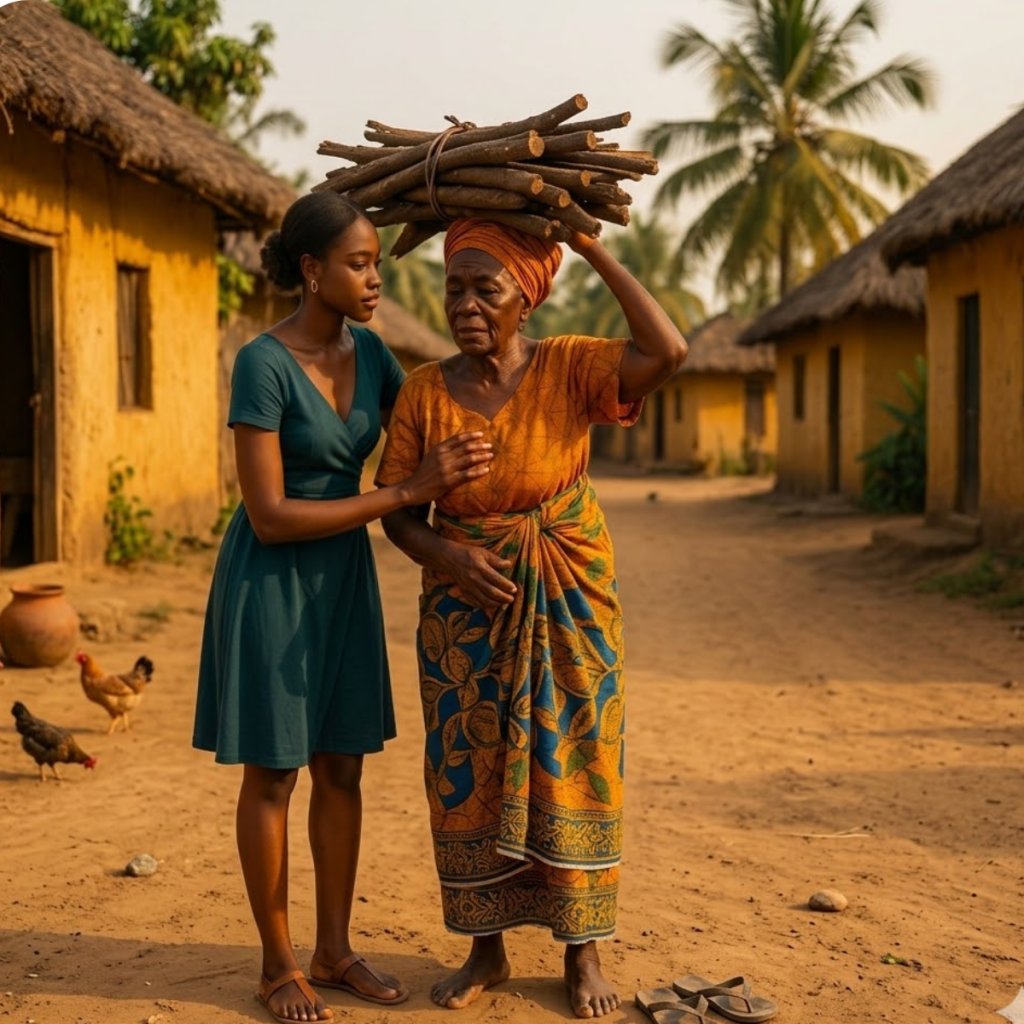
This time the woman was carrying a heavy sack across her back, bent beneath its weight.
Sophie ran to her at once.
“Mama, let me help you.”
The woman turned, surprised, then smiled warmly as Sophie lifted the sack from her shoulders.
“You are a child of light,” the woman said.
They walked together for a while. The woman asked about Caleb. Sophie answered softly, telling her he still could not walk properly and that she needed money for his treatment.
The woman listened without interruption.
Then she said, “You helped me when you had almost nothing. Heaven sees such things. Good will come to you.”
Sophie smiled politely, but deep down she did not know whether to believe in miracles anymore.
The old woman introduced herself as Deborah.
“Call me Mama D,” she said.
Sophie smiled. “That name is beautiful.”
The next morning, Sophie woke before sunrise, bathed quickly in cold water, and put on the neatest dress she owned. Before leaving, she kissed Caleb’s forehead and whispered, “Pray for me.”
At the house, the guard let her in.
A tall man with calm eyes sat in the courtyard drinking tea. He wore a clean shirt and carried himself with quiet authority.
“I’m Samson,” he said. “You came for the housemaid position?”
“Yes, sir.”
He asked a few questions. Could she clean well? Could she wash clothes? Could she arrive early and leave in the evening? Sophie answered carefully, her hands folded tightly in her lap.
Finally, Samson set down his cup and said, “You seem honest. You can start tomorrow.”
For a second, Sophie thought she had misheard him.
Then the words sank in.
She had a job.
Real wages. Real hope. A chance.
She thanked him again and again before hurrying home with joy bursting through her like sunlight after endless rain.
When Caleb saw her smile, he already knew.
“You got it?”
She laughed and nodded, and he pulled her into the tightest hug his thin arms could manage.
“We can start saving,” she said through tears. “For your treatment. For food. For everything.”
For the first time in a long while, their little room felt less like a prison and more like the beginning of something.
Sophie worked hard from her first day.
She arrived early, swept every room, washed the clothes carefully, cleaned windows, chairs, floors, and hidden corners. She never complained. Even when tired, she worked with quiet focus. There was dignity in the way she moved, as if she believed every task deserved respect.
Samson noticed.
He noticed how little she spoke, yet how much care she put into everything. He noticed that she often did more than she was asked. One evening, after returning home tired, he found a plate of hot yam porridge waiting on the table beside a note.
Good evening, sir. I thought you might be hungry after a long day. I hope you like it. — Sophie
He sat there for a long time just looking at the food.
Cooking was not part of her job.
No one had done something so thoughtful for him in a very long time.
“Who are you really?” he murmured.
A few days later, Samson’s mother called to say she was coming to stay with him for a while.
The next afternoon, Sophie was wiping the dining table when the front door opened and Samson said warmly, “Mother.”
Sophie turned casually toward the sound.
Then froze.
The woman standing in the doorway with Samson’s arms around her was Mama D.
The same old woman she had fed with her last meal.
The same woman she had helped carry a heavy load.
The same woman who had blessed her on a dusty road.
“Mama D?” Sophie whispered.
The older woman turned, saw her, and stopped too.
“Sophie?”
Samson looked from one to the other in confusion.



“You know each other?”
They all sat down in the living room, and Mama D began to explain.
She told her son that she sometimes dressed like a poor old woman and went out quietly to test people’s hearts. She wanted to know whether kindness still existed in a world that often looked away from suffering.
Then she turned to Sophie.
“This girl,” she said, her voice thick with emotion, “helped me when she had nothing. She gave me her last meal. She carried my burden. She asked for nothing.”
Sophie lowered her eyes, embarrassed by the praise.
Mama D continued, “She spoke only of her little brother and his pain. Yet she still found room in her heart for a stranger.”
The room fell silent.
Samson looked down, then away, then toward Sophie again with a different expression than before. It was no longer just admiration for a hardworking employee. It was something deeper, quieter, more dangerous to the heart.
That night, after Sophie went home, Mama D entered Samson’s room.
He was sitting on the bed pretending to read, but his mind was clearly elsewhere.
“She is special,” Mama D said softly.
Samson smiled without denying it.
“I think I’m falling in love with her,” he admitted.
Mama D clapped her hands in delight like a child receiving good news.
“Then don’t waste time,” she said.
But Samson still hesitated.
“What if she says no?”
Mama D squeezed his hand. “A girl like Sophie doesn’t give her heart cheaply. If you win it, it will be real.”
From that day on, Sophie began noticing Samson differently too.
She watched how he spoke to workers when they made mistakes—firmly, but never cruelly. She saw how he cared for his mother with patience and affection. She saw that he had power but did not use it to humiliate. He was not soft, but he was just. Not loud, but kind.
Slowly, trust began blooming in her heart.
One day, after she had finished her work, Samson called her into the sitting room. His mother was nearby, pretending not to listen too closely.
“Sophie,” he said, standing before her, “there is something I want to tell you.”
She looked up nervously.
He took a breath.
“I want to marry you.”
Sophie went still.
Her hands trembled. Her heart seemed to forget how to beat properly.
Then, in a soft voice, she said, “I’m not saying no… but I need time to think.”
Samson nodded immediately. “Take all the time you need.”
And she did.
For days, Sophie observed him even more carefully. Not because she doubted his kindness, but because life had taught her that women like her could not afford careless decisions.
What she found only reassured her.
So one morning, dressed in a simple yellow gown, she entered the house glowing with a peace she had not known before. Samson looked up from his papers and immediately sensed something had changed.
“I have thought about it,” she said.
He stood.
“And now I’m sure.”
A small smile touched her lips.
“I will marry you.”
The joy on Samson’s face was so pure that Sophie almost cried. He embraced her with all the tenderness he had been holding back, and when Mama D heard the news, she danced through the sitting room thanking God so loudly that even the guard outside started laughing.
But Samson’s love did not end with a proposal.
When Sophie shyly confessed that she wanted to return to school one day, he did not laugh or dismiss the dream. Instead, he enrolled her in a respected online university, paid her fees, bought her a laptop, and made a study space for her.
Then he learned how much she loved cooking.
Without telling her, he arranged another surprise.
He took her one afternoon to a busy street in town and placed a key in her hand. Before her stood a freshly painted shop with a bright sign above it:
Sophie’s Light Kitchen
It was hers.
Her own catering business.
She stood speechless, tears spilling freely, and asked the only thing her overwhelmed heart could find.
“Why are you doing all this for me?”
Samson looked at her with love that had no need to prove itself.
“Because you deserve the chance to become everything God placed inside you.”
And still, he was not done.
Weeks later, a doctor arrived with the news Sophie had prayed for through countless hopeless nights.
Caleb’s operation could finally happen.
“It’s all been paid for,” the doctor said.
Sophie turned and saw Samson standing quietly nearby, as if what he had done was ordinary.
She ran into his arms and wept.
The surgery was successful. Weeks later, Caleb took his first steps without fear, and Sophie fell to her knees crying so hard she could hardly breathe. All the nights of prayer, hunger, exhaustion, and pain had led to this moment.
The day of the wedding came like sunlight after a long season of rain.
Sophie wore white. Samson stood beside her with pride in his eyes. Caleb walked with strength and even danced at the reception. Mama D celebrated until she was too tired to stand. Music filled the air. Laughter rose like a blessing. Joy lived in every corner of that day.
At one point, Sophie looked at her husband, then at her brother, then up at the sky.
“God gave me a new life,” she whispered.
And she was right.
Because once, she had been a hungry girl on a dusty road, holding the last food she had in the world.
And when kindness asked something of her, she chose to give anyway.
She had no way of knowing that the road would lead from hunger to hope, from exhaustion to peace, from carrying other people’s burdens to finally having someone strong enough to help carry hers.
But that is sometimes how grace works.
It does not always arrive with thunder.
Sometimes it comes dressed as an old woman in torn clothes, asking for a little food.
Sometimes it comes after loss, after rejection, after nights when your prayers feel too tired to rise.
And sometimes, the smallest act of love opens the biggest door of your life.