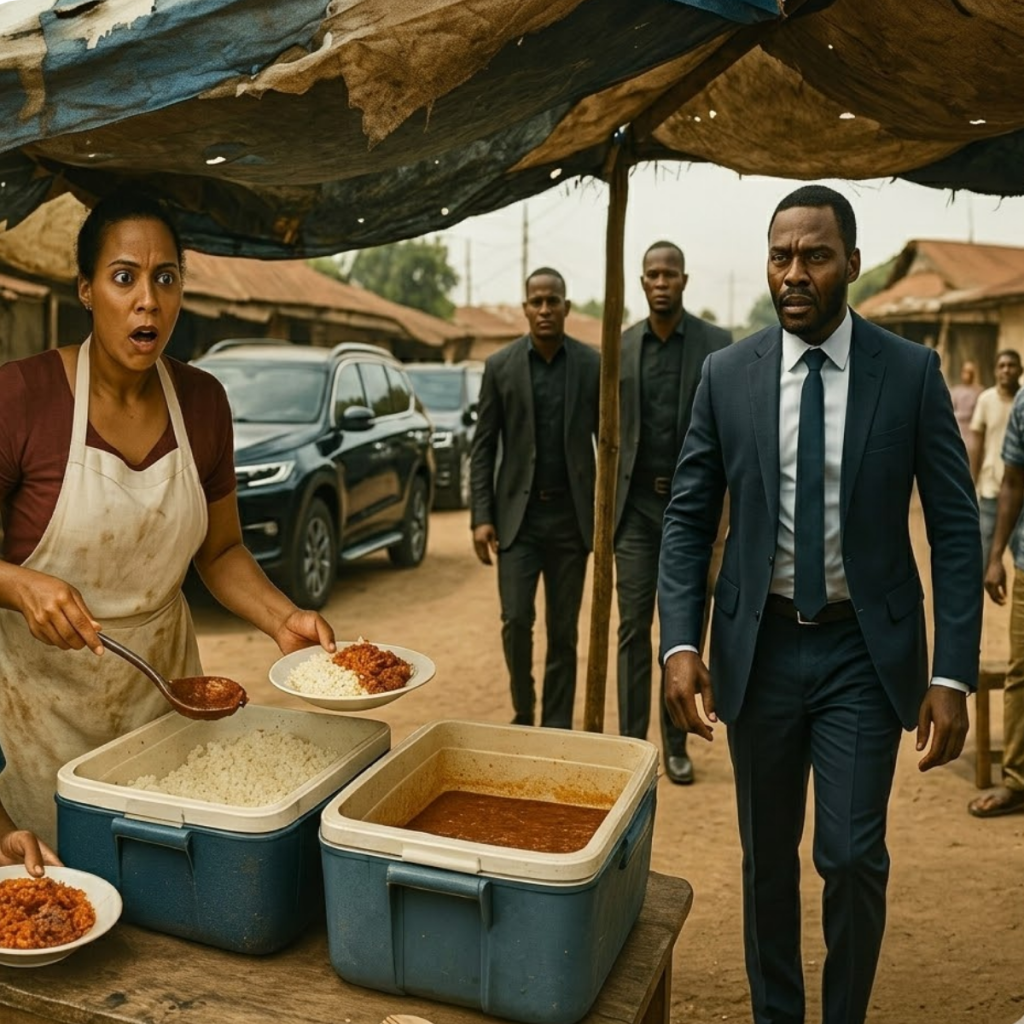
Mama Hannah was standing there, still holding her plate. Her hands were shaking. Her eyes were wide and already wet.
The man turned slowly toward her.
For a moment, nobody breathed.
Then, in the dust of that ordinary street, in front of a torn canopy and a roadside stove, the billionaire dropped to his knees.
“Mama,” he whispered, tears rolling down his face. “I am not dead.”
The world seemed to break open.
Mama Hannah’s spoon fell from her hand. Her lips trembled. She touched her chest as if to hold her own heart in place.
“My son?” she whispered. “Jerry?”
“Yes, Mama,” he said, crying openly now. “It’s me.”
She staggered backward.
Then she collapsed.
Jessica screamed. Amara rushed forward. Jerry caught his mother before she hit the ground and held her like she was made of glass.
“Mama! Mama, please!”
The community, which had spent years walking past Mama Hannah like she was part of the roadside, now crowded around in stunned silence. Some women began praying. One of the security men called for the medical team in the convoy. Someone brought water. Jessica knelt beside Hannah and fanned her frantically with a piece of cardboard.
After a few agonizing moments, Mama Hannah’s eyes fluttered open. She stared at Jerry as if she was afraid he would disappear if she blinked too long.
She lifted a trembling hand and touched his cheek.
“You survived?”
Jerry lowered his forehead to her hand.
“I survived, Mama. I’m sorry it took me so long to find you.”
People were crying now, even those who had come only to watch.
Jerry helped his mother sit down, then crouched in front of her and began to explain.
Twenty years earlier, he and his father had traveled to Lagos to buy goods for their small business. On the way, they had been attacked by armed men. His father died on the spot. Jerry was shot and left for dead. But a passing volunteer rescue team found him breathing and rushed him to a hospital. He lost blood. He lost memory. He lost everything that connected him to home.
“When I woke up,” he said quietly, “I did not know my name. I did not know I had a mother waiting for me.”
A family in Lagos took him in. They gave him care, education, and later their name. He grew, studied, built businesses, made millions. But for years, his past remained a fog. Only fragments returned—a dusty village road, the smell of firewood, his father’s laugh, and his mother’s voice singing while she cooked.
Recently, during a business project in Port Harcourt, an old man had looked at his face and said, “You look like a woman I once knew. A poor widow called Hannah.”
That one clue led him to the streets, to the market, to whispered directions, and finally to Amara’s food stand.
Jerry turned to Amara then, his eyes filled with gratitude.
“You fed her,” he said. “You gave her food when she had nothing. You let her sit here every day. You kept my mother alive.”
Amara shook her head immediately, tears rising.
“She was hungry. That’s all. I only did what anyone should do.”
But Jerry’s expression said he knew better.
“No,” he said softly. “Most people do not do what they should.”
Before Amara could answer, Mama Hannah’s breathing changed. Her hand flew to her chest. Her body slumped. The shock had hit her too hard.
This time, the medical team did not wait. They rushed her into the ambulance while Jerry climbed in beside her. He looked back at Amara and Jessica.
“Please,” he said, “come with us.”
Amara hesitated. “But we…”
“You are family now,” he said firmly.
At the private hospital, they sat under bright lights and clean walls that felt too far removed from the dusty life Amara knew. Jessica held tightly to her mother’s hand. Jerry paced. When the doctor finally came out and said Mama Hannah was stable, all three of them seemed to breathe again at once.
“She is weak,” the doctor said, “but she will recover. She has suffered too much hunger, too much stress, too much loneliness.”
That night, after Mama Hannah regained her strength, Jerry asked Amara to sit with them in her room.
There, between the quiet hum of hospital machines and the soft smell of antiseptic, he made her a promise.
“Tomorrow,” he said, “I will return with something for you.”
Amara frowned. “You don’t owe me anything.”
Jerry smiled sadly. “I owe you more than you know.”
The next morning, Port Harcourt woke up buzzing.
News had already spread through the community. The billionaire had returned. The widow under the bridge was really his mother. The woman at the roadside food stand had helped save her. By the time Amara and Jessica got to the shop, people were already gathering, pretending to buy breakfast while waiting for the black SUVs to return.
They came just after nine.
This time Jerry stepped out in white traditional wear, clean and powerful, but his face was warm when he saw Amara.
“My mother is asking for you,” he said. “But first, I need to do something.”
One of his guards handed him a thick brown envelope.
Jerry stood in front of the whole street and opened it slowly.
Then he went down on one knee again.
Amara’s eyes widened in panic. “Please, don’t kneel.”
But Jerry only smiled.
“You gave food to a woman everyone ignored. You sheltered her. You treated her like a human being. My mother came back to life under your canopy. What you did was bigger than money.”
He pulled out a document and held it up.
At the top were bold words:
KINDNESS RESTAURANT – PORT HARCOURT BRANCH
Amara stared at it without understanding.
Jerry spoke clearly so everyone could hear.
“I have bought the land. Construction begins this week. This restaurant will belong to you.”
A scream tore through the crowd.
Jessica burst into tears. A woman near the back started praising God loudly. Men who had once eaten on credit under Amara’s canopy now stared at her as if she had turned into a story no one would believe.
But Jerry was not finished.
He lifted another document.
“And Jessica,” he said gently, turning to the girl. “I heard you want to be a doctor.”
Jessica covered her mouth.



“I will sponsor your education until the day you become one.”
The girl broke down completely, clinging to her mother as both of them cried.
Amara could barely speak.
“We don’t deserve this.”
Jerry’s answer was soft.
“Yes, you do.”
Then he took them back to the hospital.
Inside Mama Hannah’s room, she smiled the moment she saw them. But she was not alone.
A man stood near the window, thin, dark, and uneasy, as if he did not yet know how to stand inside blessing after years of pain.
Amara stopped walking.
The world blurred.
Her heart began pounding so violently she thought she might faint.
The man turned.
“Amara,” he said.
Her lips parted.
Johnson.
Her husband.
The man who had disappeared three years earlier without a word.
Jessica gasped. “Daddy?”
Johnson began to cry before he could say anything else.
Amara stumbled toward him and touched his face with shaking hands. It was real. Bone. Skin. Tears. Not a dream.
“You’re alive,” she whispered.
He nodded, crying openly. “They took me. I never left you. I never chose to leave.”
Jerry stood quietly as the family collapsed into one another.
His investigators, while looking into Amara’s life the night before, had uncovered something unbelievable. Johnson had been kidnapped by the same criminal network responsible for the attack that took Jerry’s father and nearly took Jerry years earlier. During a recent raid, survivors had been found. Johnson was among them—alive, traumatized, but alive.
“I told you I would bring you answers,” Jerry said quietly.
That room held too many tears for one morning.
Mama Hannah wept. Jessica clung to both parents. Johnson kept repeating, “I’m sorry, I’m sorry,” while Amara held his face and said, “You came back. That is enough.”
From there, the years changed shape.
Kindness Restaurant rose from the dust and became the pride of Port Harcourt. What began under one torn canopy became a shining place of work, comfort, and dignity. Amara hired dozens of people. The woman once pitied for selling jollof rice by the roadside became a respected business owner whose name people spoke with admiration.
Jessica entered medical school with Jerry’s support and graduated years later in a white coat, with Mama Hannah dancing like her bones had forgotten age.
Johnson healed slowly. Trauma does not leave all at once. But he came back to himself in pieces—with therapy, with time, with family dinners, with laughter, with work beside Amara, and with the patient love of a woman who had already survived enough to know how precious return can be.
And Jerry?
He remained close.
At first, he came for updates on Mama Hannah. Then for restaurant meetings. Then for Jessica’s school milestones. Then just because he wanted to.
Somewhere between hospital visits, graduations, family lunches, and quiet evening conversations, Jessica began to see the ache in him behind the wealth. Jerry began to see the strength in her behind the soft voice and white coat.
He had come looking for a lost mother.
He found, slowly and unexpectedly, a place where his own heart could rest.
Years later, in a garden lit with warm lights, Jerry knelt before Jessica and asked her to marry him.
She said yes with tears in her eyes.
At the wedding, Amara stood beside Mama Hannah and watched the daughter she had raised under hardship walk toward a man whose life had once crashed into theirs like a miracle. Johnson held Amara’s hand so tightly his fingers shook.
And when Jessica later gave birth to twin girls, the whole family gathered around her bed laughing and crying and thanking God for a story none of them could have imagined when life was cruelest.
One evening, long after the wedding, long after the restaurant had become famous, long after the community stopped calling her “that food seller” and started calling her “Madam Amara,” she stood in the main dining hall after closing.
The lights were dim. The tables were clean. The kitchen was quiet. Outside, the city moved on, unaware of how close she had once been to a life that would have stayed small and unseen.
Mama Hannah came and stood beside her.
“You’re thinking,” the old woman said.
Amara smiled.
“I was just remembering the old canopy.”
Mama Hannah laughed softly. “And the torn plastic chairs.”
“And the charcoal smoke,” Amara added.
They stood in silence for a moment.
Then Mama Hannah took her hand.
“Do you know what saved all of us?” she asked.
Amara looked at her.
Hannah smiled through wet eyes.
“Kindness. That’s all. One bowl of food. One seat under a torn canopy. One woman who chose not to look away.”
Amara’s throat tightened.
Out of all the things money had brought into their lives—cars, buildings, comfort, connections—it was still that simple truth that mattered most.
Kindness had fed a hungry widow.
That widow turned out to be the lost mother of a billionaire.
That reunion restored a broken son, rebuilt a lost family, gave a girl her future, returned a husband, created a business, and blessed generations that had not even been born yet.
Kindness had come home.
And standing there in the soft silence of the restaurant built from a single act of mercy, Amara finally understood something beautiful:
Sometimes the greatest miracle does not begin with money or power.
Sometimes it begins with a plate of food, a torn canopy, and a heart that refuses to become hard.