The old pickup truck moved forward, jolting along the dirt road, raising a cloud of dust that slipped in through the windows and made their eyes sting. Rafael watched the dry landscape of Minas Gerais go by like a sad film; beside him in the back seat, Sofia clutched her small brown suitcase tightly, as if everything she still had left of safety in life were inside it. At the wheel, Cláudia—the woman who had become their stepmother two years earlier—drove in silence, her jaw clenched and her eyes fixed on a point somewhere far beyond the road.
Since the death of Antônio, their father, the house had filled with a strange silence. It wasn’t the calm silence of before, when he read the newspaper and spoons clinked against cups; it was a heavy silence, full of Cláudia’s irritated sighs and hard footsteps down the hallway. Rafael, only eleven, had learned to guess the woman’s mood just by the way she shut doors. Lately, she shut them hard.
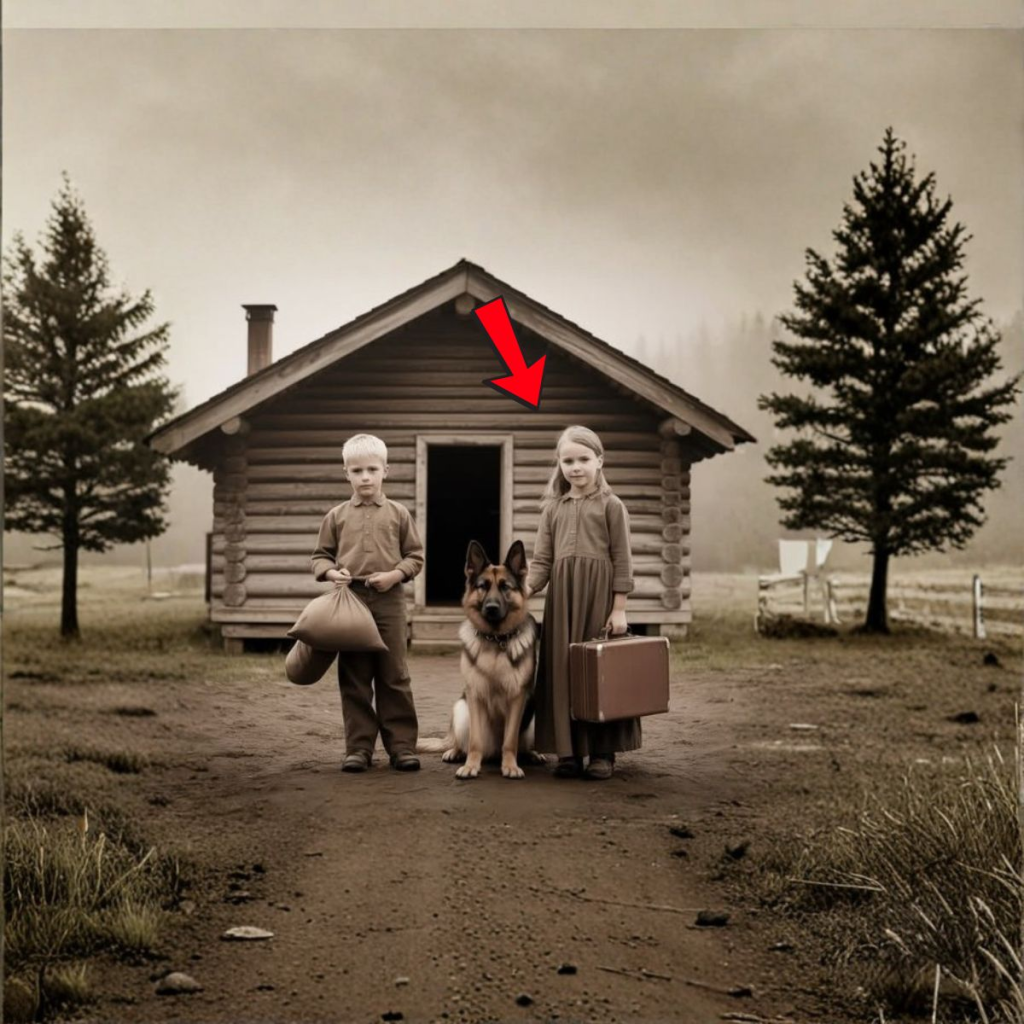
When the truck finally stopped, the tires screeched over the stones. In front of them stood an old wooden cabin, with warped boards and broken roof tiles. It looked like one strong sigh would be enough to knock it down. Rafael felt Sofia’s hand searching for his in desperation.
“Get out,” Cláudia ordered, opening the back door without looking them in the eyes. “We’re going to stay here for a few days.”
Sofia climbed out carefully, holding her suitcase like a shield. Her light eyes swept over the cabin, the tall brush, the windows covered with boards, as if she were searching for something familiar in that completely foreign place.
“Why did we come here, Cláudia?” Rafael asked, trying to keep his voice steady.
“I need to take care of some paperwork for your father’s inheritance in the city,” she answered quickly, as if she wanted the conversation to be over as soon as possible. “You’ll stay here in the meantime.”
She dropped a plastic bag into the boy’s hands.
“There’s food for a few days. Behave.”
She said it the way someone leaves behind a piece of furniture—not two children. Rafael noticed she didn’t mention a phone, or neighbors, or exactly when she would return. He also saw that in the trunk there was nothing of hers: only the bag of food. The rest of the vehicle was empty, as if there were no longer a life they would go back to together.
“When are you coming back?” Sofia asked, her voice trembling.
Cláudia glanced at her watch, restless.
“Soon,” she murmured, unconvinced. “Seu irmão cuida de você.” (Your brother will take care of you.)
She crouched down, gripped the girl’s shoulders without affection—more like adjusting something that was out of place—and immediately stood again. Rafael felt a knot tighten in his stomach. This wasn’t a quick trip out. It sounded like a farewell.
“Tell us where you’re going to be staying,” he insisted. “In case something happens.”
“Nothing is going to happen,” she replied, already getting behind the wheel. “Take care of each other.”
The engine roared, the truck turned around and drove away, lifting a cloud of dust. The two siblings stood motionless, watching the vehicle grow smaller and smaller until it disappeared around a bend in the road. A strange silence—almost alive—fell over the land.
“She’s going to come back, right?” Sofia whispered, squeezing Rafael’s hand.
He swallowed hard.
“Of course,” he lied, forcing the best smile he could invent. “Let’s see what the house looks like inside.”
He pushed the door, which complained with a long creak. Inside, it smelled of dampness, old wood, and abandonment. A small wobbly table, two broken chairs, a rusted wood-burning stove, and a plank floor that groaned under every step. The windows were almost blinded by boards nailed up in a hurry. For a moment, the children felt they were stepping not into a house, but into the dark stomach of an old animal.
They still couldn’t imagine it, but that place that seemed like punishment was about to become the stage for the biggest change of their lives.
They spent the first afternoon sweeping away dust with old rags found in a corner. Rafael managed to pry some boards off the windows, and sunlight entered like a breath of life, revealing cobwebs, cracks, and also a space that—with effort—could become something more than an improvised shelter. At nightfall, they sat on the floor to divide what Cláudia had left: some bread, two cans of sardines, bananas, and a bottle of water.
That night, the countryside showed them its other face. Owls, insects, the crackle of brush, and the distant howl of a stray dog filled the darkness. Curled up under rags pretending to be blankets, Sofia trembled.
“I’m cold,” she murmured, her teeth chattering.
Rafael hugged her tightly. For the first time he felt—like a physical weight—the responsibility of being “the older one.”
“Tomorrow we’ll make all this better,” he promised. “And Cláudia will come back.”
He said it, but in his mind the details that unsettled him marched past: the woman’s relieved look as she started the truck, the lack of any address, the tiny bag of food. Something didn’t add up.
The following days confirmed his worst suspicions. The food dwindled little by little. The water from the well behind the cabin tasted strange, so Rafael learned—through failed attempts—to light the stove and boil it. Exploring the land, he discovered what looked like an old dried-out vegetable garden. The soil was hard, but there were traces that something had once grown there.
“Dad said I had a gardener’s hands,” Sofia remarked, crouching beside the faded furrows. “We could try planting something.”
The mention of Antônio stabbed both of them in the chest, but it also sparked a stubborn flame. They began turning the soil with their hands, searching for forgotten seeds, watching the sky as if consulting a new kind of clock. Still, every morning that dawned with no sign of Cláudia made Rafael’s hope feel more fragile.
On the third day, with their stomachs growling and the bananas carefully counted, they heard a bark nearby. Thor appeared between the trees like a large, frightened shadow. He was a skinny German shepherd, his paw injured by a piece of rusted wire. He bared his teeth by reflex, but his eyes said something else: exhaustion, hunger, pain.
“He’s hurt,” Sofia said, moving closer slowly. “Just like us—only on the outside.”
“Careful,” Rafael warned, though he too felt something tighten in his chest at the sight of the animal.
The girl extended her hand, and instead of attacking, the dog sniffed her, lowering his head little by little. Rafael took the opportunity to free the paw from the wire, carefully. Thor growled once, as if protesting, then licked Sofia’s hand.
“We’re going to call you Thor,” she decided. “Like the god from Dad’s stories. Strong and protective.”
Thor stayed. In a matter of days, he became not only their companion, but their guardian and provider. He brought scraps of small animals, guided the children to bushes with fruit, and lay in front of the door at night, alert to every sound. With him, loneliness became a little less immense.
On the fourth day with no trace of Cláudia, Rafael made a decision that suddenly made him feel older.
“Sofi,” he said as the two of them, sitting on the cabin step, watched the sun sink behind the brush, “I think we have to accept that maybe she won’t come back soon.”
Sofia looked at him, her eyes full of something between fear and understanding.
“What do you mean?”
“That we have to learn to take care of ourselves. Us… and Thor. Like a family.”
The little girl fell silent for a few seconds. Then, to his surprise, she nodded seriously.
“Then we’re really going to make this our home,” she said. “Dad would be proud if we don’t give up.”
That night, fear was no longer the only fuel. There was a new determination too.
Their days filled with small tasks: removing more boards from the windows, mending the chairs, making makeshift brooms from branches. Rafael found a leaky bucket that still worked for carrying water. Sofia set up a corner with their few belongings and another corner for Thor, with clean rags. Little by little, the cabin stopped smelling only of mold and began to hold something like the scent of life.
Then the storm came.
In the early morning, the sky split in two with lightning. Rain pounded the broken tiles as if trying to tear them off. Water began to seep in everywhere. The little garden they had started so carefully was washed away in minutes. Sofia cried as she watched the sprouts float in the mud.
“All our work…” she sobbed. “What’s the point of trying if everything breaks?”
Rafael felt the same hollow inside, but he forced himself to answer differently.
“We can plant again,” he said, even though his voice trembled. “And this time we’ll do it better.”
When the rain eased, something metallic gleamed in the churned-up soil beside the shed. Digging with his hands, Rafael found a small rusted metal box. Inside, protected by scraps of waxed cloth, were tools: a hammer, some nails, an old knife that could be sharpened.
“Someone lived here before,” he murmured. “Someone who knew these things mattered.”
To the children, it felt like a message from the past: they weren’t alone in their struggle; the land itself was giving them what they needed to go on. With the tools, Rafael could repair the roof more properly, nail boards back into place, and strengthen the door. The cabin stopped being merely a shelter and began to look like a home under construction.
The first adult who saw them was Joaquim.
One day, while the three of them—Rafael, Sofia, and Thor—were cleaning the yard, the dog stood up and started barking toward the road. An older man approached slowly, carrying a basket and holding his palms out, as if he didn’t want to frighten them.
“Don’t be afraid,” he said, stopping at a prudent distance. “My name is Joaquim. I live on the farm on the other side of the hill. I saw smoke coming out of the chimney. This house has been abandoned a long time.”
His gaze moved over the children’s dirty, thin faces, their worn clothes, Rafael’s callused hands. He didn’t ask, “Where are your parents?” in an accusing tone. He simply set the basket down, took a few steps back, and said:



“I brought some things that might help you.”
Inside was fresh bread, eggs, vegetables, and even a small jar of jam. Sofia stared at it as if it were treasure from another world.
“Why are you doing this?” Rafael asked, suspicious.
“Because empty land hurts… and a house with children inside deserves help,” the old man replied with a half-smile. “If you need anything, my farm is nearby.”
From then on, Joaquim began to appear from time to time. He brought better tools, taught Rafael how to fix the wobbly table, reinforce the floor, build a small fence. Sofia listened to him tell stories from when he was young—about his sister, who years ago had been happy in that very cabin.
As the days passed, the house truly began to transform. Curtains made from clean cloth hung in the windows; the garden, now properly watered, showed its first sturdy sprouts; Thor had a little wooden doghouse Rafael built. But the greatest transformation came the day Luana appeared.
They saw her first near the little stream hidden among the vegetation. She was a girl a bit older than Sofia, with torn clothes and tangled hair. She drank water with her hands, looking around like a cornered animal. When she saw Sofia, she tensed, ready to run.
“Hi,” the little one greeted, stepping out slowly from behind a rock. “We’re not going to hurt you.”
Thor moved forward wagging his tail, sniffing the air. Luana hesitated, but she didn’t run.
“Do you live in the old cabin?” she asked in a hoarse voice.
“Yes,” Rafael answered. “It’s us and Thor.”
Luana’s story was a twisted mirror of theirs. After her grandmother—the only family she had—died, she had been sent to a “foster” home where they treated her like a servant. The beatings and hunger had been stronger than the fear of loneliness. She had run away without knowing where to go.
“You can come with us,” Sofia said, almost without thinking. “We don’t have much, but we share everything.”
“I have nothing to give in return,” Luana whispered.
“You can help us,” Rafael offered. “And you can be our friend. That’s already a lot.”
When they returned to the cabin, Luana looked around with wide eyes. It wasn’t a perfect place, but it was full of signs of care: stones lined up along the path, the fenced-in garden, the newly repaired roof boards, the corners neatly arranged. For the first time in a long time, she felt she was entering a place where she could rest.
The three girls and the dog formed an improvised family with a speed that surprised even Rafael. Luana knew how to recognize edible plants, Sofia grew more skilled in the garden each day, and Rafael discovered a natural talent for carpentry. Thor, in the middle of everything, seemed proud of his “pack.”
One day, while cleaning the old shed, Rafael found a wooden box hidden under a tarp. Inside, along with yellowed photographs of a young woman in front of the cabin, were papers stained by damp. On one of them, a name leapt out like thunder:
“Antônio Mendonça…” he read, his voice breaking. “It’s Dad’s name.”
It was a deed. The document showed that the cabin and the surrounding land had legally belonged to their father for five years.
“Then…” Sofia looked at him, confused. “This place is ours?”
“It always was,” Rafael replied, feeling anger rise in his throat. “And she knew it. Cláudia brought us here to get rid of us—on our own land.”
Outrage mixed with something stronger: a new sense of belonging. They weren’t abandoned children squatting in some random corner; they were children defending their father’s legacy.
Joaquim took the papers to a lawyer he trusted, Dr. Mário. The man—serious but with kind eyes—listened to their story, reviewed the deed, and explained in clear words what it meant: the land was theirs, but because they were minors, they needed a legal guardian to represent them. And Luana’s situation also had to be made legal so no one could tear her away from the family she had chosen.
“I could take care of that,” Joaquim proposed, moved. “I already look after you as if you were my grandchildren.”
One obstacle remained: Cláudia. Officially, she was still responsible for Rafael and Sofia. She would have to give up guardianship.
The day the woman returned to the cabin, the place looked nothing like the ruin where she had left them. The walls were painted a light blue, the garden overflowed with green, there were flowers in cans in front of the porch, and children’s laughter in the air. Rafael—taller and steadier—stood beside Sofia and Luana. Thor, alert, didn’t take his eyes off the car as it stopped.
Cláudia stepped out, staring around in disbelief. For a second, she seemed not to recognize the three figures at the doorway.
“Rafael… Sofia…” she stammered. “Estão… diferentes.” (You are… different.)
“That’s what happens when someone takes care of us,” Rafael replied—without aggression, but without lowering his gaze.
The lawyer laid out the facts: the property in Antônio’s name, the abandonment, the existence of a guardian willing to assume responsibility, the children’s right to stay. Cláudia tried to justify herself, spoke of her own pain, of how she didn’t know how to handle two children who reminded her of the man she had lost. Rafael and Sofia listened. Yes, it hurt. But they were no longer the same helpless little ones she had left behind.
“We don’t hate you,” Sofia said with a maturity that didn’t fit her years. “But this isn’t your decision anymore. Here we’re a real family. No one treats us like a burden.”
Luana, in a firm voice, added:
“They took me in when I had nothing. Here I learned what a home means.”
At last, with a trembling hand, Cláudia signed the papers renouncing guardianship. She asked if she could visit them someday. Rafael and Sofia looked at each other. They knew forgiveness wasn’t a button you pressed overnight, but they had also learned that the heart grows lighter when it lets go of hatred.
“If you come as a visitor, not as the owner of our lives,” Rafael said, “and if you accept that Luana is part of our family, you can come.”
Cláudia nodded, eyes reddened, and left. This time, she wasn’t leaving them alone—she was leaving them free.
From that day on, everything changed officially, though deep down it had changed earlier. Joaquim became their legal guardian. The government recognized the children’s right to live on the property. A retired teacher began coming a few days a week to help them read better, write, and discover the world beyond the fields. A young physical-education teacher named Carlos offered to organize games and exercises for them.
The cabin, little by little, turned into a small paradise. The garden produced more than they needed, and the surplus was sold at the town market. With the money, they bought more tools, some chickens, and later a dairy goat. Rafael built an extra room for Luana and a large table where they all ate together. Sofia filled the land with medicinal plants and flowers. Luana became an expert at caring for animals.
What had begun as a desperate struggle to survive slowly became a life project. In time, other children in difficult situations came to stay there for a while. Some were sent by social workers, others brought by neighbors who knew the story of the three siblings by heart. In the cabin, they learned not only how to plant, build, and cook, but also how to trust, to be heard, to understand that family isn’t always the one you’re born into, but the one you choose—and that chooses you.
The years passed like the seasons. Rafael grew into a strong young man, with a carpenter’s steady hands and the gaze of someone who could shape the land. Sofia became a specialist in plants, able to heal wounds of the body—and with her gentle way of speaking, many of the soul as well. Luana found in animals a reflection of her own story: creatures that, with the right care, learned to trust again.
One evening, now grown, the three of them sat on the porch, watching the sun sink behind the green fields. The old cabin was still there, but now it was surrounded by other buildings: a small tool shed, a little house for Joaquim, open classrooms under wooden roofs, carefully tended garden beds. They heard children laughing as they ran, chickens clucking, and the joyful bark of a new dog running where, decades earlier, Thor had marked his territory.
“Do you remember the first night here?” Sofia asked, resting her head on Rafael’s shoulder. “I couldn’t stop shaking.”
“Neither could I,” he admitted, smiling. “But I had to pretend I wasn’t afraid, because someone had to believe there was a future.”
Luana looked at her hands, now marked with small scars from years of work.
“If that night someone had told us this place would become all of this…” she laughed. “We would’ve called them crazy.”
Joaquim, now older, came over with slow steps and sat down beside them.
“I didn’t imagine it like this either,” he said. “But I always knew that where there is love and honest work, the land responds.”
Rafael looked at the cabin—the same house in front of which, as a child, he had watched Cláudia’s car disappear in a cloud of dust and fear.
“What began as abandonment,” he said slowly, “became our greatest blessing.”
Sofia nodded.
“Because it forced us to discover what we were capable of. To choose each other every day.”
“And to prove that no one is doomed by where they begin,” Luana added. “An old cabin can be a paradise if it’s filled with love.”
The sun disappeared completely, and the first stars appeared above the blue roof of the house. The breeze carried the smell of damp earth, a lit stove, freshly baked bread. Somewhere nearby, a child’s laughter rang out—a child arriving for the first time, with the same frightened look they had once worn.
Rafael stood up, dusted off his pants, and smiled.
“Come on,” he said. “A new story is beginning. And we know better than anyone how to help turn a cabin of fear into a home.”
And so, in the very place where they had once been abandoned, Rafael, Sofia, and Luana kept building—year after year—a paradise that had nothing to do with luxury or wealth, but with something far stronger: the certainty that even in the driest soil, love can take root and, with patience, transform any ruin into life.