She moved with calm precision, eyes clear, shoulders relaxed, the posture of a woman who had long ago learned that real power does not rush to introduce itself.
She knew exactly who Javier Beltrán was.
He, on the other hand, had no idea who she was.
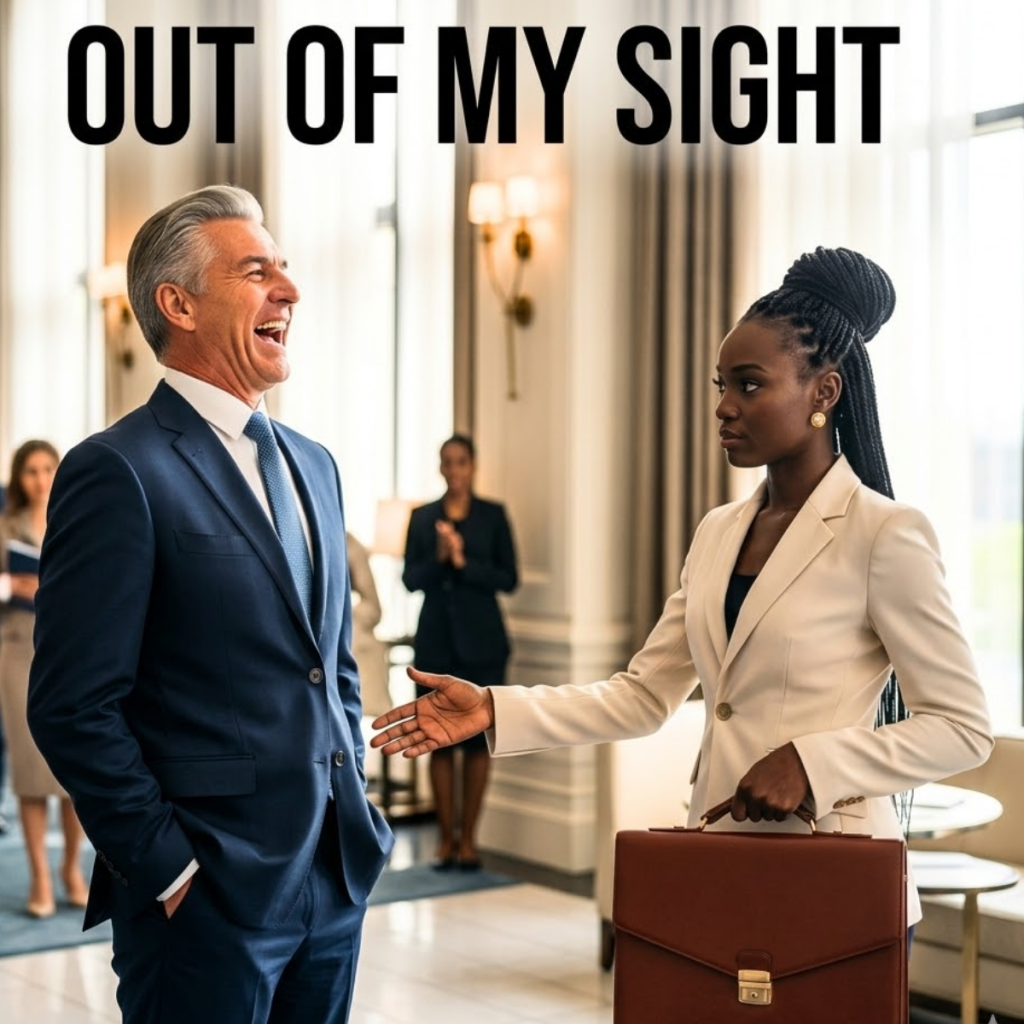
Kiara stopped before his circle of executives and extended her hand.
“Good evening, Mr. Beltrán,” she said, her voice warm but steady. “It’s a pleasure to meet before the formal signing.”
For one brief second, Javier stared at her hand.
Then he looked her over—her face, her age, her skin, her composure. Something small and ugly crossed his expression. Not obvious enough for the careless eye, but sharp enough to leave a scar on the person receiving it.
Instead of taking her hand, he slid his own into the pocket of his suit jacket and stepped back as if distance itself were a statement.
“I don’t know who you are, young lady,” he said coolly, “but the service staff usually enter through the rear hallway. If you’re here for a tip, you can wait until I’ve finished discussing business with people who matter.”
The men around him chuckled on instinct. Not because the joke was clever, but because powerful men often train rooms to laugh for survival.
Kiara did not pull her hand back immediately.
She held it there for one extra beat—long enough to give him a chance to recover his dignity by correcting himself.
He didn’t.
He turned away from her, already dismissing her with his body.
Only then did Kiara slowly lower her hand.
“Mr. Beltrán,” she said, her voice quieter now, colder, “sometimes the hand you refuse to shake is the one holding your future.”
Javier laughed without turning around.
“Go polish glasses,” he said. “Your little speeches don’t impress me.”
That was the moment the room changed, though no one understood it yet.
Kiara reached into her bag and pulled out her phone. It wasn’t flashy. Just slim, black, encrypted, and clearly expensive in the way only people who understand tools rather than toys could recognize.
She stepped aside just enough to be out of Javier’s circle, but not far enough for him to pretend she had vanished.
When she spoke into the phone, her tone was calm.
“It’s me. Execute the integrity clause. Cancel the transfer of the seven hundred million immediately. Freeze the bridge financing. Begin collateral recovery on Grupo Beltrán’s outstanding debt. Effective now.”
She ended the call, glanced once at the wall clock, and stood in absolute stillness.
Javier didn’t even bother looking at her. He took another sip of whiskey and resumed talking about market expansion, zoning approvals, and the inevitable greatness of men who understood how to build things from the ground up.
He had no idea that in less than ten minutes, the ground under his own empire would split open.
It started with a phone vibrating on the table.
Then another.
Then three more in rapid succession.
Javier frowned as his CFO stumbled toward him, face drained of color.
“Javier,” the man said, voice cracking, “something’s wrong.”
“What now?”
“Horizonte Global just withdrew.”
The room went still.
“Withdrew what?” Javier snapped.
“Everything,” the CFO whispered. “The full transfer. The bridge support. The debt protections. They’ve activated immediate recovery on the collateral loan. We are in technical default if this isn’t reversed in the next few minutes.”
Javier stared at him.
The words made no sense. They entered his ears and collapsed before reaching comprehension.
“That’s impossible,” he said. “We were about to sign.”
“No need to call anyone, Mr. Beltrán.”
The voice came from behind him.
Javier turned—and for the first time that night, real fear touched his face.
Kiara stood beside the hotel director and the notary, both of whom looked at her with unmistakable respect. Not politeness. Not courtesy. Respect.
The hotel director lowered his head slightly as he spoke.
“Mr. Beltrán, allow me to formally introduce Dr. Kiara Mendoza, CEO and majority shareholder of Horizonte Global.”
For a moment, the room forgot how to breathe.
The whiskey glass slipped from Javier’s hand and shattered against the marble floor.
He looked from the hotel director to the notary, then back to Kiara, his mind scrambling to reject what his eyes had already accepted.
“No,” he said weakly. “No, that’s not…”
Kiara finished it for him.
“That’s not what you expected?”
Now, finally, Javier extended his hand—but not with dignity. With panic.
“Dr. Mendoza,” he said, stumbling over the title, “please. This is a misunderstanding.”
She looked at his hand.
Then she placed both of hers behind her back.
“No,” she said softly. “It wasn’t a misunderstanding.”
She took one measured step closer.
“It was clarity.”
The room stood frozen around them.
“You looked at me,” Kiara continued, “and in less than three seconds, you decided I was beneath your respect. Not because of my education. Not because of my record. Not because of my company. You made that decision because of my skin and my age.”
Javier swallowed hard.
“I didn’t know who you were.”
Kiara’s expression didn’t change.
“That is exactly the point.”
She let the silence work for her.
“You didn’t need to know who I was in order to treat me like a human being. But you did need to believe my money was acceptable.”
Her voice sharpened—not louder, just clearer.
“My face wasn’t good enough for your respect, but my capital was good enough to rescue your company.”
Javier stepped closer, lowering his voice, trying now to sound reasonable, wounded, human.
“There are thousands of jobs attached to this deal. Families. Employees. People who had nothing to do with this.”
Kiara nodded once.
“And they are the only reason I’m speaking to you this gently.”
He blinked.
She continued, “Your company will be broken apart, yes. But not abandoned. Horizonte Global will acquire the assets piece by piece, preserve the viable projects, and retain the employees under new contracts.” She paused. “Contracts that begin with one non-negotiable principle: mutual respect.”
One of Javier’s executives sat down suddenly, as if his knees had stopped cooperating.
Javier looked around the room. The same men who had laughed with him minutes earlier now avoided his eyes. No one moved to defend him. No one stepped into the fire with him.
He was alone.
And for a man like Javier Beltrán, isolation was more terrifying than bankruptcy.
“I’m sorry,” he whispered.
This time, the words were real.



Too late, but real.
Kiara studied him with a sadness that felt more merciless than anger.
“Do you know how many boardrooms I have entered where men decided I was decoration before I opened my mouth?” she asked. “Do you know how many elevators I’ve stood in while men like you assumed I was staff, or charity, or someone’s assistant? Do you know how many times I was expected to prove, explain, soften, or shrink so other people could remain comfortable?”
Javier said nothing.
“You are not being punished because you insulted me,” Kiara said. “You are facing consequences because you revealed who you are when you believed I had no power.”
That line cut deeper than any public humiliation could have.
Because it was true.
And everyone in the room knew it.
Kiara glanced toward the notary.
“The signing is canceled.”
Then she looked back at Javier.
“You built your life believing respect was something you could ration. Tonight you learned it is a debt—and it comes due when you least expect it.”
She turned to leave.
He nearly dropped to his knees trying to stop her.
“Please,” he said. “Kiara, listen to me.”
She stopped, but did not turn around immediately.
When she finally looked back, there was no hatred in her eyes. Only finality.
“You could have had my trust,” she said. “You could have had my partnership. You could have had my respect with one simple gesture.”
Her gaze flicked briefly to the hand he had refused to shake.
“But arrogance is expensive, Mr. Beltrán. And tonight, you discovered just how expensive.”
Then she walked out of the lounge the same way she had entered it—without rushing, without performing, without ever once needing anyone’s permission to own the room.
No one followed her.
No one dared.
Behind her, Javier remained standing in the center of shattered glass and public silence, watching his empire collapse in real time.
By sunrise, the financial press had the story.
Grupo Beltrán had entered emergency restructuring.
Horizonte Global had withdrawn all support.
The city’s most anticipated merger was dead before the ink touched paper.
Rumors flew, as they always do. Some blamed market conditions. Some whispered about ethics clauses and conduct reviews. Some said Javier had offended the wrong person.
Only a few knew the whole truth.
That an empire hadn’t fallen because of a bad investment.
It had fallen because prejudice had mistaken itself for wisdom.
The weeks that followed were brutal.
Javier lost investor confidence first, then board support, then control. Some of his closest allies distanced themselves within days. The men who once praised his “old school values” began calling him “a reputational risk” in private meetings.
There was poetry in that, though he was too broken to appreciate it.
Meanwhile, Kiara did exactly what she had promised.
She did not destroy for the pleasure of destruction. She rebuilt.
Horizonte Global acquired the most stable parts of Grupo Beltrán, protected active employees, covered delayed salaries, and opened a new leadership structure rooted in accountability. She interviewed senior staff one by one, not asking only about performance, but about how people had been treated under Javier’s rule.
That mattered to her just as much as numbers.
Especially that.
Months later, when Kiara stood in front of the newly restructured company for the first time, the employees watched her with a different kind of silence than the one in the hotel lounge.
This silence held expectation.
Hope.
Curiosity.
Not fear.
She stood at the podium in a navy suit and looked across the room with the same composed authority she had carried that first night.
“I was told once,” she began, “that I should go polish glasses and wait my turn.”
A ripple moved through the audience. Some had heard the story already. Some had only heard fragments.
Kiara allowed herself the smallest smile.
“Life has a beautiful way of revealing what people truly believe when they think your value is negotiable.”
She let that settle.
“This company will not be built on fear. It will not be built on humiliation. And it will certainly not be built on inherited arrogance disguised as leadership.”
Several people straightened in their chairs.
“Talent deserves opportunity. Work deserves dignity. And respect should never depend on title, age, color, accent, or someone else’s approval.”
This time, the applause came slowly at first.
Then all at once.
Not because the speech was dramatic.
Because it was earned.
That evening, after the press interviews ended and the last employee had gone home, Kiara stood alone by the window of her office, looking out at the city beneath her.
The skyline glittered in the distance like a thousand private ambitions.
Her reflection looked back at her—still calm, still elegant, still carrying the scars of rooms where she had once been misjudged before speaking.
But she was not bitter.
She was focused.
Because women like her did not rise to become symbols by accident. They rose because they learned how to turn insult into instruction, exclusion into strategy, and humiliation into a level of clarity no privilege could ever teach.
Her assistant knocked softly and stepped in.
“The legal team confirmed the final transition,” he said. “The employee protection packages are in place.”
Kiara nodded.
“And Beltrán?”
“He’s out.”
She said nothing for a moment.
Then she turned back toward the city lights.
“Good,” she said quietly. “Now let’s build something better.”
And maybe that was the real ending to the story.
Not that a powerful man lost everything in ten minutes.
But that a powerful woman refused to let disrespect be the cost of doing business.
That she didn’t just walk away from prejudice—she outlived it, outworked it, and replaced it with something stronger.
Because real power is not loud.
It does not beg to be noticed.
It does not need permission from old systems or fearful men.
Real power knows exactly who it is.
And when it enters the room, it doesn’t ask for a seat at the table.
It decides whether the table deserves to remain standing at all.