By lunch, his stomach felt like a tight knot. He took his sandwich and juice to the far edge of the courtyard and sat beneath a tree where no one else wanted to be.
That was where Principal Whitaker found him.
The man carried himself with the polished confidence of someone used to being obeyed. He was tall, silver-haired, always dressed impeccably, with a voice that sounded calm even when it was cold.
“You play any instruments?” he asked.
Elijah looked up, surprised. “Piano, sir.”
Whitaker’s eyebrows lifted slightly.
“Piano,” he repeated, as if the answer amused him. “Interesting.”
Then he walked away.
That night, Elijah didn’t tell his grandmother how lonely the day had felt. He didn’t tell her about the whispers or the laughter or the way his teacher had pointed him toward the back of the room without even asking his name.
He just smiled, said it was fine, and after dinner went downstairs to the basement.
That basement was where the real part of his life lived.
In the corner sat an old upright piano, yellowed at the keys and scarred by time. Some notes were slightly off, one pedal stuck on damp days, but to Elijah it was still the most beautiful thing he owned.
His grandmother, Martha Turner, had gotten it years ago from a family she cleaned for. The instrument had been considered junk to them, too worn to keep, too expensive to repair. To Martha, it looked like a miracle. To Elijah, it became one.
That piano had raised him almost as much as his grandmother had.
After his mother died when he was four, it was Martha who worked herself tired to keep them afloat. Cleaning houses. Mending clothes. Taking any job that paid cash. She always came home exhausted, but if she heard music floating up from the basement, her face would soften.
“Play again,” she would say from the stairs. “That one that sounds like rain remembering how to dance.”
He learned from library books, borrowed sheet music, old recordings, and instinct. Music became the place where shame couldn’t touch him. When kids laughed, when bills piled up, when the neighborhood felt too small for the size of his dreams, he played.
At Lincoln High, though, none of that mattered at first.
What people saw was not talent.
They saw difference.
On the second day, the school announced a student talent showcase for parents and faculty that Friday night. The class buzzed with excitement until the teacher casually added, “And Principal Whitaker has suggested that Elijah open the program with a piano performance.”
The room erupted.
“Oh, this I have to see.”
“He’s serious?”
“This is going to be painful.”
Even Elijah froze.
He hadn’t volunteered. He hadn’t even been asked.
And yet suddenly, everyone was looking at him like he had been invited onto a stage built for humiliation.
That afternoon, he walked home slower than usual. By the time he reached the apartment, the sky was turning the color of old bruises. His grandmother was making rice and beans, humming softly as she stirred the pot.
“You look like your thoughts are heavy,” she said without turning around.
He hesitated, then finally asked, “What if they don’t want me there?”
Martha turned, wiped her hands on a dish towel, and studied him carefully.
“They don’t get to decide where your gift belongs,” she said. “Only what they do when they see it.”
Friday came gray and overcast.
The whole school seemed to be waiting for the evening, though not for the same reason. Some students planned to record Elijah’s performance, convinced they were about to witness a train wreck. Others were simply curious. A few teachers, the kinder ones, looked quietly worried.
Backstage, Elijah sat alone in a borrowed dress shirt and shoes half a size too big. His fingers were cold despite the heat under the stage lights.
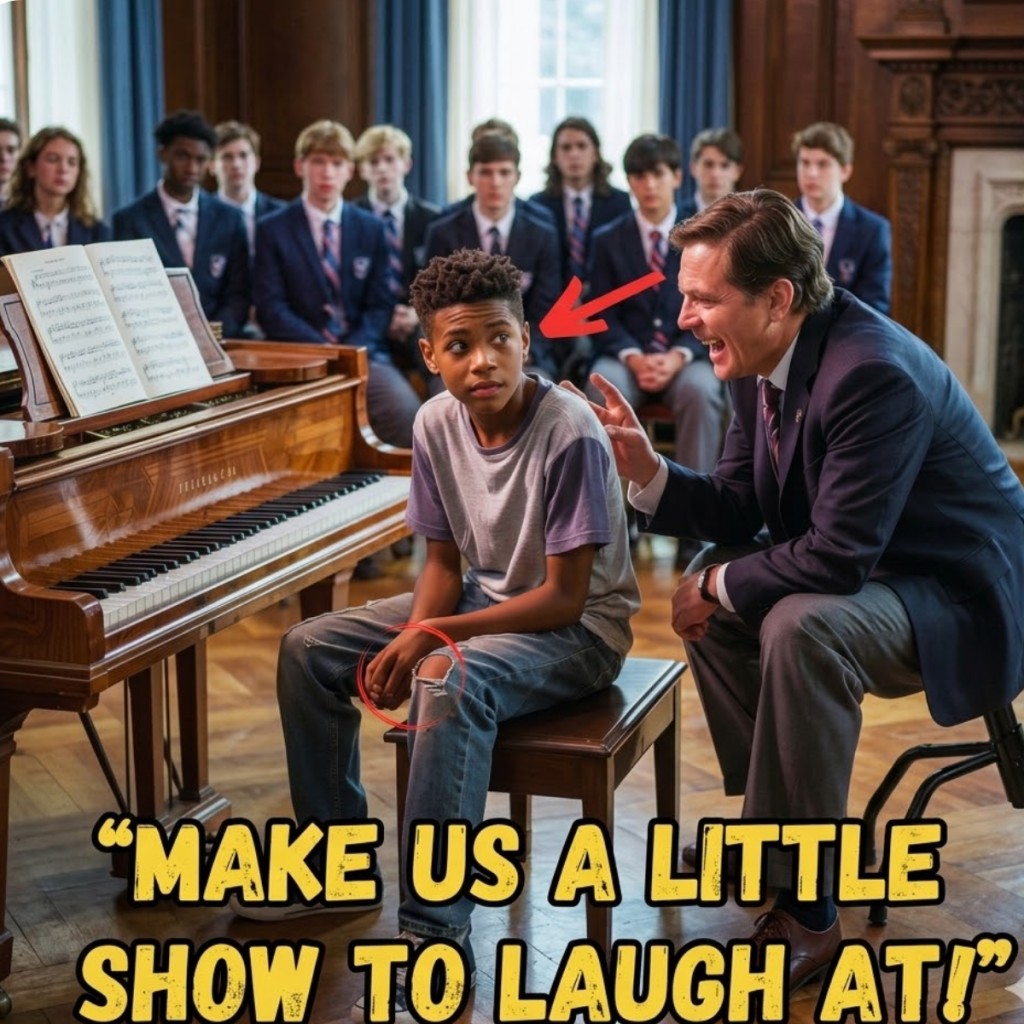
When Principal Whitaker stepped onto the stage to open the program, his voice was smooth and rehearsed.
“Tonight is a celebration of talent, diversity, and the many gifts our students bring to this school,” he said, smiling the kind of smile that never reached his eyes. “And to begin, we have something… different. Please welcome our newest student, Elijah Turner.”
A few scattered claps. More laughter than applause from the student section.
Elijah walked out anyway.
The auditorium looked enormous from the stage. Parents in expensive clothes. Teachers lined against the walls. Students leaning forward with the hungry attention people give when they think someone is about to embarrass himself.
He sat at the piano bench, adjusted it slightly, and closed his eyes.
For one second, maybe two, he heard the laughter.
Then he heard something older.
His grandmother’s voice.
Don’t play with fear. Play with truth.
His hands touched the keys.
The first notes came softly, almost like a question.
Not a flashy opening. Not showy. Just honest.
Then the melody widened, deepened, unfurled.
It was his own arrangement, built from memory, grief, and hope—part classical, part gospel, part something that belonged only to him. He played like someone opening a locked room inside himself and inviting the world to step in if it dared.
The laughter stopped first.
Then the whispering.
Then the room itself seemed to lean in.
Elijah didn’t look up. He didn’t need to. He could feel it happening. The shift. The way mockery was being replaced by something much harder for that school to offer someone like him: respect.
He played with precision, yes, but also with feeling so raw and complete that people forgot to guard themselves against it. A mother in the third row wiped her eyes. A teacher lowered his head. Even students who had spent the week sharpening their jokes sat frozen, hands halfway to their phones, no longer interested in capturing failure.
This wasn’t failure.
This was revelation.
When he finished, the final chord hung in the auditorium like breath held too long.
Silence.
Then one pair of hands began clapping.
It was the music teacher, Ms. Kendrick.
She stood.
And once she did, the rest of the room followed.
The applause rolled through the space like a wave. Not polite applause. Not the kind given out of obligation.
A standing ovation.
Elijah remained seated for half a second longer, as if he didn’t trust what he was hearing with his eyes. Then he stood and gave a small, almost startled bow.
At the edge of the stage, Principal Whitaker stayed in his seat, jaw tight, arms crossed, looking like a man who had planned a joke and accidentally handed someone a crown.
That night changed something in the school.
Not everything. Not instantly. But enough.
Students who had mocked Elijah now looked at him differently in the halls. Some with embarrassment. Some with caution. A few with admiration they didn’t know how to express. Teachers began speaking to him with more warmth. Ms. Kendrick, who had taught music at Lincoln for nearly two decades, approached him the next day with a seriousness that made him stand straighter.



“You don’t belong in the shadows here,” she said. “And I think you know that now.”
She quietly submitted his name for an audition at the City Conservatory. When the invitation arrived in a sealed envelope during class, Elijah stared at it as if it might be a mistake.
“It’s not a mistake,” Ms. Kendrick told him later. “You’re the real thing.”
But as Elijah began to rise, Whitaker began to push back.
He canceled school events. Rejected proposals for student showcases. Dismissed the excitement around Elijah as temporary sentimentality. He told faculty that emotional reactions should never interfere with academic structure. It sounded reasonable if you didn’t know the pattern behind it.
Ms. Kendrick knew the pattern.
Over eighteen years at Lincoln, she had seen scholarship students quietly edged out, minority students treated like disruptions, gifts ignored when they came in the wrong skin or from the wrong zip code. She had also learned that Whitaker never used obvious cruelty. His prejudice lived in policies, delays, omissions, and elegant excuses.
This time, she started documenting everything.
Old complaints. Emails. Meeting notes. Parent letters. Cases of students mysteriously “not fitting the environment.”
Then the district announced a surprise review of the school.
Whitaker panicked.
He began cleaning records, rewriting communications, trying to tighten control before the inspectors arrived. But by then, momentum had shifted.
Ms. Kendrick and several teachers created a student arts event of their own when Whitaker tried to block it. They called it Voices of the School. When he shut it down officially, the teachers and students moved it outside, to the grassy courtyard.
“Then we’ll do it without permission,” Ms. Kendrick said. “Truth doesn’t need a formal invitation.”
Elijah almost backed out.
“What if he stops it again?”
“Then he’ll have to stop all of us,” she said.
When he told his grandmother, she put both hands around his face and smiled.
“Then let him hear what courage sounds like.”
The evening of the performance, families gathered on folding chairs around a piano borrowed from a local music program. The sky was clear. Teachers stood shoulder to shoulder with students. Even parents who barely knew Elijah’s name showed up because word had spread: something important was happening.
Whitaker watched from the second-floor balcony, arms folded, unable to stop what had already moved beyond him.
Elijah sat at the piano.
This time he was not there because someone wanted him to fail.
He was there because a community had begun to understand what it meant to stand beside someone who had been pushed to the margins.
He played.
And if the first performance had been a revelation, this one was freedom.
The music carried not only talent but defiance, tenderness, grief, and triumph. It was the sound of a boy refusing to shrink. The sound of every insult losing its power. The sound of a school being forced to hear the voice it had nearly silenced.
When the final note faded, every person in the courtyard was standing.
Even before the district investigation concluded, everyone knew Whitaker had lost something he could never recover: control of the story.
Within days, the review turned formal. Ms. Kendrick submitted her full documentation. Former students came forward. Patterns emerged too clearly to deny. Whitaker was placed on leave, then removed.
No dramatic scandal. No shouting match. No public breakdown.
Just the slow, devastating collapse of a man who had spent years hiding prejudice beneath polished language and institutional power.
Lincoln High changed after that.
Not because one corrupt principal left.
Because people who had once stayed quiet learned what happened when they stopped.
The school launched permanent student arts and equity programs. Scholarship students were no longer tucked into the background like awkward public relations projects. Ms. Kendrick was promoted to lead curriculum development. Elijah joined the student arts council, not because he wanted a title, but because he understood what it meant to leave doors open behind you.
Months later, Lincoln held its end-of-semester celebration in the main auditorium—the same one where Elijah had first been invited onto the stage as a joke.
Now, the invitation carried honor.
When he walked out to the piano that night, the audience rose before he played a single note.
His grandmother sat in the front row in a navy dress she had saved for special church Sundays, her hands folded tightly in her lap, pride shining so brightly in her eyes that Elijah nearly cried before he even touched the keys.
He took a breath and began.
This time, the music was not sorrow turning into strength.
It was joy.
Pure, rising, fearless joy.
The kind that only comes after you have survived something meant to make you small and discovered you are larger than anyone imagined.
When he finished, the applause came in waves again.
But this time, it did not feel like surprise.
It felt like recognition.
And that was the real victory.
Not the scholarship. Not the conservatory. Not even the standing ovations.
It was this: that a boy who walked into a school carrying the weight of everyone else’s assumptions had forced that school to see him clearly.
Not as a charity case.
Not as a joke.
Not as an outsider lucky to be tolerated.
As himself.
After the performance, Ms. Kendrick asked if he wanted to say a few words.
Elijah hesitated. Then stepped forward.
“I never played to prove I was better than anyone,” he said. “I just didn’t want people to decide who I was before I got the chance to speak.”
The room fell still.
“I hope,” he added, voice steady now, “that nobody else here has to be humiliated before they are finally heard.”
There were no dramatic cheers after that. Just a deep silence, followed by applause that felt fuller than before.
Because sometimes the strongest thing a person can do is stand in the very place where others expected them to break—and answer with beauty.
Elijah Turner’s greatest achievement was never just that he could play the piano.
It was that he turned humiliation into dignity.
Exclusion into invitation.
Silence into something that could not be ignored.
And in doing that, he didn’t just change his life.
He changed the room.
Then the school.
Then everyone who had once mistaken quietness for weakness.
He showed them something simple and unforgettable:
A person does not become visible because others finally decide to look.
Sometimes they become visible because they stop apologizing for being fully themselves.