Graham leaned back with the smug relief of a man receiving something he had already emotionally spent. Elliot gave a low whistle. Celeste lowered her eyes with practiced humility, but the satisfaction around her mouth was unmistakable.
Then the lawyer paused.
His voice changed, just slightly.
“And to my daughter, Maya Thompson…”
Every face in the room turned toward her.
Maya straightened in her chair.
“The old farmhouse and adjacent barn, including the land immediately surrounding them, are hereby transferred in full to Maya Thompson.”
Silence.
Then a laugh burst out.
Not loud. Worse than loud. Sharp, amused, dismissive.
Graham leaned forward, grinning. “Well, that’s generous. She gets the hay.”
Elliot snorted. “Maybe there’s a dead horse in there too.”
Celeste crossed one elegant leg over the other and smiled as if this were all mildly unfortunate but somehow fitting. “Your father was a sentimental man,” she said. “He probably thought it would suit you. You were always more… earthy.”
The room blurred at the edges.
Maya looked down at the deed the lawyer placed before her. Two pages. A signature. A stamp. A life reduced to a barn.
Her father had once lifted her onto the roof of that barn to watch meteor showers. He had taught her how to hammer a nail, how to feed a horse without flinching, how to trust the weather by smelling the wind. When she was little, the barn had been the safest place she knew. When Celeste’s voice cut through the house like cold metal, when Graham mocked her accent from her mother’s side of the family, when Elliot ignored her like she was something left in the wrong room, her father would find her out there and say, “This place tells the truth. People don’t always.”
Now that truth felt like humiliation.
Still, Maya rose.
Her chair scraped against the floor. No one stopped talking until they realized she was standing.
She picked up the deed and held it carefully, as though it were fragile.
“I’ll take what he gave me,” she said.
Her voice was steady. That was the only victory she allowed herself.
Celeste gave a soft shrug. “Of course you will.”
Maya walked out before anyone could see the tears gathering in her eyes.
Outside, the rain had thinned to a mist. The gravel driveway glistened silver beneath the darkening sky. She stood under the porch for a moment, breathing hard, letting the cool air hit her face until the heat of embarrassment faded into something duller and heavier.
By the time she reached her car, anger had settled under her grief like a second heartbeat.
On the passenger seat lay the folded deed.
She stared at it for a long moment, then laughed once under her breath—a broken, disbelieving sound.
“A barn,” she whispered.
Then she started the engine and drove toward the valley.
The old farmhouse appeared through the mist like a memory that had refused to die.
It had once been part of the main property, back when her father still spent weekends there fixing tools and checking the western fields himself. But after he married Celeste, the family moved into the larger house on the hill, and the farmhouse was left to weather, silence, and time. Now its roof sagged in places, and ivy climbed the walls as if trying to hold them upright. The barn beside it leaned slightly to one side, its red paint faded into rust-colored ghosts.
Maya parked in the mud and stepped out.
The smell hit her first.
Wet hay. Old wood. Rust. Oil. Dust.
It smelled like childhood.
She pushed open the barn door. The hinges groaned, and a cloud of dust lifted in the gray light. The rafters were webbed with cobwebs. Rusted tools hung where her father had left them years ago. A broken lantern lay on its side beside a stack of feed sacks so old their labels had almost vanished.
For a long moment, Maya said nothing.
Then she walked inside, set her bag down, and picked up an old broom from the corner.
“If this is all you left me, Dad,” she murmured, “you could’ve at least warned me.”
Her voice echoed softly through the empty space.
She began to clean.
At first it was only something to do with her hands, some small rebellion against the laughter still ringing in her ears. But as the hours passed, the work became something else. She swept dust out of corners. She pulled down rotten twine and broken harness straps. She cleared old crates and sorted rusted tools into piles. Sunlight slowly broke through the clouds outside and began slipping through cracks in the wood, turning drifting dust into gold.
She found little pieces of herself everywhere.
A ribbon she had once tied around a fence post.
A tin cup her father always used for coffee.
Initials carved into an old beam: RT + MT.
She touched the letters with her fingertips and had to close her eyes for a moment.
“Why this place?” she whispered.
No answer came, only wind moving softly through the gaps in the boards.
Late in the afternoon, the sound of tires on gravel made her freeze.
She stepped quietly behind a stack of hay bales and peered through a narrow crack in the wall.
Celeste’s white SUV had stopped near the gate. Celeste stood outside in sunglasses and tailored slacks, though the day had turned muddy and humid. Graham stood beside her, hands in his pockets.
They didn’t come closer.
They just looked.
“She can have the dump,” Graham said.
Celeste’s voice carried easily across the open land. “Your father always confused pity with love.”
“You really think he left her anything valuable?”
Celeste gave a small, cold laugh. “If he had, he wouldn’t have hidden it in a barn.”
They drove off.
Maya remained crouched there long after the sound of the engine faded.
Something inside her changed then.
The hurt did not disappear. But it hardened. Became clearer. Colder. Useful.
She stepped back into the center of the barn and looked around with new eyes.
Not as a daughter grieving.
As someone being tested.
Near the back wall, beneath an old workbench, one floorboard sat slightly higher than the others. She almost missed it. But once she saw it, she could not unsee it.
She knelt, brushed dirt away, and pressed down.
The board shifted.
Her breath caught.
Using a rusted pry bar from the bench, she lifted it.
Beneath was a narrow compartment lined with tin. Inside lay a brass key wrapped in oilcloth and a folded piece of paper yellowed at the edges.
Maya unfolded the note carefully.
Her father’s handwriting stared back at her—firm, slanted, unmistakable.
Where the earth meets its mirror, truth waits for its keeper.
She read it twice.
Then a third time.
It made no immediate sense, but her pulse had already begun to race.
She slipped the key into her pocket and looked around the barn again.
Now every shadow felt intentional.
That night she stayed at the farmhouse, though the place groaned and cracked with every gust of wind. She made tea she didn’t drink. She sat by the window staring at the barn under moonlight, the note open in her lap.
Where the earth meets its mirror.
At two in the morning, she could no longer sit still.
She grabbed a flashlight, pulled on her father’s old field jacket from the coat rack, and crossed the damp field in the dark. Crickets sang low in the grass. The barn stood ahead of her like a waiting thing.
Inside, the air felt colder.
She swept the flashlight beam across the floor again, slower this time. Crates. Hay bales. Tools. Workbench.
Then she saw it.
Not near the hidden compartment, but farther back—where the concrete floor changed texture near a row of stacked crates. A thin crack ran through the surface in an almost perfect rectangle.
Her mouth went dry.
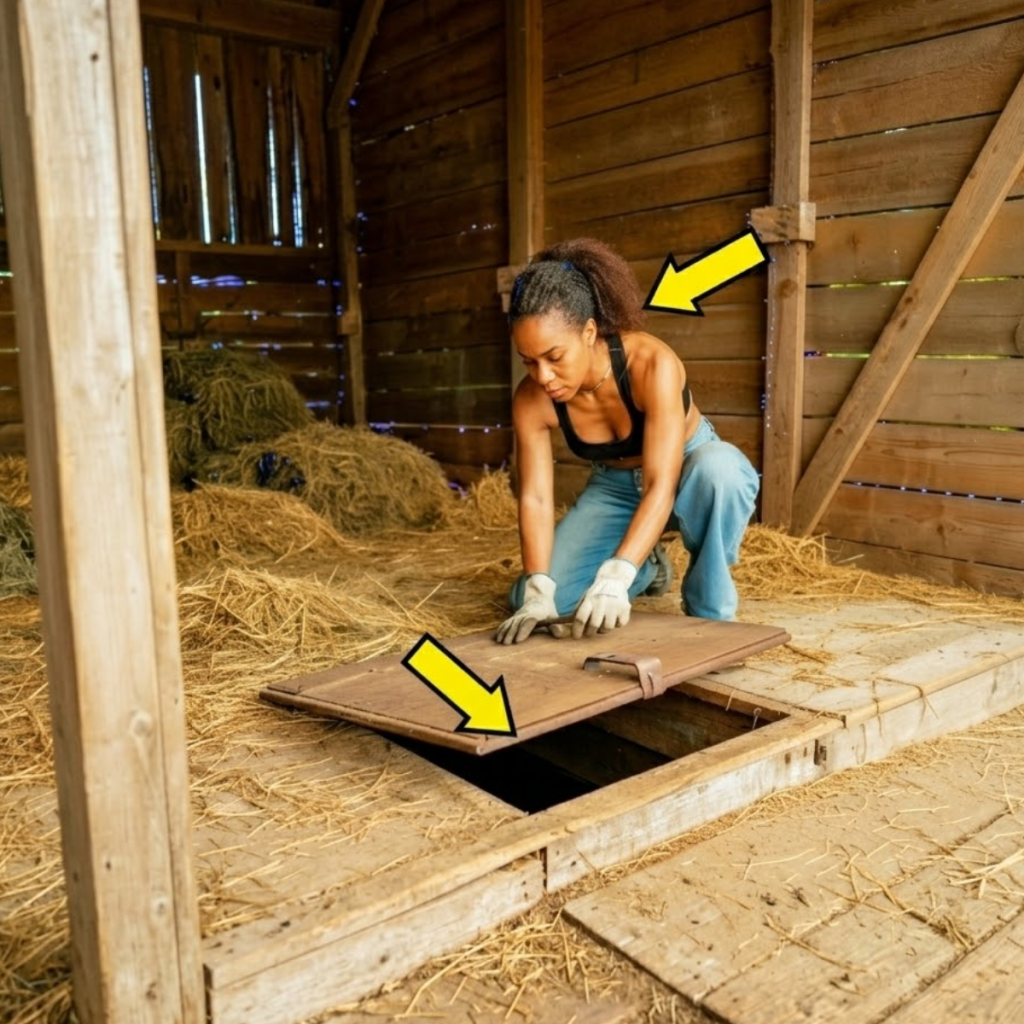
She dragged the crates aside, knees sinking into dust, and pressed both palms against the slab.
It moved.
A stale breath of air rose from below, smelling of soil, iron, and years.



Underneath the slab, narrow wooden steps disappeared into darkness.
Maya stared into the opening, suddenly aware of how loud her own breathing was.
“Dad,” she whispered, half in awe, half in fear.
Then she descended.
The steps creaked under her weight. Dirt walls pressed close on either side, reinforced with old timber. Cobwebs brushed her hair and cheek. At the bottom, the passage opened into a small underground chamber.
It was not large, but it was organized.
Shelves lined the walls. Metal boxes sat stacked in careful rows. File crates. Ledgers. Sealed envelopes. A small safe built into the far wall. Everything labeled in her father’s neat hand.
Harvest records.
Land transfer maps.
Tax archives.
Then one box in the corner, larger than the rest, with only one word written across the lid.
Maya.
Her hands trembled as she opened it.
Inside were folders bound with twine, photographs, legal documents, and a small digital recorder. On top lay the incorporation papers for Thompson Holdings—the company that controlled the family’s vineyards, homes, vehicles, and investments.
Majority shareholder: Maya Thompson.
She sat down hard on a crate.
For a few seconds she could not think at all.
Then she reached for the recorder and pressed play.
Static crackled.
And then her father’s voice filled the chamber.
“If you’re hearing this, it means I ran out of time.”
Maya covered her mouth.
Her father’s tone was tired, softer than she remembered, but steady.
“I needed to protect what was mine to give, and more importantly, who I meant to give it to. Celeste has been moving people around me for months. Lawyers, advisors, signatures I no longer trust. I couldn’t risk leaving your future in her hands.”
Maya closed her eyes.
“I put the controlling shares under your name years ago,” he continued. “Legally, quietly, and with backup copies where no one would think to look. The will was bait. I knew what they would chase. I knew what they would laugh at.”
A broken sound escaped her throat.
“If they are laughing when you hear this,” he said, “let them. It means they still don’t understand where real value lives.”
She was crying openly now, tears slipping down her face and onto the papers in her lap.
“You were never the child I needed to protect from hard work,” her father said. “You were the child I trusted with truth. The barn always kept what mattered most. I knew you’d come here. I knew you’d listen.”
The recording clicked off.
Maya sat there for a long time in the underground stillness, holding the recorder like it was a hand she could not bear to let go of.
He had not forgotten her.
He had seen everything.
And he had chosen her.
By dawn, she had gathered the key documents, the certified share records, the trust papers, and the legal instructions her father had hidden with them. When she climbed back into the barn, sunlight was spilling through the cracks in the walls, turning the dust bright as fire.
She stood in the middle of the floor, breathing hard, feeling something she had not felt since the day before he died.
Not safety.
Strength.
By ten o’clock the next morning, she walked into a downtown conference room with a worn leather folder in her hand and grief no longer visible on her face.
Celeste was already there with Graham, Elliot, and two estate lawyers.
Every eye in the room measured her and underestimated her.
One attorney adjusted his glasses. “Miss Thompson, we understand you have questions regarding the will.”
“Not the will,” Maya said, taking her seat. “The ownership.”
She opened the folder.
One document at a time, she laid the truth on the table.
Incorporation certificates.
Shareholder registry.
Control agreements.
Notarized transfers.
Certified backups.
The room changed.
The lead attorney stopped trying to hide his shock. Graham’s smirk vanished. Elliot leaned forward, then back, as if distance might change what he was seeing. Celeste went very still.
“This is absurd,” she said at last. “Those documents could be forged.”
“They’re not,” Maya said quietly. “And your own legal office can verify every signature.”
A clerk from the registrar’s office arrived twenty minutes later with certified confirmations.
The silence after that was complete.
The attorney cleared his throat, suddenly careful with every word. “Legally speaking, Miss Thompson holds controlling interest in Thompson Holdings.”
Celeste stared at Maya as if she were looking at a stranger.
Maya met her gaze without flinching.
“The houses, the cars, the land,” she said, “you inherited the appearance of ownership. My father left me the authority.”
Graham shot to his feet. “This is insane.”
Maya turned to him. “No. What was insane was assuming I never mattered.”
No one answered.
She gathered the papers back into her folder and stood.
“I’m not here to throw you out of your homes,” she said. “I’m here to make one thing clear. This family stops being built on lies today.”
Celeste’s voice came out thin and poisonous. “You’ll regret humiliating me.”
Maya looked at her for a long moment.
“I already regretted staying quiet.”
Then she walked out into the sunlight.
The rest unfolded quickly.
The appeal Celeste threatened never survived review. The documents were airtight. The control of the company, the land, and the estates was hers, exactly as her father intended.
But the real victory did not come in court.
It came weeks later, back at the barn, with spring rain softening the fields and birds nesting once more in the rafters.
Maya had repaired the doors. Replaced broken boards. Cleaned the loft. Opened the windows. The place no longer smelled like abandonment. It smelled like earth after rain. Like wood warmed by light. Like beginnings.
One afternoon, Graham and Elliot arrived without lawyers, without polished shoes, without their mother.
The older brother held out a small box.
Inside was their father’s pocket watch.
“He said he lost it,” Elliot muttered. “Guess he just didn’t trust the wrong people with everything.”
Maya took the watch carefully.
Its ticking was faint, but steady.
No one apologized. No speeches were made. But something honest passed between them at last—an understanding that truth had stripped all of them bare.
When they left, Maya sat alone on the barn steps as evening turned the fields gold.
She held the watch in one hand and looked out over the land her father had trusted her to protect.
“He didn’t leave me a broken barn,” she said softly into the wind. “He left me proof.”
Proof that love can be quiet and still be powerful.
Proof that being overlooked is not the same as being unworthy.
Proof that sometimes the thing people laugh at is the very thing that saves you.
The breeze moved gently through the open doors behind her.
For the first time in a long time, Maya smiled without pain.
And somewhere in the deep, steady silence of the land, she felt her father smile back.