Because eight months earlier, the first cruelty had already happened.
It was late. The village had gone quiet. Amaka had been asleep when Amara woke her and sent her to buy matches for the next morning’s cooking. She had begged not to go. It was too dark. Too late. But Amara slapped her so hard her ears rang and pushed her out the door.
Amaka had barely reached the bend in the road when a hand clamped over her mouth and dragged her into the dark.
She never saw his face.
She only remembered the smell of damp earth, the weight of fear, and waking up in the bush at first light with torn clothes, pain in her body, and a terror so large it made the world feel unreal.
When she stumbled home crying, Amara did not comfort her.
She beat her.
Called her a liar.
Said she had gone off with men in the night and returned at dawn pretending to be innocent.
Her father, Andrew, was away in the North working on a construction site. He had been gone for months. There was no phone in the house, and even if there had been, Amara would never have let Amaka call him.
Then came the nausea. The weakness. The sleepiness that would not go away.
At the clinic, the nurse looked at her belly, then at her face, and lowered her voice.
“She is pregnant.”
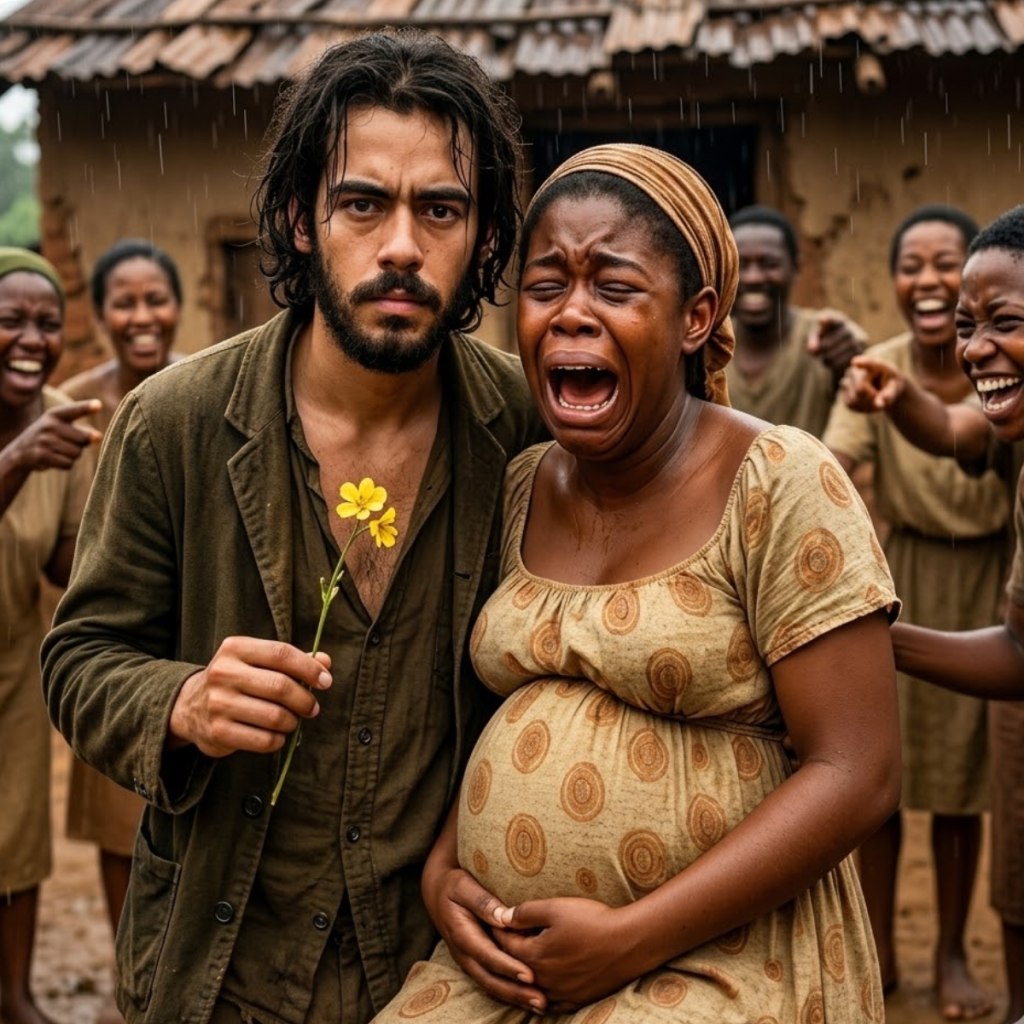
Amara dragged her home in silence, then called the neighbors herself.
“Look at her,” she shouted. “Just like her mother. Pregnant and shameless.”
That was the day Amaka understood she would not be protected. Not by the house she lived in. Not by the women around her. Not by the village.
And not even by memory, because her mother was gone too.
Amaka still remembered the day her mother died. She had been ten. She had begged her not to eat the food Amara had served. She had dreamed the night before that Amara poisoned it. She had cried and clung to her mother’s wrapper and begged her to listen.
But her mother had smiled sadly and stroked her hair.
“You’re just frightened, my child.”
An hour later, Amaka had come back into the room and found her mother on the floor, foam at her mouth, her eyes filled with horror.
“Amara…” she had gasped. “You warned me…”
Then she died.
From that day on, Amaka knew two things. First, that Amara was dangerous. Second, that knowing the truth meant nothing if you were too powerless to prove it.
Now, at thirteen, heavily pregnant and being handed to a stranger like an unwanted load, she felt her childhood closing behind her like a door.
The man finally spoke.
“My name is David,” he said quietly.
That was all.
He did not touch her. He did not smile. He did not make promises. He only lifted her small bag and gestured for her to follow him.
Amaka walked because she had nowhere else to go.
They left the village while the laughter of some of the onlookers followed behind them like thrown stones.
She did not look back until they reached the outskirts. When she did, she saw the roof of her father’s house disappearing into the distance and whispered the only prayer she had strength left to form.
“God, please… let this not be the end of my story.”
They walked for a long time. At least that was how it felt. The road gave way to dry grass and thinner footpaths. Her feet hurt. Her back hurt. The child inside her shifted heavily, as if even her unborn baby could feel her fear.
Then David stopped.
Ahead of them, in a clearing hidden by trees, stood a black SUV.
Not just one. Several.
Men in dark suits stood nearby, alert and respectful. The moment they saw David, they straightened.
One stepped forward.
“Sir,” he said softly. “Everything is ready.”
Amaka froze.
Sir?
She turned to the ragged man beside her.
David faced her, and for the first time there was something deeply gentle in his expression.
“You are safe now,” he said.
She stared at him, unable to make sense of anything.
“What is happening?” she whispered.
David took a breath.
“My name is David Jonathan. I am the CEO of David Jonathan Motors.”
Amaka said nothing.
Her mind refused the sentence completely.
The man she had been forced to marry in disgrace. The man dressed like a homeless wanderer. The man sent to carry her away.
A CEO?
He seemed to understand her disbelief.
“I heard about you from one of my drivers,” he said. “He is from your village. He told me what your stepmother had done, how your father was away, how you had no one to stand for you. I knew if I came as myself, Amara would find another way to hide you or harm you. So I came in a form she would never question.”
Amaka’s throat tightened.
“You mean… this was all…”
“A way to get you out alive,” he said.
For the first time in months, she felt something crack inside her—not in pain, but in relief so sharp it almost felt like grief.
She climbed into the SUV with trembling legs.
By nightfall, she was sitting in a mansion in Lekki so large it did not look real.
Everything terrified her at first—the soft chairs, the polished floors, the glass walls, the quiet servants who moved with professional calm. David did not overwhelm her with explanations. He only gave her space, food, clean clothes, and one promise.
“You will not be harmed here.”
The next morning, a doctor came.
Then a nurse.



Then regular antenatal care.
Within days, Amaka had a room of her own. Within weeks, she was sleeping without fear of being beaten awake. David never once crossed a line with her. He treated her with respect so natural and steady that, slowly, her body began to believe what her mind still struggled to accept.
When her son was born, she held him against her chest and cried until she could not breathe.
He was tiny, warm, perfect.
She named him Obinna.
For a while, hope became something she could touch.
But life was not finished testing her.
One night, the baby began to cry, then choke. David rushed into the room and they sped toward the hospital, but before they arrived, Obinna had gone still in her arms.
He was dead before dawn.
Amaka thought that was the end.
She tried to follow him.
David stopped her.
He found her in time, held the knife away from her shaking hands, and sat beside her on the floor until morning, saying almost nothing. There are pains no words can carry. What saved her was not speech, but presence.
Days turned into weeks. Weeks into months.
Grief did not vanish, but it loosened its grip enough for life to enter again.
David sent her back to school.
At first, people stared. A young girl returning after scandal. A child widow in all but name. A mother without a child. But Amaka had already lived through deeper humiliation than their whispers could create.
She studied hard.
Then harder.
Computer science caught hold of her in a way she had not expected. Logic made sense when people did not. Code obeyed order. Systems could be repaired. Broken things could be rebuilt. There was comfort in that.
Years passed.
Amaka graduated from secondary school, then from university as a software engineer. The frightened girl who had once been pushed out of her father’s house became a woman employers fought to recruit. But success did not harden her. If anything, it widened her heart.
She started a foundation that paid for urgent surgeries for poor families—people who, like her younger self, had once believed their suffering was invisible unless they could afford to make it visible.
Then one day, her assistant walked into her office looking unsettled.
“There is someone here to see you,” she said. “He says… he is your father.”
Amaka stood so quickly her chair slid backward.
When Andrew entered, he looked older, thinner, and deeply tired. The moment he saw her, his face collapsed. He crossed the room and fell into her arms with the desperation of a man who had spent years searching for forgiveness without believing he deserved it.
“I looked for you,” he whispered. “God knows I looked. When I came home and found out what happened, you were gone. She was gone. You were both gone.”
Amaka closed her eyes.
For years she had imagined this moment with anger. Questions. Accusation.
But all she felt was sorrow.
She told him everything.
About the assault.
The pregnancy.
Amara.
The forced marriage.
Obinna.
David.
Her father cried like a broken man.
Then she told him one more thing.
“Amara is here.”
He stared at her in confusion.
“She has an eye tumor,” Amaka said. “She needs surgery. She cannot pay for it.”
Andrew’s face changed.
“You are not saying—”
“Yes,” Amaka said. “I am paying.”
He stepped back as if struck.
“After everything she did?”
Amaka held his gaze.
“I am not doing it for her innocence,” she said. “I am doing it for my peace.”
The surgery was successful.
When Amara’s bandages came off and she saw Amaka standing before her—alive, successful, calm, impossibly kind—something in the older woman finally broke. She said very little. Shame had become too large for speech.
A week later, Amara took her own life.
When the news came, Amaka did not celebrate. She did not weep either. She only stood very still by her office window and understood, with a quiet ache, that some people are consumed by the very darkness they once used against others.
Years later, at a fundraiser for her foundation, Amaka stood on stage beside her father and told a room full of strangers that survival is not always loud. Sometimes it is a soft decision made over and over again to keep going.
After the event, she visited her mother’s grave for the first time in almost twenty years.
She knelt, laid flowers in the dust, and whispered, “She couldn’t erase you. And she couldn’t erase me.”
David married her properly not long after, with joy and music and all the dignity that had once been stolen from her. The ceremony made headlines. Some called it a miracle. But Amaka knew better.
It was not a miracle.
It was courage. It was mercy. It was the stubborn refusal to let cruelty write the final line.
Once, she had been a thirteen-year-old girl walking barefoot out of a house that no longer wanted her, praying only that this would not be the end of her story.
It wasn’t.
And that became the most powerful thing she ever carried.