People who used to call him “Engineer” now passed him with pity or embarrassment. His beard grew wild. His clothes hung loosely on his shrinking body. He stopped trying to explain anything. Stopped trying to be seen.
But one thing never left him.
His hands still knew what to do.
Even when his life broke, his skill did not.
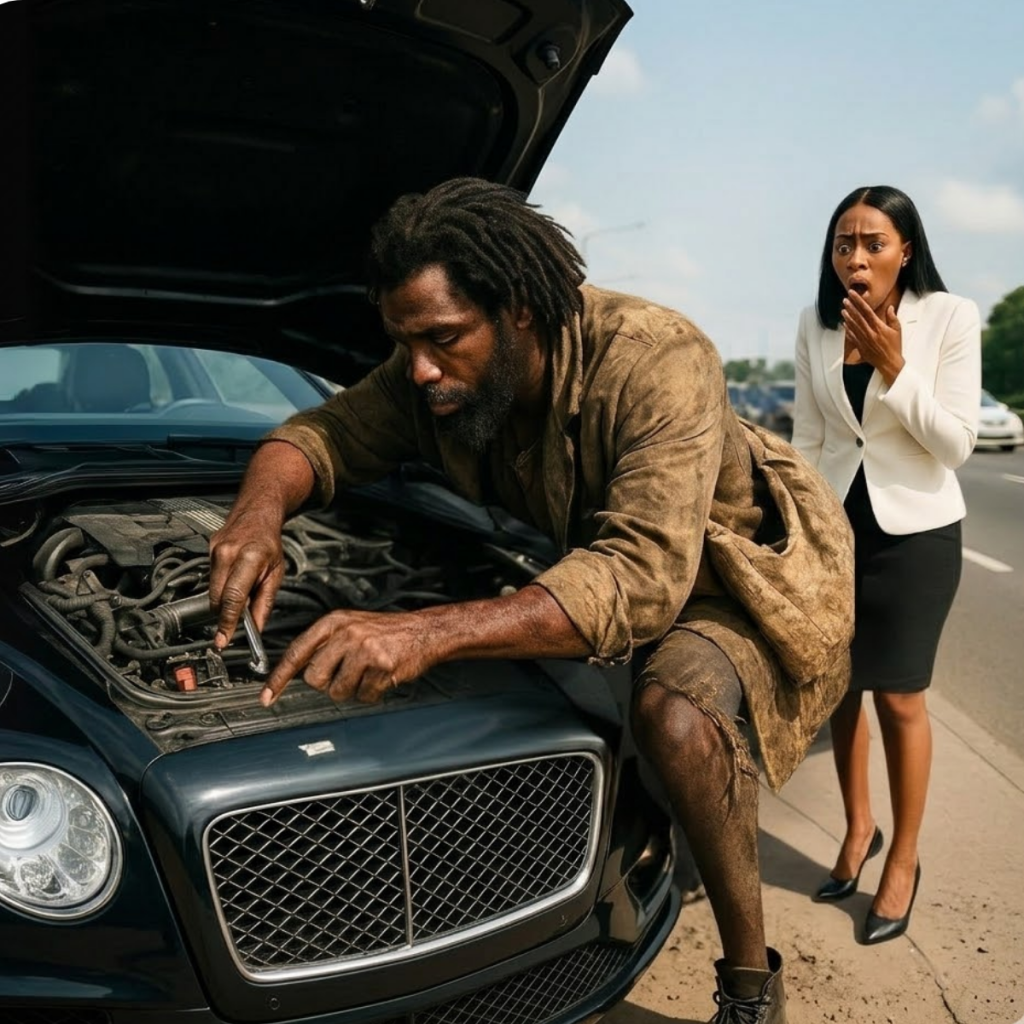
That was why, on one blazing afternoon, when he saw a black Bentley parked awkwardly by the roadside with its hazard lights blinking and a young woman in a white blazer struggling to restart it, something inside him moved before his pride could stop it.
The Lagos highway was hot, noisy, impatient. Exhaust fumes mixed with dust. Okadas zigzagged through traffic. Hawkers shouted. Nobody had time for anybody.
The woman did not look helpless. She looked furious. She checked her watch, tried the ignition again, then hit the steering wheel with the palm of her hand.
Jonathan stepped closer.
“I can help you fix it,” he said quietly.
She turned sharply.
For a second, all she seemed to see was the beard, the torn shirt, the worn sandals, the bag of tools. Her face tightened with suspicion.
“Who are you?”
“My name is Jonathan,” he said. “I’m an automobile engineer.”
She stared at him for a moment longer. Then she looked at her watch again. Whatever meeting or deadline was chasing her, it was winning.
“If you make it worse, I’ll call security,” she said.
Jonathan did not argue. He dropped to his knees beside the car, opened his old tool bag, and went to work.
A loose cable. A bad contact. A wire that had shifted just enough to choke the ignition sequence.
Five minutes later, he stepped back.
“Try it now.”
The woman got in, turned the key, and the Bentley came alive instantly.
She froze.
Then she stepped out again, staring first at the car, then at him as if she had just watched a ghost fix a machine.
“How did you do that?”
Jonathan gave a tired shrug. “The engine was speaking. I listened.”
Something about that answer changed her expression.
She asked his name again. This time more softly. Then, without knowing why, he told her the truth.
He told her about the note.
About Amara.
About the twins.
About the bridge.
About how losing everything had not killed him, but had left him walking around like a man who no longer believed his life belonged to him.
When he finished, the woman blinked hard, as though fighting tears she had not expected.
“My name is Monica Johnson,” she said. “And I want to help you.”
Jonathan almost laughed. Help had become one of those words people said when they wanted to feel kind without doing anything difficult.
But Monica did not speak like that.
She spoke like a woman used to changing things.
He found out why soon enough.
Monica was not just wealthy. She was powerful. She was the CEO of Bright Future Technology, one of the biggest tech companies in Africa. Billionaire. Innovator. The kind of woman newspapers called visionary and men called intimidating when they were afraid of her success.
That same day, she took him to her house.
Then to a barber.
Then to buy clothes.
Then to her company headquarters, where she looked him in the eye and said, “I want to invest in you. Not because I pity you. Because talent like yours should not die under a bridge.”
Within weeks, she had leased a beautiful workshop space on the mainland, bought cutting-edge equipment, handled the legal paperwork, and placed his name above the entrance.
J&M Auto Tech.
At first people came because they were curious.
Then they came because he was brilliant.
The man who had fixed a Bentley in five minutes soon became the mechanic everyone in Lagos was talking about. He repaired what other garages gave up on. He trained apprentices patiently. He worked hard, spoke little, and carried himself with a quiet dignity that made people trust him.
And Monica kept coming by.
Sometimes with business updates. Sometimes with lunch. Sometimes with questions she didn’t need answers to, only an excuse to hear him talk.
He told her about engines.
She told him about code, systems, pressure, and what it meant to lead people while hiding your own loneliness.
One evening, on the rooftop of her mansion, with the city glowing below them, Monica asked the question he had tried not to ask himself.
“Do you still think about the girls?”
Jonathan looked out at the skyline.
“Every day.”
She was quiet for a while.
Then she said, “You were a good father.”
His throat tightened.
He wanted to say something that had been growing inside him for weeks. Something dangerous. Something hopeful.
Instead, his phone rang.
Unknown number.



He answered.
There was silence at first, then a voice he knew instantly.
“Jonathan… it’s me.”
His body went still.
“Amara,” he said.
Her breathing was uneven. “I need help. Please. I have nowhere else to go. The girls… they need you.”
A few minutes later, Jonathan opened the gate of Monica’s mansion and saw the past standing outside it.
Amara looked nothing like the woman who had once left him. She was thinner, older, humbled by something harsher than regret. Behind her stood Mimi and Mara, seven years old now, tired and dusty and beautiful.
When they saw him, they screamed, “Daddy!”
The girls ran into his arms with such force that he almost fell backward. He held them so tightly it hurt. They were crying. He was crying. All the years he had lost rose in his chest like floodwater.
Inside, Amara told the truth.
The DNA results that had shattered their marriage had been fake.
The man she ran away with—Maxwell—had forged them. He had wanted to destroy Jonathan out of old jealousy and used her weakness, her fear, and her guilt to do it. By the time she discovered the truth, Maxwell had already taken the money and thrown her and the girls out.
Jonathan sat very still while she spoke.
He had imagined this reunion a hundred different ways during those nights under the bridge. In most of them, he was angry enough to throw her out.
But pain had changed him.
So had Monica.
When Amara finally finished crying, Jonathan looked at the girls asleep on the couch and said the only thing he was sure of.
“I will take care of them. They are my daughters. That will never change.”
Then he wrote her a cheque.
Two million naira.
Not because he had forgotten what she had done. Not because betrayal no longer mattered. But because bitterness had already taken too much from him, and he refused to let it decide the shape of the man he would become.
That night, on the same rooftop where she had once listened to his broken story, Monica told him she loved him.
Jonathan answered by reaching into his pocket and pulling out a ring.
“I love you too,” he said. “And I don’t want another life that doesn’t have you in it.”
They got married three months later.
The wedding was elegant but full of tenderness rather than spectacle. Mimi and Mara were flower girls. Amara sat quietly in the front row, dressed simply, her eyes full of the complicated ache of someone watching the life she destroyed be rebuilt without her. Monica wore white. Jonathan smiled like a man who had nearly drowned and could finally breathe again.
A year later, they welcomed a baby boy.
Their home, once quiet and expensive, became loud and alive—homework, toy cars, meetings, bedtime stories, engine manuals, crayons, and the small chaos of a family that had been stitched together through pain and grace.
But the final truth came later.
One afternoon, Monica received an anonymous email. Inside it were documents, recordings, and the original test records proving beyond doubt that Mimi and Mara had always been Jonathan’s biological daughters.
Maxwell had known it.
He had lied anyway.
Monica showed Jonathan the evidence. He read every page slowly, then set them down and looked out at the garden where the girls were laughing with their little brother.
“What will you do?” Monica asked.
Jonathan was quiet for a long time.
Then he smiled faintly.
“I already got back everything that matters. The truth is just a bonus.”
Years passed.
J&M Auto Tech became one of the most respected automobile centers in Lagos. Monica’s company expanded. Mimi and Mara graduated from university, both in medicine. Their little brother grew up thinking engines and software belonged naturally in the same conversation.
Jonathan never forgot the bridge.
Because of that, he started a training program for unemployed young mechanics, especially boys and men who had been written off by life the way he once had been. He taught them more than engines. He taught them discipline, self-respect, patience, and the dangerous power of hope.
One journalist called their story a miracle. Jonathan disagreed.
It was not a miracle.
It was kindness.
The kind that stops beside a broken car.
The kind that sees a ruined man and decides not to look away.
The kind that forgives without becoming foolish.
The kind that gives a second chance without demanding perfection in return.
Years later, when Jonathan and Monica stood in their garden watching the sunset while their children laughed somewhere behind them, Monica slipped her hand into his and asked, “Do you ever think about how close you came to disappearing?”
Jonathan nodded.
“Every day.”
“And what do you think now?”
He looked at her. Then at the house. Then at the workshop lights glowing in the distance. Then at the sound of his daughters laughing.
“I think,” he said softly, “that sometimes life breaks you so completely that you stop recognizing your own future. But if one person chooses kindness at the right moment, that future can still find you.”
Monica smiled and leaned her head against his shoulder.
And this time, there was no note on the floor.
No silence in the house.
No one leaving.
Only love, healing, children, work, and the quiet peace of two people who had walked through ruin and still found their way home.