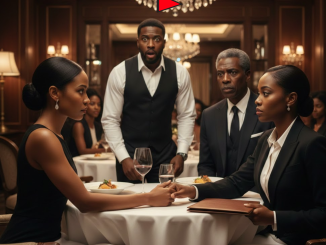
Ana José tilted her head and smiled with open contempt. “Of course I am. You walked in here acting like you have some kind of right. Do you even know where you are?”
The building was on the twenty-seventh floor of a glass tower in one of the most expensive business districts in the country. The kind of place where polished shoes moved quickly, where coffee was overpriced, where appearance often entered a room before competence did. People there knew how to speak in soft voices while delivering hard humiliations. They knew how to hide prejudice under procedure and arrogance under corporate language.
Antônia knew this type of place too.
Which was why she had come alone.
She had arrived earlier than scheduled, by choice. No assistant. No formal announcement. No executive escort. Just herself, an envelope in her bag, and a simple request.
She wanted to see how the branch really treated people before anyone knew who she was.
Now she knew.
Ana José tapped her manicured nails against the counter and smirked. “My job is to stop people like you from disrupting the operation here.”
A soft gasp rose from somewhere behind Antônia. Someone whispered, “That’s too much.” Another person said nothing at all and kept filming.
Antônia’s fingers tightened slightly around the strap of her bag. Only slightly.
She had learned long ago that dignity sometimes looks like stillness.
“I am not disrupting anything,” she replied. “I am asking you to do your job.”
The smile on Ana José’s face changed. It didn’t disappear, but it sharpened.
“My job?” she repeated. “My job?”
She slapped one hand against the desk, the sound cracking through the lobby. Several people flinched.
“Yes,” Antônia said. “Your job.”
Something in that answer disturbed the rhythm of the room. It was no longer amusing. Not as amusing. The mockery had hit resistance, and resistance without anger is harder to crush.
Ana José folded her arms. “You’re very confident for someone who was just put in her place.”
Antônia said nothing.
That silence started to spread.
Not the silence of defeat. The silence of waiting.
A younger employee at the side station leaned toward Ana José and muttered, “Maybe just check it.”
Ana José shot her a warning glance. “Do you want to handle this?”
The woman recoiled immediately.
Antônia drew a small envelope from her bag and placed it on the counter. She didn’t slide it forward dramatically. She didn’t wave it in the air. She simply placed it there, neatly, as if what mattered would speak for itself.
“You can check whenever you’re ready,” she said.
Ana José snorted. “I don’t need to check anything.”
“You do,” Antônia answered.
The words landed softly, but with weight.
People were no longer smiling. The atmosphere had shifted in that invisible way it does when arrogance begins to sense danger before understanding it.
Ana José grabbed the envelope with open annoyance and tore it open. She pulled out the document inside, already prepared to mock whatever it contained.
Her eyes moved across the first line.
Then the second.
Then back again.
The smile vanished so quickly it was almost violent.
The woman behind her whispered, “What is it?”
Ana José didn’t answer. She kept staring at the paper as if it had changed languages in her hands.
“What is this?” she asked, but now her voice had lost its performance.
Antônia held her gaze. “The authorization.”
“For what?”
Antônia answered without hurry.
“For the ethics audit that begins today.”
The room went cold.
A murmur passed through the lobby, low and spreading. A man lowered his phone completely now. The younger employees straightened. One of the women near the waiting chairs pressed her lips together and stared at Antônia with something that looked like sudden respect.
Ana José blinked, then laughed again—but this time the sound was brittle and thin.
“No. No, that can’t be right.”
“It is,” Antônia replied.
“You’re the auditor?”
“I am the person responsible for the audit, yes.”
No one laughed now.
Ana José looked at the document again, then at Antônia, then over her shoulder as if expecting someone else to appear and explain away the moment.
Instead, the branch manager emerged from the corridor behind the offices, summoned perhaps by the unusual silence or by the rising panic that now seemed to cling to the air.
He was a heavyset man in a gray suit, the kind of executive who moved with the confidence of someone used to being obeyed. But the moment he saw the paper in Ana José’s hand and the woman standing at the counter, his expression tightened.
“What’s going on?” he asked.
Ana José swallowed. “She says she’s from the audit team.”
Antônia turned toward him. “Good afternoon. Antônia Pedro.”
Something in her tone made him understand before he saw the document. When he did read it, the color drained from his face.
“The audit starts now?” he asked weakly.
“Not now,” Antônia said. “It started the moment I walked in.”
The sentence settled over everyone like dust after a collapse.
For the first time, several employees looked openly afraid.
Antônia picked up the envelope again and placed it carefully back inside her bag. Then she rested both hands lightly on the counter and looked at Ana José, not cruelly, not triumphantly, but with a steadiness that seemed far more unbearable than anger would have been.
“You were right about one thing,” she said. “This place does demand posture.”
Ana José lowered her eyes.
Antônia continued, her voice calm.
“The problem is that you confused posture with superiority.”
No one breathed.



“You assumed that because I came in alone, because I wasn’t dressed to impress you, because I asked instead of ordering, I must be someone you could humiliate safely.”
Ana José’s mouth opened, but nothing came out.
Antônia did not press harder. She didn’t need to.
“I didn’t come here to be recognized,” she said. “I came here to observe.”
Now the manager stepped in, trying desperately to reclaim some kind of authority. “Ms. Antônia, please. Let’s move this to a private room.”
Antônia looked at him, then briefly at the people still gathered around them.
“Why?” she asked. “So it can become quieter now that it has become inconvenient?”
That stung.
Because everyone knew she was right.
The humiliation had been public when it was aimed downward. It only became something to hide once the hierarchy flipped.
The manager pressed his lips together. “That is not what I meant.”
“It should have been handled correctly from the beginning,” she said. “At the desk. With respect. Without an audience. Without laughter.”
A long silence followed.
Then, unexpectedly, one of the younger employees stepped forward. It was the same woman who had quietly suggested checking the document earlier.
“She told her to leave before even looking,” the woman said, her voice shaking. “And she said… she said people like her shouldn’t be here.”
Ana José turned sharply. “Why are you talking?”
The woman’s eyes filled, but she didn’t step back this time.
“Because it was wrong.”
That was the crack.
Not in policy. Not in structure.
In fear.
Once one person spoke, the others began to move. Another employee admitted he had seen this happen before. A client said he had felt uncomfortable from the beginning. Someone else said he had the first part of the exchange on video. The lobby, which had served as a silent audience, began to become what it should have been from the start: witnesses.
The manager rubbed a hand across his face.
Antônia did not gloat. That was not why she was there.
She drew a notepad from her bag and wrote down names, times, statements. Her questions were direct, professional, precise. The atmosphere shifted completely. What had begun as cruelty disguised as confidence was now becoming evidence.
At one point, Lucas—the intern responsible for visitor check-ins—appeared from the side hallway carrying coffee trays, stopped in the doorway, and stared at the room in confusion.
The manager looked at him and said, “Go back.”
Antônia spoke before the boy could move. “No. Stay.”
He froze.
“What’s your role here?” she asked.
“Reception support, ma’am.”
“Were you present when I arrived?”
“Yes.”
“What did you see?”
He swallowed hard. “You asked politely. She didn’t let you finish.”
Antônia nodded once and wrote it down.
Ana José looked as if she might faint.
By the time they finally moved into the conference room, the story had already begun to travel beyond the floor. Internal messages were being sent. Calls were being made. The regional office had been notified. A formal ethics review was no longer a possibility. It was a certainty.
Hours later, when the first phase of the emergency inquiry was finished, Antônia stepped out of the glass conference room into the now nearly empty lobby. The evening light had turned the windows gold. The crowd was gone. The laughter was gone too.
Only Ana José remained near the far desk, seated now, shoulders collapsed, face stripped of every trace of arrogance.
She looked up as Antônia approached.
For a second, it seemed she might apologize.
Instead, she whispered, “I didn’t know who you were.”
Antônia stood still.
“That sentence,” she said quietly, “has ended more careers than people realize.”
Ana José stared at her.
“Because it reveals everything.”
She turned to leave, then paused near the elevator.
“When respect depends on identity, it was never respect. It was calculation.”
The elevator doors opened.
Antônia stepped inside without waiting for a response.
She did not smile. She did not enjoy what had happened. Justice and satisfaction are not the same thing, and she knew that better than most.
But as the elevator descended through the city skyline, she allowed herself one deep breath.
Not because she had won.
Because she had remained standing.
And sometimes, in places built on polished surfaces, expensive language, and quiet cruelty, that is the most powerful thing a person can do.
By the next week, changes had already begun. Ana José was suspended pending termination. The branch manager was placed under review for omission and tolerance of abusive conduct. Mandatory ethics retraining was ordered across all São Paulo corporate locations. Anonymous complaint channels were reopened. Lobby interactions would now be randomly reviewed. Three employees who spoke up during the incident were formally commended.
Months later, one of those employees sent Antônia a message.
You changed the way people speak to clients here. They’re careful now. Not fake-careful. Human.
Antônia read the message in silence, then closed her phone.
That was enough.
Because she had not walked into that building to be admired. She had walked in to reveal what lived behind the polished counter when no one important was supposed to be watching.
And what the people in that lobby learned that day was simple:
Humiliation feels powerful only until truth enters the room.
Then the laughter dies.
And all that remains is character.