He pushed away from the trophy case and strolled toward her with an easy smirk, one hand outstretched.
“Thanks,” he said.
But it wasn’t gratitude. It was command.
Maya met his eyes. Cold blue. Amused. Already certain he knew how this would go.
“You’re welcome,” she said.
Then, instead of placing the ball in his waiting hand, she turned slightly and tossed it in a smooth, easy arc to one of the boys behind him.
The boy fumbled the catch.
A small thing. Barely anything, really.
But for Kyle Donovan, who built his entire identity on being obeyed in small ways by people who never wanted trouble, it was humiliation.
The boys around him shifted. Someone let out a low “oh.” The smirk slid off Kyle’s face.
“New girl, right?” he said, taking one slow step closer. “You should probably learn how things work around here.”
Maya adjusted the strap of her backpack.
“I already returned your ball.”
Kyle laughed, but there was no warmth in it now.
“When someone like me asks for something, someone like you doesn’t get cute.”
The racial edge was subtle enough that anyone listening later could pretend they were imagining it. But Maya knew the language. She had lived long enough to know that some people preferred their prejudice deniable, thinly wrapped in tone and implication.
“I wasn’t being cute,” she said evenly. “I was being helpful. Now move.”
His eyebrows rose.
“Or what?”
Maya looked at him without blinking.
“Or I’ll report you for harassment.”
That made his friends laugh, and Kyle joined them, though his laugh had gone brittle.
“Harassment?” he repeated. “That’s a big word.”
He stepped even closer, blocking her path completely now.
“Maybe you don’t understand who you’re talking to.”
Maya did understand.
He was a boy who had never been told no by anyone he considered beneath him.
She shifted her weight.
“Please move.”
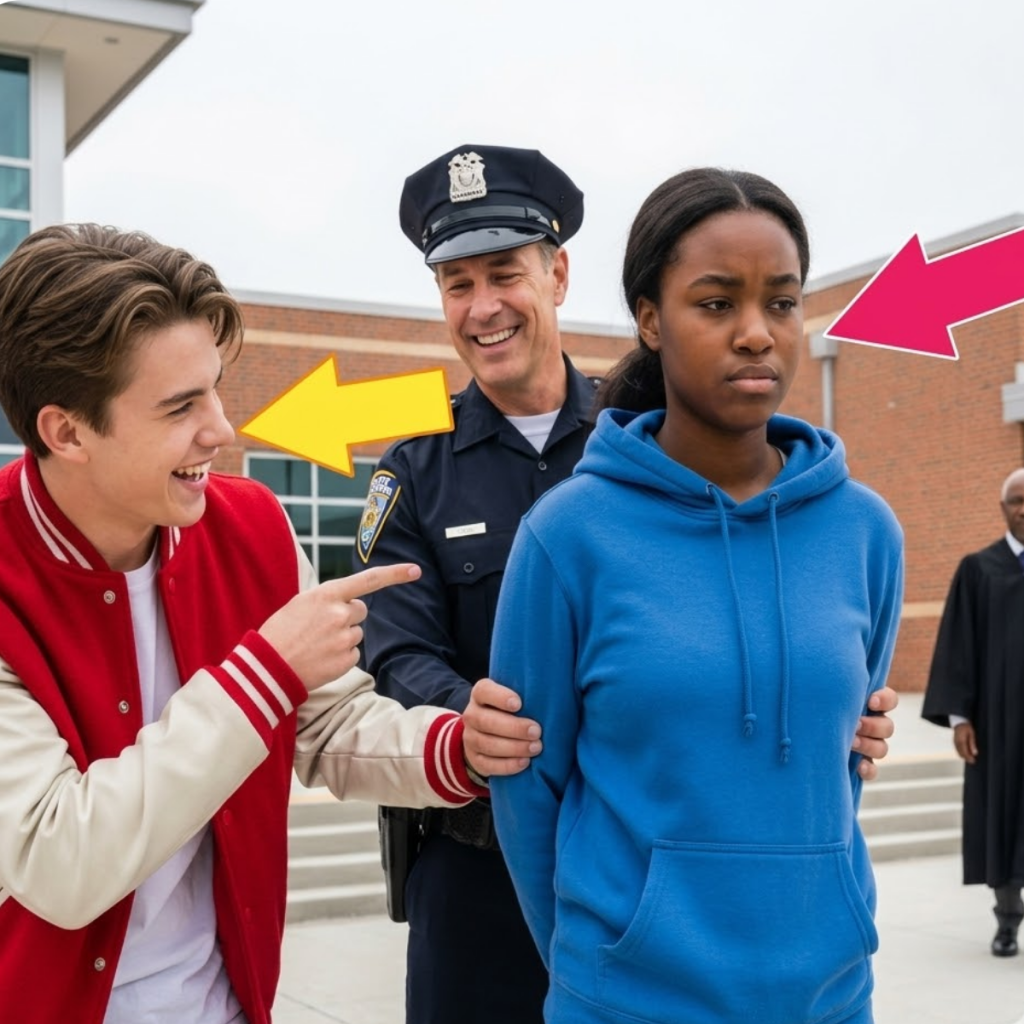
Kyle stared at her for one long second, then pulled out his phone.
The whole hallway seemed to lean in.
“Fine,” he said. “If you want to play it like that, let’s do this right.”
He dialed without taking his eyes off her.
“Hey, Dad,” he said, voice instantly changing into something louder, shakier, performative. “Yeah, I’m at school. There’s a girl here threatening me. She shoved me and won’t stop. I don’t feel safe.”
Maya’s stomach went cold, but her face gave him nothing.
Kyle listened, nodded once, then ended the call.
“My father is Deputy Chief Donovan,” he said. “He’s on his way.”
The hallway went silent.
Even the teachers who had been watching from their classroom doors seemed to draw back slightly, as if the arrival of Brendan Donovan had turned a school confrontation into something more dangerous.
Maya took out her own phone.
Not to call anyone. Just to send a single message.
Then she leaned against a locker and waited.
Ten minutes later, Deputy Chief Brendan Donovan entered the hallway like he owned the building.
He was a taller, older version of his son. Same hard mouth. Same thick shoulders. Same expression of inherited certainty. His uniform was immaculate, his badge polished, his presence immediately rearranging the air around him. Students stepped back. Teachers lowered their eyes. Nobody wanted to be in the line of his attention.
Kyle went straight to him.
“She shoved me,” he said quickly. “And threatened me when I asked for my ball back.”
Brendan looked at Maya for the first time.
Not as a student.
Not as a child.
As a problem.
“Is that true?” he asked.
“No, sir,” Maya said. “It is not. Your son blocked my path, made racially charged remarks, and is now lying to you.”
The silence that followed was dangerous.
Brendan’s face hardened instantly.
“Watch your tone.”
Maya kept her voice steady.
“I am telling you exactly what happened.”
Brendan took one step toward her.
“My son says you threatened him. That makes this a police matter.”
Maya felt the entire hallway go cold around her.
“With respect,” she said, “this is a school dispute, and there are witnesses.”
Her calculus teacher, Mr. Henderson, finally stepped forward from his classroom doorway.
“Chief Donovan,” he said carefully, “I saw part of the interaction. I really think this should go through the office—”
Brendan cut him off without even looking at him.
“Thank you, Mr. Henderson. I’ll handle it.”
Then he looked back at Maya.
“Turn around.”
A murmur moved through the hallway.
Maya’s heartbeat kicked once, hard.
“You’re arresting me?” she asked.
“For assault and making threats,” Brendan said.
She stared at him.
There are moments when a person realizes that reason has already been left behind. That facts will not save them because facts are not what this is about anymore. This was not investigation. It was performance. A father in uniform protecting his son’s ego by teaching a Black girl what happened when she refused to play along.
“You have no probable cause,” Maya said clearly.
Brendan took out the handcuffs.
“You can explain that downtown.”
The metal clicked shut around her wrists.
The sound was so sharp, so wrong in the middle of a school hallway, that several students gasped aloud. One girl started crying quietly. Mr. Henderson took another step forward, then stopped when Brendan turned on him with a single look.
Kyle stood just off to the side, smiling.
That smile would haunt him later.
At the precinct, Maya was processed with chilling efficiency.
Fingerprinting.
Photograph.
Holding cell.
No one screamed at her. No one needed to. The coldness of procedure did the work just as well. It was the kind of bureaucratic humiliation meant to teach submission. To say: look how quickly a lie can become paperwork if the right person tells it.
Maya sat on the narrow bench in the holding cell and said almost nothing.
When an officer tried to question her, she replied calmly, “I want a lawyer.”
Then she picked up her book and began reading.
That unsettled them more than tears would have.
Brendan Donovan watched her through the glass of his office. Something about her stillness bothered him. Most teenagers cried. Or raged. Or begged to call someone important. Maya did none of those things. She looked like someone waiting for a schedule to catch up to the truth.
An hour later, it did.
The black sedan that pulled into the front of the station did not park in visitor parking.
It stopped directly in front of the entrance.
A man in a dark, perfectly tailored suit stepped out. He was in his fifties, tall, controlled, with the kind of presence that changed a room before he even entered it. Beside him was a woman carrying a briefcase, severe and composed.
The desk sergeant took one look at the man and stood so fast his chair rolled backward into a filing cabinet.
Judge Harold Thorne did not raise his voice.
That made it worse.
“My daughter, Maya Thorne, was brought here one hour and seven minutes ago,” he said. “I am here as her father and as her counsel. I want to see her immediately. Then I want the arresting officer, the arrest report, and every piece of documentation connected to her detention.”



The sergeant swallowed hard and buzzed them through.
Maya looked up from her bench when the holding cell opened. For the first time that day, the mask cracked just a little.
“Hey, Dad.”
Judge Thorne stepped inside, took one look at the handcuffs, and the fury in his face went so quiet it frightened the officers more than shouting would have.
He hugged his daughter once, quickly, then turned back toward the hallway.
“Get Deputy Chief Donovan into Interview Room Two,” he said.
Brendan walked into that room expecting an attorney.
Instead, he found Judge Harold Thorne sitting alone at the table.
The door shut behind him.
For the first time that day, Brendan Donovan looked uncertain.
“Your Honor, I—”
“The most disturbing part of this,” Judge Thorne said, his voice calm as polished stone, “is that you had no idea who she was.”
Brendan stopped.
Judge Thorne folded his hands in front of him.
“You did not know she was my daughter. Which means you believed this was acceptable treatment for an ordinary Black teenage girl who contradicted your son.”
“Judge, there’s been a misunderstanding—”
“No,” Judge Thorne said. “There has been an abuse of power. You took the word of your own son without reviewing footage, without interviewing neutral witnesses, without consulting school administration, and you used the full authority of your office to handcuff and incarcerate a student for the crime of embarrassing him.”
Brendan’s face had gone pale.
“Sir, I was trying to protect my son.”
Judge Thorne leaned forward slightly.
“Your son is a bully. You are his enabler. And today, in a school hallway, you turned your badge into a family weapon.”
The room went still.
Judge Thorne’s eyes never left his.
“You are suspended, effective immediately. The district attorney will review this arrest for criminal exposure. My daughter is being released now. And if you think this ends with embarrassment, then you do not understand what you have done.”
When Brendan walked back into the bullpen, every officer avoided his eyes.
He processed Maya’s release with trembling hands.
Kyle had arrived with his mother by then, red-faced and confused, still expecting his father to fix everything.
Instead, he watched his father unravel.
Maya stepped out of the station beside Judge Thorne without once looking rattled. But before she entered the waiting car, she paused and looked at Kyle.
Not with cruelty.
Not with triumph.
Just with the kind of clarity he had never once been forced to face.
For the first time in his life, Kyle Donovan understood that power and safety were not the same thing. That some people did not need to shout to end you. They only needed the truth, and enough standing to make sure it was heard.
The fallout hit fast.
The story leaked within twenty-four hours.
By the second day, it was everywhere. A deputy chief had arrested a judge’s daughter after his son lied about her in a school hallway. The racial dynamics were obvious. The abuse of power was undeniable. Lincoln High, already shaky with gossip, became a storm center.
Brendan Donovan was forced to resign before the week ended.
Kyle was charged with filing a false police report.
Then everything got worse.
Because once the Donovans began to fall, other people found their voices.
Maya, who had no interest in simply surviving what happened and moving on as if the system had not tried to swallow her whole, started asking questions.
Not for revenge.
For pattern.
She spoke to students. To parents. To a local reporter whose instincts told her there was more buried beneath the school incident than one lying teenager and one corrupt father.
That was how Maya found Sarah Gable.
Sarah had gone to middle school with Kyle.
She had transferred away years earlier after what the town had always called a rough patch and what the truth revealed had been a sustained campaign of cruelty. Kyle had stolen intimate photos from her phone and shared them. When Sarah’s parents went to Brendan Donovan for help, expecting a police officer and father to stop it, Brendan had done something worse than nothing.
He covered it up.
He threatened Sarah’s family. Suggested that if they pushed for charges, their daughter would be painted as promiscuous, unstable, dramatic. He used the power of his office to bury what should have destroyed his son’s life long before Maya ever arrived at Lincoln High.
When that information surfaced during civil discovery, it detonated the case.
What had started as false arrest became evidence of a much larger pattern. Brendan Donovan had not simply abused power once. He had built a private fortress around his son’s cruelty and used his badge to protect it.
The district attorney filed new charges.
Obstruction.
Official misconduct.
Accessory liability tied to the cover-up of child sexual abuse material.
This time, Brendan broke.
At his deposition, confronted with the old reports, the witness statements, and Sarah’s testimony, he sobbed and confessed.
By the time sentencing arrived, he looked twenty years older.
Sarah gave a victim impact statement so devastating that even the court reporter had to pause once to steady herself.
Kyle, tried as a juvenile but facing charges serious enough to destroy any hope of a clean future, sat beside his attorney looking like someone who had only just realized that impunity is not inheritance. It is a temporary illusion.
When Brendan was finally allowed to speak, he did not turn first to the judge.
He turned to Maya.
“I failed as an officer,” he said hoarsely. “I failed as a father. I created this. I protected it. And I am ashamed.”
Maya did not answer him.
She didn’t need to.
His shame no longer belonged to her.
It belonged to the wreckage he had made.
Kyle was sentenced to juvenile detention with the possibility of holding through age twenty-one. His future narrowed overnight into court supervision, permanent records, and the kind of social ruin that privilege had never prepared him to survive.
Brendan went to prison.
The lawsuit against the city ended in a settlement large enough to rewrite department policy and force outside oversight.
Lincoln High changed too, though not because schools change quickly. They changed because they had been humiliated into honesty. Staff members who had looked away too often could no longer pretend neutrality. Students who had once laughed along with Kyle found out laughter leaves records too.
A year later, Maya Thorne stood at the podium as valedictorian.
The gym was packed.
Parents, teachers, students, district officials, local reporters.
There was an empty space in the senior photo display where Kyle Donovan’s portrait would have been.
Maya saw it as she walked to the stage.
She didn’t smile.
She didn’t mention him either.
Her speech was not about revenge.
It was about strength.
About the difference between noise and character. About the danger of systems that confuse status with virtue. About justice—not as punishment alone, but as the steady refusal to let privilege write the story unchallenged.
She spoke simply.
Clearly.
Powerfully.
And when she finished, the audience rose.
Not because of scandal.
Not because of pity.
Because everyone in that room knew, whether they wanted to admit it or not, that they were standing for a girl who had been handcuffed in a hallway and still found a way to leave with her dignity intact while the family that tried to humiliate her collapsed under the weight of its own corruption.
As Maya stepped off the stage, Judge Harold Thorne was waiting at the side.
Proud. Quiet. Steady.
The way he had been the day he opened that holding cell.
Some storms destroy everything they touch.
Others clear the air so completely that the truth finally has room to breathe.
Kyle Donovan had called his father to arrest a new Black girl for defiance.
Instead, he had called down the end of his own family’s empire.
And Maya Thorne, who never once shouted, never once begged, never once forgot who she was, walked through the wreckage and into a future none of them had been powerful enough to stop.