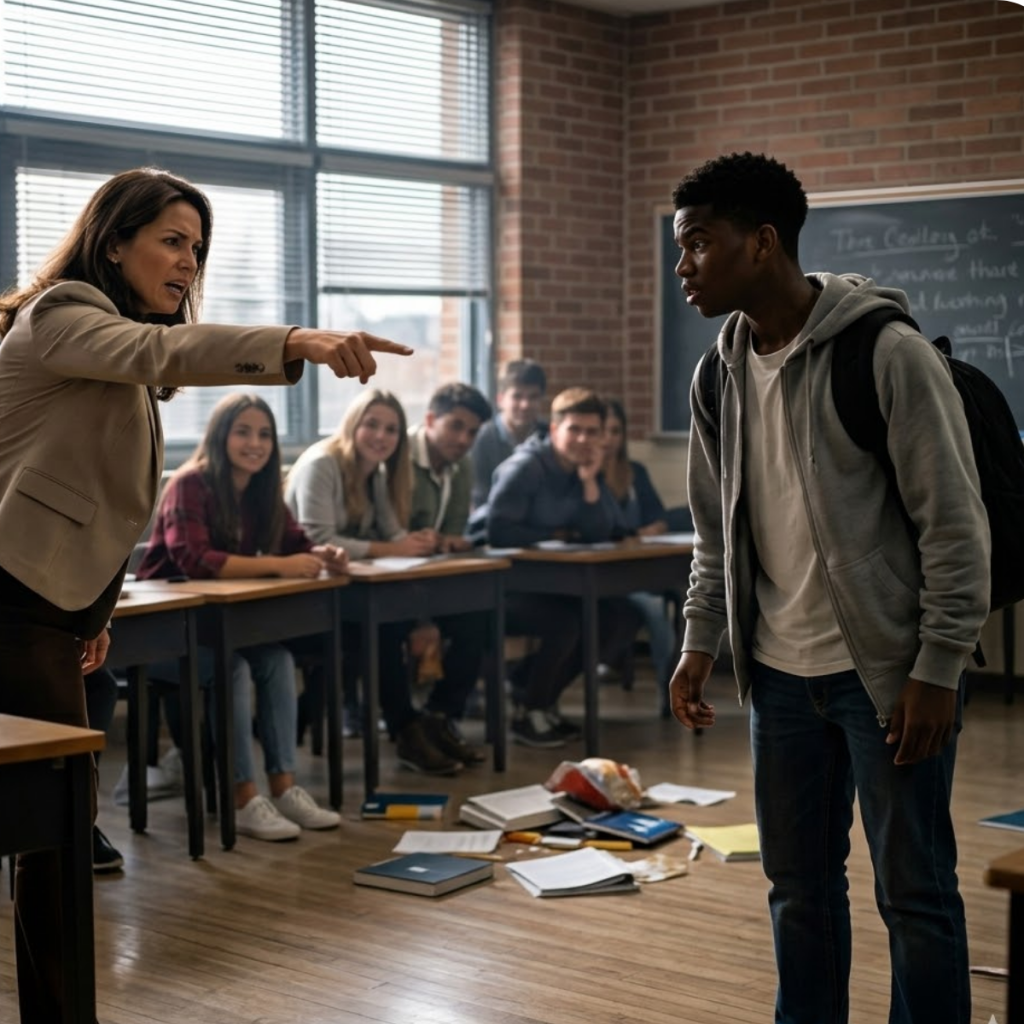
“You were the last one to enter this room. Since no one else seems eager to admit it, you’ll be the one to clean it.”
The room went still in that uncomfortable way classrooms do when everyone senses something unfair is happening, but nobody wants to be the first to step into it.
A girl near the front leaned toward the boy beside her and whispered, “Why is it always him?”
The boy shrugged, not quietly enough. “You know why.”
Jamal heard that.
He heard every word.
And somehow, that hurt more than the accusation.
Because this wasn’t new.
Every time something went missing, every time a joke crossed a line, every time a chair was broken, or a pencil case disappeared, or a paper got ruined, somehow the suspicion floated toward him like smoke finding the same open window.
He looked around the room one last time.
No one spoke.
Not the kids who knew he was late because he had stopped to help the janitor carry supplies.
Not the boy in the back who had clearly seen what happened.
Not the two girls beside the window who had watched another student knock over the paint and laugh.
No one.
So Jamal bent down, picked up the rag from the sink area, and started cleaning.
Blue paint spread across his fingers. It stained the cuff of his shirt. Each wipe across the floor felt slower than the last, not because the job was hard, but because humiliation has weight. And when you’re carrying it alone in front of an audience, it gets heavier by the second.
Behind him, the whispers kept going.
“I heard he got blamed for something last week too.”
“He always acts like the victim.”
“Maybe she’s just tired of him.”
Mrs. Hargrove clicked across the floor in her heels, glancing down only once.
“Make sure you get every corner,” she said.
“Yes, ma’am,” Jamal replied quietly.
He hated that he said it.
Hated how normal it sounded.
Hated how practiced he had become at swallowing things.
A boy in the back finally raised his hand.
“Miss, I think I saw—”
“Focus on your work,” she snapped without turning around.
The boy lowered his hand immediately.
And that was that.
Truth buried.
Lesson resumed.
Humiliation filed away as discipline.
When Jamal finally finished, he stood slowly. His hands were blue. His face wasn’t angry. That almost made it worse. He looked like someone who had been here before and already knew rage would not help him.
Mrs. Hargrove glanced over and nodded once.
“Good. Maybe next time you’ll be more careful.”
Jamal stared at her.
“I told you it wasn’t me.”
She gave a small shrug. “Then maybe you should start acting like someone people can trust.”
This time, no one laughed.
Because even the kids who didn’t like Jamal felt the cruelty in that sentence.
He nodded once. Not because he agreed. Because he understood.
No matter what he said, she had already decided who he was.
He went to his desk, sat down, and opened his bag. The room faded around him. His ears still worked, but he stopped letting the noise in. He looked at his stained hands for a long moment, then reached for his phone beneath the desk.
One message.
No drama.
No explanation.
Just a calm, deliberate decision.
He typed.
Sent it.
Then he slid the phone back into his backpack and stared straight ahead.
Mrs. Hargrove went on teaching as if nothing had happened.
That was the strangest part.
The world had tilted, and she was still talking about color theory.
Ten minutes later, the intercom crackled.
“Attention, please. All staff are to remain in their classrooms. Administration will be making rounds immediately.”
A ripple moved through the room.
Students looked up.
Chairs creaked.
Whispers sharpened.
“What’s going on?”
“Did someone report something?”
“Is it about the fight yesterday?”
Mrs. Hargrove’s face shifted, just slightly. She straightened her papers and forced a smile.
“Everyone focus on your assignments.”
But the tension had already arrived.
Then came the footsteps in the hallway.
Heavy. Fast. More than one person.
Jamal didn’t turn around. He didn’t fidget. He just sat there with those blue-stained hands resting on his desk like he had expected something—not this exact moment, maybe, but something.
The door opened without a knock.
The principal walked in first.
Behind her came two board members.
And beside them was a man in a dark suit, tall, broad-shouldered, carrying the kind of presence that changes the air before he says a word.
The room froze.
Mrs. Hargrove blinked. “Sir? Is everything okay?”
No one answered her.
The man’s eyes moved across the room until they landed on Jamal. Then they dropped to his hands. The paint.
Silence stretched so tight it felt like someone might tear it by breathing.
Then he asked, very calmly, “Why is he cleaning?”
No one answered.
Mrs. Hargrove laughed softly, the way people do when they think they can still talk their way out of something.
“It’s just a simple classroom issue,” she said. “Nothing serious.”
The man didn’t even look at her. He walked directly to Jamal.
“Who told you to do this?”
Jamal stood up.
“It’s fine,” he said quietly. “I already cleaned it.”
The man’s face changed—not with anger, but with something deeper. The kind of control people develop when they’ve learned to hold their fury in public.
He turned, finally, toward Mrs. Hargrove.
“Did you assign him to clean up something he said he didn’t do?”
She hesitated.
“It was just a classroom consequence,” she said. “He was the last one in.”
“For something he didn’t do,” the principal added, her voice catching slightly.
Mrs. Hargrove turned to her in surprise. “I assumed—”
“Exactly,” the man said.
That single word dropped into the room like a hammer.
Assumed.
The boy at the back raised his hand again, but this time he didn’t wait to be called on.
“She’s lying,” he blurted out. “I saw Tyler knock the paint off the table. Jamal really did just walk in. I tried to say something.”
Mrs. Hargrove’s face lost its color.
The man nodded slowly, then looked around the room, taking in every child, every desk, every silent witness who had learned a lesson that had nothing to do with art.
Then he spoke.
“My name is Mayor Steven Brooks.”
A sharp wave of recognition passed through the class.
Even kids who didn’t follow politics knew the name. Some had seen him on television. Others had seen him in newspaper articles taped in the hallway after school board visits or city education funding meetings.
But it was what he said next that cracked the whole room open.
He rested one hand gently on Jamal’s shoulder.
“And I’m his father.”
No one moved.
Not the teacher.
Not the principal.
Not the students.



It wasn’t just surprise that filled the room. It was shame.
The kind that comes when people realize they only see injustice once power enters the room wearing a suit.
Mrs. Hargrove swallowed hard. “I… I didn’t know.”
Mayor Brooks looked at her steadily.
“That’s the problem,” he said. “You should not need to know who he belongs to in order to treat him like he belongs here.”
There it was.
The truth.
Not polished.
Not shouted.
Just laid down in the center of the room where no one could step around it.
Mrs. Hargrove opened her mouth, then closed it again.
The principal stepped forward.
“Mrs. Hargrove, effective immediately, you are suspended pending full review. Your conduct will be investigated by the district.”
The teacher looked stunned. “For one misunderstanding?”
“No,” the mayor said quietly. “For the pattern behind it.”
The words settled over the room slowly.
Because everyone knew it was true.
This had never just been about paint.
It was about who got blamed easily.
Who got doubted quickly.
Who had to prove innocence before being granted basic fairness.
Who was expected to endure humiliation politely.
And the children had seen it all.
Jamal stood still through all of it.
He wasn’t smiling. He wasn’t triumphant. He looked tired. More tired than any fourteen-year-old should look.
Mayor Brooks turned slightly toward him, his voice softening.
“You okay?”
Jamal hesitated.
Then he nodded once.
Not because he was okay.
Because he was trying.
The room had changed now. Students who had stayed silent earlier couldn’t seem to meet his eyes. A girl in the front whispered, “I’m sorry,” though she didn’t know if he heard her. The boy in the back looked half relieved, half guilty that he had waited so long to speak.
The principal dismissed the class early.
As the students packed up, the mayor stayed where he was, not rushing, not grandstanding. He waited until the room began to empty, then sat in the chair beside Jamal’s desk.
For the first time all day, Jamal looked unsure.
“You didn’t have to come down here like that,” he muttered.
Mayor Brooks exhaled.
“Yes,” he said. “I did.”
Jamal rubbed at the paint on his hand with a tissue. It only smeared more.
“I could’ve handled it.”
His father nodded. “I know.”
“You always say I need to stay calm.”
“You did stay calm.”
Jamal looked up at him then, and the hurt finally surfaced beneath the calm.
“She does this all the time,” he said. “Maybe not always like this, but… it’s always something. She already decided what kind of person I was before I even said anything.”
Mayor Brooks was quiet for a long moment.
Then he said, “I know something about people deciding who you are before they know you.”
Jamal gave a dry half-laugh. “Yeah. I guess you do.”
His father looked at his stained hands.
“When I was your age,” he said, “my teacher accused me of cheating because I got the highest score in the class. She said it didn’t make sense. Said boys like me didn’t usually write papers like that.”
Jamal stared.
“What happened?”
Mayor Brooks smiled without humor. “Nothing. My mother came to school in her nursing shoes, still wearing her night shift ID badge, and told them exactly who they were dealing with.”
Jamal snorted once despite himself.
“She sounds scary.”
“She was. Still is.” Then his father’s expression sobered. “But listen to me. What happened today matters. Not just because it hurt. Not just because it was unfair. It matters because silence teaches the wrong people that they were right.”
Jamal looked down.
“I’m tired of always having to prove myself.”
His father leaned closer.
“I know. But you are not invisible. And you are not crazy for noticing what’s happening. You saw it clearly. That matters too.”
For a moment, Jamal’s face softened in a way it hadn’t all day.
Later that evening, when they got home, Jamal’s grandmother was waiting in the kitchen with fried chicken, cornbread, and the kind of fierce love that does not ask whether you are hungry before feeding you anyway.
She took one look at his stained hands and said, “Who did I need to pray over?”
Jamal laughed for real then, a short, surprised sound that made the whole day shift inside him.
He told the story over dinner.
Not dramatically.
Not like a victim.
Just honestly.
His little sister listened with wide eyes. His grandmother kept muttering, “Mm-hmm,” the way older women do when they are building judgment brick by brick. His father mostly listened, stepping in only when Jamal got too quiet and left out the parts that hurt most.
That night, after everyone went to bed, Jamal stood alone in the bathroom scrubbing the last traces of blue paint from under his fingernails.
It took longer than he expected.
Some stains do.
But as the water ran and the color finally started to fade, he thought about the way the room had gone silent when his father said, “I’m his father.”
Not because his father was the mayor.
Because someone had finally stepped into the room and made it clear that Jamal was worth defending.
That mattered.
The next week, the school held an assembly on bias, accountability, and student dignity. Some teachers rolled their eyes. Some students acted bored. But Jamal paid attention. Not because he believed one assembly would fix everything. He didn’t.
But change had to start somewhere.
And maybe sometimes it starts with a mess on the floor, a lie no one challenges, and one boy deciding he’s done carrying what never belonged to him.
Over the next few months, things didn’t become perfect.
That would be a lie.
People still whispered sometimes.
Some classmates still looked at him through old assumptions.
A few teachers became awkwardly too nice, which felt almost as fake as the disrespect.
But some things did change.
The boy in the back who had tried to speak that day started sitting with Jamal at lunch.
The girl in the front stopped whispering and started asking direct questions instead.
And Jamal himself changed too.
Not into someone softer.
Into someone clearer.
He stopped shrinking to make other people comfortable.
Stopped apologizing for speaking carefully.
Stopped carrying blame just because it arrived in his direction.
And when another student got accused months later for something she didn’t do, Jamal was the first one to speak.
“It wasn’t her,” he said. “I saw what happened.”
His voice didn’t shake.
That was the real turning point.
Not the public exposure.
Not the humiliation of a teacher.
Not even the mayor standing in the doorway.
It was that moment.
The moment Jamal chose not to become silent just because silence had once been used against him.
Years later, people would still talk about that day. Some would remember the scandal. Some would remember the teacher losing her job. Some would remember the principal’s face or the mayor’s words.
But Jamal would remember something simpler.
Blue paint on his hands.
A room full of silence.
And the moment truth finally walked through the door.
Because sometimes justice does not arrive as revenge.
Sometimes it arrives as recognition.
As a father placing a steady hand on his son’s shoulder.
As a principal finally refusing to excuse “assumptions.”
As a classroom being forced to see what it had pretended not to notice.
As a boy learning that being calm is not the same as being powerless.
And maybe that was the deepest lesson of all:
You should not have to be important for people to treat you with dignity.
You should not need a powerful last name for your pain to count.
You should not need rescue in order to deserve fairness.
But if the world forgets that, even for a moment, truth has a way of returning.
And when it does, it does not whisper.
It stands in the doorway.
Looks the room in the eye.
And says, clearly, enough.