But Vanessa had decided Eleanor was “incompatible with the new dynamic.”
Richard had repeated those exact words, as if his mother were a broken appliance instead of the woman who had raised him.
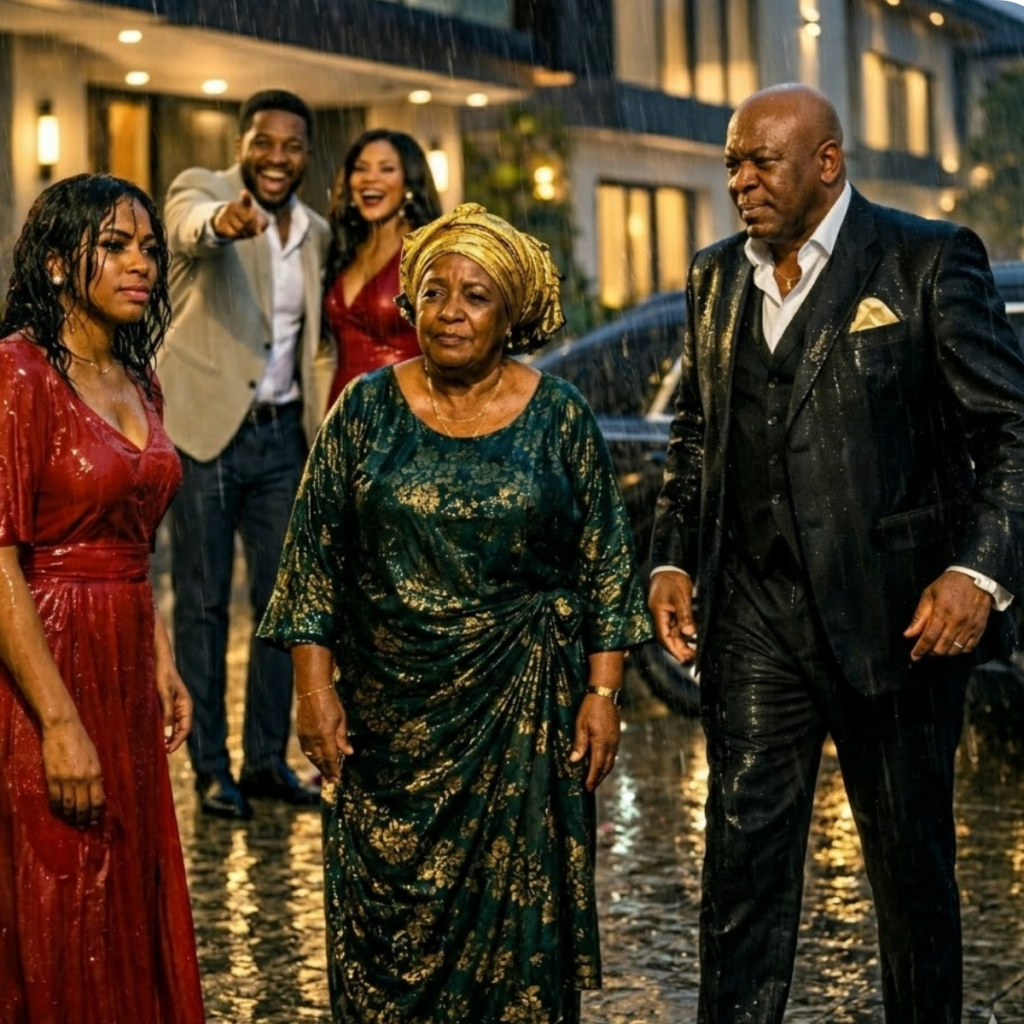
So now the two women stood together outside the locked gate, drenched and discarded under a storm-heavy sky.
“He’ll come out,” Eleanor said after a long silence, though even she sounded unconvinced.
Dorothy looked at the glowing windows of the house she had cared for, cleaned, decorated, filled with flowers, meals, holidays, and second chances.
“No,” she said quietly. “He won’t.”
She wasn’t crying.
Not because she didn’t want to. But because something inside her had already moved past tears into a colder kind of clarity.
And through all of it—through the humiliation, the shock, the ache of being replaced—another memory kept flashing through her mind.
Three weeks earlier.
11:47 p.m.
A deserted road outside the city.
A silver car half-angled against a guardrail.
A man slumped inside, bleeding out in the dark.
Dorothy had been driving home alone that night, exhausted after a late volunteer meeting, when her headlights caught the shape of him. Most people might have slowed down, whispered a prayer, and kept moving. It was late. It was dangerous. It was someone else’s tragedy.
But Dorothy had pulled over.
She had run through the cold, used her scarf as a tourniquet, checked his pulse with shaking fingers, screamed into the dark for help no one could hear, and held pressure on the wound for forty long minutes until the ambulance finally came. She had kept talking to him the whole time, though he was barely conscious.
“Stay with me.”
“You’re not dying here.”
“Do you hear me? Stay.”
She never asked his name.
She never stayed for recognition.
She went home soaked, trembling, and too tired to explain.
Richard barely looked up from his phone when she came in.
Now, standing in the rain outside the house that was no longer hers, Dorothy had no idea that the man she saved knew exactly who she was.
Across the city, on the forty-fourth floor of a glass tower, Gerald Harmon stood by his office window watching rain stripe the skyline.
At sixty-one, Gerald Harmon had built one of the most powerful private infrastructure firms in the country. Men in expensive suits called him careful, brilliant, impossible to impress. People said he trusted numbers more than emotion.
They were wrong.
What Gerald trusted most was character.
And six weeks ago, when he nearly died alone on a dark road, character was what had saved him.
His team had identified Dorothy within seventy-two hours. Since then, he had quietly learned everything: her name, her marriage, her history, the financial dependence Richard had carefully built around her, the affair with Vanessa, and the fact that Richard’s company was currently one of the final firms being considered for Harmon Global’s biggest contract of the decade.
Three and a half billion dollars.
A deal Richard had rearranged his whole life to win.
Gerald had waited because timing mattered.
Tonight, timing was no longer something to debate.
He picked up a printed still from a highway traffic camera. Grainy, timestamped, imperfect. It showed Dorothy kneeling beside him on the wet pavement that night, one hand at his wound, the other gripping his.
No audience. No cameras she knew about. No reward waiting.
Just decency.
He stared at the image for a long moment, then called his head of security.
“Where are they now?”
“Outside the residence, sir. In the rain.”
Gerald closed his eyes.
“Bring the car around.”
Back on the street, Dorothy had just draped her coat over Eleanor’s shoulders when a long black limousine glided into view.
It didn’t slow gradually.
It came straight toward them, cutting through the rain like it already knew exactly where it belonged, then stopped directly in front of the locked gate.
Dorothy frowned.
Eleanor tightened her grip on her cane.
The rear door opened.
A tall man stepped out into the rain without an umbrella. Dark coat. Steady eyes. The kind of presence that didn’t need to announce itself because it changed the air the moment it arrived.
Dorothy stared.
Recognition came slowly, then all at once.
Not from the road that night—she had barely seen his face then—but from newspapers, business magazines, television screens in waiting rooms and airport lounges.
Gerald Harmon.
Eleanor spoke first.
“Who are you?”
He turned to her with immediate respect.
“My name is Gerald Harmon,” he said. Then he looked at Dorothy. “And six weeks ago, your daughter-in-law saved my life.”
The world seemed to stop.
Dorothy felt the ground tilt beneath her. Not from fear. From disbelief.
Gerald took one step closer, his voice calm and warm.
“Mrs. Callahan, I’ve been looking for the right moment to thank you properly. I’m sorry it had to be like this.”
Dorothy opened her mouth, but no words came.
At that exact moment, high above them, behind one of the upstairs windows, Richard saw the limousine.
He saw Gerald step out.
And for the first time in years, Richard Callahan felt genuine panic.
He knew what this meant.
Gerald Harmon was not just any powerful man. He was the man. The contract Richard had spent the last eight months chasing, manipulating, performing for—that contract lived or died by Gerald’s decision.
And Gerald was standing in the rain with Dorothy.
Richard didn’t think. He ran.
Down the stairs. Through the hall. Past Vanessa, who was frozen near the window, her expression drained of color.
By the time Richard opened the front door and stepped out into the storm, Gerald was already looking at him.
Not angrily.
That would have been easier.
Gerald looked at him with something colder than anger.
Certainty.
“Mr. Callahan,” Gerald said, “I came here as a courtesy to inform you personally that Harmon Global is withdrawing your firm from consideration for the contract.”



Richard’s face went blank.
“Mr. Harmon, if you’ll just let me explain—”
“I’m not here to discuss the contract,” Gerald said. “That decision is already made.”
Rain rolled down Richard’s face, but he didn’t seem to notice.
Gerald continued, voice even.
“I’m here because the woman who saved my life is standing outside in the rain after being turned out of her own home. I intend to make sure she does not remain there another minute.”
Then he turned to Dorothy.
“I have a guest residence on my estate. It is yours and Mrs. Eleanor’s for as long as you need it. My attorneys will contact you in the morning. But tonight, please—come out of the rain.”
For a second, Dorothy just stood there.
Not because she doubted him.
Because she was trying to understand how one act she barely spoke of had returned like this—quietly, powerfully, at the exact moment her own life had been shattered.
Richard stepped down from the porch and approached the gate.
“Dorothy.”
Just her name.
No defense.
No explanation.
No grand apology yet.
Only her name, spoken by a man who had finally run out of strategies.
Dorothy turned and looked at him. Not bitterly. Not lovingly. Just clearly.
The way you look at someone after the illusion is gone and there is nothing left to negotiate.
“Goodbye, Richard,” she said.
Then she picked up her suitcase.
Eleanor moved first, climbing carefully into the limousine. Dorothy followed.
Gerald held the door open, not like a billionaire rescuing someone, but like a man honoring a debt of humanity.
The door closed.
The car pulled away.
And Richard Callahan stood in the rain, watching the taillights disappear, realizing too late that the one woman he had treated as powerless had been the bridge to everything he wanted.
The next morning changed everything.
Gerald’s legal team moved quickly. Dorothy and Eleanor were settled into a warm guest house on his estate, with fresh clothes, hot tea, and a guest room overlooking a garden where Eleanor, to everyone’s surprise, immediately began giving opinions about the flower beds.
Dorothy barely slept that first night, not from fear but from the strange emptiness that comes after surviving something that should have broken you.
Gerald visited the next afternoon.
Not with pity.
With clarity.
“I’m not interested in saving people who don’t want to be saved,” he told Dorothy as they sat on a sunlit terrace. “But I am very interested in honoring people who do the right thing when no one is watching.”
She studied him carefully.
“You don’t owe me anything.”
He gave a small smile.
“That’s true. But I choose to.”
Meanwhile, Richard’s collapse began.
Without the Harmon contract, three major investors backed out within weeks. The firm he had nearly destroyed his life to elevate began unraveling faster than he thought possible. Vanessa, who had loved access far more than affection, left before the house was even listed for sale. She vanished with less drama than she had entered, and this time Richard didn’t chase after anyone.
He sent Dorothy one message through his lawyer.
Three sentences.
I’m sorry.
I was wrong.
I hope you’re well.
Dorothy read it once. Then again.
And deleted it.
Not because she hated him.
But because she had finally learned the difference between forgiveness and access.
Some apologies do not reopen doors.
They simply mark the moment those doors close forever.
Six months later, Dorothy sat in a corner office on the thirty-eighth floor of Harmon Global Enterprises.
Not as a guest.
Not as a symbol.
As the newly appointed Director of Community Development.
Gerald had built the role around something Dorothy did naturally: seeing people others overlooked. Understanding dignity not as a slogan, but as a need. She oversaw grants, housing partnerships, trauma support programs, and emergency aid initiatives for women and seniors in crisis.
When Gerald first offered her the role, she didn’t say yes right away.
That, too, was new.
The old Dorothy would have accepted immediately, grateful just to be chosen. The woman who had stepped into a limousine in the rain understood that her yes had value now.
So she waited three days.
She prayed. She talked to Eleanor. She listened to herself.
Then she said yes.
Eleanor thrived too.
She claimed part of Gerald’s estate garden as if she had always been meant to command roses and gardeners. She laughed more. Slept better. Carried herself like someone whose son had failed her, yes—but not like someone ruined by it.
Gerald eventually visited the same dark stretch of road where Dorothy had saved him. He stood there alone for a long time, looking at the guardrail, the shoulder, the place where one woman’s refusal to drive past had split his life in two.
That same week, he signed the founding papers for the Dorothy Callahan Foundation for Community Dignity.
When he told her, Dorothy cried.
Not because of the money.
Not even because of the honor.
But because after years of being useful without being seen, she had finally been recognized for the part of her that mattered most.
Not as a wound.
As a strength.
The biggest lesson Dorothy carried from that night in the rain was not revenge.
It was this:
Kindness is never lost.
It may travel silently.
It may return in a form you never expected.
It may take longer than you hoped.
But it is always working.
And sometimes, when people throw you out into the storm convinced your story is over, life sends a limousine—not to rescue you from your worth, but to remind you that your worth was never theirs to deny.