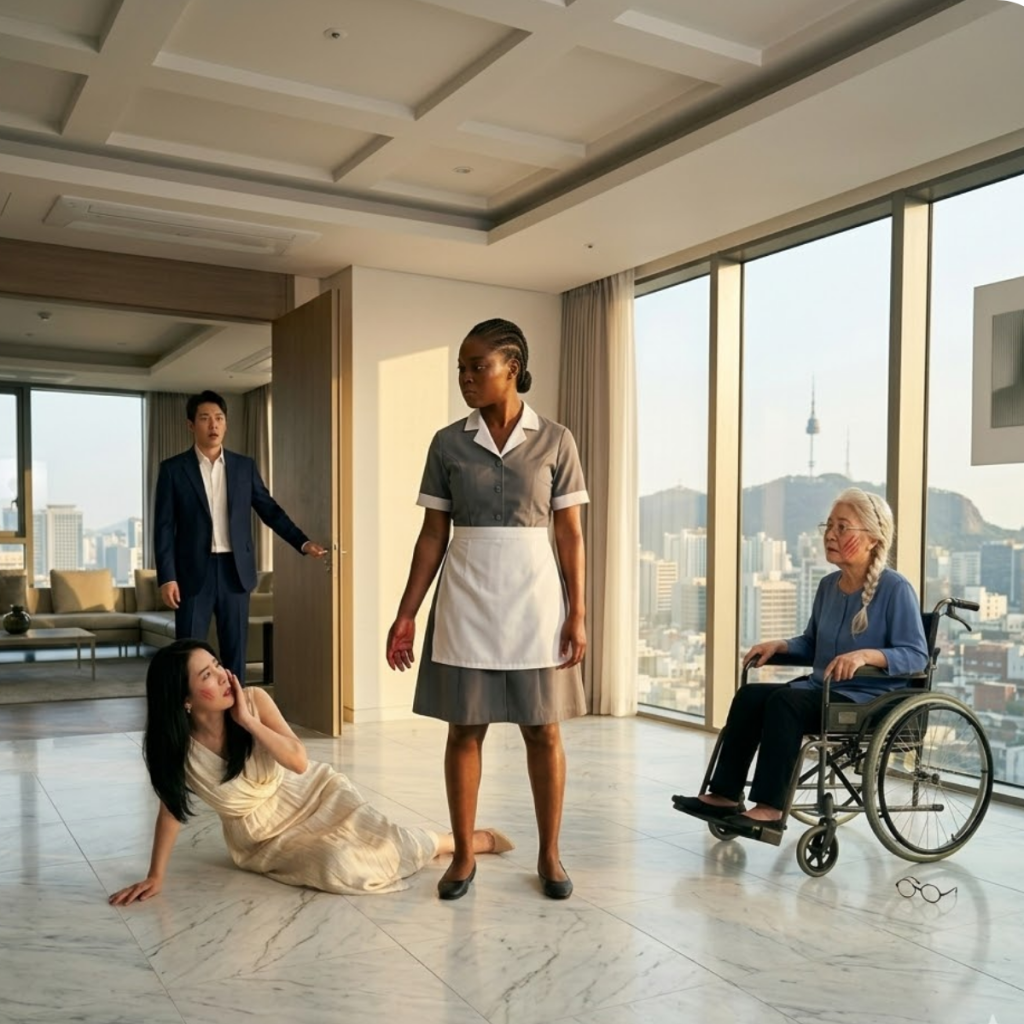
His Nigerian maid standing protectively in front of her, shaking but refusing to move.
Three people.
Three versions of the truth.
Ten seconds to decide which one he would believe.
But the real story had begun months earlier, long before that slap, long before Ruth had ever stepped inside the penthouse.
It began four months ago, with one suitcase, a temporary work visa, and the voice of her late grandmother echoing in her heart.
You have strong hands, Ruth.
Use them to hold people up.
Ruth Okonkwo arrived in Seoul on a gray morning with tired eyes and exactly one formal blouse ironed on the floor of a guesthouse because there had been no ironing board. She was twenty-seven, Nigerian, from Lagos by way of Imo State, and she had taken the job because caregiving was the only work she trusted herself to do with dignity.
Her grandmother had raised her.
Her grandmother had also lived most of her life in a wheelchair after surviving polio.
By age six, Ruth was already lifting her gently from bed to chair, helping her bathe, rubbing lotion into dry legs that could no longer move, braiding her hair for church, learning how to read mood through silence. She knew what it meant when the world stopped seeing a disabled woman as a full human being. She knew how loneliness could settle into a room like dust.
So when Mrs. Park, the housekeeper, brought her into the Kang family penthouse and said, “Madam Kang is in a wheelchair. She used to be a professor. She is sharp, and she will test you,” Ruth only nodded.
“I was trained by my grandmother,” she replied. “I’m used to strong women.”
Kang Yunji was seventy-one.
She was small, thin, sharp-eyed, with cropped white hair and the kind of face that still carried authority even after pain had tried to silence it. Three years earlier, a car accident had left her paralyzed from the waist down. Since then, the world around her had slowly shrunk—fewer visitors, fewer conversations, fewer reasons to use the mind that had once filled lecture halls.
When Ruth first entered her room, Yunji looked her over carefully.
“You’re Nigerian.”
“Yes, ma’am.”
“Which part?”
“Lagos. But my people are Igbo. Imo State.”
Yunji’s eyebrow rose.
“I taught Achebe for twelve years,” she said. “Tell me. Was Okonkwo brave or foolish?”
Ruth answered without hesitation.
“Both. Brave enough to resist. Foolish enough to think fear was strength.”
For the first time, something flickered in Yunji’s face.
It wasn’t quite a smile.
But it was interest.
“You’ll do,” she said.
That was how it began.
At first, their rhythm was simple. Ruth helped with washing, dressing, repositioning, meals, medication, and physical support. But gradually, something deeper formed.
In the mornings, Yunji read Korean poetry aloud.
In the afternoons, Ruth read Chimamanda Ngozi Adichie, and Yunji interrupted constantly to argue with the text.
They debated novels like women starved for intelligent company.
One day Ruth suggested braiding Yunji’s hair.
“My grandmother said braids made her feel like a queen,” she said.
“I’m seventy-one,” Yunji replied dryly.
“My grandmother was eighty-three.”
After a long pause, Yunji gave in.
When Ruth finished the cornrows and held up a mirror, Yunji touched her scalp with gentle wonder.
“I look ridiculous,” she said.
“You look like a queen,” Ruth answered.
Yunji laughed.
A real laugh. Full and warm and rusty from disuse.
Ruth heard footsteps pause outside the room that day, then move away quickly. Someone had been listening.
The next week, she made jollof rice.
Chef Lim had already left the kitchen, so Ruth used the quiet hour after dinner to cook the way her grandmother had taught her—tomatoes, onions, peppers, seasoning, heat. She brought a bowl to Yunji, who eyed it suspiciously.
“It’s orange.”
“It’s supposed to be.”
“It smells aggressive.”
“In Nigeria, polite food is bad food.”
Yunji ate every bite.
From then on, Tuesdays became jollof rice day.
And somewhere between the braids, the books, and the rice, Yunji started returning to herself.
Then there was Sarah.
Sarah Yoon came every day at 11:30 sharp. She was glamorous, polished, social-media perfect. She brought flowers, wore expensive perfume, called Yunji “Mother” in a soft, loving voice, and posted filtered photos captioned with phrases like “blessed” and “family first.”
But Ruth didn’t trust her.
Kindness, in Ruth’s experience, had a certain messiness to it. Real care stumbled. It forgot itself. It got tired. It didn’t perform.
Sarah’s kindness was too perfect.
One afternoon, while carrying tea down the corridor, Ruth heard Sarah whispering through a half-open door.
“Once the wedding is done, we’ll move you somewhere nice. A clean facility. Good care. Better than this.”
Yunji’s voice was very small.
“Please don’t.”
“Then behave,” Sarah said coolly. “When the doctor comes, you’ll tell him you’ve been confused. Forgetful. You understand?”
Ruth stood frozen in the hallway, tray shaking in her hands.
That was when she started watching.
By the second week, she found bruises on Yunji’s upper arm—clear fingertip marks, not accidental bumps.
By the third week, she entered the room one afternoon and found Yunji’s wheelchair turned toward the wall.
Not the window.
Not the bookshelf.
The wall.
She had been sitting like that for five hours.
By the fourth week, Ruth found Yunji’s glasses hidden in a bureau drawer, leaving her unable to read for two full days.
By the fifth week, she walked in just as Sarah stood in a high heel on Yunji’s fingers, smiling sweetly while saying, “I’m just adjusting your blanket.”
Every act was small enough to be denied.
Every cruelty designed to leave doubt.
Every humiliation aimed at weakening Yunji’s confidence, isolating her, making her look unstable.
Ruth went to June once.
He listened, but Sarah cried first.
She always cried first.
And in front of him, Yunji—terrified of being sent away to a facility and declared mentally incompetent—said the words Sarah wanted.
“She’s mistaken. Sarah has been kind.”
Ruth left the room furious.
“Be angry,” she told Yunji later, wrapping her swollen hand in ice.
“I’m too tired to be angry,” the old woman whispered.
“Then I’ll be angry for both of us.”
And she was.
Still, she stayed.
She braided.
She read.
She cooked.
She turned the wheelchair back toward the light.
She cleaned the hidden glasses and placed them gently back on Yunji’s face.
She sat with her in silence when words were too heavy.
Then came that Thursday afternoon.
4:07 p.m.
Ruth opened the door and saw Sarah standing over the wheelchair, her hand still raised. Yunji’s head was turned from the blow. Her glasses had flown across the floor. One lens cracked on impact.
Something inside Ruth detonated.
Not strategy.
Not thought.
Reflex.



Three fast steps.
An open palm.
“Don’t touch her again.”
That was the moment June walked in.
Sarah recovered first, of course.
“She attacked me,” she cried. “Out of nowhere.”
But something had changed in Yunji.
Maybe it was the slap.
Maybe it was the sight of someone finally standing between her and the woman who had tormented her for months.
Maybe it was the memory of who she used to be before fear made her smaller.
Whatever it was, her voice returned.
“Sarah hit me,” she said.
The room changed.
Then the truth poured out.
She took my glasses.
She turned my chair to the wall.
She stepped on my fingers.
She threatened to have me sent away.
She told doctors I was losing my mind.
She’s trying to have me declared incompetent so she can control the trust.
Sarah’s tears dried instantly.
June looked at her and, for the first time, really saw her.
That should have ended it.
But Sarah did what women like her always did when their performance cracked.
She fought dirtier.
Within hours, she had called the police and leaked a story to the press: Billionaire’s African maid violently attacks fiancée.
Technically, it was true.
Ruth had hit her.
Her visa was flagged. Immigration was notified. Online comments flooded in.
Deport her.
Savage.
She forgot her place.
Ruth read every word in silence.
That evening, June knocked on her door.
“I hired a lawyer,” he said.
Ruth folded her arms.
“Why?”
“Because you did what I should have done months ago.”
She laughed bitterly.
“I hit your fiancée.”
“You protected my mother.”
Then he showed her the hidden surveillance system.
The penthouse had been wired with private cameras after a renovation. Sarah had never known.
Four months of footage.
They watched everything.
Sarah hiding the glasses.
Sarah turning the wheelchair toward the wall.
Sarah stepping on Yunji’s fingers.
Sarah whispering threats about a facility, legal incompetence, isolation.
And Ruth.
Braiding hair.
Making jollof rice.
Turning the wheelchair back toward the light.
Sitting beside Yunji at night.
Holding her hand in silence.
Returning her, slowly, to herself.
June watched until dawn.
By morning, he had legal records pulled.
And then they found something worse.
Three years earlier—two weeks before the accident that killed his stepfather and paralyzed his mother—a trust transfer had been quietly initiated through Sarah’s family law firm.
A brake inspection scheduled for the morning of the accident had been canceled by a call traced to that same firm.
The implication was horrifying.
Sarah had not only wanted Yunji weakened.
Her family may have tried to profit from the accident that destroyed her life.
When June told his mother, she went very still.
For three years, she had blamed herself.
She had told her husband they were running late. He skipped the mechanic. She had lived with that guilt every day since.
Now she finally knew the truth.
“It wasn’t me,” she whispered.
“No,” June said, kneeling in front of her. “It was never you.”
The press conference took place three days later.
The media expected damage control over a “maid assault scandal.”
Instead, they watched four months of footage.
They saw Sarah’s abuse.
They heard the threats.
They saw the forged medical strategy.
They saw Ruth protecting Yunji.
Then June revealed the trust filings.
The brake inspection cancellation.
The reopened accident investigation.
Finally, Kang Yunji rolled forward and faced the cameras herself.
“My name is Kang Yunji,” she said, back straight, braids neat, glasses shining under the lights. “I taught Korean literature for thirty years. I am not confused. I am not declining. I was silenced. There is a difference.”
Then she looked toward Ruth.
“That woman you called a violent maid,” she said, “was the only person in this house brave enough to fight for me when I no longer could.”
The room erupted.
Sarah was investigated for elder abuse, fraud, and conspiracy.
Her brand collapsed in days.
The charges against Ruth were dropped that same afternoon.
Three weeks later, life inside the penthouse felt different.
Not luxurious.
Alive.
The reading lamp stayed on.
The wheelchair never faced the wall again.
Tuesdays still smelled like jollof rice.
Ruth remained, no longer just a maid but Yunji’s chosen companion, reader, braid-maker, and friend.
And June, slower than his mother but smarter than he once was, began showing up every Tuesday—not for business, not out of duty, but to sit with them. To listen. To learn how a home is built not by marble and chandeliers, but by who is safe inside it.
One evening in the kitchen, as Ruth stirred the pot and June leaned against the counter pretending not to watch her too closely, Yunji called from down the hallway in her strong professor’s voice:
“I can hear both of you. And yes, it is a date.”
Ruth burst out laughing.
June nearly smiled.
And somewhere in that laughter, in that light, in that ordinary Tuesday evening, the penthouse stopped feeling like a prison and finally became what it had not been in years.
A home.
Ruth had come to Seoul with one suitcase and a temporary visa.
She came because she knew how to care for a woman in a wheelchair.
She stayed because she refused to watch another woman disappear in plain sight.
She had strong hands.
And when the moment came, she used them exactly the way her grandmother told her to.
Not just to hit.
To hold someone up.