She found him near a wall of glass overlooking the gardens.
Henrique Costa sat in a motorized wheelchair, facing the window, still as stone. He was forty, broad-shouldered, immaculately dressed, and handsome in the severe, dangerous way some men are when pain has hardened into arrogance. His dark hair was trimmed perfectly. His jaw was sharp. His eyes, when he finally turned, were colder than she had prepared for.
“You’re late,” he said before she could finish greeting him.
She blinked. “Sir, I arrived at seven.”
“Seven means seven. Not seven-oh-five.”
He let the silence stretch just long enough for her to feel foolish, though she knew she had done nothing wrong.
“What’s your name?”
“Dandara Santos.”
He repeated it as if tasting something odd. “Dandara. Unusual.”
Then he picked up a sheet of paper from the side table.
“Your duties are simple. General cleaning, organizing the house, serving meals when required, and above all”—his eyes lifted to hers—“not annoying me. Can you manage that?”
“Yes, sir.”
“I doubt it.”
He handed her the sheet.
“Start with the library. I want every book dusted and reorganized alphabetically by author. There are four hundred sixty-two of them. You have until one o’clock.”
Her stomach tightened. It was impossible. He knew it was impossible.
“Sir, I can start now and finish—”
“You can either finish by one or leave right now.”
He turned the chair away from her as if the conversation was over.
Dandara stood there for one second, then two, her hands clenching inside the sleeves of her uniform. She could already feel the trap. He wanted her to protest. He wanted her to fail. He wanted the satisfaction of seeing her break.
Instead, she said quietly, “I’ll begin now.”
For the first time, the corner of his mouth twitched.
Henrique had learned to enjoy these little games.
Two years earlier, he had been a different man. Wealthy, confident, newly engaged, always moving, always in control. Then came the accident. One violent night. Metal twisting. Glass exploding. The kind of phone call that changes the shape of a life before sunrise.
He survived. His legs never fully did.
Three months later, his fiancée left him.
She had cried when she said it, as if tears could make her cruelty more elegant. She hadn’t signed up to be a nurse, she told him. She wanted a husband, not a burden.
Since then, Henrique had discovered something ugly about grief: if you feed it long enough, it stops being sorrow and becomes power. If he couldn’t control his own body, he would control the atmosphere around him. If he couldn’t walk out of his pain, he would make others stand in it.
So he humiliated staff.
Invented impossible tasks.
Fired people for breathing too loudly, dusting too slowly, speaking too softly, smiling at the wrong time.
It made him feel less abandoned.
At least, that was the lie he told himself.
By twelve-forty, Dandara was still in the library, standing on a ladder, moving book after book with aching hands. Sweat had darkened the collar of her blouse. Her back burned. Her feet throbbed. But she did not stop.
Henrique appeared in the doorway at twelve-fifty, expecting to find disorder, maybe tears.
Instead, he found four hundred sixty-two books standing in perfect order.
He looked around slowly.
Every shelf spotless.
Every title aligned.
No complaint. No drama.
“Now the dining room,” he said flatly. “Every crystal glass washed by hand.”
He left before she could answer.
The day continued like that—one unreasonable command after another. He sent her from the library to the dining room, from the dining room to the upstairs windows, from there to the guest suites, then the linen room, then the kitchen. Each task was meant to break her.
It should have.
But Dandara had lived too much life to be frightened by exhaustion alone.
Her father had died when she was fifteen. Her mother, already fragile, had fallen into a quiet sadness that settled in the house like dust. Dandara left school early, took whatever jobs she could find, and learned how to survive before she had fully learned how to dream. She had danced at church when she was younger, at school festivals, at neighborhood gatherings where people clapped in rhythm and forgot their problems for a little while. She had loved it, deeply, instinctively, but love did not pay for medicine.
Now her mother’s lungs were failing slowly, and each month came with new pills, new tests, new costs.
So no, Henrique Costa was not the first hard thing Dandara had faced.
By evening, she limped slightly from fatigue, but she was still working.
When Dona Glória told Henrique at seven o’clock that the new girl had completed every task, he felt something sharp and irrational rise in his chest.
Annoyance.
Not because she had failed.
Because she had not.
When Dandara passed his office on her way out, he looked up just in time to see the way she carried herself—exhausted, yes, but not defeated. There was still dignity in her posture.
That unsettled him more than if she had cried.
The next morning, she came back.
At six-fifty, exactly.
Dona Glória stared at her in disbelief. “You came back?”
“Yes.”
“God help you, girl.”
Henrique gave her the windows next. Sixty-three of them, inside and out, each one expected to shine like glass in a palace, not glass in a house no one actually lived in. Then he ordered all the bed linens washed by hand, though the washing machine worked perfectly well.
She knew he was lying.
He knew she knew.
Still, she only said, “I’ll start now.”
Around noon, while she was cleaning the tall windows in the sitting room, he rolled up beside her and ran one finger over the pane.
“A streak,” he said.
There was no streak.
But she took the cloth and wiped it again.
He watched her in silence for a moment, then asked, “Don’t you have any pride?”
She turned to him, not angry, just tired.
“I do, sir. I have pride in working. Pride in helping my mother. Pride in not giving up. You can humiliate me if you want, but you can’t take that away.”
Something in the room shifted.
It was subtle, but he felt it.
Henrique turned away without another word.
Later that afternoon, he sent her to the old ballroom.
The room had been sealed for two years. It still held traces of the life he used to have—music, laughter, parties, photographs of a smiling man standing beside a beautiful woman who no longer loved him once he became difficult to display.
Dandara pulled the sheets off the furniture, uncovering mirrors, a grand piano, old framed photographs.
“You’re curious,” Henrique said from the doorway.
She jumped. “I’m sorry, sir. I was just—”
“Looking at my old life.”
He wheeled himself farther into the room.
“I used to host parties here. Music, dancing, people everywhere. Now it’s a mausoleum.”
“You could open it again,” she said before thinking.
He let out a bitter laugh. “So people can stare at me with sympathy? No, thank you.”
Then, suddenly, he snapped.
“You know nothing. Nothing about waking up and not feeling your own legs. Nothing about being left behind by the person you planned to marry. Nothing about watching your life burn down while everyone tells you to stay positive.”
Dandara stood very still and let him speak.
Then she said softly, “You’re right. I don’t know your exact pain. But I know what it is to lose everything and still have to get up the next day.”
He looked at her.
“My father died suddenly. My mother broke after that. I had to stop being a girl and become the adult in the house overnight. I know what it is to bury dreams because bills are louder.”
He said nothing.
“And I know this too,” she continued. “You’re letting that woman win.”
His eyes hardened. “What?”
“Your fiancée. The one who left. She broke your heart, and now you punish the whole world so you won’t have to admit she still controls your life.”
The silence that followed was dangerous.
Then Henrique’s voice dropped.
“Get out.”
She did.
But her words stayed.
That night, he sat alone in the ballroom long after the house was asleep, staring at the photographs on the wall and wondering why a housekeeper with worn shoes had managed to tell him the truth more clearly than anyone else in two years.
The next morning, his mother arrived.
Helena Costa was elegant in the effortless way of women who had long ago stopped needing to prove they belonged anywhere. She kissed her son, inspected him with one sharp look, and then noticed Dandara in the hall.
“You’re new,” she said.
“Yes, ma’am.”
“How long have you lasted?”
“Three days.”
Helena laughed softly. “Then you may be the strongest person in this house.”
Later, after an argument in the library loud enough for half the downstairs staff to hear, Helena made an announcement that changed everything.
The family’s annual charity gala would return in two weeks.
Henrique protested. She overruled him.



Then she turned to Dandara.
“And you,” she said, “are going to dance.”
Dandara blinked. “I’m sorry?”
Helena smiled gently. “I saw your body move when you thought no one was watching. You have something rare.”
Henrique scoffed. “A maid dancing at a gala. Perfect. A full circus.”
But Helena ignored him.
“I’ll handle the dress,” she said. “You bring the courage.”
That night, Dandara practiced in the empty ballroom after everyone slept.
She had no formal training, only instinct, memory, music stored in her bones from a younger life. Still, she returned each night, teaching herself through repetition, bruising her feet, aching through fear.
Henrique saw her once through the half-open door.
She was alone, hair loose, dancing without audience or applause, falling, rising, trying again.
There was something unbearably pure about it.
Not ambition.
Need.
And for the first time in years, he felt something that was not anger.
Envy.
Not of her poverty. Not of her struggle.
Of her ability to still want something.
Two nights before the event, Dandara fell hard and injured her knee. Henrique found her sitting on the ballroom floor, crying quietly into the dark because pain and exhaustion had finally reached the place where determination lived.
Without a word, he brought ice.
She looked up in surprise as he knelt awkwardly beside her wheelchair and pressed the cold pack gently to her swollen knee.
“Why are you doing this?” she asked.
He looked down.
“Because I know what it means to lose your body for a while.”
That night, he helped her choose the music.
The event arrived in a flood of light and polished shoes.
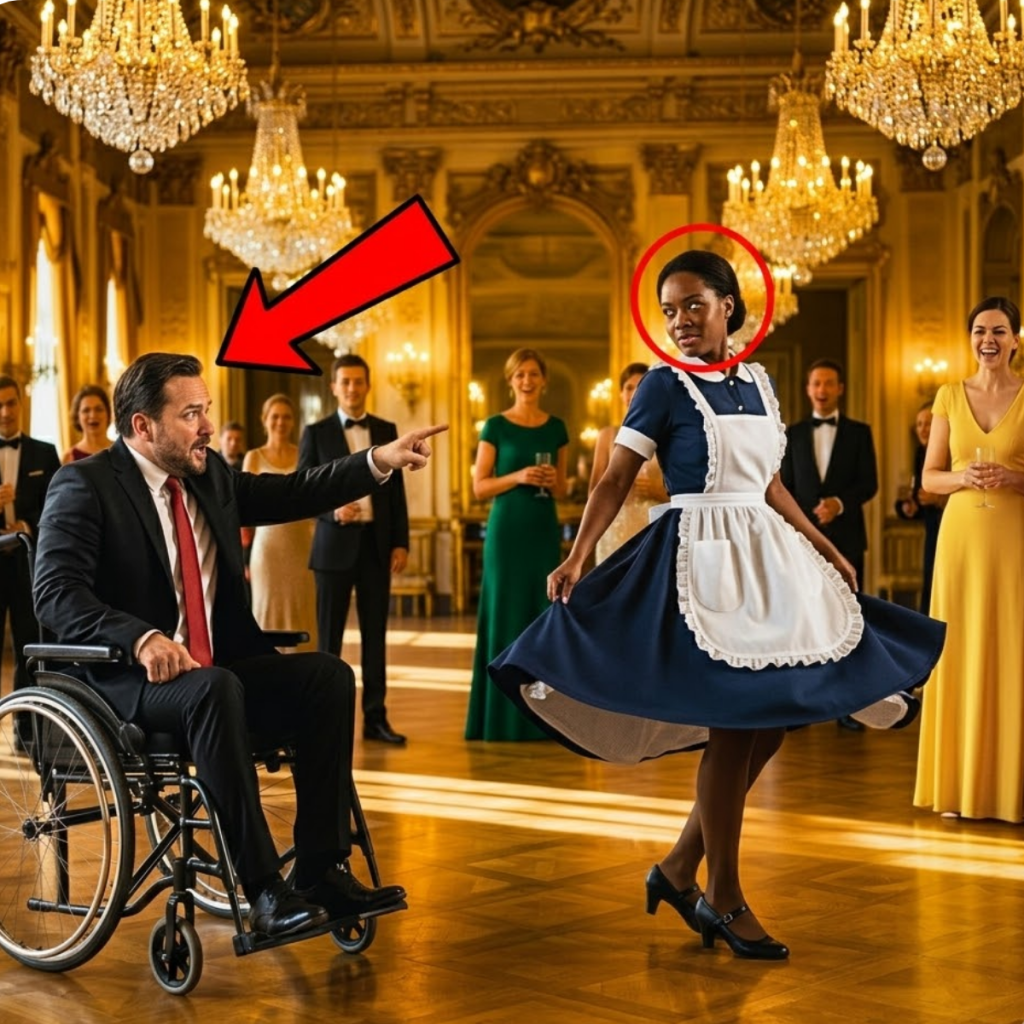
More than two hundred guests filled the mansion. Wealthy donors, politicians, old friends of the family, all sipping champagne and pretending generosity came naturally to people who had never worried about survival.
Dandara waited backstage in a red dress Helena had bought for her. It was simple, graceful, and far too beautiful for a woman who still thought of herself as temporary in every room.
Then something went wrong.
No music.
In the corner, Cristina—another employee, loyal to old bitterness and desperate to see Dandara fail—smiled to herself. She had tampered with the sound system.
The guests began murmuring.
Henrique noticed immediately. So did Dandara.
For one terrifying second, she felt the old fear return.
Then she stepped onto the stage anyway.
Barefoot.
No music.
No apology.
She raised her hands and began to clap, slow and steady.
One beat. Then another.
Some guests joined in out of confusion. Then more.
Soon the entire room was pulsing with rhythm created by human hands.
And Dandara danced.
Not polished. Not theatrical. Real.
She transformed sabotage into art. Used the sound of the people around her as music. Her body found the beat and rode it like truth. By the time the technical crew managed to restore the actual music, she was already flying.
And the room was hers.
She danced with every wound she had survived.
She danced with poverty in her spine and hope in her chest.
She danced like a woman who had never once been invited to dream safely, and therefore had learned to dream dangerously instead.
Henrique watched from the center of the room, unable to breathe around the thing rising in his chest.
She finished in silence.
And then, instead of bowing, she looked directly at him.
Really looked.
Then she stepped down from the stage, crossed the room, stopped before his wheelchair, and extended her hand.
“Dance with me,” she whispered.
His eyes widened. “I can’t.”
“You can,” she said. “In your own way.”
No one moved.
He placed his hand in hers.
Dandara began to move around him slowly, guiding his hands into the dance, letting his arms become part of the story. Not fixing him. Not pitying him. Including him.
For the first time since the accident, Henrique did not feel like the absence in the room.
He felt present.
Useful.
Seen.
Alive.
And when tears came, he let them.
He cried in front of two hundred people and did not care because grief had finally been interrupted by something stronger.
Grace.
The applause that followed shook the chandeliers.
The next morning, Henrique waited for Dandara in the kitchen.
He looked different somehow. Not healed. But open.
“I owe you an apology,” he said. “For everything.”
She said nothing.
He took an envelope from the table.
“I want to pay for your dance training. The best school in São Paulo. Full tuition, transport, everything. And I want to create a foundation for young artists who never get a chance. You’ll be the first.”
Dandara stared at him.
“Why?”
He swallowed. “Because you reminded me I still have a choice. I can stay bitter, or I can become someone better than the man pain made me.”
That was not the end of their story.
It was the beginning.
Dandara trained. Henrique returned to physical therapy. She pushed him when he wanted to quit. He funded her future when she could barely imagine one. Their friendship deepened into something strong and strange and beautiful—the kind of bond built not on fantasy, but on witnessing each other at the lowest point and refusing to walk away.
Six months later, Dandara performed her first professional solo at the Municipal Theater.
In the front row sat her mother, healthier now, tears in her eyes.
Beside her sat Helena.
And beside Helena stood Henrique—standing, trembling, leaning on two crutches, but standing.
Only forty-five seconds.
Forty-five brutal, glorious seconds.
But they were his.
When Dandara saw him from the stage, something in her chest cracked wide open.
She danced like freedom.
And when the curtain fell and the applause rose, she came down from the stage and wrapped her arms around him.
Outside the theater, a new plaque would later be mounted on a restored building funded by the Costa Foundation:
The Dandara Santos Institute for Dance and Arts
For young people with talent, courage, and nowhere else to go.
Henrique looked at that plaque one afternoon with Dandara beside him and said quietly, “I thought losing my legs meant my life had ended. But you taught me something better. Sometimes life doesn’t end. It just asks to be lived differently.”
Dandara smiled and squeezed his hand.
“And sometimes,” she said, “all it takes is someone willing to hold yours until you remember.”
In the end, that was the truth of it.
She had come to his mansion thinking she was there to clean his floors.
He had met her believing she was just another person he could break.
Instead, she gave him back the part of himself he had buried under rage.
And he gave her what the world had denied her for far too long:
A door.
She still had to walk through it on her own.
But for once, it was open.
And sometimes, that is how lives change.
Not with miracles.
Not with perfect timing.
Not even with love at first sight.
But with one wounded person reaching for another and saying:
Try again.
I’m still here.
Don’t stop now.