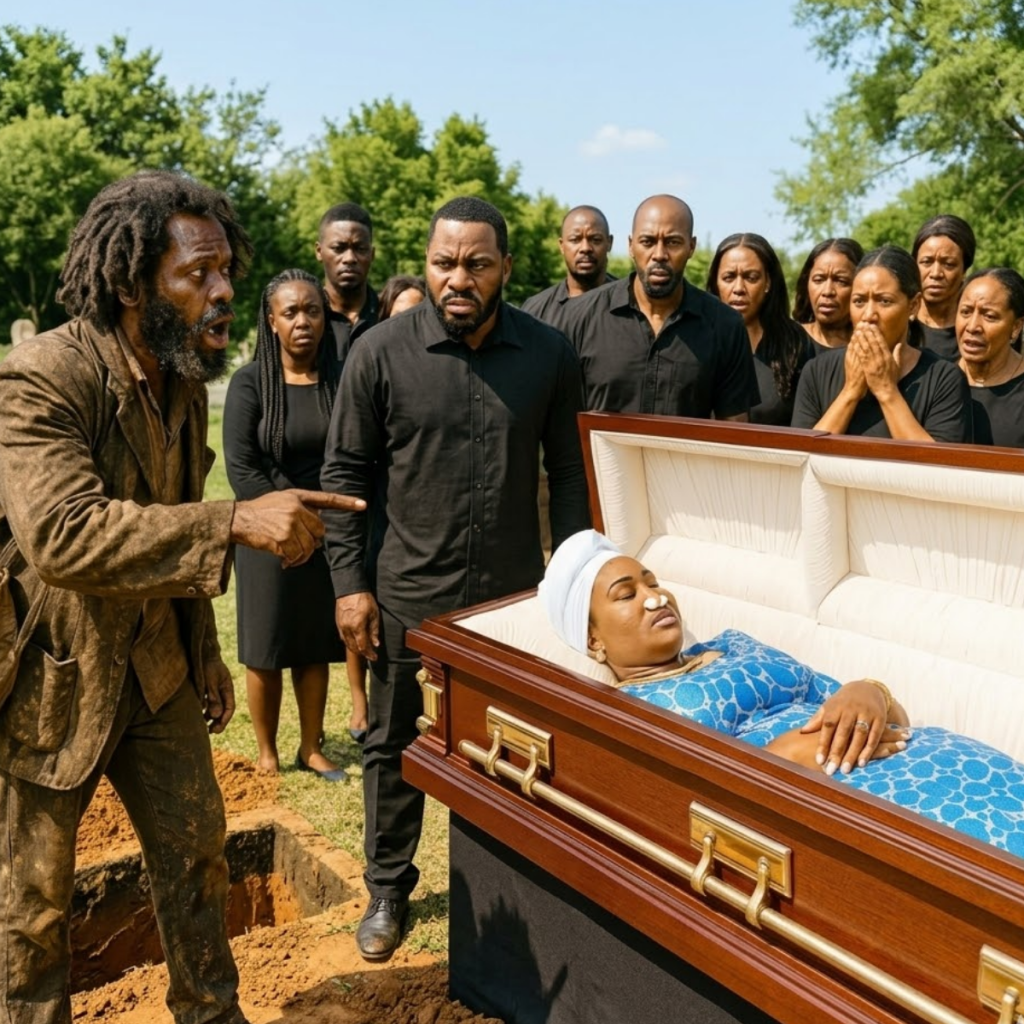
At the front row, Judith’s elderly aunt rose slowly from her seat, her eyes narrowed.
Benjamin took a breath and looked directly at the casket. His voice softened.
“Madam,” he whispered, as though speaking through the wood, “hold on.”
Then louder, to everyone: “Sit her up. Remove the cotton. Give her air. I have the neutralizer.”
That word hit the gathering like a stone thrown into still water.
Neutralizer.
Williams stepped forward, furious now. “Enough! Remove him!”
But the crowd had shifted. Fear and curiosity were wrestling in the same room, and curiosity was starting to win.
Judith’s aunt lifted a trembling hand. “If there is even a chance,” she said, “we must check.”
“That is not necessary,” Williams shot back. Sweat had begun to shine across his forehead. “The doctor confirmed. Everything was done properly.”
All eyes turned toward the family physician, Dr. David Afory, who stood stiffly at the edge of the tent, his face too blank to be innocent.
Benjamin looked straight at him.
“She gave you a hospital,” he said. “She trusted you.”
Something flickered in the doctor’s eyes.
That was the moment the room changed.
Not loudly. Not dramatically.
Just enough.
Because guilt, once seen, cannot hide well.
Benjamin knelt beside the casket and gently laid his old coat beneath Judith’s neck like a pillow.
“Please,” he said. “Help me raise her a little. Just enough.”
The aunt moved first.
Then a young man in a black suit.
Then one of the grave workers.
Then two women from the family.
Together, they lifted Judith’s upper body slightly.
The aunt removed the cotton wool from Judith’s nostrils with careful fingers.
Benjamin opened his weathered shoulder bag and pulled out a small brown vial.
Williams lunged forward.
“If you put any strange thing in her body—”
But two men from the crowd stepped between them.
“If she is dead,” one said, “then it changes nothing.”
Benjamin uncapped the vial, drew up a small amount with a glass dropper, and leaned close.
“One drop,” he whispered. “Come back, madam.”
The liquid touched Judith’s tongue.
Nothing.
The cemetery held its breath.
Benjamin counted under his breath.
One.
Two.
Three.
Four.
Five.
Still nothing.
A ripple of dread moved through the crowd. Some faces hardened again, ready to return this to tragedy instead of miracle.
Benjamin lifted the dropper for one more try.
Williams shouted, “Don’t you dare!”
Benjamin ignored him and let the second drop fall.
At first, the movement was so small it could have been imagination.
Then Judith’s throat worked.
A tiny cough escaped her lips.
The aunt screamed.
“Her hand! Her hand moved!”
Now the whole tent exploded.
People cried out.
Some began praying.
Some backed away in horror.
Some moved closer as if the dead rising had made them forget fear completely.
Benjamin leaned in again.
“She’s breathing,” he said, tears standing in his eyes. “I told you. She’s breathing.”
Judith’s chest rose faintly.
Then again.
Her eyelids fluttered.
And suddenly Williams did something that no grieving husband should ever do.
He reached into his jacket and pulled out a syringe.
The crowd gasped.
For one wild second, it looked as though he might finish what he had started.
But now people saw him clearly.
Two guards tackled him before he could get near the casket.
The syringe flew from his hand and clattered against the concrete beside the grave.
Judith’s eyes opened halfway.
Cloudy. Confused. Fighting through whatever darkness had held her.
Her lips trembled.
Then, in a voice so weak it seemed stitched together from pain, she whispered one word.
“Why?”
Her gaze landed on Williams.
The look on his face changed in an instant. Not grief. Not shock. Not relief.
Panic.
Then rage.
“She was supposed to be gone!” he shouted as the guards pinned him harder to the ground. “She was supposed to be gone!”
Every last illusion shattered.
All eyes turned toward Dr. David.
The doctor staggered backward, pale, sweating, unable to hold his posture under the weight of what everyone now knew.
Judith coughed again, stronger this time.
Benjamin steadied her with hands that were rough, careful, and shaking.
“You’re safe,” he told her softly.
She stared at him, truly seeing him for the first time. Not the torn coat. Not the beard. Not the smell of the street.
The man who had refused to let them bury her alive.
“You saved me,” she whispered.
Benjamin lowered his eyes. “I only spoke when no one else would.”
By the time the police sirens cut through the cemetery gates, the truth was already standing in plain sight.
Williams was arrested right there beside the grave he had prepared for his wife.
Dr. David was led away too, sobbing, protesting, then crumbling into confessions nobody respected anymore.
And Judith Anderson, the woman they had almost buried, sat upright on her own casket and looked at the world as if she had returned from someplace too dark to name.
The trial that followed gripped the country.
Every newspaper carried her face. Every television station replayed the footage from the cemetery. Every panel discussion asked the same question in different words: how had a man nearly buried his wife alive for money?
The courtroom overflowed each day.
Judith entered slowly, still recovering, but with her head high.
Williams no longer looked like a polished businessman. He looked hunted. Cornered. Angry at the fact that greed had failed him.
Dr. David looked worse. Shame had broken his spine long before prison ever would.
The prosecution built the case carefully.
The toxin in the syringe.
The false death certificate.
The suspicious rush to burial.
The testimony of the driver who said Judith was alive when they reached the hospital.
The toxicologist who explained how the poison slowed her body enough to imitate death.
The witness statements.
The timeline.
The conspiracy.
And then they called Benjamin.
He stood in the witness box in a clean shirt Judith’s staff had bought for him, but nothing in his face had changed. Hardship still lived there. So did dignity.
He told the court how he had been sleeping beneath a bridge near the private hospital when he overheard a conversation inside a parked car. Williams and Dr. David arguing. Williams insisting the poison had worked. Insisting the burial happen quickly. Insisting that once Judith was underground, the empire would finally belong to him.
“I heard enough to know a crime was happening,” Benjamin said. “And enough to know that if I kept quiet, a woman would be buried alive.”



The defense tried to mock him.
“A beggar hears voices under bridges,” the lawyer sneered. “Why should the court trust a homeless man?”
Benjamin straightened.
“I may be poor,” he said, his voice steady as iron, “but I do not lie. Hunger is not madness. Sleeping outside does not make a man useless. I heard what I heard. And if I had remained silent, she would be dead.”
The whole courtroom went still.
Some truths do not need decoration.
They only need courage.
Then Judith herself took the stand.
When she looked at Williams, there was no fear left in her face. Only grief sharpened by clarity.
“I loved you,” she said. “I trusted you with my life, my business, my name, my future. If you felt small beside me, you could have spoken. If you felt wounded, you could have walked away. But instead, you chose murder.”
Williams broke then.
Not into repentance.
Into resentment.
He stood, furious, voice cracking with long-festering bitterness.
“You had everything!” he shouted. “The companies, the money, the power! I was a guest in your empire. A husband in name. A shadow. I wanted what should have been mine!”
A gasp swept the room.
There it was.
Not confusion. Not accident. Not a mistake.
Greed.
Pure and ugly and stupid enough to believe it deserved a crown.
The judge’s sentence came down like stone.
Life imprisonment for Williams.
Life imprisonment for Dr. David.
No mercy.
No elegant escape.
No empire.
When the gavel fell, Judith closed her eyes and exhaled like a woman setting down a weight she had carried through death and back.
Outside the court, cameras flashed.
People called Benjamin a hero. The man who stopped a burial. The homeless stranger who saved a billionaire. Reporters fought for his words.
He hated the attention.
Not because he was humble in the performative way people admire.
But because he had spent years being invisible, and sudden visibility can feel almost violent when you are not ready for it.
That evening, Judith asked him to stay at her mansion.
He refused at first.
“I am not a man for houses like that,” he said.
Judith looked at him for a long moment and answered, “And I am not a woman who owes her life to a man and leaves him under a bridge.”
So he stayed.
In the weeks that followed, Judith learned Benjamin’s story.
He had once been a software engineer. A husband. A father. Then he lost his job. His wife disappeared with their daughter and left behind one final wound: the child he had loved was not his by blood.
It had ruined him.
Not just financially.
Spiritually.
He had walked away from life before life could keep humiliating him.
Judith listened without interrupting.
Then she said quietly, “Pain made you disappear. But it did not make you cruel. That is why you still matter.”
He looked at her as if no one had said something like that to him in years.
Maybe no one had.
At first, Benjamin helped around the estate out of gratitude. Then he began assisting Judith with company matters—organizing files, checking reports, solving technical problems before younger staff even understood what the problem was.
His mind had never left him.
It had only been buried beneath sorrow.
One afternoon, during a tense board meeting, a corrupted investor presentation threatened to derail a major negotiation. While executives panicked, Benjamin quietly stepped in, restored the file, rebuilt the system, and saved the meeting in less than ten minutes.
The room fell silent.
Judith smiled.
“Ladies and gentlemen,” she said, “this is Benjamin Okoro, my special adviser.”
That was how his second life began.
Not with pity.
With usefulness.
With respect.
With being seen.
In time, Judith and Benjamin grew close. The kind of closeness grief recognizes in another wounded person. They talked late into the evenings. About betrayal. About faith. About what it means to survive something that should have ended you.
Judith loved him, quietly, for a while.
Not because he had saved her.
Because he had remained tender after the world had done its worst to him.
But life rarely unfolds according to private wishes.
Benjamin met a woman named Juliana through Judith’s charity foundation. She was kind, thoughtful, and patient enough to love a man who still flinched inside. Benjamin came alive with her in a way Judith had hoped to inspire, but never claimed to deserve.
It hurt.
Then it healed.
Because real love does not always ask to be chosen romantically. Sometimes it simply wants the other person restored.
Judith paid for their wedding herself.
Months later, Judith found love too—not with drama, not with fireworks, but with George, a widower whose gentleness matched her strength instead of resenting it.
They married quietly.
Benjamin and Juliana sat in the front row.
And for the first time since the grave had nearly closed over her, Judith felt not merely alive, but whole.
Ten years passed.
Children were born.
Businesses grew.
Old wounds softened into scars.
Williams, in prison, wrote letter after letter asking for forgiveness. At first, Judith ignored them. Then she read one. Then another. Each one smaller than the man who had written it.
On the tenth anniversary of the day she was almost buried alive, Judith stood before a hall full of people and said something that stunned the nation.
“I forgive Williams Anderson,” she said.
Not because he deserved it.
Not because the past vanished.
Not because justice failed.
But because she refused to let hatred become the second grave he dug for her.
Later, when she sat in her garden beside Benjamin and their families while children ran through the grass and evening gathered softly around them, she lifted her glass and smiled.
“From ashes to dawn,” Benjamin said.
Judith nodded.
“Yes,” she answered. “From ashes to dawn.”
Because that was the truth of it.
A woman had nearly been buried alive by the man who wanted her fortune.
A homeless stranger had stopped death with a trembling hand and a stubborn refusal to stay silent.
And in the end, both of them rose.
Not just from danger.
From invisibility.
From grief.
From the lies people had told about what they were worth.
And maybe that is the part worth remembering most.
That sometimes the person everyone ignores is the one carrying the truth.
That sometimes the woman in the casket is not dead—only silenced.
And that greed may dig the grave, but it cannot always keep its secret once daylight arrives.