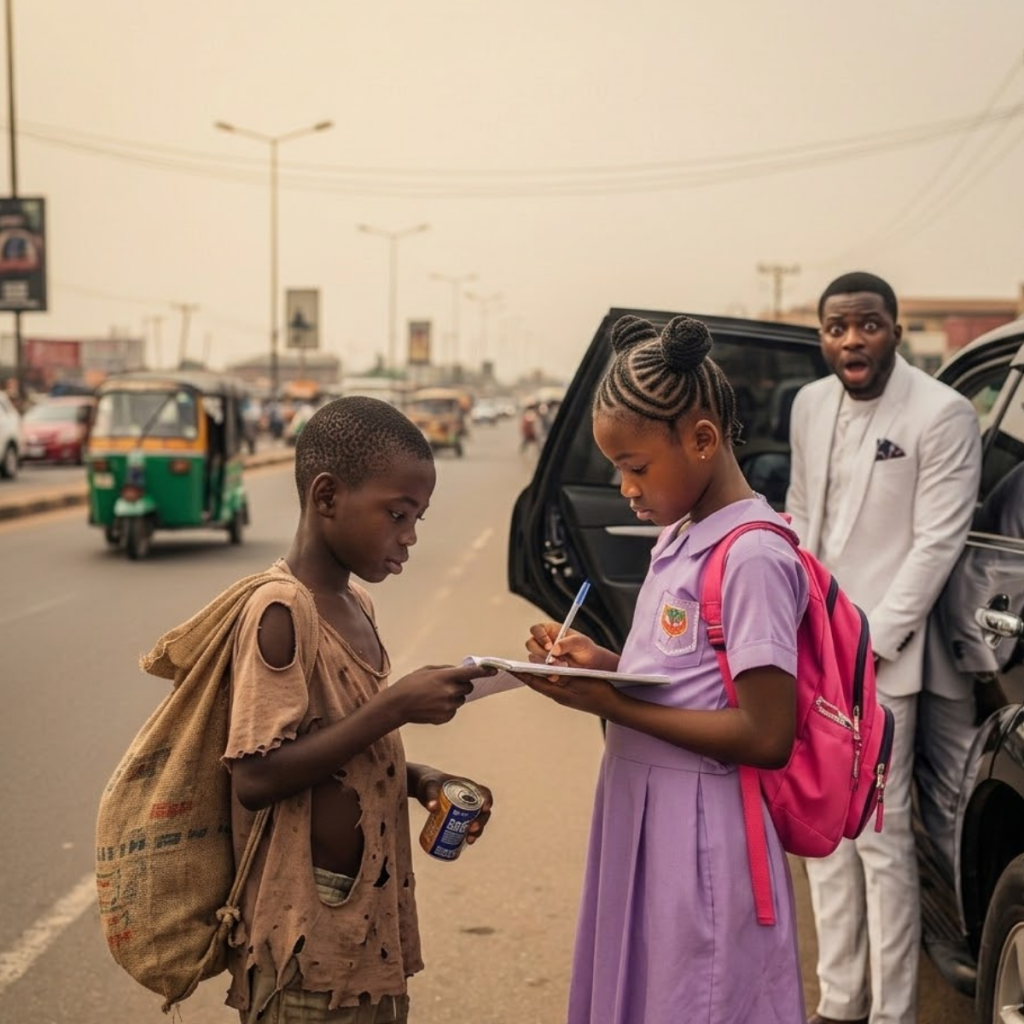
He watched schoolchildren pass in clean uniforms and imagined himself among them. He memorized words from billboards. He copied numbers in the sand with sticks. He listened to lessons floating through open windows and held onto every sentence like a starving boy clutching crumbs.
He had gone to school once. Only briefly. A kind woman named Mrs. Amanda, who sold food by the roadside, had seen something in him and paid his fees for a while. For the first time, Benjamin sat in a classroom, wore a secondhand uniform, and discovered what everyone else discovered within days:
He was exceptional.
He answered questions older children missed. He memorized poems after hearing them once. He understood numbers the way some people understood songs. Teachers stared. Classmates stopped laughing. For a few bright months, Benjamin felt like he was finally stepping into the life he had always watched from outside.
Then Mrs. Amanda left the country.
The money stopped.
And the gate closed again.
Benjamin stood outside that school for hours the day they told him not to come back. He begged to sit at the back of the class. He promised he would not make noise. The headmistress looked at him, at his worn bag and thin arms and the dust on his legs, and said words he never forgot:
“This is not charity.”
So he returned to the street.
He sold sachets of water in traffic. He dodged buses and insults. He hid his intelligence the way other boys hid coins in their socks. At night, when Sarah slept restlessly beside him, Benjamin whispered multiplication tables to the stars so he would not forget himself.
And every morning, no matter how many times adults chased him away, he found a school wall, an open window, a broken fence—some small crack through which he could still reach learning.
That was how he found Queen’s Crest International School.
Or maybe it was how the school found him.
He used to slip through a gap near the back hedge and crouch beneath a wide mango tree, close enough to hear the teachers through an open classroom window. He wrote on scraps of paper, old flyers, pieces of cardboard, anything that could hold a mark. If he got caught, he ran. If he got insulted, he returned the next day anyway.
One afternoon, while sounding out a difficult English passage to himself, he heard a voice behind him.
“You’re the boy they always chase away, right?”
Benjamin turned so fast his heart nearly stopped.
A girl stood there in a spotless school uniform, her braids neat, her shoes shining, her face curious instead of cruel. Her name tag read Lily Williams.
“I didn’t mean any harm,” Benjamin said quickly, backing away. “I was just listening.”
“Why?” she asked.
He looked at her, confused. No one had ever asked why. They only asked what he was doing there, who sent him, how dare he.
“Because I want to learn,” he said.
Lily stared at him for a moment, then sat beneath the tree and opened her textbook.
“Can you explain fractions?” she asked. “I don’t understand them at all.”
Benjamin blinked.
Within minutes, he was teaching her.
He broke the lesson down with patience no teacher had ever shown him, using examples from sliced bread, orange pieces, and bus fares. Lily listened with wide eyes. Something that had confused her for weeks suddenly made sense.
When she solved a problem correctly, Benjamin clapped without thinking.
Lily smiled in a way that looked both surprised and relieved.
“No one claps for me,” she admitted.
That afternoon changed both of them.
After that, they met under the mango tree every day during lunch.
Benjamin came barefoot, carrying scraps of paper and a blunt pencil.
Lily came with neat books, packed lunches, and the loneliness of a rich girl who had everything except someone who truly saw her.
Under that tree, their worlds disappeared.
Benjamin taught her literature, math, grammar, and confidence.
Lily gave him food, notebooks, small gifts, and friendship.
He made learning feel alive. She made him feel visible.
For the first time in his life, Benjamin was not treated like a problem to be removed. He was needed. Respected. Chosen.
For the first time in Lily’s life, someone celebrated her for trying, not for her surname, not for her grades, not for being the daughter of a powerful man. Benjamin saw her the way she had always wanted to be seen.
“You’re not dumb,” he told her once after she solved a page of problems by herself. “You just needed someone to explain it like it mattered.”
She grinned. “And you’re not cursed.”
Benjamin looked away. “You don’t know what people call me.”
Lily leaned closer and whispered, “Then let me call you something else. Magic.”
He laughed, but his eyes filled anyway.
That was the word she used for him after that.
Magic.
For weeks, their secret world held.
Then one afternoon, the black SUVs rolled into the school compound.
Teachers straightened. Security guards saluted. Even the air seemed to tighten.
Lily looked toward the convoy and felt her stomach drop.
Her father.
David Williams was one of the most powerful businessmen in Lagos, a billionaire whose name opened doors and closed arguments. He did not make surprise visits. He certainly did not come for lunch.
Benjamin had just arrived beneath the tree, breathless and smiling, when he saw Lily’s face change.
“What’s wrong?”
She whispered only two words.
“My dad.”
Benjamin turned.
The man stepping out of the SUV looked like wealth given human shape—tall, composed, sharply dressed, every movement controlled. Benjamin’s first instinct was to run.
But before he could, the voice came.
“Lily.”
Mr. Williams walked toward them, his eyes moving from his daughter to the boy beside her. He took in the torn shirt, the bare feet, the nylon bag, the biscuit in Benjamin’s hand.
“Who is this?” he asked.
Benjamin lowered his head. Lily stepped in front of him.
“This is Benjamin,” she said. “He’s my friend.”
“Your what?”
“He teaches me.”
That made her father pause.
Lily took a breath. “The reason I’m doing better in school is because of him. He explains things better than anyone. He helps me every day.”



Mr. Williams looked at Benjamin again, more carefully this time.
“Who are your parents, child?”
Benjamin’s voice came out dry. “I don’t know my father, sir. My mother is sick. She begs by the roadside near Oshodi. We don’t have a home.”
“And you are not in school?”
Benjamin shook his head. “No one to pay the fees.”
Lily reached for his hand.
Mr. Williams watched that small gesture. Something in his expression changed.
“Take me to your mother,” he said quietly.
Benjamin panicked. “Sir, please don’t punish her. She doesn’t know I come here. She’s not well. If I stop coming, I’ll stop. Just don’t hurt her.”
The billionaire’s face softened for the first time.
“I’m not here to hurt you,” he said. “I want to understand.”
Thirty minutes later, his convoy rolled into the dusty part of Lagos where Benjamin’s life had been trapped for years.
Sarah sat near the gutter, laughing at something invisible, her hair tangled, her wrapper dirty, her eyes far away.
Benjamin pointed with trembling fingers.
“That’s my mommy.”
Mr. Williams stepped out of the car and crouched beside her. Sarah looked at him and asked if he had brought back the sky she had lost. Benjamin stood there, ashamed and desperate and helpless all at once.
Then Mr. Williams turned to his assistant and gave the order that changed everything.
“Call Dr. Evans. Psychiatric unit. Full treatment. No delays.”
Benjamin stared.
The billionaire rose and faced him fully.
“And you,” he said, “from today, you are not a homeless boy.”
Benjamin could barely breathe.
“I don’t want money,” he whispered. “I just want my mother to be okay.”
Mr. Williams placed a hand on his shoulder.
“We will help her,” he said. “And you are coming with us.”
By that evening, Benjamin had taken his first proper bath in years. He wore fresh clothes. He ate at a dining table under bright lights. He slept in a bed with sheets that smelled clean. Even then, he did not believe it was real.
The next morning, Lily handed him a Queen’s Crest school uniform, neatly ironed.
“You belong here,” she said.
When Benjamin walked through the school gate that day—not hiding behind fences, but entering through the front like every other student—whispers followed him.
Wasn’t that the street boy?
Yes.
But now he came carrying a backpack, wearing polished shoes, and walking beside the founder’s daughter as her equal.
He was brilliant from the first lesson.
Teachers were stunned. Students stared. Benjamin answered question after question, not with arrogance, but with the quiet hunger of someone who had spent years learning from shadows and now stood finally in the light.
And while Benjamin’s life transformed, so did Sarah’s.
Months of treatment began restoring pieces of her mind. She did not return all at once. First came silence instead of screaming. Then proper sentences. Then recognition—not always of Benjamin, but of the world around her.
Recovery hurt in its own way. There were days Benjamin visited her and she did not know his face. Days when she smiled politely and called him “young man.” Days when he left the hospital carrying fresh heartbreak.
But he kept coming.
Because love had raised him. Love had saved him. Love had no right to become impatient now.
Years passed.
Benjamin thrived.
He won competitions. Spelling bees. Academic awards. Scholarships. The same boy who once wrote in the dirt beneath a mango tree stood on national stages spelling words adults could barely pronounce. He became a symbol, then a headline, then something deeper than both.
But none of that mattered as much as the day the court made official what his heart had known long before.
David Williams adopted him.
In a quiet courtroom, when the judge asked Benjamin whom he chose, he turned to the two men before him—one who had helped create his body and abandoned it, and one who had rescued his life and rebuilt it—and answered with a voice that shook only at the beginning.
“One man gave me life,” he said. “The other taught me how to live.”
Then he looked at Mr. Williams and said, “I choose him.”
That was the day Benjamin became Benjamin Williams in law.
But in truth, he had become his son the day a billionaire saw a barefoot boy and looked closely enough to notice his worth.
Many years later, under another mango tree, Benjamin sat in the courtyard of a foundation built for the mentally ill, the abandoned, the forgotten. Children played nearby. Nurses moved through the building with quiet purpose. Families waited with hope instead of shame.
Dr. Benjamin Williams, one of the country’s youngest neuropsychiatrists, watched the leaves shift in the breeze and smiled.
Lily, now grown and still his closest friend, sat beside him.
“Do you ever miss those days?” she asked softly.
Benjamin looked up into the branches.
“No,” he said. “I carry them.”
He thought of the broken kiosk. The gutter. The hunger. The school fence. The first lunch under the tree. The hand that reached for him without disgust. The father who chose him. The mother who healed enough to sing again, even if memory returned only in fragments.
And he thought of what one act of compassion had done.
Not charity.
Compassion.
The kind that sees potential where everyone else sees waste.
The kind that gives opportunity instead of pity.
The kind that changes not just a life, but the lives that life will later touch.
Benjamin looked toward the center’s entrance, where frightened families were arriving with loved ones society had given up on.
“No child is born worthless,” he said quietly. “And no one is too broken to be loved.”
That was the truth he had lived.
Once, he was a barefoot boy peeking through classroom windows, praying someone would notice him.
Now, he built doors and held them open for others.
And every time someone asked where it all began, Benjamin smiled and answered the same way:
“Under a mango tree. With a pencil, a friend, and a chance.”