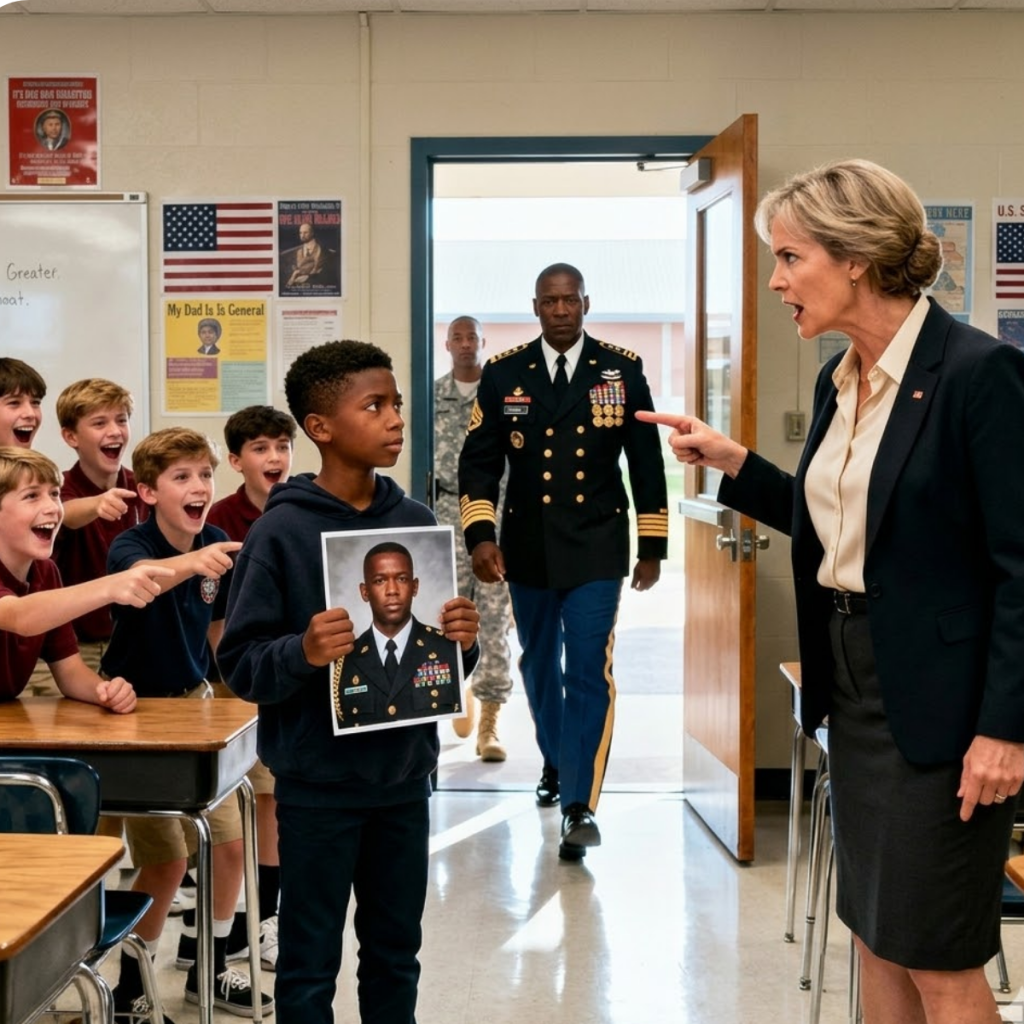
Mrs. Henderson’s face changed the second she saw the photo.
Not confusion.
Not surprise.
Disbelief.
The kind that comes from prejudice dressed up as common sense.
“A four-star general?” she repeated sharply.
James nodded. “Yes, ma’am.”
She stood up from her chair.
The room went quiet.
James felt that familiar tightness in his chest, the one that comes when you know an adult is about to decide your truth is inconvenient.
Mrs. Henderson stepped closer and took the board from his hands.
“Class,” she said, lifting the poster high, “this is what we call pathological lying.”
A few students laughed nervously.
James blinked. “I’m not lying.”
Mrs. Henderson ignored him.
“Do you think I’m stupid, James?” she asked. “Do you think I don’t know there are only a handful of four-star generals in the entire United States?”
“My dad is one of them,” James said quietly. “I can call him right now. He’s at the Pentagon this week. I can prove it.”
But she was no longer interested in proof.
That would have required curiosity.
What she had was certainty.
And certainty is often the ugliest cousin of bias.
Mrs. Henderson stared at the photo again, then at James, then back at the class.
“This is stolen valor,” she announced. “A federal crime.”
Then, before anyone could move, she ripped the poster in half.
The sound was sharp and final.
The room gasped.
James stared at her, frozen.
She tore it again.
And again.
The pieces of his father’s face, the timeline, the stars, the words he had worked so carefully to arrange—all of it fell to the floor around his shoes.
“People from neighborhoods like yours,” she said coldly, “do not just grow up with fathers who are four-star generals.”
No one spoke.
Twenty-eight students watched.
Some looked down.
Some whispered.
A couple smirked because they did not know what else to do with the discomfort.
James bent slowly and picked up one torn piece at a time.
His fingers shook, but his voice stayed steady.
“You didn’t ask anyone else for proof.”
Mrs. Henderson crossed her arms. “Because the other students weren’t making outrageous claims.”
He looked up at her, hurt finally giving way to something harder.
“How is it outrageous if it’s true?”
But she had already decided.
She wrote him up for academic dishonesty, accused him of “behavioral issues,” and sent him to the principal’s office with a pink referral slip crumpled in his fist.
As he walked down the hallway, his phone buzzed.
It was his mother.
How did it go, baby?
James stared at the screen for a second before typing back.
She called me a liar. She tore it up.
Three dots appeared instantly.
Then:
I’m on my way. Hold on.
Another message arrived a few seconds later from a number he barely recognized.
This is Colonel Morrison, your father’s aide. Your mother called. Stay strong. Help is coming.
James didn’t understand what that meant.
Not yet.
Principal Donald Graves sat behind his desk with the heavy sigh of a man who had practiced looking burdened by other people’s pain without ever actually carrying any of it.
He read the referral slip, leaned back, and looked at James the way adults sometimes do when they have already chosen the easier story.
“Mrs. Henderson has fifteen years of experience,” he said. “She knows when students are exaggerating.”
James swallowed hard. “I’m not exaggerating.”
Graves tapped his desk. “James, let’s be realistic.”
That phrase made something inside James go cold.
Let’s be realistic.
It sounded so reasonable.
It always does when people are about to explain why your life does not fit the version of the world they are comfortable with.
Then Graves said it plainly, though not in so many words.
Your mother works as a nurse. You live in subsidized housing. You qualify for free lunch.
Families like yours do not line up with fathers like that.
James felt the humiliation all over again.
Not because he was ashamed of his mother.
Never that.
Sarah Washington worked double shifts because she loved her job, because she believed in service, because she refused to let anyone define her by her husband’s rank or by the size of their apartment.
But hearing the principal use those facts as evidence against his truth made James understand something important and painful.
This had never been about the project.
It was about what people like Mrs. Henderson and Principal Graves thought a family like his was allowed to look like.
Then the office door opened.
His mother walked in first, still wearing her scrubs, her hospital ID clipped to her pocket.
Behind her stood an older woman in a sharp suit carrying a leather folder.
“My attorney,” Sarah said calmly when Graves stood up in confusion.
The room changed immediately.
The school secretary stopped typing.
Graves lost some of his easy confidence.
Sarah did not raise her voice. She did not need to.
She simply laid out the truth.
She had filed complaints before.
Several of them.
About Mrs. Henderson’s treatment of James and other students of color.
Every one of them had been ignored.
Then the attorney, Margaret Carter, opened her folder and revealed something worse.
James was not the first.
There had been other families. Other complaints. Other children from military households—especially Black and Latino students—who had been doubted, belittled, and treated unfairly by the same teacher.
Still, no one had acted.
Graves went pale.
Then Sarah’s phone rang.
She answered, listened, and when she hung up, her face was calm in a way that made the room even more tense.
“Principal Graves,” she said, “I suggest you look up who currently serves as Deputy Chief of Staff for Strategic Plans and Policy at the Pentagon.”
He frowned, confused, then sat at his computer and typed.
A few seconds later, all the color drained from his face.
Before he could say a word, the office door opened again.
Two Army officers walked in.



One was Lieutenant Colonel Morrison.
The other was Major General Patricia Hughes.
Two silver stars gleamed on her shoulders, and her presence filled the room before she even spoke.
She did not sit.
She did not smile.
“I’m here,” she said, “because a teacher at this school publicly accused the son of one of my officers of fraud, humiliated him in front of his peers, and destroyed his property based on nothing more than her own assumptions.”
Then Mrs. Henderson was called down to the office.
She arrived expecting another ordinary meeting.
But the moment she saw the uniforms, her face changed.
When Major General Hughes introduced General Robert Washington by title and record—Bronze Star, Purple Heart, twenty-eight years of service, Pentagon command—Mrs. Henderson looked as though the floor had disappeared beneath her.
“I didn’t know,” she whispered.
And that was the worst thing she could have said.
“You didn’t check,” Hughes answered. “That is the problem.”
Then the door opened one last time.
This time, the room did not merely go quiet.
It shifted.
Because General Robert Washington walked in wearing full dress uniform, four silver stars on each shoulder, ribbons across his chest, the full weight of a career built through service, sacrifice, and leadership.
But when he saw James sitting there with red eyes and his shoulders curled inward, he was not first a general.
He was a father.
He crossed the room in three steps.
“Hey, buddy,” he said softly.
That was all it took.
James broke.
He stood up, ran to him, and buried his face in his father’s uniform.
“She tore it up,” he whispered. “She said I was lying.”
His father held him close.
“I know, son. I know.”
Then General Washington turned.
And the father gave way to the commander.
He faced Mrs. Henderson with a steadiness more frightening than shouting.
“My son worships me,” he said. “Do you understand what that means? He was proud of me. Proud enough to bring my story into this classroom. Proud enough to stand in front of his peers and tell the truth. And you took that pride and shredded it because it didn’t fit your imagination.”
Mrs. Henderson began to cry.
Again, she said, “I didn’t know.”
General Washington’s voice sharpened.
“You didn’t know because you didn’t care to know. You looked at his skin, his address, his mother’s profession, and decided his truth was impossible. That is not a mistake. That is bias.”
The word hung in the room.
No one challenged it.
Because everyone knew it was true.
The next morning, Jefferson Middle School felt different.
Mrs. Henderson was gone.
Principal Graves was on leave.
An interim principal, Dr. Patricia Foster, had been assigned by the district before first period.
And at ten o’clock, James walked back into Room 204—this time with his mother and father beside him.
Ms. Rodriguez, who had quietly tried to intervene the day before, now stood at the front of the room.
General Washington addressed the class not with anger, but with truth.
He asked who had believed James was lying.
Slowly, several hands rose.
Then he asked why.
And the students, to their credit, answered honestly.
Because generals seemed too important.
Because James seemed too normal.
Because they had never seen someone like him connected to someone like that.
General Washington nodded once.
“Then let me teach you something,” he said. “Important people come from everywhere. Heroes come from every neighborhood. And if you laugh when someone’s truth is being torn apart, you become part of the damage.”
He told them about his own childhood.
A small apartment in Detroit.
A mother who cleaned houses.
Free lunch.
A teacher once telling him that boys like him did not become officers.
Then he looked at James.
“And now my son heard the same kind of lie.”
The room was silent.
Not the silence of fear this time.
The silence of learning.
Then General Washington handed James a new poster.
Laminated. Beautiful. Official. Better than the one that had been destroyed.
“For your project,” he said quietly. “And I expect an A.”
James smiled for the first time since the day before.
Then he stood in front of the class and gave his presentation.
This time nobody interrupted.
When he finished, one student started clapping.
Then another.
Then the whole room stood.
Six months later, the school hall outside Room 204 was lined with student posters honoring family members who served as soldiers, nurses, teachers, firefighters, and public servants.
At the center hung James’s poster of his father.
Not because his father was a four-star general.
But because his truth had nearly been crushed—and survived anyway.
Mrs. Henderson lost her job.
Her teaching license was revoked.
Principal Graves never returned.
The district reopened complaints, changed policies, brought in oversight, and finally began listening to the students it had failed.
And James?
James walked taller.
Not because his father arrived with stars on his shoulders.
But because he learned something even more important.
Your truth does not become a lie just because someone powerful refuses to believe it.
That is the part that stays with you.
Yes, James got justice.
Yes, his father had the rank to force the system to look.
But what about the children whose fathers are not generals?
What about the kids whose mothers cannot afford lawyers, whose truth is all they have, and whose stories get dismissed because no one important walks through the office door behind them?
Their dignity matters too.
Their truth matters just as much.
That is why this story is bigger than one classroom.
Because somewhere, right now, another child is standing at the front of a room telling the truth while an adult decides it sounds impossible.
And what happens next may depend on who is willing to see, to speak, and to stand.
Sometimes heroes wear four stars.
And sometimes they are the students who record, the classmates who testify, the teachers who refuse to stay quiet, and the children who keep telling the truth even after someone tries to tear it in half.