Still, he told himself this was a professional bank in the financial district. Bright marble floors, glass walls, corporate smiles. The kind of place that advertised trust.
By 12:13 p.m., the lobby was full with the lunch crowd.
Twelve customers waited in line. Tellers moved quickly. Fluorescent lights hummed overhead. At counter three sat Sarah Winters, branch manager, mid-forties, polished hair, perfect posture, the practiced expression of a woman who had spent years believing she could size up a person in three seconds and never be wrong.
Brandon stepped forward, set down his briefcase, and placed the check on the counter.
“Good afternoon,” he said. “I’d like to deposit this.”
Sarah glanced at the check.
Then at Brandon.
And something in her face changed.
It was subtle—small enough that a person who had never experienced it might have missed it. But Brandon saw it instantly, because he had seen it his whole life.
That look.
The look that says this doesn’t belong to you.
The look that says people like you don’t walk in here carrying numbers like that.
The look that says I have already decided who you are.
Her smile stayed in place, but only on her mouth.
“Can I see some identification?”
Brandon handed over his driver’s license.
She studied it too long.
Then asked for a second ID.
He handed her his passport.
She held the photo up beside his face in full view of the people behind him, not just verifying him, but displaying her doubt. Publicly.
Then came the next question.
“Do you have business documentation?”
For a moment, Brandon just looked at her.
There it was. The beginning.
He opened his briefcase and handed over incorporation papers, an acquisition announcement, tax records, bank statements, more than any customer should have had to present for a legal deposit.
Sarah barely glanced at them.
“Do you have more proof of the source of funds?”
He felt something tighten in his chest.
“Is there a problem?” he asked quietly.
“We’re just being careful,” she said. “Fraud is common with checks this size.”
Behind him, twelve people were now openly watching.
Brandon had spent his life learning how to stay calm in rooms where calm was the only thing standing between dignity and disaster.
So he kept his voice level.
“The check is from Premier Logistics. You can verify it with them directly. Their CFO’s contact is on the acquisition documents.”
Sarah did not pick up the phone.
Instead, she picked up hers.
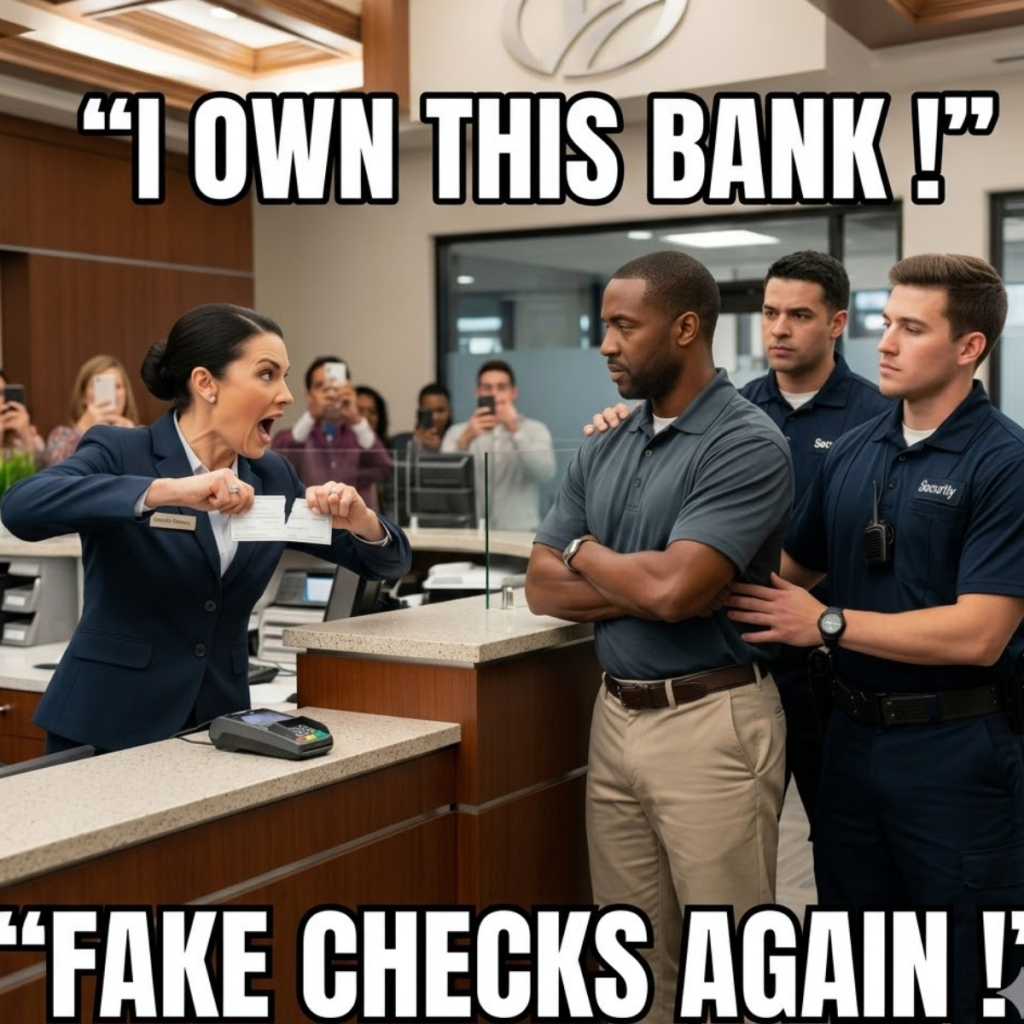
“Security to counter three, please.”
The words landed like a slap.
For one second, the entire lobby went still.
Security.
For a deposit.
For a Black man standing quietly with a briefcase and paperwork.
Officer Thomas Mitchell approached without aggression, but his presence was enough. Sarah did not need handcuffs. She only needed the suggestion that Brandon might belong in them.
“This gentleman has presented a suspicious check,” she said. “Please remain nearby.”
Brandon slowly pulled out his phone and set it on the counter.
Sarah’s eyes narrowed. “Sir, you can’t record in here without permission.”
“Pennsylvania is a one-party consent state,” Brandon replied. “And I’m not leaving until you process this deposit or give me a written reason why you won’t.”
A flicker of anger crossed her face.
She was not used to being challenged. Not by a man she had already placed beneath her.
“Sir, I need you to step aside so I can help other customers.”
“No.”
The word was calm, but it changed the air in the room.
“Excuse me?”
“I said no. I’m not stepping aside. Either process the check or explain, clearly, why you’re refusing.”
Sarah stood up.
Now her voice rose so the whole lobby could hear.
“This check appears fraudulent.”
Brandon slid a business card toward her. “Then call Premier Logistics.”
She ignored it.
Instead, she picked up the check between two fingers as if it were contaminated.
“Where did you get this?”
Not earn.
Not receive.
Get.
Brandon stared at her.
“I sold my company.”
“What company?”
He explained. Coleman Software. Logistics AI. Twenty-three employees. Multi-state contracts. Five years of growth. Acquisition closed three days earlier.
She listened with the bored suspicion of a person who had already decided the truth was less powerful than her prejudice.
Then, in front of twelve silent witnesses, she made the choice that would end everything.
She looked him in the eye.
And tore the check in half.
The sound was sharp, violent, unnatural in a quiet bank lobby.
Before Brandon could even react, she tore it again.
Four pieces.
A woman somewhere behind him gasped.
No one moved.
No one stopped her.
Sarah stepped around the counter and threw the torn pieces at Brandon’s chest.
“This check is fraudulent,” she said loudly. “And you are attempting to commit fraud. Security, escort this man out of my bank before I call the police.”
The pieces slid down his shirt, fell onto his shoes, scattered near his father’s briefcase.
For a moment, Brandon could not hear anything except the pounding of his own blood.
Five years.
Five years of sacrifice, skill, sleeplessness, rejection, persistence.
Reduced to paper falling at his feet because a woman looked at his skin before she looked at the facts.
He could have shouted.
Could have cursed.
Could have given her exactly what she expected.
Instead, he bent down, picked up the four pieces carefully, placed them in an envelope from his briefcase, and straightened.
Then he asked one question.
“What is your full name?”
Sarah lifted her chin. “Sarah Winters. Branch manager. And you need to leave.”
He took a photo of her name tag. Then the torn check. Then the security camera timestamp above the lobby.
“Thank you,” he said.
And that was when the door opened.
James Anderson, regional vice president, walked in from a lunch meeting nearby.
He stepped into the tension immediately. Saw Sarah flushed and angry. Saw security standing by counter three. Saw paper on the floor. Saw Brandon.



And then recognized him.
His face drained of color so fast it was almost frightening.
“Mr. Coleman,” he said.
Then, after a beat that made everything worse:
“Sir.”
The word froze the room.
Twelve customers. One security guard. One branch manager who had just destroyed a ten-million-dollar check and called the customer a fraud.
Sarah turned toward Anderson slowly, confusion giving way to fear.
Why was her boss calling this man sir with real respect?
Why did he sound nervous?
Anderson bent down, picked up one torn piece, and read enough to understand exactly what had happened.
“What happened here?” he asked, though the answer was already in his face.
Sarah rushed to explain. “He brought in a suspicious ten-million-dollar check. I followed protocol. He became confrontational—”
“Stop,” Anderson said.
One word.
Cold. Sharp. Final.
He turned back to Brandon, voice lowered now, careful and strained. “Mr. Coleman, sir, could we please speak privately?”
Brandon looked at him for a long moment.
“Your branch manager just destroyed my property, accused me of fraud, called security on me, and threatened to have me arrested. And now you want privacy?”
“Please,” Anderson said. “Let me make this right.”
Brandon’s laugh was small and humorless.
“Make it right?”
He looked around the lobby.
At the witnesses.
At the elderly white woman still standing in line, horrified.
At Sarah, whose confidence was finally beginning to crack.
“You can’t make this right,” Brandon said. “You can only decide what kind of truth you tell after it.”
Then he added, louder, for everyone to hear:
“She didn’t call me sir until she thought she had to. You didn’t call me sir until you recognized me. That’s the problem.”
The elderly woman behind him took a step forward.
“He’s right,” she said quietly. “I watched the whole thing. She treated him differently from the start.”
Brandon nodded to her, then turned back to Anderson.
“I’m leaving. I’ll get the check reissued elsewhere. And after that, I’ll decide what happens next.”
Anderson looked like a man trying to hold water in his hands.
“Mr. Coleman—”
But Brandon had already picked up his briefcase.
He walked out with the envelope in one hand and his dignity in the other.
In the parking lot, he sat in his car with both hands gripping the steering wheel.
Not shaking from fear.
From rage.
The recording on his phone had captured fifty-two minutes.
Every question.
Every assumption.
Every public humiliation.
He stared at his reflection in the rearview mirror and thought about his daughter. About what silence teaches children. About what noise costs adults.
Then he called an attorney.
Jordan Hayes listened without interrupting.
When Brandon finished, Jordan said, “Do you have the recording?”
“Yes.”
“Witnesses?”
“At least one. Probably more.”
“Then we don’t keep this quiet.”
That same night Brandon wrote a LinkedIn post. Simple. Precise. No theatrics.
Today I walked into a bank with a $10 million check from the sale of my company. I walked out with torn paper and a reminder that success does not erase assumptions. I’m sharing this because silence protects systems that do not protect us.
He did not name the bank.
He didn’t have to.
By morning, the post had spread further than he expected. Hundreds of comments became thousands. Messages began arriving from strangers, then from professionals, then from other Black customers who had stories of their own.
A reporter called.
Then another.
Then came the first witness statement.
Then the second.
Then a thread online from years earlier: similar treatment, same bank, different branch.
Then more.
By the end of the week, Brandon’s private humiliation had become public evidence.
A pattern emerged.
Customers of color asked for more documents, more proof, more patience. White customers waved through. Complaints buried. Settlements hidden. Employees trained with coded language like unlikely customer profile and high-risk presentation.
Brandon’s case had not exposed one cruel woman on a bad day.
It had cracked open a system.
At the state banking commission hearing, Sarah Winters testified under oath that she had been “following protocol.” James Anderson admitted he only realized the magnitude of the situation when he recognized Brandon by name. The bank’s executives blamed training errors, then former management, then misunderstanding.
But the most powerful moment came when Brandon finally took the stand.
The room was silent. Cameras live. Thousands watching.
A commissioner asked him, “When Mr. Anderson called you ‘sir,’ what did you feel?”
Brandon folded his hands and answered with the calm that had carried him through the worst moments of his life.
“I felt like respect was being given to the version of me he recognized,” he said. “The entrepreneur. The successful man. The man whose name meant something to him. But the Black man who walked in fifty-two minutes earlier with a briefcase and a check? That version of me didn’t deserve respect until he was recognized. And that’s the problem.”
The room stayed still.
“Dignity shouldn’t require credentials,” Brandon continued. “Respect shouldn’t require recognition. The word sir should come at minute one, not minute fifty-two.”
That phrase traveled farther than anything else.
Respect shouldn’t require recognition.
By the time the final ruling came down, the bank had been fined millions. Sarah Winters was terminated and barred from working in banking. Mandatory oversight was imposed. Past complaints had to be reopened. Victims were compensated. Training materials were destroyed. Public reporting requirements were put in place.
Brandon received a settlement, yes.
But he donated a large portion of it to a civil rights legal fund and created a scholarship in his father’s name for students who refused to be made small.
Months later, he walked into a different bank to deposit another large check from a new contract.
The teller smiled and said, “Good morning, sir. How can I help you?”
Just like that.
No suspicion.
No performance.
No humiliation.
Just the ordinary respect that should never have been extraordinary.
That evening, Maya asked him from the back seat, “Daddy, was it worth it? The fight?”
Brandon thought about the courtroom, the witnesses, the messages from strangers, the people who had finally found the courage to speak because he had spoken first.
He thought about his father’s briefcase. About torn paper. About the word sir arriving far too late to save anyone in that lobby, but maybe early enough to change what came next.
He looked at his daughter in the mirror and smiled.
“Yes, baby,” he said. “It was worth it.”
Because money can prove success.
But dignity proves something deeper.
And no one—no matter their title, their clothes, or the color of their skin—should ever have to earn the right to be treated like a human being the moment they walk through the door.