The morning everything started had looked harmless enough.
The sunlight in Guadalajara came in soft through the kitchen window, touching the old tile floor Ernesto had installed with his own hands thirty years earlier. Clara was arranging warm tortillas in an embroidered cloth basket she had inherited from her mother. Coffee filled the room with the kind of smell that only exists in homes built by routine, sacrifice, and tenderness repeated over decades.
Ernesto sat at the wooden table he had made when Mauricio was ten years old. He ran his hand across the polished surface without thinking, the way people touch objects that have outlived arguments, birthdays, storms, and fear.
That house was never just property.
It was overtime under the sun.
It was furniture sold to make tuition payments.
It was Clara mending the same curtains twice instead of buying new ones.
It was Ernesto walking home with blistered feet so Mauricio could have better shoes.
It was a life built slowly enough to be solid.
Then Mauricio entered the kitchen in an expensive suit, glancing at his watch before he looked at either of his parents.
“Mom, Dad, we need to talk about something important.”
Clara smiled, still hopeful the way mothers often are long after hope has been earned.
“Sit down, mijo. I just made coffee.”
“I don’t have time.”
That was the first cut.
Then came the second.
“I’ve been reviewing some plans,” he said. “This house could be used better.”
Ernesto lifted his eyes slowly. “Used better?”
“Yes. Renovated, modernized, maybe sold. This area has gone up in value. We’re wasting potential.”
Clara’s smile faded, though she tried to keep her voice gentle.
“But this is our home, Mauricio. You grew up here.”
He sighed, impatient already.
“Exactly. And now it’s time to think bigger. We can’t stay tied to the past forever.”
Ernesto took his cup in both hands.
“The house is still in my name,” he said calmly.
For the first time that morning, Mauricio really looked at him.
“That’s just an administrative detail, Dad.”
An administrative detail.
The phrase hung in the room like a bad smell.
Clara felt it immediately, even if she couldn’t yet explain why. Ernesto felt it too. That was the moment he understood his son was not sharing an idea. He was advancing a plan.
That night at dinner, the truth arrived dressed more politely but with sharper edges.
Mauricio came back with Andrea, his wife, who wore expensive perfume and the kind of controlled expression people use when they want something to sound reasonable before it becomes ruthless.
Clara had prepared mole, Mauricio’s favorite since childhood. She lit small candles to make the evening feel warm, as if love could soften what she already sensed coming.
It did not.
Andrea spoke first.
“We wanted to discuss an opportunity,” she said, placing her fork down carefully. “This property is underused. It could be sold at an excellent price and converted into something much more valuable.”
Ernesto didn’t interrupt. He simply waited.
Mauricio leaned forward.
“You two don’t need this much space anymore. We could move you into a smaller apartment. More practical. Easier to maintain.”
Clara stared at him. “You mean sell our house?”
Mauricio exhaled like the conversation itself was slowing him down.
“Mom, this isn’t emotional. It’s strategic.”
That was when Ernesto understood something important.
His son had not come to ask permission.
He had come expecting compliance.
“And have you already promised this house to someone else?” Ernesto asked quietly.
Mauricio hesitated.
That hesitation said everything.
By the next afternoon, he returned with a black portfolio full of documents and the hard confidence of a man who thought signatures were only a matter of pressure.
Ernesto sat in the living room waiting for him.
No coffee this time.
No softness.
Just silence.
“These are the papers,” Mauricio said, laying them on the coffee table. “It’s simple.”
Ernesto opened the folder slowly, reading every page with the patience of a man who understood that speed benefits only the person hiding something.
“Are you really going to read all of it?” Mauricio asked.
“I always read what I sign.”
Andrea stepped in smoothly. “It’s only authorization to streamline the process.”
Ernesto closed the folder.
“I won’t sign today.”
Mauricio’s jaw tightened.
“Dad, this isn’t a game.”
“No,” Ernesto said. “It’s my house.”
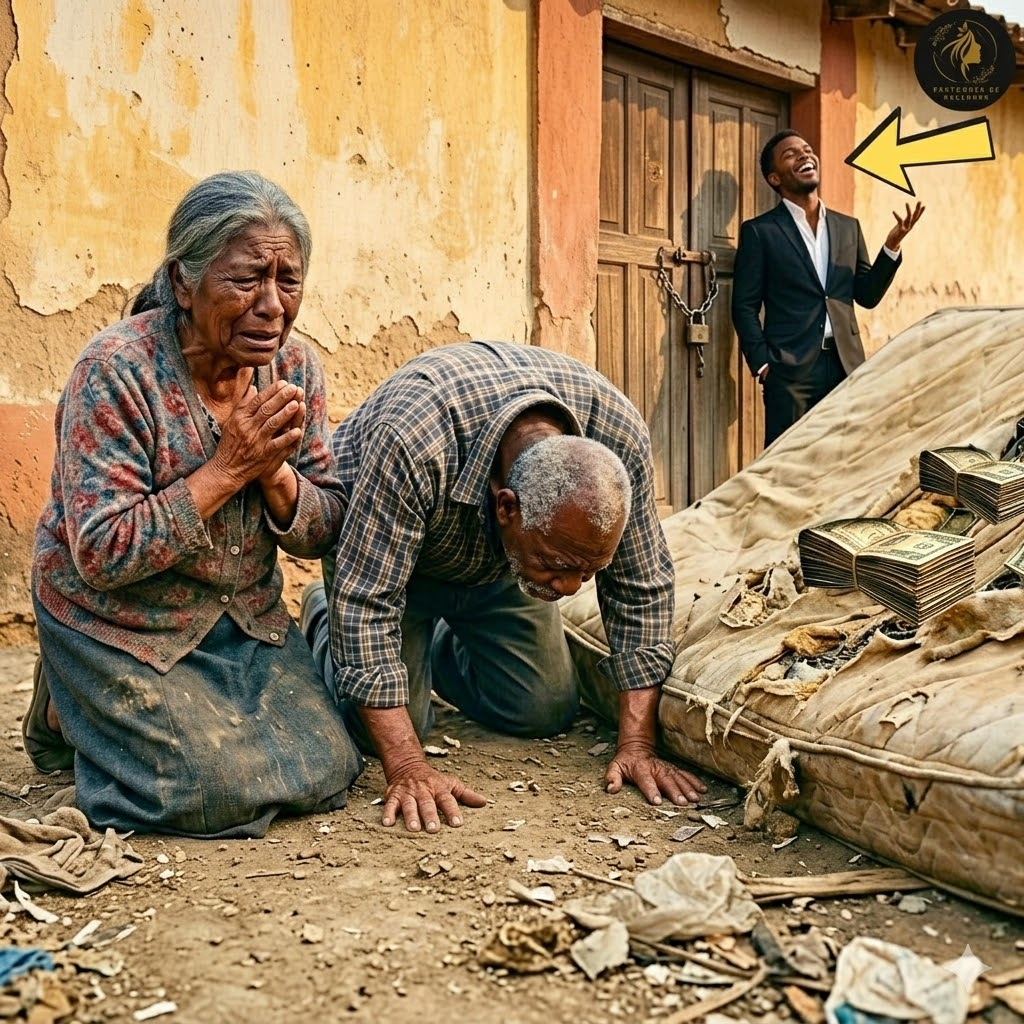
And then, because arrogance loves performance, Mauricio called two workers from the truck outside and ordered them to bring in a filthy, worn-out mattress wrapped in cloudy plastic.
Clara looked at it in disbelief.
“What is that?”
“A mattress we don’t use anymore,” Mauricio said with a shrug. “I figured you might need it. If you’re going to stay here like this.”
The insult was deliberate.
He wanted them to feel small.
Displaced.
Old.
Temporary in the very place where they had built everything.
Ernesto said nothing. That unsettled Mauricio more than anger would have.
Then came the final move.
That evening, the sound of drilling shattered the front porch silence. Clara looked through the window and saw a locksmith replacing the locks.
Ernesto stepped outside.
“What are you doing?” he asked the man.
Before the locksmith could answer, Mauricio climbed out of a black truck and crossed his arms.
“I hired him.”
Clara’s voice cracked. “What does this mean?”
“It means we need order,” Mauricio said. “If you’re not going to cooperate, I have to protect my investment.”
Investment.
Again.
Always the same word when people want to turn love into leverage.
“This is our home,” Clara whispered.
Mauricio shook his head. “Legally, it’s only a matter of time.”
Neighbors had started watching by then, pretending not to stare while staring completely. Ernesto saw them all. People he had helped with broken pipes, borrowed tools, funeral chairs, school rides, and unpaid favors that never made it into anyone’s account books.
Mauricio held out the new key as if granting mercy.
“You can stay tonight. Tomorrow I need the house cleared.”
Clara physically recoiled.
The cruelty in that word—cleared—cut deeper than any shouting would have.
But Ernesto only took the key and looked at his son with a calm so deep it almost felt frightening.
“Have you already signed something based on this house?” he asked.
“That’s none of your concern.”
That was answer enough.
Ernesto nodded once. “I understand.”
Mauricio mistook that calm for surrender.
He left believing he had won.
Inside, the mattress stood against the wall like an accusation.
When Ernesto and Clara tried to move it later that night, both stopped at the same moment.
“It’s too heavy,” Clara said.
Then the sound came—a dull, unnatural thud from inside.
Not springs.
Not normal stuffing.
Ernesto went out to the workshop and returned with an old box cutter.
“What are you doing?” Clara asked.
“Finding out what they really left us.”
He cut along the seam carefully.
At first, only foam appeared.
Then cloth.
Then a rectangular bundle wrapped in plastic.
Ernesto pulled it free and stared.
Money.
He cut again.
And again.
More bundles. Stack after stack. Fists of bills compressed tightly into packets, hidden inside the empty body of the mattress.
Within minutes, the floor was covered.
Clara fell to her knees, tears rushing into her eyes.
“Ernesto… is this Mauricio’s?”
He picked up one bundle, examined the bills, then continued cutting until he found something else buried deep inside.
A sealed manila envelope.
He opened it.
Inside were old copies of property documents, deeds, signatures, annotations, dated decades earlier.
Clara watched his expression change—not into surprise, but recognition.
Then understanding.
The house had never left his name.
Not legally. Not even close.
Years earlier, when Mauricio had first asked for support in expanding his business, Ernesto had agreed to sign only a limited guarantee document. It allowed his son to mention the house as symbolic family backing, not as a transferable asset, not as saleable collateral, not as a mortgageable property. And on top of that, Ernesto had quietly filed a notarized declaration five years earlier stating the property could not be used in any formal financial structure without his direct, notarized authorization.
Mauricio had either never read what he signed or assumed he could force the final step later.
He had built an entire financial tower on assumption.
And the old mattress?
That had once been Ernesto’s hidden emergency fund, built slowly over decades from cash saved outside the banking system because he had grown up learning that stability is not something you trust blindly to institutions. At some point, someone had searched his workshop, found the mattress, and moved it without knowing what it contained.
Mauricio, in trying to humiliate his parents, had unknowingly returned the very safety net he thought they no longer deserved.
Clara sat staring at the money.
“He brought back our emergency fund.”
“Without knowing it,” Ernesto said.
At dawn, they went to see Licenciado Rafael Ortega, an old notary who had handled the original property papers.
His office smelled like polished wood and old paper, the kind of place where truth still sat in folders instead of cloud servers.
He reviewed every page carefully and then looked up.
“The title remains entirely in your name, Don Ernesto. The house was never transferred.”
“And the guarantee document?”



“Limited only. Your son had no right to present this property as formal collateral without explicit notarized authorization.”
Then Ortega found another sheet from the envelope and his expression sharpened.
“This is serious.”
He explained it plainly. Mauricio had already presented a development plan to a bank using the house as support for a large project. No mortgage had been formally registered yet, but a preliminary promise structure existed. If the bank discovered the house had been presented beyond its legal scope, Mauricio’s project could face immediate suspension, internal review, and potentially devastating reputational consequences.
Ernesto didn’t flinch.
Clara did.
“He bet everything on this house,” she said softly.
Ortega nodded. “And if he cannot validate ownership control, the bank will ask questions he cannot talk his way around.”
That same morning, Mauricio got the call.
The bank required immediate direct validation from the registered property owner.
He tried to stay calm. He told Andrea it was a technicality. But when she read the actual wording, she understood faster than he did.
This was not paperwork.
This was exposure.
And when she realized he had signed commitments counting on his father’s later cooperation, something inside her shifted. That night, unable to sleep, she called Don Ernesto in secret.
There was no performance left in her voice.
“The bank is pressuring him,” she admitted. “There’s a 72-hour deadline.”
“I know,” Ernesto said.
“How?”
“Banks are predictable.”
Andrea hesitated, then confessed she had copied part of the contract file.
“Keep it,” Ernesto told her. “Don’t use it yet.”
She was confused. “You don’t want me to intervene?”
“No. I want him to keep moving exactly as he thinks he should.”
Because some lessons, Ernesto understood, cannot be spoken into a person.
They have to reach them through consequence.
The next morning, Mauricio arrived at the house before nine, no greeting, no apology, no softness.
“The bank needs immediate validation,” he said. “I need you to go with me.”
Ernesto asked only one question.
“What exactly did you declare?”
Mauricio answered too quickly.
“That the property backed the project as formal guarantee.”
Clara felt the room tighten around that sentence.
Then Mauricio’s phone buzzed.
A new message from the bank: formal review. Joint appearance required with registered owner.
He looked up, suddenly less certain.
“They need you there.”
“I could go,” Ernesto said calmly.
Relief flashed across Mauricio’s face for half a second.
Then Ernesto placed the gray folder on the table.
“But not to confirm what you think.”
Mauricio opened it.
Saw the notarized declaration from five years earlier.
Read the line clearly prohibiting any use of the property as formal collateral without direct protocolized authorization.
His face drained of color.
“Why would you do this?” he asked, voice breaking between anger and panic.
Ernesto looked at him with sadness, not triumph.
“Because when someone starts running too fast, sometimes the only mercy left is to leave a boundary where they can crash before they destroy themselves completely.”
At the bank the next day, the truth was brief and devastating.
The executive asked whether Ernesto, as legal owner, had ever authorized the property as formal guarantee for Project Horizonte.
“No,” Ernesto said.
No raised voice.
No drama.
Just truth.
He placed the notarized declaration on the table.
The executive read, nodded, and with corporate neutrality that somehow made everything worse, announced the consequences: the credit line was suspended pending internal review. The project file would be referred to compliance. No further disbursements. No new financing until the matter was fully evaluated.
Mauricio tried to explain. Called it a preliminary interpretation. A misunderstanding. An administrative inconsistency.
But credibility is fragile.
And once a bank decides it cannot trust your documents, the conversation stops being about opportunity and becomes about risk.
By that afternoon, the first investor withdrew.
By evening, business contacts were calling, not to congratulate him, but to ask careful questions with legal undertones. A local financial portal published a short item about inconsistencies in a real estate development file. It didn’t accuse him of fraud. It didn’t need to. Doubt does most of the work by itself.
The empire Mauricio had built so quickly did not collapse in one dramatic moment.
It frayed.
Then cracked.
Then began to sink under the weight of promises unsupported by reality.
Without the bank credit, Project Horizonte became a liability instead of a vision. Without confidence, even his remaining assets looked smaller. He could sell land, sell the luxury vehicle, even liquidate reserves, but still not cover the exposure he had created.
And somewhere between spreadsheets, legal notices, and investor withdrawals, something finally happened that had not occurred once in all the weeks before:
He stopped blaming everyone else.
He went back to the house wearing no suit this time.
No polished confidence.
No rehearsed language.
When Ernesto opened the door, he did not see the businessman from magazine covers.
He saw his son.
Mauricio stood there looking exhausted, almost frightened by the size of his own failure.
“Dad,” he said, and his voice sounded younger than it had in years, “I’m on the edge of losing everything.”
Ernesto looked at him quietly.
“Everything,” he asked, “or what you built too quickly?”
Mauricio lowered his eyes.
The question hurt because it was precise.
“I don’t know how to get out of this without destroying what’s left.”
Clara appeared behind Ernesto and watched her son the way mothers watch boys who have come home bleeding—not always from the wound they admit.
“I didn’t come to ask you to sign,” Mauricio said. “I came to ask you to teach me how to do it right.”
That was the first honest sentence he had spoken in a long time.
And it changed everything.
Not instantly.
Not magically.
Ernesto did not hand him money. He did not sign guarantees. He did not rescue him from consequence.
He gave him something harder.
Structure.
Discipline.
Limits.
For weeks, Mauricio worked quietly. He sold the luxury car. Liquidated two parcels of land that actually belonged to him. Canceled unsustainable contracts. Shrunk the company instead of trying to save appearances. He abandoned the project before it buried what remained of the business.
The bank closed its review with no criminal action, but the mark on his record stayed: project suspended due to documentary inconsistencies.
It hurt.
And because it hurt, it taught.
One afternoon, months later, Mauricio came back to the house with new plans rolled under his arm.
Smaller plans.
Real plans.
No dramatic pitch. No borrowed certainty.
“This time,” he said, “I’m only going to build what I can sustain without using what isn’t mine.”
Ernesto studied him for a long moment.
He no longer saw hunger without restraint.
He saw discipline beginning.
Clara smiled softly, the kind of smile only mothers know how to give when change has finally moved from words into character.
The house stayed in Ernesto’s name.
The will remained untouched.
Its inheritance would still depend not on blood alone, but on conduct.
And yet something had changed more deeply than any document ever could.
The house felt like a home again.
The old mattress was gone. The hidden cash had been declared legally and turned into a transparent family emergency fund. No more secrets. No more assumptions. No more power games disguised as efficiency.
One warm afternoon, while sunlight came in through the same kitchen window where it all began, Mauricio helped his father repair a door in the backyard.
They talked, not about leverage, not about valuation, not about expansion.
They talked about time.
About mistakes.
About what it means to build something that can survive wind.
And maybe that was the real inheritance after all.
Not the house.
Not the money.
Not even the lesson about contracts.
But the deeper truth Ernesto had tried to protect all along:
A home is not an asset until someone forgets how much love it took to build it.
Success can raise buildings quickly.
Character takes longer.
And when pride moves faster than integrity, life has a way of slowing you down—sometimes with a locked door, sometimes with a bank review, sometimes with an old mattress full of money and meaning.
Mauricio thought backing a project with his parents’ house would make him stronger.
Instead, losing control of it taught him what strength really was.
It wasn’t getting his father to sign.
It was learning how to stand on what was truly his.
And Ernesto did not win because he was harsher.
He won because he held the line without humiliation.
Because he understood that rescuing someone from consequences can ruin them just as surely as abandoning them.
Because love is not always soft.
Sometimes love is a boundary.
Sometimes love is saying no before life says it harder.
By the end, Mauricio did not lose his life.
He lost an illusion.
And in doing so, he gained something far more valuable than fast growth or polished reputation.
He gained earned respect.
The kind that doesn’t come from headlines, cars, or contracts.
The kind that begins when a person finally understands that trust is not inherited.
It is honored.