She did not fall in love with his potential or the empire he might build one day. She loved the man he was before the world applauded him.
Months later, on a quiet bench overlooking the city, Ethan asked her to marry him. There were no photographers, no orchestra, no expensive theatrics. Just a trembling voice, a ring he had saved carefully to buy, and a promise spoken from the deepest part of himself.
“No matter how high life takes me,” he told her, “I will never let success come between us.”
Naomi believed him.
At the time, so did he.
Their early marriage was simple and warm. They lived in a small home filled with prayer, laughter, shared meals, and dreams spoken out loud late at night. Then their son Micah was born, and for a while it felt as if life had become exactly what both of them had prayed for.
Not long after Micah’s birth, Martha visited with a handmade blanket for her grandson and words Ethan would remember much later.
“Poverty can test a marriage,” she told him gently. “But wealth can test it even more.”
Ethan smiled and assured her that nothing would ever come between him and Naomi.
But life has a cruel way of testing the promises people are most certain they will keep.
A year later, Ethan’s company exploded.
What had once been a small but promising business suddenly became a fast-growing empire. Investors came. Contracts multiplied. His name began appearing in magazines. Doors opened. So did new temptations.
At first, Naomi was proud of him. She had prayed for his success. She had believed in him when no one else had. But success brought more than opportunity. It brought new voices into Ethan’s life. Voices that praised him while quietly pulling him away from the people who had loved him before the money.
One of those voices belonged to his aunt, Vivien Callaway.
Vivien was elegant, sharp, and deeply devoted to status. She had tolerated Naomi when Ethan was still building something uncertain. But now that his rise seemed unstoppable, her patience disappeared. She began making little comments about Naomi’s simple dresses, her modest upbringing, her awkwardness in elite circles. To Vivien, Naomi was no longer just family. She was an embarrassment Ethan had outgrown.
Then there was Damian Ross, Ethan’s business partner.
Damian knew how to feed ambition without ever calling it pride. He told Ethan that powerful men had to think differently, live differently, and stop letting emotional ties interfere with bigger decisions. He made Naomi’s gentleness sound like weakness. He made loyalty sound small. Over time, his words found places in Ethan that exhaustion had already softened.
Ethan’s days grew longer. His patience grew shorter.
Naomi noticed the change before Ethan ever admitted it. He came home later. Listened less. Replied in distracted fragments. Even when he sat beside her, part of him felt far away.
She tried not to complain. She knew pressure came with growth. But what frightened her was not the work. It was the distance.
Then came the family dinner that broke something neither of them could fully repair.
The Callaways gathered in polished rooms filled with expensive laughter and thinly hidden judgment. Naomi went because she wanted to support Ethan. Throughout the evening, Vivien smiled politely while offering insult after insult disguised as sophistication. Naomi’s clothes were “sweetly simple.” Her manners were “still adjusting.” Her background was mentioned with that special kind of cruelty that sounds almost kind if you don’t listen closely.
Ethan heard every word.
He saw Naomi’s eyes dim.
And he said nothing.
No defense. No hand reaching for hers. No quiet correction. Just silence.
That silence hurt more than Vivien’s sharpest remark ever could.
When they got home, Naomi finally asked the question that had been waiting all night.
“Why didn’t you say anything?”
Ethan, tired and already defensive, muttered that it had not been the right place to make a scene.
Naomi’s eyes filled with tears. “It wasn’t about making a scene. It was about standing beside me.”
That opened the floodgate.
Weeks of loneliness, swallowed hurt, and unspoken fear came pouring out. Naomi told him she missed him. She told him their home no longer felt warm. She told him she could live without wealth, without status, without all the things people admired—but she could not live inside a marriage where she felt abandoned while still standing next to her husband.
And Ethan, worn down by work and poisoned by too many proud voices, answered with frustration instead of tenderness.
He told her she didn’t understand the pressure he was under. He told her she was making everything harder. He spoke as though love itself had become one more burden on his shoulders.
Then Naomi reminded him of his promise.
And Ethan, in the worst moment of his pride, looked at her and said the words that shattered everything.
“Maybe love isn’t enough anymore.”
The room seemed to go still after that.
Naomi didn’t scream.
She didn’t argue.
She simply saw the truth.
The man she had married was no longer fighting for their marriage.
So she went upstairs, packed a small suitcase, lifted sleeping Micah into her arms, and came back down.
Ethan asked where she was going, but his voice no longer held certainty.
Naomi looked at him through tears and answered softly, “Somewhere peace still lives.”
Then she left.
Martha opened the door without asking for explanations. One look at her daughter’s face told her enough. She welcomed Naomi and Micah inside, held them both, and whispered the words Naomi needed most.
“You are not alone.”
Ethan remained in the mansion that night surrounded by silence. Part of him believed Naomi would come back after a few days, once emotions cooled. Instead of running after her, instead of fighting for the family that had just walked out his front door, he buried himself in work.
And that became his greatest mistake.
Because by the time pride finally quieted, absence had become its own kind of life.
Naomi did not have the luxury of collapse.
Back in her mother’s neighborhood, she took whatever honest work she could find. She washed dishes, helped in catering kitchens, and stretched every dollar for Micah’s sake. Through it all, she made one quiet decision: she would not pour her pain into her son. He would grow up loved, not burdened by bitterness.
Martha stood beside her through every hard day.
And slowly, Naomi’s gift began making room for a new future.
People noticed her cooking. It tasted like comfort, like home, like the kind of food that quiets something tired in the soul. Neighbors asked for extra portions. Small orders became steady ones. Word spread.
Then Grace Reed, the pastor’s kind-hearted wife, tasted one of Naomi’s meals and made a simple suggestion that changed everything.
“Why not sell it properly?”
With help from the church and a few loving hands, Naomi opened a small food stall near the market square.
It was modest.
But it was hers.
She served rice dishes, soups, stews, bread, and whatever else she could make with care. Customers came because the food was good. They returned because Naomi made them feel seen.
Micah grew up around that stall, greeting regulars, handing out napkins, proudly telling strangers that his mother made the best food in the city.
And somehow, in that small life Ethan would once have called too simple, Naomi found peace.
Not because the pain vanished.
But because she learned to carry it without letting it define her.
Two years later, Ethan had everything he once thought he wanted.
The company had grown beyond imagination. He had houses, influence, status, invitations to rooms people dreamed about entering. On paper, he had won.
In reality, he went home every night to a beautiful emptiness.
The penthouse was bigger now, quieter too. No laughter from the kitchen. No little footsteps. No Naomi asking if he had eaten. He tried filling the silence with work, then with more work, then with carefully arranged dinners he never truly wanted.



Nothing touched the loneliness.
His driver, Mr. Lewis, noticed it before anyone else did. He had known Ethan long enough to remember Naomi in the back seat laughing softly, baby Micah asleep against her shoulder. He noticed how quiet Ethan became whenever they passed humble neighborhoods, church steps, food carts, children holding their mother’s hands.
One evening, Ethan opened a drawer and found old family photographs he had hidden away instead of throwing out. Naomi smiling in their tiny kitchen with flour on her hands. Micah asleep on his chest. A life that once felt ordinary now looked like the only treasure he had ever truly owned.
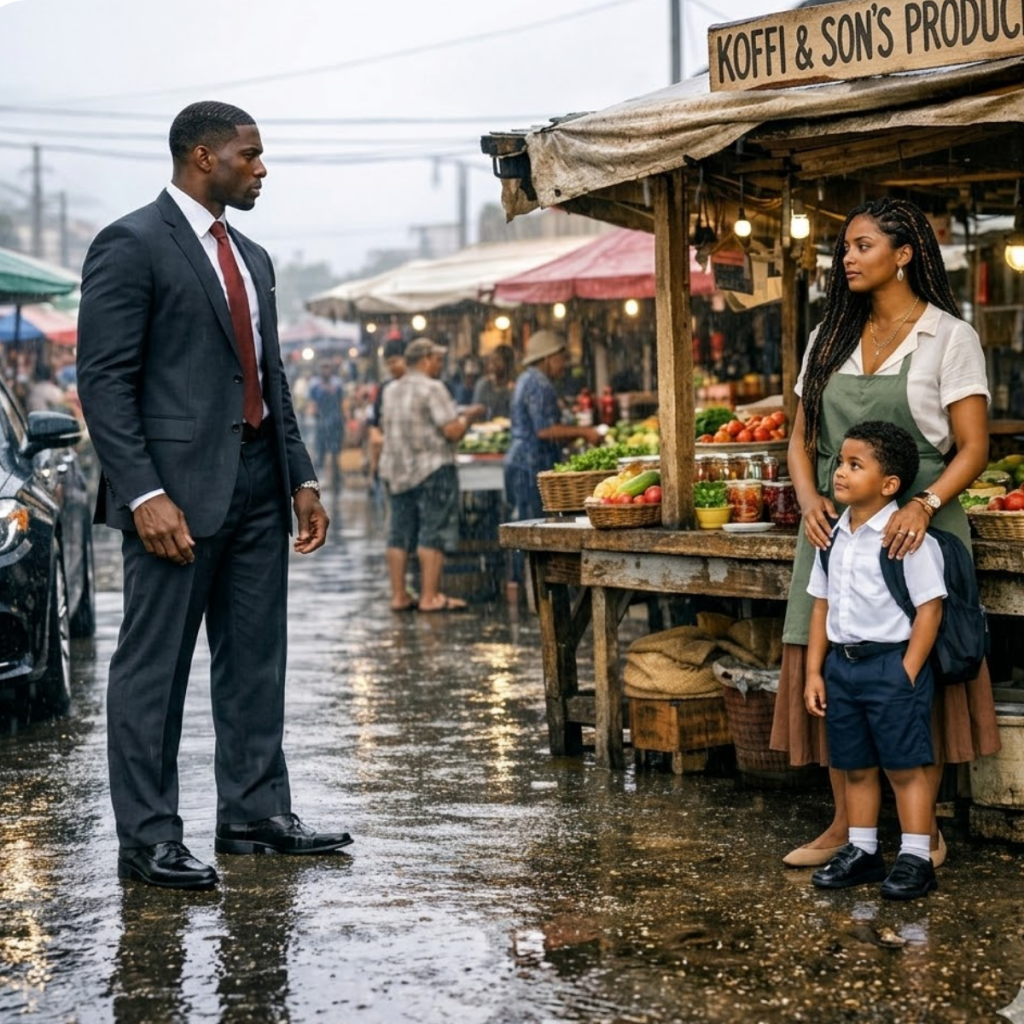
Then came the rainy afternoon at the market.
The moment Ethan saw Naomi and Micah again, all his success turned hollow inside him.
He crossed the street like a man approaching a place he no longer had the right to enter.
Naomi looked up and froze when she saw him.
“Naomi,” he said softly.
“Ethan.”
Micah looked between them with innocent curiosity. “Mom knows you?”
Naomi’s fingers tightened around the counter, but her voice stayed gentle. “Yes. I do.”
There was no shouting. No dramatic accusation. Just careful voices carrying years of unfinished sorrow.
That night Ethan returned to the market in his mind over and over. The next day he returned in person.
At first, he came with excuses. He bought food. Carried boxes. Fixed a loose shelf. Replaced a lantern without being asked. He did not force conversation. He did not try to buy back the past with money. He simply kept showing up.
That mattered.
Naomi had spent years healing from not being heard. Now she watched Ethan listen.
Mr. Lewis told him something that humbled him deeply. Naomi had never poisoned Micah against him. She had every reason to speak with bitterness, but she had chosen dignity. She had left a place for Ethan in their son’s heart, even after all the pain.
That truth changed him more than guilt ever had.
Soon Micah began warming to him. A school project gave Ethan a reason to help. Then came a school event where Micah asked, with quiet hope shining in his face, “Could both of you come with me?”
And they did.
For the first time in years, Ethan and Naomi stood beside each other again—not pretending nothing had happened, but choosing presence over pride.
Then Ethan did something Naomi never expected.
He walked into Pastor Daniel Reed’s church on a Sunday morning and sat in silence while the sermon spoke of repentance—not words, but changed direction. Not apology as performance, but humility that alters a life.
Something in Ethan finally broke open.
He distanced himself from Damian. He stopped allowing Vivien’s opinions to shape his heart. He began apologizing without defense. And in all the ordinary acts—carrying supplies, helping Micah, showing up without demand—Naomi saw a man no longer trying to win, but trying to become worthy.
When Martha’s health began failing, she called Ethan to sit beside her one evening.
She asked him plainly if he truly intended to honor Naomi this time—not only when life was easy, but when pride whispered louder than love.
Ethan’s eyes filled.
He told her that success had once made him feel strong, but now he knew real strength was humility, faithfulness, and presence. If Naomi ever chose him again, he said, he would spend the rest of his life proving he deserved that grace.
Martha nodded, satisfied not by polished words, but by the honesty of a humbled man.
In time, Ethan offered Naomi something new—not rescue, not control, but support. He asked if she would let him help expand her little food stall into a real restaurant.
Naomi resisted at first.
That stall had been built with sacrifice, tears, and dignity. She was not willing to lose herself inside his generosity.
So Ethan made one promise, and this time it sounded different from the man who had once spoken so easily.
“It will be yours,” he said. “Your name. Your dream. I’m not trying to save you. I’m trying to honor what you built.”
Naomi finally agreed.
They named the restaurant Second Harvest.
To Naomi, the name meant more than business. It meant life after loss. Peace after pain. The truth that some things buried by heartbreak can still bloom again in the right season.
On opening day, the whole neighborhood came.
Grace cried openly. Pastor Daniel prayed over the building. Customers from the market arrived dressed for celebration. Ethan stayed mostly in the background, watching Naomi smile among people who had become her true community.
Later that night, after the last customer had gone and the restaurant had gone quiet, Ethan found Naomi standing near the counter beneath the soft lights.
He stepped closer.
“I never stopped loving you,” he said. “I just lost my way.”
Naomi looked at him for a long time, tears gathering in her eyes.
“I still love you too,” she admitted. “But my love is slower now. Wiser. It can’t live on promises alone.”
Ethan nodded. He did not argue. He did not rush her.
Maybe that was why the next moment came.
Naomi reached for his hand.
“The past was real,” she said softly. “The wounds were real. But so is change. So is grace. So is everything we survived.”
Then she told him she was willing to give their marriage another chance.
Not as the young couple they once were.
But as two humbled people who had finally learned what love truly costs.
At that exact moment, Micah came running in from the hallway, too excited to sleep, and threw his arms around both of them.
Ethan and Naomi laughed through tears as they held their son between them.
And there, inside a restaurant born from sorrow, prayer, and perseverance, the family that once fell apart stepped into a new season.
Not perfect.
Not untouched.
But whole in a deeper way than before.
Because love is not proven when life is easy.
It is proven when pride has every chance to win—and doesn’t.
Ethan had gained everything the world celebrates and still discovered that success without love is only a polished kind of emptiness.
Naomi had lost almost everything once, yet she held on to dignity, faith, and the quiet strength to build again.
And in the end, that quiet strength became the bridge home.
Maybe that is what makes this story stay with us.
Not the money.
Not the mansion.
Not even the heartbreak.
But the truth that real love must be protected, especially when life becomes loud enough to drown it out.
And sometimes, the most beautiful endings are not the ones where nothing breaks.
They are the ones where broken people choose to rebuild the right way.