The Bitterroot sunrise came in pale silver bands across the Montana mountains, beautiful enough to make danger look polite.
Ethan Rowe sat in his wheelchair with a blanket over his legs and tried to believe the morning meant something good. His wife, Claire, had suggested the trip two weeks earlier as an anniversary surprise. “Somewhere quiet,” she had said. “Somewhere you can breathe again.” After seven hard years of chronic pain, interrupted sleep, and learning how to live after the combat injury that took the use of his legs, Ethan wanted to believe her. He wanted to believe kindness had not entirely burned out of their marriage.
But the trail felt wrong from the start.
Claire pushed too fast on the narrow gravel switchbacks. She answered simple questions with clipped words. Every time Ethan asked how much farther the overlook was, she tightened her grip on the chair handles instead of easing it. Behind them, his German Shepherd service dog, Bishop, paced with a tension that did not match the morning. Bishop had followed Ethan through rehab, panic attacks, flashbacks, and the endless humiliation of needing help with tasks that once felt automatic. The dog never wasted a warning.
So when Bishop moved in front of Claire, blocking the chair and growling low at her hands, Ethan did not dismiss it.
Claire snapped, “Your dog is becoming a problem,” and jerked the leash harder than necessary.
That was when something cold moved through him.
He remembered the late-night phone call weeks earlier, Claire whispering in the kitchen and hanging up the second she noticed he was awake. He remembered her sudden interest in life insurance forms, signatures, and the power-of-attorney binder she had once ignored for months. He had told himself it was stress. Caregiver fatigue. The slow erosion that comes when one person is always helping and the other is always needing. Gratitude, he had decided, required silence.
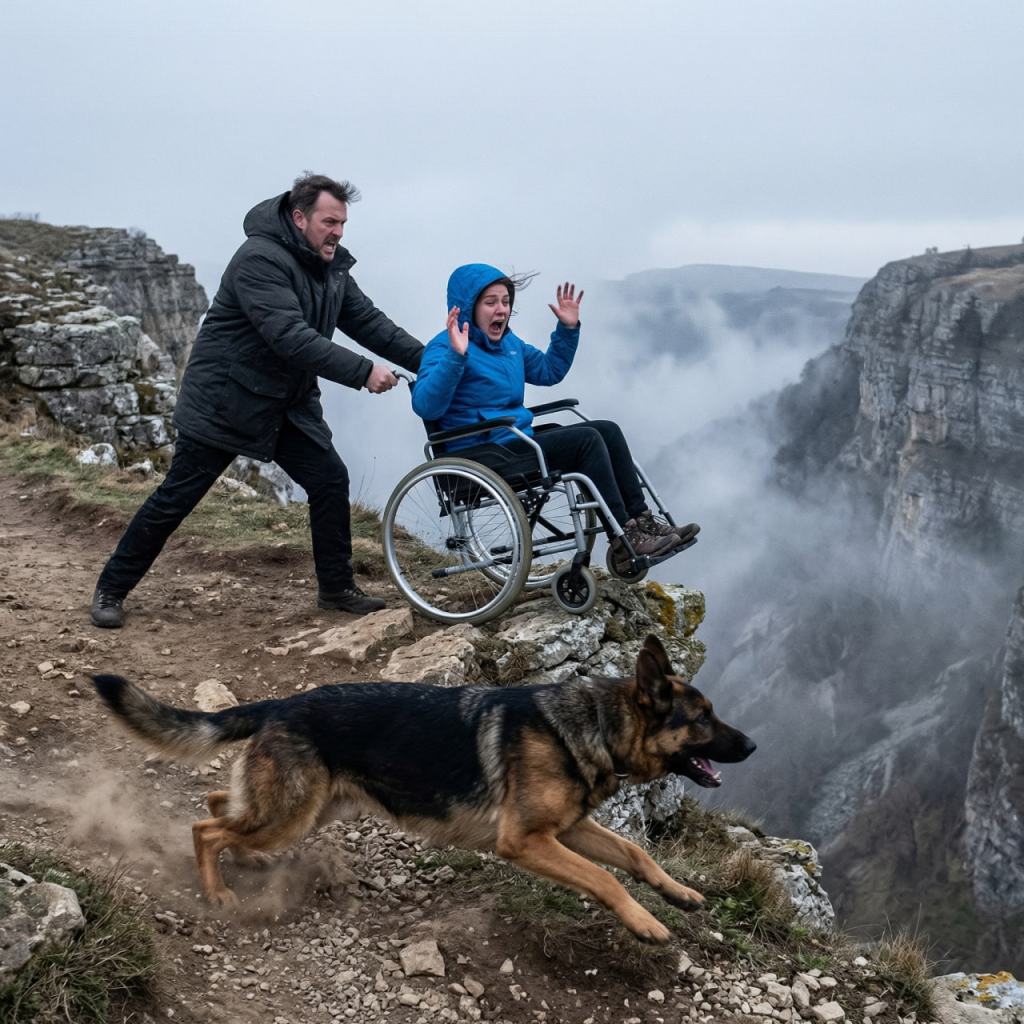
Now the trail pinched into a stone shelf at the overlook, and empty air opened beside them in a clean, brutal drop.
Claire pushed the chair far too close to the edge.
“I can’t keep doing this,” she said.
Her voice was not emotional. It was flat. Rehearsed. Like a line she had practiced enough times to remove all feeling from it.
Ethan reached for the wheel rim, but his hands were slower than fear. Claire bent slightly, clicked off the brake, and let go.
The world tipped.
Bishop exploded into a bark. Gravel scattered. Ethan felt the chair slide, then pitch forward into nothing.
He dropped through open air, slammed into brush, and stopped hard enough to black out for a second. When he opened his eyes, he was thirty feet below the trail, half-hanging on a scrub pine that had caught the twisted chair frame. Above him, Bishop’s barking tore across the canyon. Claire stepped once toward the edge, looked down, and then turned away.
Something fell from the trail and landed in the rocks beside Ethan.
A phone.
The screen was cracked but still glowing with one unread text:
Do it before he changes the trust back.
So who had been helping Claire—and could Bishop bring help before the tree gave way in Part 2?
Ethan’s first clear thought was not pain.
It was time.
The scrub pine holding the bent wheelchair frame had rooted out of a narrow crack in the canyon wall, and every shift of his weight made the trunk creak against stone. Below him, the slope fell another forty feet into broken rock and dead timber. Above him, Bishop barked in sharp, furious bursts that echoed off the cliff face. Claire was gone.
Ethan forced himself to breathe slowly. One rib on the left felt cracked. Blood ran warm from a cut at his hairline. His right hand still worked well enough to grab the twisted armrest and keep the chair from swinging. The phone beside him was wet, the screen shattered in one corner, but the last message remained visible. He read it twice.
Do it before he changes the trust back. Dylan is already exposed.
Dylan.
Not just some stranger. Dylan Mercer, the estate adviser Claire had insisted on using six months earlier. The same man who had pushed aggressively for Ethan to transfer the mountain cabin and a parcel of inherited timberland into a “family liability shelter” while his pain medication was at its worst. Ethan had signed nothing final. He had delayed. Asked questions. And apparently that had made him inconvenient.
“Bishop,” he shouted hoarsely. “Find help!”
The barking stopped for one second. Then he heard paws tearing back up the trail.
Fifteen endless minutes later, voices reached him from above.
A woman first. “Easy, boy. Show me.”
Then a man. “He’s in the wash below the overlook. Call it in now.”
The rescuers were not hikers by chance. Bishop had made it to the parking pullout and nearly knocked over Abby Lawson, an off-duty search-and-rescue volunteer heading up the road after an early supply run. The dog had blood on his vest, frantic focus in his eyes, and just enough training left in his body to turn panic into purpose. Abby followed him back to the overlook, called in coordinates, and found Ethan suspended over the drop before the pine gave out completely.
She lay flat at the edge and met his eyes. “Name?”
“Ethan Rowe.”
“I’m Abby Lawson with Bitterroot SAR. Stay with me.”



A local climbing guide named Ben Kessler had stopped when he saw the emergency call go out and anchored Abby’s rope while she rappelled down to Ethan. She clipped him into a harness, stabilized his neck, and secured the broken chair frame long enough to cut him free. Ethan barely felt the lift back up the rock. He did feel Bishop slam his head against Ethan’s shoulder the second they reached the trail.
At the hospital in Hamilton, Ethan gave his statement before pain medication blurred the edges.
“My wife pushed me.”
The first deputy in the room looked skeptical until Abby handed over the broken phone in a plastic evidence bag. She had photographed the text message before the screen dimmed and emailed it to herself, her supervisor, and her brother, a state trooper, because mountain rescues had taught her one useful lesson: never trust a single copy of the truth.
Claire had already filed her version.
According to her, Ethan panicked near the cliff, grabbed the wheel, twisted the chair off balance, and went over before she could stop him. She claimed Bishop ran after the fall and she hiked out in shock to call for help. But the timeline broke the moment investigators compared it to Abby’s rescue log. Claire had left the overlook and driven nearly twelve miles before calling 911. More damaging still, trailhead footage from a Forest Service parking camera showed her sitting in the SUV for seventeen minutes before making that call.
Not crying.
Not shaking.
Texting.
By evening, Detective Lauren Pierce from the state major crimes unit had the phone records for Claire and Dylan Mercer. They were not just speaking. They had exchanged thirty-two calls in the week before the “anniversary hike,” including one at 4:11 a.m. that morning. Lauren also pulled Ethan’s policy file and found a recent increase in his life insurance, plus unsigned draft papers transferring his inherited land into a trust Claire would fully control if he died before contesting the revision.
When Claire came to the hospital late that night wearing the right expression and carrying the wrong kind of flowers, Bishop rose from the floor and blocked the doorway with a growl so low the nurse at the station stood up.
Claire stopped smiling.
And when Detective Pierce told her they had recovered the phone from the canyon wall, the color left her face so completely that Ethan finally understood what guilt looked like before it learned to speak.
By the next morning, the case was no longer a bad marriage story.
It was attempted murder.
Detective Lauren Pierce moved fast because people like Claire Rowe usually did one of two things when the first lie failed: run, or erase whatever remained. State police seized her phone, her SUV, and the home office she shared with Ethan before noon. What they found there turned a mountain push into a financial conspiracy.
Dylan Mercer—no relation to Ethan, despite the shared last name—was not just an estate adviser. He was Claire’s lover, and together they had been moving toward the same goal from two directions. Claire had been pressing Ethan emotionally, trying to get him to sign trust modifications while his medications were strongest. Dylan had been building the paper structure to absorb Ethan’s inherited cabin, timber parcel, and a disability settlement account into shell-managed holdings Claire could control after his death. The unsigned drafts Ethan found suspicious had stalled them. His decision to schedule an independent review the following week had cornered them.
So they changed tactics.
The trail evidence ruined any hope of calling it an accident. Abby’s rescue photos showed clear tool marks on the wheelchair brake assembly. A crime-scene technician later confirmed the right brake cable had been loosened before the trip, making the chair unstable under force. Trailhead surveillance also captured Claire removing a small metal multi-tool from the cargo area before pushing Ethan onto the path. More importantly, Dylan’s deleted text messages were recovered from the burner app Claire thought was secure.
If he backs out, everything rolls back.
The overlook is clean. No witnesses that early.
Let the dog run. People will blame panic.
That last line hit Ethan harder than the push.
They had counted on Bishop surviving. They just expected him to be dismissed as a frightened dog.
Instead, he had found the right person.
Dylan was arrested first in his office outside Missoula while trying to shred policy drafts and move money from a consulting account tied to Claire’s recent payments. Claire lasted another six hours before detectives found her at a motel near Butte with two packed suitcases, Ethan’s medication folder, and the house safe key she had told everyone was “missing for months.” She still tried to hold the line during interrogation. Caregiver exhaustion. Depression. A tragic misunderstanding on a narrow trail. Then Lauren placed Abby’s timestamps, the surveillance stills, the altered brake assembly photos, and the recovered texts in front of her.
Claire stopped talking.
Three months later, Ethan entered the courthouse with Bishop at his side and a cane strapped across the back of a lighter, custom chair. His left ribs had healed crooked. His nightmares had not become easier. But the look on Claire’s face when she saw him alive was worth more than anger. It was the collapse of a plan that had once felt certain.
Dylan took a plea on conspiracy and financial fraud before trial and testified against her. Claire was convicted of attempted deliberate homicide, conspiracy, and insurance fraud. The judge said the mountain had not been chosen for beauty but for silence, and that silence had nearly finished the crime.
After sentencing, Ethan did not go home right away.
He asked Abby to drive him back to the overlook.
The wind was lighter that day. Summer had worked green back into the lower slopes. He rolled to the safer side of the rail and looked across the canyon where the scrub pine had once held him between life and death. Bishop leaned his weight against Ethan’s leg exactly the way he had during rehab, during panic attacks, during the long nights when survival felt smaller than grief.
Some betrayals end a life.
Others expose it.
Claire had tried to turn a mountain into a witness that could not speak. Instead, the only living witness she failed to account for had four legs, a service vest, and more loyalty than anyone else in Ethan’s world.
That was enough.
If this story hit you, comment your state and tell me whether Bishop, Ethan, or Abby showed the most courage.