Redstone Community Bank in Bozeman usually smelled like printer paper, coffee, and winter coats drying near the lobby heater. That morning it smelled like fear before anyone admitted it out loud.
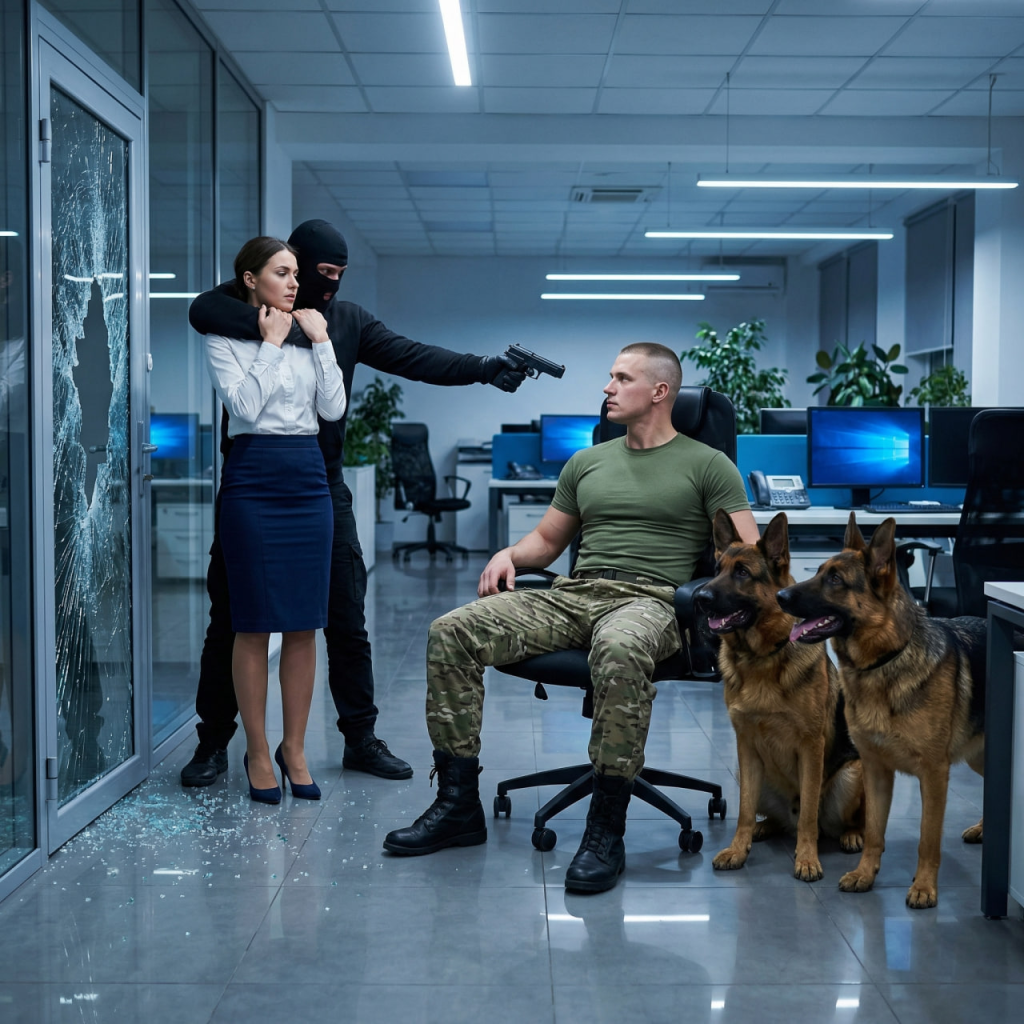
Nolan Drake stood in line with a folder under his arm and two dogs at heel. He was thirty-eight, a retired Navy SEAL with a repaired knee, a careful gaze, and the kind of stillness that often made strangers mistake him for calm when he was actually measuring exits. The folder held architectural drawings and financial projections for a rehabilitation center for retired working dogs. The two dogs beside him were part of the pitch. Rex, a broad-chested sable German Shepherd, stood steady and unreadable. Scout, younger and faster, watched every doorway with bright, restless attention.
Then the front doors slammed open.
Four men came in hard and loud enough to suck the air out of the room. The leader, Travis Cole, carried a shotgun with the shaky confidence of a man pretending practice and courage were the same thing. A thickset man named Mason swept a pistol across the lobby. Another, wiry and sweating, clutched a steel pipe. The youngest of the four, Eli, dragged a large black duffel bag that looked heavier than cash ever should.
“Everybody down!” Travis shouted.
People dropped fast. A teller near the counter, Naomi Price, raised both hands and froze. Walter Briggs, the gray-haired security guard by the side wall, looked stunned for only half a second before becoming very still. Bank manager Daniel Reeves vanished through a side office door with his phone half-hidden in his palm.
Nolan lowered himself slowly, not because he was compliant, but because lower meant more information. He tracked the room in pieces. Travis was loud but unstable. Mason’s trigger discipline was sloppy. The man with the pipe kept pacing because he needed motion to hide fear. The kid with the duffel—Eli—kept glancing at the bag like he didn’t fully trust it.
Then Nolan heard the sound.
A faint, steady ticking.
Not from a wall clock. Not from a watch. It came from inside the duffel.
Eli shifted the bag and dropped it beside a support pillar. The ticking got louder.
The wiry man snapped his head toward it. “What is that?”
Eli swallowed too hard. “Nothing.”
Travis turned pale around the eyes. “What did you bring?”
Nolan watched Walter Briggs reach one hand subtly toward the silent alarm panel under the side counter and press it without looking. Good. Help was coming. But not fast enough if the bag held what Nolan suspected.
He lifted his eyes to Travis and spoke in a voice flat enough to cut through panic.
“Your kid doesn’t know what he’s carrying. If that bag is live, this isn’t a robbery anymore.”
Travis swung the shotgun toward him. “Shut up.”
Rex’s muscles tightened. Scout’s ears flattened toward the pipe man’s shifting hands. Nolan stayed still.
Because once fear inside a room like that turned inward on itself, somebody was going to make a fatal mistake.
And when Eli whispered, “He told me it was just leverage,” Nolan understood something worse than robbery was already in motion.
Who was “he”—and what had these four men really been sent into the bank to destroy?
The room broke in small ways first.
Naomi the teller started crying quietly behind the counter. Mason told her to open the drawers faster even though his hands were shaking too much to keep the pistol level. The man with the steel pipe—Ricky Haines—kept pacing between the teller stations and the vault corridor as if movement could stop him from thinking. But Nolan stayed focused on the youngest one.
Eli wasn’t built for this. He looked nineteen, maybe twenty, with fear all over his face and the posture of a boy who had agreed to something far smaller than the thing now sitting at his feet. Nolan had seen men like him overseas and back home—useful because they were desperate, disposable because they were frightened, and always the last to understand the real plan.
Walter Briggs, the security guard, met Nolan’s eyes only once. It was enough. Nolan knew the silent alarm had gone out. What he didn’t know was whether the first responders would rush the front doors and trigger panic before the situation inside finished cracking.
Travis forced manager Daniel Reeves out of the back office and shoved him toward the vault hall. “Open it.”
Daniel looked at the duffel, then at Nolan, then back at Travis. “That vault’s on delay.”
That answer changed things.
Travis swore. Mason cursed at Daniel. Ricky demanded they grab the teller drawers and run. Eli took one step back from the duffel and said the one sentence no criminal crew ever survives.
“This wasn’t the plan.”
Nolan filed it immediately.
“Then tell me the plan,” he said.
Travis snapped the shotgun toward Nolan again. “You talk too much.”
“No,” Nolan said. “You don’t know what your own boss wants. That bag isn’t for cash. It’s for the building.”
Eli looked at him—really looked—and the truth landed. “He said just scare them. Blow a wall if we needed to.”
Mason rounded on him. “You said it was demolition powder for the vault.”
“It is,” Eli blurted. “I think. He gave me the bag. I never opened it.”
Nolan’s eyes went to Daniel Reeves. The bank manager had gone very still in a way that had nothing to do with fear. He wasn’t staring at the robbers. He was staring at the duffel. And that was when Nolan noticed something else—the manager’s office door stood open behind the hall, revealing filing shelves and a locked records cabinet, not the vault. Daniel had not run for safety earlier. He had tried to get to something else.
“Who’s ‘he,’ Eli?” Nolan asked.
Eli licked his lips. “Mr. Sutter.”
Daniel Reeves flinched.
Nolan had his answer.
Martin Sutter was Redstone’s outside commercial consultant, the man who had appeared in half the town’s development deals over the last five years, including the foreclosure fight Nolan had been studying while applying for his loan. The dog rehab property Nolan wanted had once belonged to a ranching family pushed out after Redstone financed a land transfer through one of Sutter’s shell groups. If Sutter wanted something destroyed inside this bank, it wasn’t stacks of cash. It was paper.



Travis realized Nolan had connected too much too fast. “Tape him,” he barked.
Ricky moved first, rushing with the pipe half-raised. Scout exploded before Nolan spoke, not wild, not chaotic, but into the exact lane Ricky committed himself to. One bark, a snap at air, a perfect disruption. Ricky recoiled sideways. Nolan drove upward from the floor, caught the pipe wrist, and slammed it into the edge of a brochure stand hard enough to drop the weapon.
Rex moved at the same instant—straight into Mason’s gun arm with a controlled body hit that sent the pistol skidding beneath the chairs.
Everything went loud.
Naomi screamed. Travis jerked the shotgun toward the dogs. Walter Briggs came off the wall and tackled Mason before he could recover the weapon. Eli backed away from the duffel, shouting, “Don’t shoot near the bag!”
That was the line that froze everyone for half a second.
Half a second was enough.
Nolan dragged Ricky behind the loan desk, got one hand on the dropped pipe, and shouted at Eli, “If you want to live, unzip it slow and tell me what you see.”
Eli stared at Travis, then at the bag, then at Nolan.
Finally he crouched and opened the duffel three inches.
Inside were red wire bundles, a digital kitchen timer duct-taped to a metal canister, and printed loan files packed around the explosive like kindling.
And clipped to the top folder was one name in black marker:
DANIEL REEVES
The bank manager turned and ran for the back office.
So why was the man pretending to be another hostage trying to escape the second the evidence showed up in his own bomb bag?
The room stopped being a robbery in that instant.
It became a cleanup job.
Daniel Reeves bolted for the records hallway, but Nolan was already moving. He hurdled the low partition with his bad knee screaming, caught the manager by the jacket at the office threshold, and drove him into the copier hard enough to drop him face-first onto the carpet. Reeves clawed once toward the locked filing cabinet before Rex planted himself between the man and the handle with a growl that shook the room into silence again.
“Don’t touch it,” Nolan shouted.
Walter Briggs, still wrestling Mason near the front chairs, finally found breath enough to yell, “Police are outside!”
That changed Travis Cole. Men like him borrowed bravery from momentum. Once they felt the window closing, they got dangerous in desperate ways. He swung the shotgun toward Eli, who was still frozen beside the open duffel.
“You set me up,” Eli said.
“No,” Travis snapped. “Sutter set all of us up.”
That was the last useful truth Travis ever volunteered.
He grabbed for the bag, maybe to carry it, maybe to drag it, maybe simply because panic makes fools return to the most dangerous object in the room. Scout beat him there, leaping up and driving his forearms off the duffel without making contact with the device itself. The movement broke Travis’s balance. Nolan crossed the space and smashed the steel pipe into the shotgun barrel, sending it clattering across the tile.
Outside, officers shouted commands through a bullhorn. Inside, Nolan kept his voice low and exact.
“Everybody away from the bag. Nobody runs. Nobody touches paper.”
Eli obeyed first. Then Naomi. Then Walter. Ricky was curled on the floor holding his wrist. Mason had given up. Only Daniel Reeves kept breathing like a trapped animal.
Because he knew what the officers outside did not yet understand.
The bomb was not designed to level the whole bank. It was designed to burn the loan archive, hard drives, and foreclosure records stored in Reeves’s office and the basement file room below it. Cash theft was cover. Terror was cover. The whole operation had been staged to erase evidence linking Reeves and Martin Sutter to fraudulent land seizures, altered appraisals, and laundering through development shell companies.
The bomb squad arrived eight minutes later, and those were the longest minutes in the building.
Nolan kept the robbers separated. Walter held Mason and Ricky at gunpoint with Mason’s own recovered pistol. Eli sat on the floor with both hands visible, crying now with the stunned grief of someone realizing he had walked into a felony designed to kill him too. The bomb technician eventually opened the duffel fully and confirmed what Nolan had already guessed: a crude but real incendiary charge rigged to ignite files and trigger secondary burning from accelerant packets stuffed around the records folders.
Reeves and Sutter had not trusted the robbery crew to get into the bank cleanly and leave quietly.
They had trusted them to die messily if necessary.
The documents recovered from the bag blew the case open by the next afternoon. Reeves had hand-selected the files to be destroyed—foreclosed ranch titles, altered K9 unit surplus land transfers, loan modification rejections, and payout ledgers tying Redstone money to Sutter’s development entities. One of those files was Nolan’s target property, a decommissioned training ranch he had been trying to purchase for his retired K9 rehabilitation center. Another contained forged signatures from an elderly widow whose land had been seized after her husband’s death.
By the end of the week, Martin Sutter was arrested at the airport trying to leave for Denver. Reeves took a deal only after learning Travis had already admitted Sutter pitched the robbery as a “records snatch” with extra pay if the building caught fire. Travis, Mason, and Ricky still faced charges, but Eli’s cooperation and the bomb evidence made his role different. Desperate, guilty, but not the architect.
As for the dogs, the whole bank talked about them for months as if they had moved on instinct alone. Nolan knew better. Rex and Scout had done what years of discipline, exposure, and trust had trained them to do: read the room, wait for the right break, and act only when action mattered more than stillness.
Three months later, Nolan walked back into Redstone Community Bank for a different reason. The old ownership had been replaced, the interim director had reopened the tainted loan files, and his project funding finally cleared. The retired K9 center would be built after all on land that never should have been stolen in the first place.
Rex lay at heel. Scout watched the doors.
The lobby smelled like coffee again.
But now everyone inside understood how close it had come to smelling like smoke.
If this story hit hard, comment your state and tell me: who changed the outcome more—Nolan, Walter, Rex, or Scout?