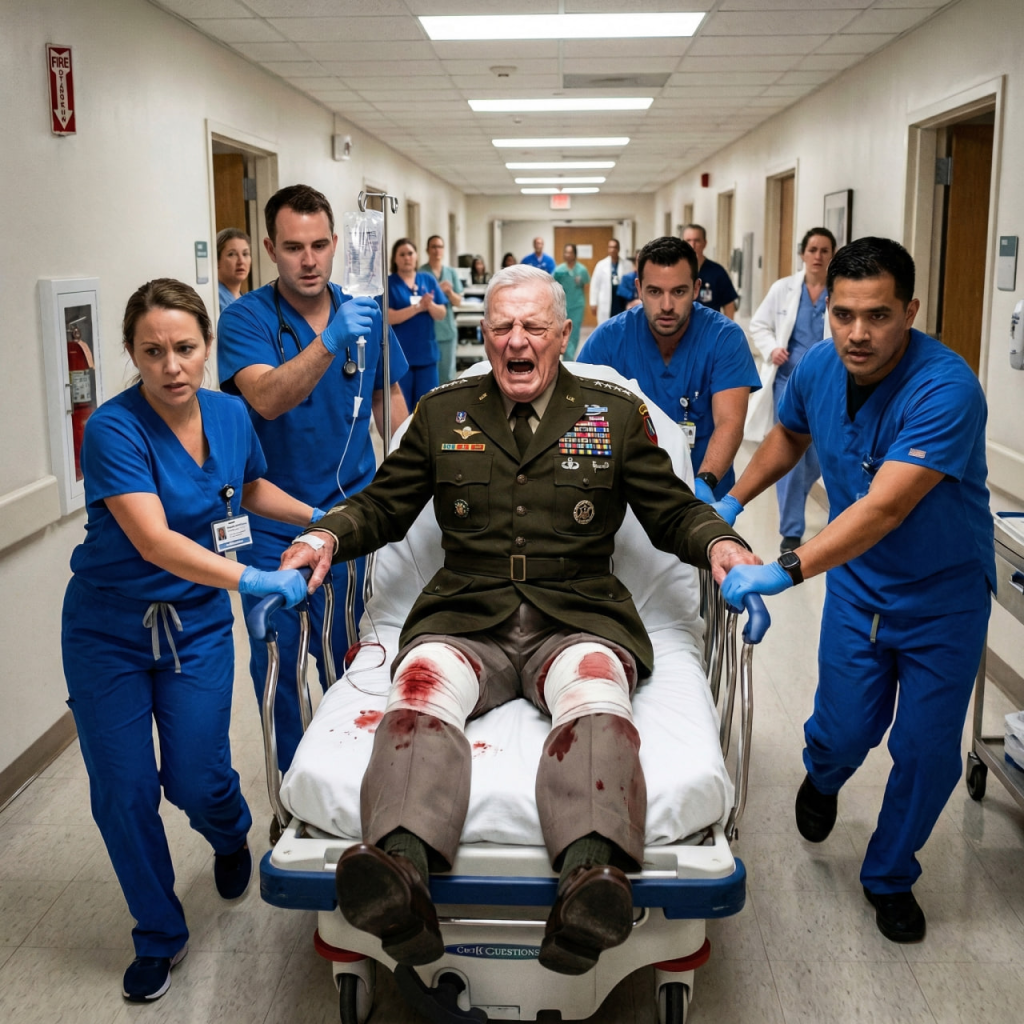
St. Agnes Mercy Hospital had seen senators, judges, and millionaires come through its emergency entrance, but when General Thomas Varden arrived, the trauma wing changed shape around him. Orderlies moved faster. Residents stopped talking. Administrators appeared from nowhere. He came in pale, furious, and bleeding through a pressure dressing high on his left thigh where shrapnel had lodged dangerously close to the femoral artery.
“Get me your best vascular surgeon,” he snapped through clenched teeth. “Now.”
There was no discussion after that. Only one name surfaced.
Dr. Natalie Rowan entered the operating room quietly, already gloved, eyes on the scans floating above the lightbox. She had built her reputation the hard way—salvage cases, midnight trauma reconstructions, six-hour procedures other surgeons declined. She did not waste words, and she did not advertise what she could do.
General Varden turned his head, saw her face, and went still.
For a second, the monitors seemed louder.
Ten years fell away.
Back then, Natalie had been Captain Rowan, a junior military physician in Afghanistan. During an ambush outside Jalalabad, she had diverted blood and evacuation priority to a local child who would have died in minutes without intervention. A supply convoy under Varden’s command was hit shortly after. The Army needed a clean explanation for a dirty chain of failures, and Thomas Varden had found one in a young doctor who could be labeled emotional, undisciplined, and unfit for command pressure.
Her career ended. His survived.
Now he lay on her table with an artery one bad movement away from letting him bleed out.
“This is a mistake,” he whispered.
Natalie did not blink. “I’m Dr. Rowan. I’ll be leading this surgery. If you object, say it now.”
He said nothing.
The operation took nearly six hours. The fragment had torn tissue unpredictably, and every millimeter mattered. Natalie exposed the vessel, isolated the damage, repaired the artery, and preserved the leg against odds that would have cost lesser men blood, limb, or both. She did not speak to Varden except in clinical terms, and when the final sutures were placed, she felt no triumph. Only completion.
He survived.
But in recovery, something turned wrong.
A nurse she didn’t recognize hesitated over an IV port with a vial labeled as post-op anticoagulant. Natalie caught the dosage first, then the color of the fluid, then the mismatch with the chart. She closed her hand over the syringe before it reached the line.
“That is not his medication,” she said.
The nurse panicked, dropped the tray, and bolted before security reached the door. In the scramble, the vial vanished.
An hour later Natalie confronted Colonel Adrian Holt, Varden’s longtime aide, in the ICU corridor. He listened without surprise and answered too evenly.
“You should focus on medicine, Doctor,” he said. “Some matters are above your concern.”
That was when she knew this was not a bad handoff. Not fatigue. Not hospital confusion.
Someone had prepared to kill General Thomas Varden after she saved him.
She locked the ICU room, turned to the man who had once destroyed her life, and asked, “How many enemies do you have, General?”
Varden swallowed hard. “Enough,” he said, “to kill anyone standing too close.”
But who wanted him dead badly enough to plant a killer inside the hospital—and what did they think he still knew?
Natalie did not leave the ICU floor after that.
She called pharmacy herself, pulled the medication audit from the machine outside Varden’s room, and had the overnight charge nurse lock down every vial on the cart. The result came back ugly in less than twenty minutes. The syringe intended for Varden had been drawn from a batch of concentrated potassium chloride that should never have been stocked in a bedside medication drawer. It had been relabeled with a printed sticker from another patient’s anticoagulant order. Not a nursing mistake. A deliberate substitution.
The badge used to access the drawer belonged to a float nurse who had called out sick three hours earlier.
Whoever came into the unit had come wearing someone else’s identity.
Natalie’s first ally turned out to be Paul Moreno, the gray-haired overnight security supervisor who had worked hospitals long enough to tell panic from performance. He reviewed the corridor footage frame by frame with her and found the gap: two cameras on the critical-care hallway had gone black for ninety-three seconds at exactly the right time. When they came back online, the false nurse was already outside the room.
“Too clean,” Paul muttered. “That’s either someone who knows hospitals or someone who had help from somebody who does.”
Natalie went back inside. Varden was awake now, pale under the monitors but mentally sharp in the way powerful men often were even when their bodies failed them. His voice had lost force, not control.
“You stopped the first one,” he said. “There will be another.”
“That sounds like prior knowledge.”
He looked at the ceiling for a long second before answering. “I was on my way to meet federal investigators when the convoy hit the device that brought me here.”
Natalie folded her arms. “Investigators about what?”
“About Afghanistan. About procurement fraud, diverted reconstruction funds, false casualty routing, and an after-action report I signed when I should have refused.”
She said nothing.
Varden met her eyes anyway. “You were not the reason that convoy was hit ten years ago.”
She felt the old anger rise so cleanly it almost steadied her. “No. I wasn’t.”
He nodded once. “Adrian Holt rerouted it off the approved road to cover an unsanctioned transfer with a defense contractor. When the convoy was struck, I protected my command, my promotion board, and the men above me who wanted a simple explanation. You became the simple explanation.”
Natalie looked away before the room got smaller.
He kept going because he had finally run out of places to hide.
“I was going to testify. There are ledgers, routing memos, and payment records. Holt knows where they lead. So do the people who used those routes to make money.”
“Where is the evidence?”
“In my field bag. Colonel Holt has it.”



That fit too neatly.
Natalie stepped into the hall and found Holt at the nurse station reviewing transfer paperwork that had not existed ten minutes earlier. He claimed a secure military facility wanted Varden moved before daylight “for continuity and protection.” The documents were polished, signed, and almost certainly false. Natalie called the number on the header instead of the one Holt offered.
The office listed had no knowledge of any transfer.
That was bad enough. Then pharmacy resident Eli Mendez arrived with something worse: a hidden note in the electronic chart metadata. Someone had tried twice to change Varden’s allergy list and add a medication that would have masked a second lethal electrolyte load as a cardiac complication.
Not just murder. Murder shaped to look natural.
Natalie forwarded the audit trail to the hospital CEO, legal counsel, and a former JAG investigator she trusted from her Army days. Then she made the one decision Holt did not expect.
She recorded Varden’s statement on her phone with date, time, and his explicit identification of Adrian Holt and the Afghanistan routing fraud. If Varden died, the testimony would still live.
At 3:12 a.m., the ICU lights flickered once.
Then Paul Moreno came off the elevator fast and pale.
“Three men in federal jackets just walked in through ambulance receiving,” he said. “They’ve got transfer papers, a military transport gurney, and one of them is carrying your patient’s field bag.”
Natalie looked through the ICU glass and saw Colonel Holt step into view behind them.
The first murder attempt had failed.
Now they were coming to remove the body before it became evidence.
Natalie had less than a minute to decide whether she was protecting a patient, a witness, or the only confession she would ever get from the man who ruined her life.
In the end, she protected all three.
“Code Blue in Room Nine,” she told the charge nurse.
The overhead system carried it instantly. On a normal night, a cardiac arrest call flooded an ICU hall with staff, carts, respiratory therapy, and noise. Natalie used that fact like a doorstop. Within seconds the corridor filled with people moving fast toward the wrong emergency, creating exactly the kind of chaos a covert extraction team could not control cleanly.
Colonel Holt saw it and knew what she had done.
“Natalie,” he said sharply as he reached the doorway, “stand aside.”
“No verified transfer. No release order. No patient movement,” she answered.
The men in federal jackets looked official at first glance, but hospitals reward detail. Their badges were clipped wrong. Their transfer forms used the old trauma floor designation from before the ICU remodel. One man gripped the gurney rail like he had carried rifles more often than patients.
Paul Moreno stepped into the hall beside her. “You’re done here, Colonel.”
Holt’s expression thinned. “You have no idea what you’re interfering with.”
Natalie almost laughed at that.
“No,” she said. “I have a very good idea.”
Inside the room, General Varden used shaking fingers to pull a cloth patch from the seam of his field bag where one of the fake transfer men had set it down during the corridor confusion. Hidden beneath the patch was a memory card sealed in tape. When Natalie saw it, the whole structure made sense. The visible bag was bait. The evidence was in the lining.
She passed the card to Eli Mendez at the med station. “Copy it now. Three locations.”
Eli didn’t ask questions. He ran.
Holt realized too late that the room had become more dangerous for him than for Varden. He made a final play—loud authority, emergency language, pressure on the CEO now arriving from the elevator—but the hospital’s legal counsel cut straight through it after reviewing Natalie’s audit logs and listening to the first thirty seconds of Varden’s recorded statement.
“No transfer,” counsel said. “And nobody leaves.”
That was when Holt tried to run.
He never got far. Paul caught him at the stairwell landing, and two city officers responding to the false transfer call finished the arrest while Holt shouted about national security and classified operations. The fake transport men were held separately. One started talking within the hour when he learned the memory card had already been copied.
The files broke everything open.
There were contractor invoices from Afghanistan tied to phantom fuel shipments, convoy rerouting emails, casualty timing reports altered after the ambush that ended Natalie’s career, and recent payment trails connecting Holt to a private defense firm under federal review. Most damaging of all, there was a draft testimony packet Varden had prepared for investigators, signed but not yet delivered, naming Holt and two retired procurement officers in the old fraud chain. Varden had finally decided to tell the truth. Holt had decided truth was more dangerous than murder.
By noon, federal agents from the Defense Criminal Investigative Service were in the building. By evening, the story had outgrown the hospital. Holt was charged with attempted murder, conspiracy, and obstruction. The contractor’s offices were searched in two states. Varden gave a sworn bedside deposition from ICU, his voice weaker than it had once been but cleaner. He admitted the false report. Admitted the scapegoating. Admitted Natalie Rowan’s court-martial had been built on a lie convenient to powerful men.
Weeks later, the Army Board for Correction of Military Records vacated the findings that had destroyed her career. It could not return ten years. It could not return the uniform. But it returned the truth to the file, which in some lives is the closest thing to justice arriving on time.
When Varden was discharged, he asked to speak with her privately.
“I don’t deserve your forgiveness,” he said.
“No,” Natalie answered. “You don’t.”
He nodded once, accepting the only honest answer left.
Then she handed him the discharge packet and said, “Try deserving survival.”
After he left, she stood alone for a moment in the ICU room where he had almost died twice—once from shrapnel, once from the men who needed his silence. The monitors were quiet now. The danger had moved elsewhere. For the first time in ten years, the old weight in her chest did not feel like defeat.
She had not saved him out of mercy.
She had saved him long enough to make the lie bleed in public.
If this story hooked you, comment your state and tell me what mattered most: truth, duty, or accountability in the end.