Terminal 3 usually sounded like ordinary pressure—rolling suitcases, overhead announcements, crying toddlers, late connections, expensive coffee, tired people pretending not to be tired. Officer Mason Reed had worked airport interdiction long enough to know what normal chaos felt like. It moved fast, messy, and honest. His partner, a black-and-tan German Shepherd named Juno, worked by a different standard. She ignored the surface and trusted scent, pattern, and the tiny things people leaked when they believed no one was really watching.
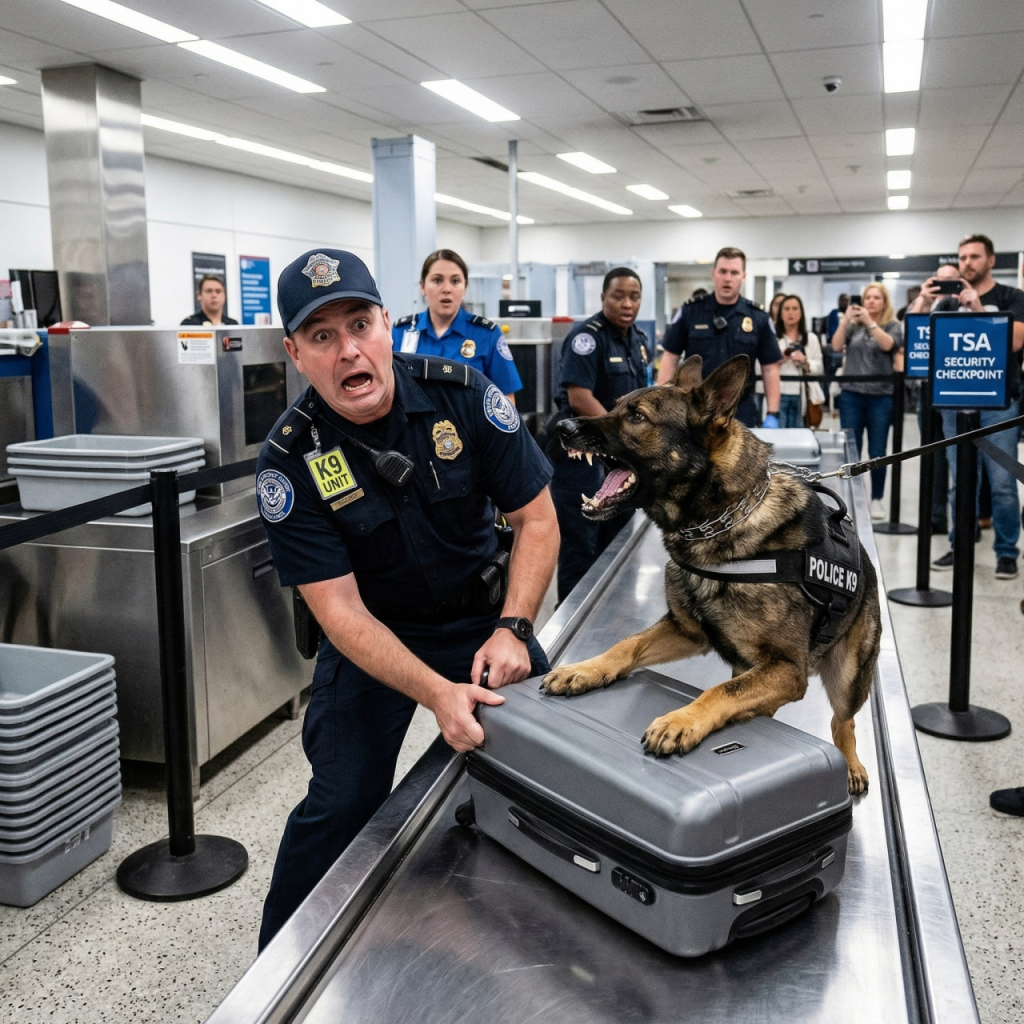
That morning, Mason and Juno were on a routine sweep near Carousel 7 when the suitcase came off the belt.
It was charcoal gray, hard-sided, and almost suspiciously clean. No airline sticker tears, no frayed handle, no old baggage scars, no childish ribbon or hurried owner mark. It looked less like luggage and more like a prop designed by someone who had studied what anonymity was supposed to resemble.
Juno stopped so hard Mason’s heel scraped the tile.
Her nose hit the seam once, then again, quick and urgent. Her ears tightened. A low growl built in her chest—not the aggressive warning she gave when somebody moved wrong around Mason, but the deeper, more focused sound that meant something dangerous and unfamiliar had just entered her world. Then she struck the bag with her shoulder and pawed hard at the zipper line as if the problem inside needed daylight immediately.
Mason keyed his radio without raising his voice. “Carousel 7. Clear the area now.”
Within seconds, the terminal’s ordinary noise broke into fragments. Passengers were pushed back. Airport security built distance. A bomb team was called. Juno stayed fixed on the suitcase, but what bothered Mason most was that after every few seconds she lifted her head and checked the air behind them, toward the maintenance corridor beside the baggage hall.
Like the bag mattered.
But not only the bag.
The explosives unit opened the case under controlled procedure.
Inside were no clothes. No toiletries. No tourist clutter. Instead there were fitted compartments packed with forged passports, heat-sealed cash bundles, two identity encoders, blank chip cards, a slim document laminator, and a narrow device that looked like a card reader until the bomb technician muttered, “This is a skimmer head with a data injector.”
Then he held up a flash drive sealed in plastic.
Two letters were written on it in black marker.
C.H.
Juno swung toward the maintenance hall and growled again, louder this time.
Mason turned just in time to see a man in a navy maintenance jacket push through the side door, glance once at the secured carousel, and start walking away too fast.
So who was “C.H.”—and why was the man who packed the suitcase still inside the airport when Part 2 began?
Mason handed Juno’s leash to the nearest airport officer for less than two seconds—just long enough to clear the civilians back from Carousel 7—then took her again and moved toward the maintenance hall at a run. Juno needed no command now. Her head was low, ears pinned, pulling hard enough to drag his shoulder forward. Whatever had been inside that charcoal suitcase had not arrived by accident, and whoever brought it into Terminal 3 had just looked at the scene and tried to walk away before anyone could ask why.
The man in the navy maintenance jacket heard the boots behind him and broke into a sprint.
He shoved through a gray service door, clipped a cleaning cart, and cut left into a corridor lined with breaker rooms and supply cages. Mason caught one detail before the man turned the corner: the jacket was airport issue, but the shoes were not. Expensive leather. Too clean. No actual maintenance worker ran electrical access in polished shoes.
“Stop! Airport police!” Mason shouted.
The man didn’t stop.
Juno exploded forward. Mason let her stretch to the end of the line, using her speed to force the distance down. Two airport officers peeled in from the opposite corridor after hearing the radio call. The man saw them, veered right, and hit a keypad door marked Authorized Personnel Only. He swiped a badge, cursed when the light flashed red, and turned just as Juno hit him square in the thigh.
He went down hard.
Mason was on him a second later, driving the man’s wrist flat to the floor while Juno held position, teeth bared but disciplined. The suspect smelled wrong up close—printer toner, adhesive, machine oil, and a sharp chemical note Mason knew from evidence rooms where seized card skimmers got processed.
The badge clipped to the man’s jacket read Evan Pike – Facilities.
Nội dung quảng cáo
One look at his face and Mason knew the badge was fake. The laminate edge was too thick, the embedded photo fractionally off-center. Good enough at a glance. Not good enough under stress.
The officers cuffed him. Pike said nothing. Not even “You’ve got the wrong guy.” Just breathed hard and stared toward the baggage hall, furious that something had gone early.
Juno wasn’t watching him anymore.
She pulled toward a wall-mounted utility locker twenty feet away and barked once.
Inside the locker was a collapsible tool bag, a second badge printer ribbon, blank work orders, and a disposable phone wrapped in a plastic glove. Mason slipped the glove off and checked the screen. No contacts. No saved names. Just a string of deleted texts and one lock-screen preview that hadn’t cleared in time:
Bag exposed. Delay C.H. 15 min. H will redirect.
Mason read it twice.
Back at Carousel 7, the bomb technician had already finished a quick field review of the flash drive. He met Mason halfway, face tight in the way experienced people looked when they had bad news but not enough of it yet.
“Not random fraud,” the tech said. “Targeted operation.”
He turned the tablet so Mason could see.
The flash drive held a folder labeled C.H. Inside were gate maps, camera blind spots, airport escort routes, and a complete arrival profile for one passenger landing that morning from Washington, D.C.: Caroline Hayes, Senior Investigator, DHS Office of Inspector General. Her photo, flight number, seat assignment, and planned pickup instructions were all there. At the bottom of one document was a note in plain text:



Intercept before official contact. Phone first. Credentials second. Move through service corridor if resistant.
Mason felt the logic lock into place all at once.
The suitcase had not been packed for travel. It was a mobile identity kit—passports, chip cards, laminator, encoder—everything needed to strip a person of control and rebuild the paper trail around them. And the man in the fake maintenance jacket had stayed inside the airport because his job was never to leave with the suitcase.
His job was to meet Caroline Hayes before her real security detail did.
Juno snapped her head toward the arrivals corridor.
Flight 281 from Washington had landed eighteen minutes earlier.
And somewhere inside Terminal 3, the woman marked C.H. might already be walking with the wrong escort.
By the time Mason reached the arrivals concourse, the crowd had folded back into its usual airport disguise—families with signs, rideshare drivers scanning faces, business travelers moving with practiced impatience. That was what made it dangerous. A frightened person stood out. A deceived person did not.
Juno worked the floor in short, deliberate pulls, ignoring the chaos and searching for one scent: the man in the fake maintenance jacket. If he had helped stage the pickup, his odor would be on the route. Mason radioed Caroline Hayes’s description, flashed her federal arrival photo to two airport officers, and kept moving.
Then Juno stopped.
Not at the doors. Not at the curb.
At a man holding a white placard that read DHS TRANSFER – HAYES.
He was in his forties, silver at the temples, dark overcoat, airport lanyard turned just enough that the name card flipped backward. Smooth posture. Calm face. The kind of man people trusted because he looked built out of policy and procedure.
Beside him stood a woman in a navy blazer, carry-on at her side, listening while he spoke close and quietly.
Caroline Hayes.
Mason felt the temperature change in his chest.
The man saw the uniform first, then the dog, then the officers widening out behind Mason. His hand moved instantly—not toward a weapon, but toward Hayes’s elbow, guiding rather than grabbing, as if he could still make it look official if he kept control of the frame.
“Ma’am,” Mason called, voice sharp enough to cut through terminal noise, “step away from him right now.”
Hayes turned. The man smiled the way corrupt people did when they believed they could fix the next five seconds with confidence alone.
“I’m Caleb Hart, Airport Operations,” he said. “There’s been a credentialing mix-up with her pickup. I’m resolving it.”
That was the second the initials clicked.
Not just Caroline Hayes.
Caleb Hart.
C.H. had been both the target and the insider.
Juno lunged before Hart could pivot. Mason released just enough line for her to slam her front weight into Hart’s hips. Hayes stumbled free. Hart tried to bolt toward the employee lane, but two officers closed it off. He changed direction, shoved a baggage cart into one of them, and reached inside his coat.
Mason drew.
“Don’t.”
Hart froze with a phone in his hand, not a gun. The screen was already open to a remote-wipe prompt. He had one thumb over CONFIRM.
Juno’s growl made him think better of it.
They took him to the floor in front of a hundred stunned travelers and at least thirty raised phones. Hayes stood off to the side, breathing hard but steady, one hand on her bag and the other on the badge wallet clipped inside her blazer. When Mason asked if she was hurt, she shook her head and said, “He knew my office, my route, my contact name. He even had the revised pickup code. Someone inside federal scheduling leaked it, or he’s been inside airport systems longer than we thought.”
“Long enough,” Mason said, looking at Hart, “to believe he owned the handoff.”
What followed moved fast and ugly. Hart’s office yielded cloned access cards, contractor invoices tied to the fake maintenance badge, and terminal camera logs with deliberate blind spots during selected arrivals. The man in the navy jacket—real name Nolan Pike—had packed the suitcase as a field lab and stayed because he was Hart’s runner, meant to support the interception if Hayes resisted or if her electronics needed to be copied on site. They had done versions of it before: vulnerable travelers, flagged couriers, people carrying evidence, people too tired to question an official-looking escort at the wrong moment.
This time they ran into Juno.
By evening, Hart and Pike were both in federal custody. Terminal 3 reopened, the carousel resumed, and the airport tried to sound normal again, but word had already spread through every break room and security desk on the property. A dog had hit on one suitcase, and a whole operation had come apart.
Later, after Hayes gave her statement, she crouched carefully beside Juno and scratched behind her ear.
“Tell me the truth,” she said to Mason. “Did she save my life, or just my case?”
Mason looked at his partner, then at the long terminal windows turning black outside.
“In places like this,” he said, “sometimes that’s the same thing.”
If you were standing in that terminal, what would have tipped you off first—the spotless suitcase, the fake maintenance jacket, or the man with the sign who looked too calm? Tell me which clue gave the whole game away.