The fall festival in Briar Point, Virginia, had been built for photographs. Strings of lights hung over the fairground paths, craft tents lined the square, and the elementary school choir waited behind a plywood stage painted with pumpkins and blue sky. It should have been simple. Maya Dalton had promised her daughter she would be there, and promises had become sacred after grief broke their home into before and after.
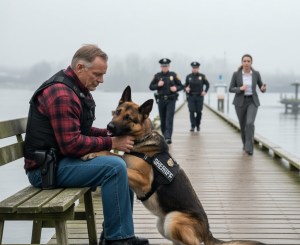
Eighteen months earlier, two officers had come to her door with a folded flag and a script no family ever forgot. Chief Marcus Dalton, her husband, had not come home. Since then, sleep came in fragments, crowds sat wrong on her skin, and silence could turn sharp without warning. That was why Koda walked at her left side, close enough to anchor, disciplined enough to disappear unless needed.
He had once worked alongside Marcus overseas. Now he worked for Maya.
Addie waved from behind the curtain, white choir blouse crooked at the collar, eyes bright with nerves. Maya raised a hand and forced a smile. “You’ve got this,” she mouthed.
That was when she noticed the four boys with phones.
They moved through the festival like they owned the right to other people’s discomfort. One mocked an older veteran’s limp while another filmed. A third narrated like cruelty became harmless if it was said in a joking voice. They drifted from target to target, fishing for reactions, laughing when strangers turned away.
Then the tallest one locked on Maya.
He wore a backward cap and the confidence of someone who had never learned that consequences belonged to him too. His friends followed as he crossed the grass toward her, camera already up.
“Cool dog,” he said. “He bite?”
“Don’t touch him,” Maya said. “Don’t touch me. Keep walking.”
That should have been enough. It wasn’t.
He stepped in anyway and grabbed her shoulder for the camera, squeezing like the moment belonged to him. Maya’s body went still in the way it did before action. Her eyes changed first.
“Last warning,” she said.
The boy smirked and brushed two fingers against her cheek.
Koda moved.
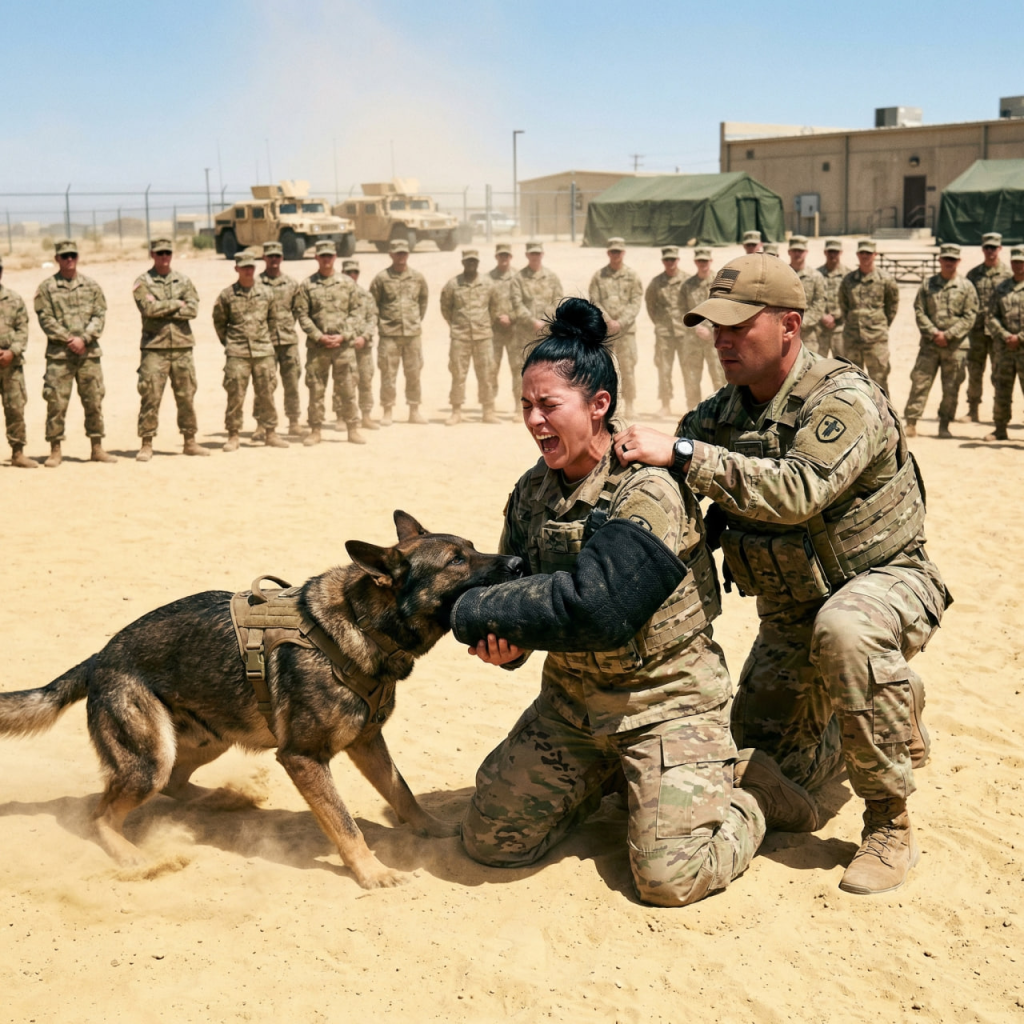
He hit the boy’s forearm in a trained, controlled hold—no shaking, no tearing, just a full clamp and a braced stance that stopped the boy’s body cold. The phone dropped into the grass. The other boys lurched backward, shouting. Around them, people screamed first and thought second.
Maya’s voice cut through it all.
“Hold. Stay.”
Koda obeyed instantly.
Police arrived in under two minutes. Officer Wade Mercer took one look at the boy on the ground and his tone shifted before he asked a single question.
“Release the dog. Now.”
“Out,” Maya said.
Koda let go and stepped back to heel.
The boy—Evan Harlow, according to his friends—clutched his arm and began yelling about assault, lawsuits, and “psycho dog people.” Mercer barely glanced at Maya before moving to shield the boys from the crowd. Festival volunteers rushed in. Someone shouted that the choir was lining up. Maya looked toward the stage and saw Addie peering past the curtain, eyes wide, searching for her mother.
Then a woman at Maya’s elbow whispered, “You need to see this.”
She turned her phone around.
It was a live group chat from one of the boys’ backup streams, still running. The message at the top had been posted ten minutes earlier.
Get the SEAL widow with the dog. That’ll blow up by dinner.
And just below it, another message from an account saved as W. Mercer:
Don’t worry. I’ll clean up the report.
By nightfall, Briar Point had already decided which version of the story it wanted.
Online clips showed Koda’s hold but not Evan Harlow grabbing Maya first. Captions called her unstable, dangerous, “that military widow with the attack dog.” One local page asked why a woman with “obvious trauma issues” had brought an aggressive animal near children. The boys’ prank channel cut the footage to fourteen seconds and posted it before the festival lights were even down.
Maya had seen operations move fast before. Smears were no different. If you got there first, truth had to catch up on foot.
At the station, Officer Wade Mercer wrote the incident report like he was smoothing a wrinkle. He listed Maya as “combative in tone,” described Koda as “unpredictable,” and referred to Evan’s contact as “attempted petting.” When Maya asked why his name appeared in the boys’ group chat, Mercer’s jaw tightened.
“You threatening an officer now?”
“No,” she said evenly. “I’m telling you your phone number is in my evidence.”
That was the first moment he stopped acting relaxed.
Because Maya had not come unprepared for life after the teams. She still thought in layers when pressure hit. Before heading to the festival, she had synced her phone to automatic cloud upload, and the moment Koda engaged, her camera had kept recording from chest height. It caught her clear verbal warning. It caught Evan grabbing her shoulder. It caught his fingers on her face. It also caught Officer Mercer greeting him by first name before anyone had given a statement.
The problem was local power.
Evan Harlow was the son of Preston Harlow, the county commissioner who funded half Briar Point’s public events and all of its campaign billboards. Wade Mercer was Preston’s sister’s boy. Everybody in town knew that. Most people behaved as if knowledge and permission were the same thing.
Animal control seized Koda for mandatory observation before midnight.
That was the part that nearly broke Maya.
Not the report. Not the whispers. Not even Addie crying in the car because she thought she had done something wrong by looking for her mother from the stage. It was watching Koda walk into the county kennel without resisting, trusting her the way good dogs trusted the people they were trained to read, and knowing that if the lie stuck, they could call him dangerous and keep him from ever coming home.
The next morning Maya started low and exact.
She spoke first to the disabled veteran the boys had mocked near the funnel cake booth. His name was Frank Bellamy, retired Marine Corps gunnery sergeant, and he had seen the whole thing after they laughed at his cane. Then she tracked down a mother from the craft aisle whose toddler had nearly been knocked over by the same group. Then a school music volunteer admitted the boys had asked backstage whether “the Dalton widow” would be there because one of them “wanted the military dog clip.”
By noon, Maya had six witness statements.
By two, she had something better.



A sophomore from the high school media club named Lila Torres sent her a direct message from a burner account. Lila had helped with festival livestream backups and recognized the boys from prior complaints. Before the prank channel deleted its raw archive, she copied the entire feed.
The unedited video was poison.
It showed Evan and his friends planning targets in real time. It showed one of them reading aloud from the choir program, which listed Addie Dalton by name under “Special Recognition for Gold Star Families.” It showed Evan grinning and saying, “The widow’s perfect. If the dog reacts, Wade’ll bury it.” Then, right before he walked up to Maya, another voice behind the camera said, “Touch her face. That’s what gets the panic response.”
Maya watched that section twice and felt something colder than anger settle into place.
They had not picked her because she was nearby.
They had picked her because they knew exactly who she was.
Attorney Rachel Kim, a former Navy JAG who had served with Marcus on family legal matters years ago, came down from Norfolk that evening after Maya forwarded the files. Rachel was calm, efficient, and visibly unimpressed by small-town confidence.
“This is not a dog case anymore,” she said after watching the raw feed. “This is assault, cyber harassment, evidence manipulation, and official misconduct if Mercer touched that report.”
She filed an emergency petition to halt any dangerous-dog designation until the full video could be reviewed. She also sent preservation notices to the festival board, the sheriff’s office, the prank channel platform, and county animal control.
That night, a truck rolled slowly past Maya’s house three times.
On the fourth pass, something hit the mailbox.
When Maya stepped onto the porch, she found a dead battery pack from a camera rig and a folded note tucked beneath it.
Drop it, or the dog disappears.
Inside, Addie stood at the hallway corner, pale and silent.
Maya picked up the note, smoothed it flat, and for the first time since Marcus died, Addie saw that particular look come over her mother’s face—the one that said fear had just been replaced by a plan.
Maya did not go back to Briar Point police after the note.
She went around them.
Rachel Kim sent the raw footage, witness statements, and the threat to the Virginia State Police major crimes office before sunrise. Frank Bellamy gave a signed affidavit. Lila Torres turned over the original backup files and the metadata proving the boys’ posted clip had been edited after the fact. The festival board, suddenly aware that one of its sponsors’ sons had targeted a Gold Star family for content, handed over security footage from three angles and every volunteer email tied to backstage access.
By noon, state investigators had frozen Officer Wade Mercer’s report, flagged the prank channel for evidence preservation, and ordered county animal control not to move Koda pending a review.
That did not stop Briar Point from trying.
Commissioner Preston Harlow called a press conference on the courthouse steps and described the whole thing as “an unfortunate misunderstanding involving a traumatized attendee and an overtrained animal.” Evan appeared beside him in a sling he did not medically need, face arranged into soft public suffering.
Maya watched the stream from Rachel’s office and said, “He practiced that expression.”
Rachel almost smiled. “Good. Jurors hate rehearsal.”
The emergency hearing was held two days later in a county courtroom packed well beyond capacity. Some came for the spectacle. Some came because the raw video had leaked enough to make the town uneasy. Addie did not attend. Maya sent her to stay with Marta, Marcus’s mother, where there were no cameras and no strangers asking questions in grocery aisles.
State police went first.
They established the raw timeline with digital timestamps. Evan and his friends targeted multiple strangers. They identified Maya in advance from the program. They discussed provoking a “panic response.” Evan approached after a verbal warning. He made first physical contact twice. Only then did Koda engage.
Rachel then played Maya’s full phone video and the festival security angles back to back.
There was nowhere left to hide.
Koda’s hold lasted less than seven seconds before Maya’s command. No tearing. No re-engagement. No pursuit after release. The state animal behavior specialist called it “a controlled protective response consistent with advanced working-dog conditioning under perceived assault conditions.”
Then came the part that cracked the room.
One of Evan’s friends—Tyler Boone, seventeen, suddenly aware he did not want adulthood to begin with perjury—admitted under oath that Officer Mercer had texted them after the incident telling them which part to clip and which part to delete. Tyler had saved the messages because he thought they were funny at the time.
They were not funny in court.
The prosecutor displayed them on the screen.
Cut the shoulder grab. Keep the dog hit.
Don’t post my name.
My uncle says we can make this disorderly if she mouths off.
Preston Harlow stopped looking at the cameras after that.
The judge ruled from the bench. Koda was to be released immediately with no dangerous-dog designation. The court found Evan had initiated unlawful physical contact and that the dog’s response ended upon command. The judge also referred the assault and evidence issues for criminal review and ordered the prank channel’s monetization records preserved.
By evening, the state police had charged Evan Harlow with misdemeanor assault and cyber harassment, Tyler and the others with related juvenile offenses, and Wade Mercer with official misconduct, evidence tampering, and witness intimidation connected to the threat note. Preston Harlow was not cuffed that day, but the ethics inquiry into his office opened before sunset when phone records showed he had contacted the festival director asking for the Dalton family’s attendance confirmation.
The town did what towns do when power fails in public: it acted shocked.
A week later, the choir held a second performance on the courthouse lawn as part of a veterans’ fundraiser the school refused to cancel. Addie stood in the front row this time, chin lifted, eyes sweeping the crowd only once before she found her mother.
Maya was there.
So was Koda, back at heel, calm and solid, the picture of discipline that the first lie had tried to erase. When Addie sang, Maya did not stand at the edge anymore. She stood in full view, not because the fear had vanished, but because she had decided her daughter deserved to see what staying upright looked like.
Marcus was gone. That remained true.
But the promise had held.
Maya had come.
If this story hit you, comment your state and say who impressed you most: Maya, Koda, Rachel, or Addie.