At Fort Ridgeline’s K9 gate, nothing important was supposed to happen by surprise.
That was the point of the place. Every bag was checked. Every vehicle was logged. Every dog was trained to remove uncertainty from human judgment. Staff Sergeant Mason Reed had spent three years building his patrol-and-detection dog, Atlas, into the kind of animal commanders used in demonstrations because he never freelanced, never broke command, and never confused nerves for threat. In Mason’s experience, people lied far more often than dogs did.
The trouble began just after 0900, when the city delegation rolled toward the checkpoint in polished SUVs.
They were a publicity group from the metro police department—six senior officials, two civilian board members, one photographer, and Lieutenant Ryan Keller, the decorated bomb squad officer everyone on base had been told to treat like a future chief. Before the visit, Major Preston Wade, Ridgeline’s deputy security commander and Mason’s former mentor, had pulled him aside with a warning that sounded casual and wasn’t.
“They’re here for optics,” Wade said. “Especially Keller. Keep it smooth.”
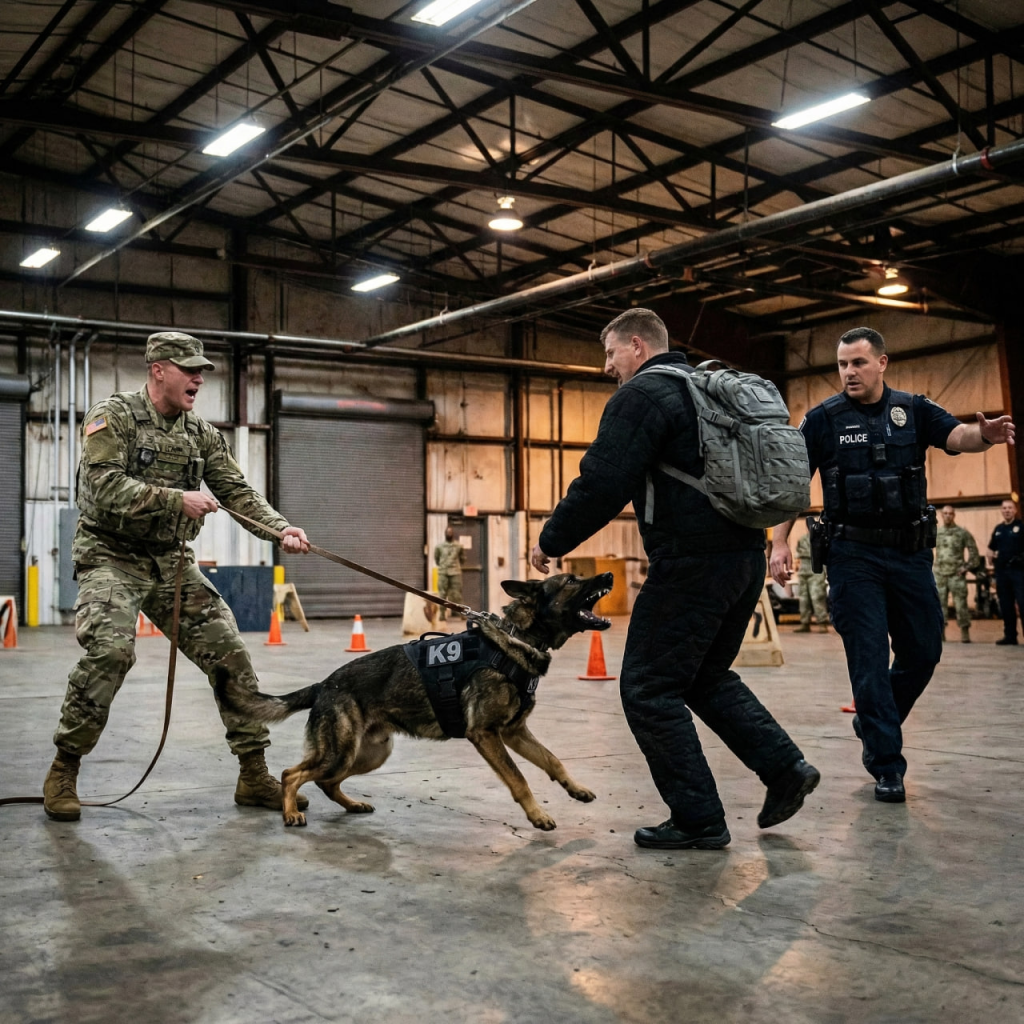
Mason had nodded, but he watched hands, not smiles. Atlas sat at heel until Keller stepped out of the second SUV carrying a dark brown leather duffel bag. Then the dog changed.
It was immediate.
Ears forward. Neck rigid. A low vibration in his chest that Mason felt through the leash before Atlas surged, not at the group, but straight toward Keller and the duffel. The bark that tore out of him was not confusion. It was a hard working-dog alarm, sharp and relentless. Mason locked the leash and gave a control command. Atlas hit a crouch, but he kept growling, eyes fixed on the bag as if nothing else in the world existed.
The delegation recoiled. Cameras flashed. Someone snapped, “Control your dog.”
Mason didn’t look at them. He looked at Keller.
The lieutenant had gone pale.
Only for a second. But Mason saw it. So did Major Wade, who stepped in before protocol could catch up with the moment.
“That’s enough,” Wade said. “Walk them through.”
“Sir,” Mason answered, keeping his voice level, “my dog is giving a live alert. I need to search the bag.”
Wade’s face hardened. “You need to follow my order.”
Mason complied because arguing in front of visitors would end his authority before he could use it. Atlas resisted for half a beat—another thing he never did—then came back to heel, still trembling with tension. As Keller passed, the lieutenant’s fear drained away and left behind something worse: relief.
That night Mason reviewed the checkpoint footage and found the camera angle covering Keller’s bag had been deleted from the server.
Then he checked the ordnance log.
Two pounds of breaching compound and six electronic detonators had been signed out last week for a demolition class that never took place—and the approval signature belonged to Sergeant Owen Fisk, the armory supervisor who had died in a supposed drunk-driving wreck twelve days earlier.
If Atlas had been alerting on explosive residue, why was a dead man’s name attached to missing charges—and why had Major Wade protected the one officer carrying the bag?
Mason did not file a complaint that night.
He knew better.
At Fort Ridgeline, accusations without hard proof had a way of circling back as career problems for the person who raised them. So he started where he trusted the facts: Atlas, the logs, and the scent.
At dawn he took the leash and walked Atlas past the checkpoint lane under the pretense of routine maintenance training. The dog ignored every vehicle marker, every tire track, every civilian smell baked into the concrete from the day before. Then Mason brought out the nylon gate stanchion Keller’s duffel had brushed during the VIP screening.
Atlas locked on instantly.
“Track,” Mason said.
The dog pulled him away from the main yard, behind the admin building, across a gravel cut-through, and toward an old breaching shed near Range Four that had been closed since the previous winter. The padlock on the outer chain was new. The hinges were not. Someone had been using the structure while keeping it officially sealed.
Mason photographed the door before touching it. Inside he found burned cardboard targets, empty military-issue blasting cap sleeves, a coffee thermos still warm enough to suggest recent use, and a dark stain near the floor drain that did not belong in a training shed. Atlas sniffed the stain, then the base of a steel locker, and sat.
Mason pried it open.
Inside were shipping foam, three evidence tags from the city bomb squad, and one blood-specked patch bearing the name tape FISK.
He stepped out immediately and made the call he had been avoiding.
Special Agent Tessa Morgan from Army CID arrived two hours later in an unmarked sedan with no patience for politics and even less for staged explanations. Mason showed her the deleted camera segment, the ordnance discrepancy, the shed, and Atlas’s checkpoint training record. Tessa listened, asked tight questions, and then told him the one fact that changed the whole shape of the case.
Owen Fisk’s “drunk-driving crash” had already bothered her.
His blood alcohol level was high, but the steering wheel injury pattern did not match the damage to his truck. It looked like a body placed after the fact. CID had opened a quiet review, then hit resistance from both base command and the city police liaison’s office. Mason’s checkpoint incident was the first piece that tied Fisk’s death to missing explosives.
By late afternoon, Mason had another lead. Owen Fisk’s widow, Lena, agreed to meet off base at a diner near the highway. She looked exhausted, angry, and past caring about the cost of either emotion.
“Owen told me three nights before he died that something was wrong with visiting-city inventory transfers,” she said. “He said one metro lieutenant kept bringing in a brown bag and leaving with cases that weren’t supposed to be leaving. He also said Major Wade told him to stop asking why a bomb-tech officer needed access to military breaching stock.”
Lena slid a storage-unit key across the table.
“Owen said if anything happened, this was insurance.”
The unit held exactly what Mason feared: a toolbox containing copied ordnance sheets, visitor entry logs, and a thumb drive labeled RANGE FOUR / DO NOT TRUST WADE.



On the drive were photos of Keller’s duffel open on a metal table. Inside sat det cord, detonation switches, military blasting caps, and stripped evidence-barcode stickers from city police property. Another folder contained video from a hidden phone camera. Owen Fisk whispered into frame while hiding behind stacked crates.
“They’re trading confiscated weapons and army breaching gear to a private contractor through joint-training exceptions,” he said. “Keller moves it. Wade clears it. If this gets out, they’ll say I was drunk before they say I was right.”
The final file was worse.
A license plate. A warehouse address at the municipal airfield. A note typed in all caps:
NEXT TRANSFER FRIDAY NIGHT / CIVIC MEDAL GALA / USE VIP ENTRY
Mason had barely finished reading when his own phone lit up with a direct order from Major Wade.
Report to command immediately. Leave the dog.
He looked through the diner window and saw two base security SUVs pulling into the lot.
Atlas rose beside his chair without being told.
And Mason understood what the order really meant: they knew Owen Fisk hadn’t kept the truth to himself—and now they were moving before Friday night arrived.
Mason did not report to command.
He left cash on the diner table, took the back exit with Atlas, and got into Tessa Morgan’s CID sedan before the first security SUV reached the front door. By then she had already seen enough from Owen Fisk’s storage unit to call the Bureau of Alcohol, Tobacco, Firearms and Explosives and loop in the Army’s explosives accountability office. If Major Wade and Lieutenant Ryan Keller were moving stolen ordnance through a “joint training” pipeline, this had gone far beyond a base disciplinary matter.
By evening, the target was clear.
The city’s annual Civic Medal Gala was being held inside a restored aircraft hangar on the municipal airfield, a polished event full of uniforms, donors, cameras, and enough public ceremony to make scrutiny feel impolite. Keller was scheduled to receive a leadership commendation. Wade was attending as military guest liaison. The private contractor named in Owen Fisk’s files, Black Arrow Recovery, was listed as one of the night’s sponsors.
Perfect cover.
Tessa’s plan was simple. Let the exchange begin. Catch the bag in motion. Tie the physical transfer to the documents before anyone could claim training confusion or undercover privilege. Mason’s role was limited but critical: Atlas would work the same odor profile from the checkpoint under formal evidentiary conditions. If the dog alerted again on Keller’s bag, it would corroborate Fisk’s records and strengthen probable cause for immediate search and arrest.
At 8:42 p.m., Keller arrived in dress uniform with the same dark brown leather duffel.
Mason saw Wade clock Atlas from across the hangar and knew the major understood the problem instantly. There was no anger on Wade’s face. Only the cold calculation of a man deciding how much time he had left.
Keller moved through the crowd toward a side corridor marked STAFF ONLY. A Black Arrow executive stepped out from a catering door. Wade drifted into position to block sightlines.
“Now,” Tessa said into her mic.
Mason and Atlas intercepted at the corridor mouth. The dog hit the scent before Mason even gave the cue. Atlas snapped into a hard alert—bark, lunge, sit, fix—every movement textbook and undeniable. Keller stopped walking. The Black Arrow executive turned to run. ATF agents came through both side doors at once.
“Bag on the floor!” Tessa shouted.
Keller hesitated just long enough to ruin himself. Wade reached for his radio, then for something lower at his waist. Mason saw the motion and moved, driving the major into the wall before the weapon cleared leather. Atlas hit controlled contact on Wade’s forearm, enough to lock the arm and stop the draw without tearing it apart. Wade screamed once, more in shock than pain.
Keller dropped the bag.
ATF opened it on camera.
Inside were military blasting caps, shaped breaching charges, detonation cord, two serialized rifle suppressors stripped of police evidence tags, and one sealed envelope containing cash payouts linked to three prior transfers. Tessa laid Owen Fisk’s copied logs beside the contents. The serial numbers matched.
Wade tried one last story. Joint operation. Sensitive transfer. Need-to-know. Tessa cut him off with a single question.
“Show me the authorization.”
There wasn’t one.
Within an hour, Keller, Wade, and two Black Arrow executives were in custody. Search warrants followed for Wade’s office, Keller’s city unit, and the off-airfield warehouse listed in Fisk’s files. Investigators found more stolen breaching material, seized firearms, falsified destruction forms, and accounting records showing the ring had been selling restricted equipment through staged training losses for nearly eighteen months.
Three weeks later, Owen Fisk’s death was reclassified from drunk-driving fatality to homicide.
Mason stood at the back of the memorial when that announcement came down. He did not say much. He didn’t need to. Atlas sat beside him, calm again, the same dog everyone had doubted for thirty seconds at a checkpoint until the evidence caught up to his nose.
Some people in uniform had tried to bury the truth under rank, reputation, and ceremony.
They would have succeeded too, if one military K9 had done the polite thing and stayed quiet.
He didn’t.
And that was enough.
If this story gripped you, comment your state and tell me: would you trust the dog, the handler, or both?