Rain pressed against the windows of the Harbor House Diner in thin gray sheets, making the pier outside look farther away than it was. At the counter, men in rubber boots ate in silence. At the booths, locals stirred coffee that had sat too long on warmers and talked only when they had to. In Grayhaven, Maine, bad weather usually meant patience. Lately it had meant something else—waiting to see what would be taken next.
Marlene Cross sat alone by the window in the same seat she had chosen for years, her coat brushed clean though the hem was frayed. She came for the view of the harbor and the habit of remembering. Her husband had once tied up before noon and walked through that diner door hungry, wet, and grinning. He had been dead eleven months now, found in cold water near Pier Nine, the sheriff calling it a boating accident before the body had even been fully examined.
Most people accepted what they were told. In Grayhaven, it was easier that way.
When Wade Granger came in, the room changed. He was not the richest man in town, but he acted like wealth had chosen him personally. He owned half the bait sheds, financed the new marina proposal, and liked being seen where people were trying to mind their own business. He stopped beside Marlene’s table and asked, loud enough for everyone to hear, whether she had reconsidered selling the old house by the pier.
Marlene looked up once. “No.”
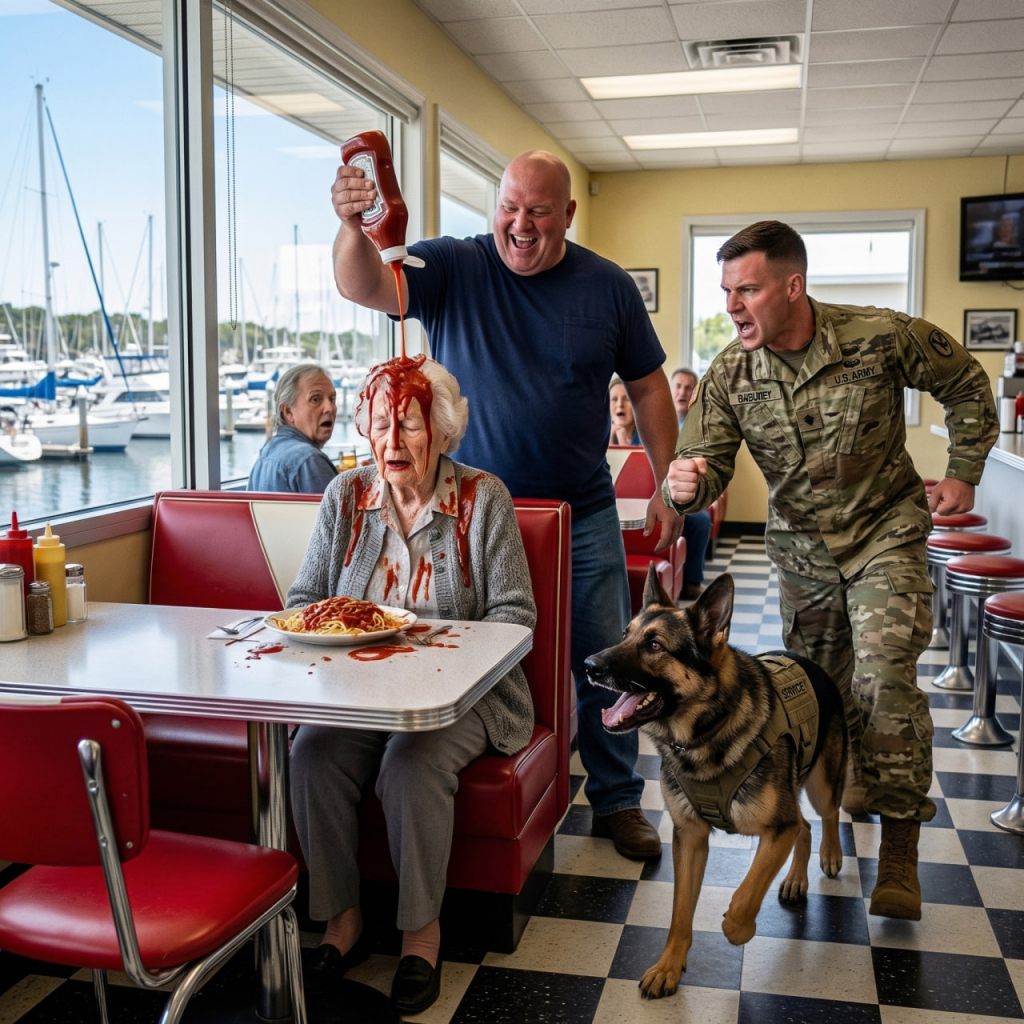
Wade smiled like he enjoyed resistance more than obedience. He mocked the peeling paint, the unpaid repairs, the idea that a widow needed all that waterfront alone. When she turned back to the rain, he picked up the bottle of cocktail sauce from her table and poured it over her hair and shoulders.
No one moved.
Tess at the counter covered her mouth. Doak the cook froze in the kitchen pass-through with a spoon in hand. The whole diner seemed to shrink around Marlene as the red sauce ran down the back of her coat and dripped onto the floor.
Then a chair scraped.
From the far booth, Jonah Cross stood up. He had his mother’s last name and his father’s size, and most of the town knew him even if they pretended not to. He had been gone for years, working private maritime security and then living quiet out west after his service. At his feet, an old German Shepherd named Bricks rose without barking.
Jonah walked to his mother, took off his jacket, and placed it over her shoulders. Only then did he look at Wade.
“Step back,” he said.
Wade laughed and kicked a chowder bowl off a nearby table, shattering it. Then he swung a boot toward Bricks, trying to draw a reaction. The dog did not lunge. He gave one deep, controlled growl and sat.
That unsettled everyone more than barking would have.
Sheriff Roy Talbot arrived minutes later without urgency, listened to Wade’s version first, then shrugged the rest away as misunderstanding and temper. Outside, in the parking lot, Wade leaned close enough for Jonah to smell whiskey and mint.
“Take her and leave town,” he said. “Or next time I start with the dog.”
That night, someone smashed the porch light at Marlene’s house, tampered with the water meter, and threw stones against the siding until dawn. Jonah fixed the line in bare hands while Bricks watched the yard without blinking. Just after sunrise, a deckhand slipped Jonah a memory card and a crumpled fuel receipt, muttered that cameras at the pier had been “failing” on expensive nights, and hurried away before anyone could see.
When Jonah opened the memory card, the last recovered clip showed his dead father on Pier Nine arguing with Wade Granger—while Sheriff Talbot stood five feet away and did nothing.
Then Bricks went rigid at the back door.
Someone was on the porch.
Jonah killed the lamp and moved through the house without speaking. Bricks was already facing the kitchen entrance, shoulders stiff, ears angled forward. Marlene set her coffee down so carefully it made Jonah more afraid than if she had panicked.
A knock came at the back door. Not hard. Deliberate.
“Mrs. Cross?” a man called. “Gas company. We got a complaint about the meter.”
Jonah looked at the clock. It was 5:18 a.m.
He stepped to the side of the door and lifted the curtain with two fingers. No utility truck. No uniform. Just a man in a rain shell, cap low, hands empty in the way armed men liked to pretend they were harmless.
Jonah opened the door fast enough to take away the man’s plan. “Try again.”
The stranger backed off one step. His eyes flicked to Bricks, then toward the road. “Wrong house.”
He left quickly, but not far. Jonah watched taillights idle at the end of the lane for almost a minute before turning toward town.
Marlene stood by the table, staring at the memory card still plugged into Jonah’s laptop. “Your father said he was going to the pier that night because someone asked him to check a broken winch,” she said. “I always thought that call felt rehearsed.”
Jonah replayed the clip frame by frame. Wade Granger, Sheriff Talbot, his father Daniel Cross in a storm coat, all at Pier Nine at 11:43 p.m. The camera jittered, glitched, then cut. The second file on the card held no video, only audio. Wind, boots on wet planks, Daniel’s voice angry and distant: You’re not moving that through my harbor. Then another voice: It’s not your harbor anymore. A heavy splash followed. After that, static.
Doak from the diner called an hour later and told Jonah to come through the alley, not the front.
In the diner’s back storeroom, Doak slid a ledger page across a flour sack. “Found it under an old register when the health inspector came through. Don’t ask me why I kept it. Maybe because I was tired of being a coward.”
The page listed late-night fuel sales to boats that had never officially left dock. Beside two dates was the same signature: R. Talbot. Another line showed diesel purchased for a refrigerated truck owned by Granger Marine Holdings on the night Daniel died.
By noon Jonah had three pieces of proof and one ugly question: why did Wade need Marlene’s house so badly?
The answer came from Gus Morrow, a lobsterman with bad lungs and eyes that never stopped checking windows. Jonah found him mending traps behind the bait shed.
“Your old place sits over the capped service tunnel from the cannery days,” Gus said. “Runs from the bluff behind your house to the cold-storage basement under Pier Nine. Been sealed on paper for twenty years. Not sealed in fact. Daniel found out they were using it after midnight—boxes in, boxes out, no Coast Guard logs, no customs, nothing clean about it. That’s why Wade wants every house on that stretch sold. Once he owns the shoreline, nobody asks what moves under it.”



“What was in the boxes?”
Gus looked sick. “Pills, mostly. Maybe cash on the way back. Enough money to buy silence wholesale.”
That night Jonah went below the pier with Bricks and a flashlight wrapped in red tape. The tunnel entrance behind the old boiler room had been reopened from the inside. Fresh boot prints, dolly grooves, torn pallet wrap, and a dropped pharmacy carton with serial numbers filed off the shipping label. Near the wall lay a cracked phone that belonged to Milo Sutter, the deckhand who had given Jonah the memory card.
Milo was found thirty minutes later in an abandoned bait freezer behind the ice plant, beaten but alive, hands zip-tied, mouth split open. Before the ambulance took him, he gripped Jonah’s sleeve and whispered, “Talbot’s got copies of forged code violations. They scare owners, then Wade offers cash. Your mother’s house is last one holding the tunnel line.”
By morning, Jonah had copied everything twice and sent one package to a state investigator he trusted from an old coastal task force. He kept the other in a metal toolbox under Marlene’s sink.
Sheriff Talbot arrived before lunch with two deputies and a paper in his hand. He announced that Marlene’s home had been declared unsafe after “anonymous structural complaints” and would be subject to emergency seizure if she did not vacate within forty-eight hours.
Marlene read the notice, lifted her chin, and asked one question. “Who signed this before the inspector even came?”
Talbot’s face tightened for the first time.
Across the yard, more neighbors had gathered than Jonah expected. Tess from the diner. Doak in his stained apron. Gus with his cap in both hands. No one spoke yet.
Then Wade Granger pulled up, stepped out smiling, and told Marlene he’d still buy the property—cheap, today, out of pity.
Jonah took one step toward him.
From the crowd, a voice finally broke. Then another. Then three more.
And for the first time in years, Grayhaven stopped looking away.
People did not become brave all at once. Jonah knew that. Courage usually arrived in pieces: a sentence spoken too late, a document handed over with shaking fingers, a witness deciding he was more tired of fear than afraid of consequence. In Marlene Cross’s yard, with the rain finally thinning and Sheriff Talbot standing there with false paperwork in his fist, Grayhaven began changing by inches.
Tess spoke first. She told Talbot she had watched Wade dump cocktail sauce over Marlene in the diner and watched the sheriff call it nothing. Doak stepped beside her and handed over copies of the fuel ledger page. Gus Morrow followed with the old cannery survey that marked the service tunnel under the waterfront homes. One of the harbor clerks, a woman Jonah barely knew, raised her phone and said she had six months of marina invoices showing construction materials billed for a project that had never legally broken ground.
Talbot tried bluster. Then warning. Then the old local trick of making decent people feel foolish for speaking too loudly. It failed because too many had already started.
Wade Granger looked from face to face and understood what was happening before Talbot did. Fear was no longer organized.
He smiled anyway. “You all think paper changes anything?”
Marlene stepped down from her porch, sauce stains gone now, grief still present but no longer bowed under it. “No,” she said. “People do.”
Wade’s expression hardened. He walked closer to her than Jonah liked and lowered his voice, though not enough. “Look around,” he said. “Nobody’s stopping me.”
He was wrong, and the roomless sky over the yard proved it a second later. Phones lifted. Cameras pointed. Deputy Larkin, younger than the others and pale as chalk, did not move to help Wade. Instead he looked at the forged notice in Talbot’s hand and said, quietly but clearly, “Sheriff, that form number was retired last year.”
Talbot wheeled on him. “You work for me.”
Larkin swallowed. “Not like this.”
That was the crack. Once it opened, the rest came fast.
Jonah brought out the toolbox from beneath the sink and spread the copies on the hood of Wade’s truck: the memory card stills, the fuel records, the survey map, the recording of Daniel Cross’s last argument on Pier Nine. Milo Sutter, bruised and stitched but stubborn enough to arrive from the clinic wrapped in a blanket, added the last piece. He said Wade’s men had used the tunnel to move pill shipments from offshore transfers, and Talbot kept patrol cars off the pier on delivery nights. Daniel had caught them. He had threatened to go federal. He never made it home.
Talbot lunged for the papers. Bricks stepped between him and Jonah, silent except for one low growl that stopped everybody cold.
Wade made a different choice. He ran.
He sprinted toward the bluff road leading down to Pier Nine, where his thirty-foot lobster boat sat fueled and ready. Talbot took two steps after him, then stopped when he saw three different phones tracking his face. Jonah ran harder. Bricks kept pace beside him, old but still sure-footed. Behind them came half the town, not as a mob, but as witnesses who had finally decided visibility mattered.
Wade reached the pier, untied the stern line, and shoved the boat off with one foot. Jonah hit the dock just as Wade swung a gaff hook. Jonah blocked it with his forearm, pain flashing hot, then drove Wade into a stack of bait crates. The boat drifted half-free, engine coughing. Wade grabbed for the throttle. Bricks leaped onto the dock edge, barking now, forcing Wade to turn. That hesitation lasted only a second, but it was enough for Jonah to wrench the keys free and throw them into the harbor.
By the time state troopers arrived—summoned hours earlier by the package Jonah had sent—the whole town was there.
Wade Granger was arrested on the pier he had tried to own. Sheriff Talbot was led away beside him, shoulders smaller without the badge’s protection. Federal investigators later tied the tunnel operation to a regional pill-trafficking line, land fraud, forged municipal notices, and Daniel Cross’s homicide. The marina project collapsed. Several seized properties were returned. Others never had to be sold after all.
Weeks later, Marlene sat again by the diner window, coffee warm, harbor gray, but the room behind her different. People met her eyes now. They spoke first. They did not pretend not to know her son.
Jonah stood outside with Bricks, looking over the pier where his father died and where the silence finally broke. Grayhaven was still a worn town with rain in its bones and money problems it could not solve overnight. But fear no longer lived there rent-free.
And sometimes that is how a place begins again.
If this story hit hard, comment your state and tell me: who showed the most courage when the whole town finally stood up?