The storm came down so fast over the Wyoming high country that the road seemed to disappear while Caleb Danner was still driving on it.
At thirty-eight, Caleb had learned to trust weather the same way he trusted men with weapons: respect it early, or pay later. He kept both hands steady on the wheel of his old pickup and leaned toward the windshield, following the last faint grooves left by county plows before the snow erased even those. He had promised a winter supply drop to a ranch family beyond Miller’s Gap, and men like Caleb tended to keep promises even when no one was around to punish failure.
In the passenger seat, his retired military German Shepherd, Boone, lifted his gray-muzzled head and whined once.
Caleb ignored it at first.
Then Boone pawed the dashboard.
That got his attention immediately.
The dog had only ever used that signal in one context: hidden danger.
Caleb pulled the truck onto the shoulder and killed the engine. Boone was out before the door fully opened, limping through knee-deep snow with his nose low and his body tight. Caleb followed with a flashlight and an emergency blanket tucked under one arm, muttering under his breath that whatever this was had better justify freezing to death in a churchyard.
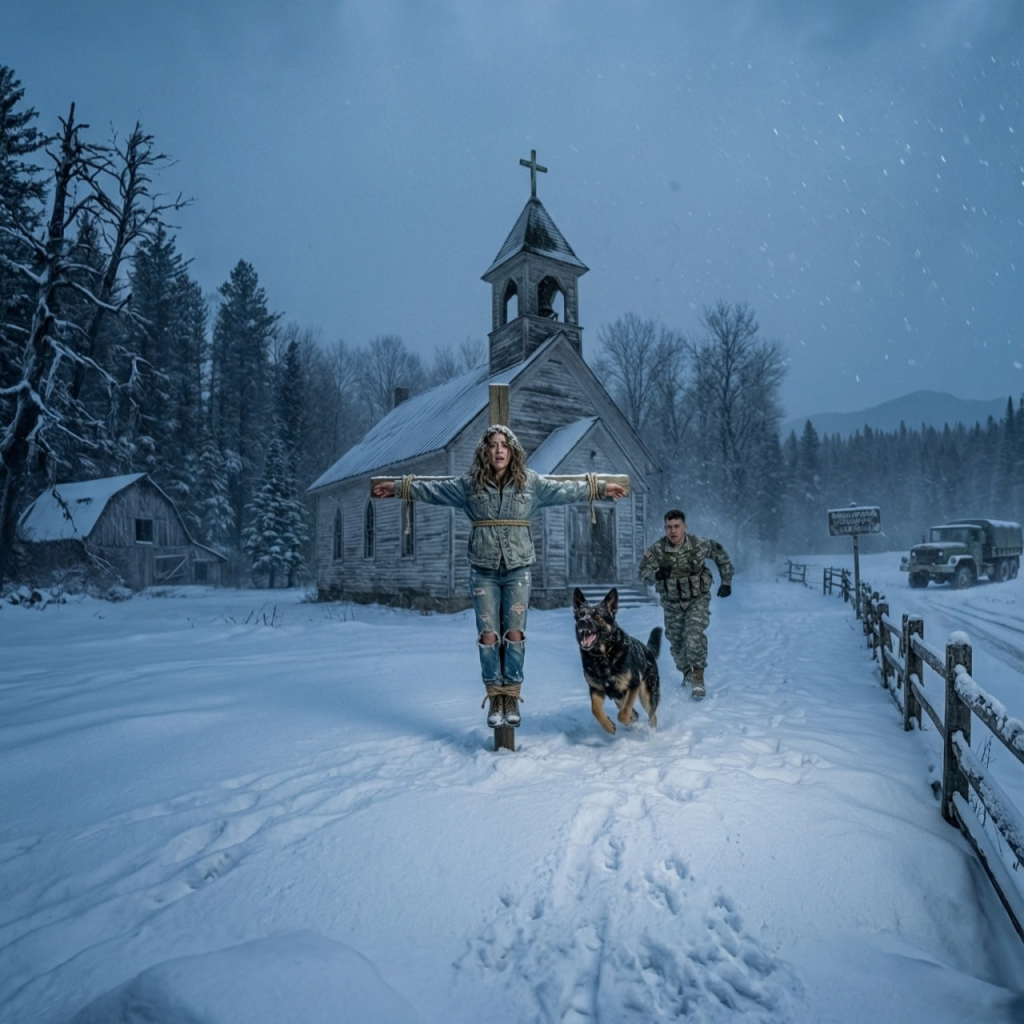
The abandoned church emerged out of the white like something forgotten on purpose.
Its bell tower leaned. The front doors were chained. One stained-glass window had long ago blown out and been covered with warped plywood. The place looked dead until Boone stopped near the side wall and growled at a drift piled against the stone foundation.
Caleb dug.
A glove appeared first. Then a sleeve. Then the pale, bruised face of a woman half-buried in packed snow, wrists tied behind her, ankles bound, lips split with cold. She was alive only because winter had not yet finished the work someone else had started.
Near her shoulder lay a torn Bible, soaked through and forced open. Across the inside cover, someone had written in block letters:
SILENCE KEEPS THE TOWN CLEAN.
Caleb felt something old and hard settle behind his ribs.
Not panic. Recognition.
He cut the rope from her ankles, wrapped her in thermal layers, and checked her pulse with gloved fingers. Weak, but there. Boone pressed in close, sharing what body heat he could, eyes fixed on the tree line as if he expected company.
On the drive back to the cabin, the woman surfaced only once, enough to whisper, “Sarah Wynn.”
Then she went silent again.
By the time Caleb got her inside, had the stove burning hot, and the ropes off her wrists, Boone had already moved to the back window and started barking—once, twice, sharp and certain.
Caleb pulled back the curtain.
Fresh boot prints were forming in the snow outside his cabin.
Whoever had left Sarah to die at the church had not trusted the storm to finish the job—and now they were coming to finish it themselves.
Caleb did not panic when he saw the boot prints.
Panic belonged to men who had not rehearsed bad outcomes in their heads for years. He simply let the curtain fall, checked the rifle above the mantle, and turned back toward the woman he had dragged in from the snow.
Sarah Wynn sat propped against the couch beneath three blankets, her face still gray with cold but her eyes sharper now. She had the look Caleb had seen before on extraction targets and survivors—people who had passed through terror and come out the other side stripped down to focus. Boone remained at her feet, not affectionate, exactly, but locked onto her as if she had been assigned to the pack five minutes ago and that was already enough.
“You have maybe thirty seconds before I decide whether I’m defending a stranger or stepping into someone else’s blood feud,” Caleb said. “Make them count.”
Sarah took one shallow breath. “I’m a bookkeeper for Hollow Creek Community Outreach.”
The name meant nothing to him.
“It’s not a charity,” she continued. “It’s where they clean money. County contracts, church donations, opioid settlement funds, relief grants—anything that can move under the cover of helping people. The church was one of their old sorting sites before they burned the records room.”
Caleb’s expression did not change. “Who’s they?”
Her answer came fast. “Councilman Reed Talbot. Sheriff’s brother-in-law. Pastor Nolan Wren. A hauling company owner named Dennis Pike. Maybe more. I found duplicate ledgers. Real numbers and public numbers.” She held up her bruised wrists. “I copied some of it. They found out.”
That explained the bindings.
Not the church.
“Why leave you alive at all?” Caleb asked.
Sarah looked toward the stove, then back at him. “Because dead in a blizzard looks different from murdered in town.”
That tracked.
Boone barked again, lower this time. Closer.
Caleb killed the overhead lamp and moved to the side wall. Through the edge of the shutter he counted at least three figures near the tree line. One stayed back by a truck. Two were advancing carefully, the way men do when they believe fear is already softening the target for them.
Sarah saw his face and understood. “They won’t stop,” she said.
“No,” Caleb replied. “They won’t.”
He handed her a revolver from the lockbox under the table. Her eyebrows lifted.
“I don’t know if I can hit anything,” she said.
“You don’t have to hit everything,” Caleb told her. “You only have to make them regret coming through that door.”
That drew the faintest breath of humor from her, gone as quickly as it came.
The first knock arrived exactly one minute later.
Not frantic. Not uncertain. A measured rap of knuckles against old pine, followed by a male voice pitched into false patience.
“Miss Wynn? County assistance. We heard there may be a stranded motorist.”
Caleb did not answer.
The voice came again. “We’re here to help.”
Sarah’s mouth hardened. “That’s Dennis Pike.”
Of course it was.
Caleb stepped into the center of the room, rifle visible but not raised. “You can help by walking away.”
Silence answered first. Then a laugh from outside.
“Whoever’s in there,” Pike said, “you don’t want trouble over a woman who stole from decent people.”
Sarah’s voice cut through before Caleb could stop her. “You mean I copied what you were hiding.”
The porch boards creaked.
Then came the line that told Caleb everything about how this would end.
“We can still be kind,” Pike said. “Open the door, hand her over, and none of this needs to touch you.”
Caleb almost smiled.
Men who say that are already planning where to bury you.



The first shot punched through the window beside the kitchen sink and shattered the plate rack. Boone lunged toward the sound. Sarah flinched but did not scream. Caleb dropped to one knee and returned fire through the frame, forcing one of the men off the porch. Cursing erupted outside. Another round tore into the log wall near the stove.
So that was the negotiation finished.
What followed was quick and ugly. Caleb used the cabin the way he had once used ruined buildings overseas—angles, silence, movement, denial. Boone held the rear hallway and nearly took the arm off the first man who tried the back door. Sarah fired once through the porch shadow and, whether by skill or fury, clipped somebody hard enough to send him crashing down the steps.
Then Caleb made the decision that changed the night.
He remembered the old battery-powered live feed camera he had mounted over the supply shed after a black bear broke into his fuel cans the previous spring. The system uploaded through a storm-hardened satellite link to a remote account he barely used. If it was still working, then every face outside, every voice, every threat, every shot fired at his cabin could become something much harder to bury than a dead woman in church snow.
He slid to the side desk, powered the receiver, and saw the screen flicker alive.
Still recording.
He turned the feed outward and whispered, “Now we see whether your clean town likes watching its own men hunt witnesses.”
But even as the stream went live, truck headlights appeared from the lower road.
Not one truck.
Two.
The men outside had called reinforcements—and Caleb suddenly realized this was bigger than one councilman’s money laundry.
Because one of the arriving vehicles was a county sheriff’s unit.
The moment Caleb saw the sheriff’s unit roll through the snow, the whole shape of the fight changed.
Until then, he had allowed himself the possibility that Dennis Pike and his crew were local predators operating around compromised officials. Corrupt, violent, dangerous—but still small enough to isolate. The county vehicle erased that comfort. Whatever Sarah had found was not merely protected by power.
It was part of power.
The cruiser stopped forty yards below the cabin. No lights. No siren. Just engine idle and patience. A deputy stepped out wearing winter tactical gear, rifle low, posture relaxed in a way honest lawmen do not wear when approaching gunfire in a blizzard. He called up toward the house.
“Mr. Danner, this is Deputy Colin Talbot. We’re taking over from here.”
Sarah went pale under the blankets. “That’s Reed Talbot’s nephew.”
Caleb’s jaw tightened. “Of course it is.”
He moved to the side window camera monitor and checked the live feed. The upload indicator was still green. Good. At least one thing on the mountain still answered to reality. He angled the exterior microphone higher and let the system keep transmitting.
“Deputy Talbot,” Caleb called back, “if you’re here to help, arrest the men shooting at my house.”
Talbot didn’t even pretend very hard. “You’re sheltering a thief and interfering with county operations.”
Sarah gave a bitter laugh from the couch. “County operations. That’s rich.”
Boone stood at the back door with hackles raised, old body rigid despite the limp that came in cold weather. Caleb knew the dog didn’t have many fights left in him. That made every sound outside matter more.
Talbot’s men repositioned. Pike’s crew stopped acting like freelance thugs and started moving with confidence again now that a badge had joined the circle. One of them dragged the wounded porch shooter downslope. Another carried a fuel can.
They were going to burn the cabin.
That told Caleb they had run out of ideas clean enough to explain later.
He dropped beside Sarah and set a second magazine within her reach. “Can you move?”
She tested her weight, winced, nodded. “Enough.”
“Good. There’s a root cellar hatch under the pantry rug. If the walls light up, you go down it.”
“You?”
“I’ll be right behind you.”
It was a lie, and they both knew it.
Then the first bottle hit the porch.
Flame rolled across the boards, orange and hungry against the white storm. Smoke pushed under the eaves. Boone barked once, vicious and furious. Sarah moved for the hatch, then stopped when the camera monitor flashed motion at the lower road.
A third set of headlights.
Different vehicle. Larger. Plow chains.
Then a fourth.
The live feed had reached someone.
Later they would learn exactly who: a volunteer fire captain in Miller’s Gap watching storm cameras from home, a rancher who recognized Pike’s truck on the stream, and a state reporter in Casper who clipped the footage before anyone could kill the feed. But in the moment, all Caleb saw was uncertainty spread through the men outside as two civilian trucks and one state highway patrol unit came up the road far too fast for comfort.
“Now,” Sarah whispered.
Caleb acted instantly.
He kicked open the side door and sent one precise shot into the fuel can in Pike’s hand. The container burst sideways, dumping fire into snow instead of onto the porch. Boone launched past him and drove the nearest attacker into the drift. Sarah, from the shadow of the doorway, shouted at full force into the live microphone mounted outside:
“My name is Sarah Wynn. Reed Talbot and Dennis Pike are trying to kill me because I found the stolen ledger in Hollow Creek Outreach.”
That did what bullets couldn’t.
It made secrecy impossible.
Deputy Talbot turned toward the camera tower on instinct, saw the red recording light, and understood far too late that the storm had not hidden him. It had broadcast him. He made the worst choice of the night and raised his rifle toward the camera mast. The highway patrol unit coming up the road saw it too and lit the whole mountain blue.
“Drop the weapon!” a trooper shouted.
Talbot fired once.
The return fire dropped him into the snow.
Everything broke after that. Pike ran. One of his men surrendered immediately. Another tried to take Boone with a boot and got his forearm torn open for the effort. Caleb moved downslope through smoke and snow, cut Pike off near the split rail fence, and put him face-first into the drift hard enough to keep him there until the troopers arrived. Sarah came down the porch steps on shaking legs, revolver still in hand, and watched the men who had left her for dead finally run out of ways to own the story.
By dawn, the ledger was recovered from where she had hidden it inside the church bell cavity. It named the whole machine—falsified relief contracts, diverted church funds, hush payments, opioid settlement theft, property laundering through the outreach office, and sheriff’s office protection stamped over each dirty path like holy approval. Reed Talbot was arrested before noon. Pastor Nolan Wren followed by evening. Dennis Pike took two days to start talking and three hours to start naming bigger people once he realized the live stream existed in a hundred saved copies.
The town did not stay clean.
That was the real lesson.
It had only looked clean because good people had been taught to keep quiet and snow had a way of making burial feel permanent.
Months later, when the church was finally condemned and the county board tried to speak in careful tones about healing, nobody used the word silence anymore without remembering what it had nearly cost. Sarah Wynn entered witness protection for a time, then came back under federal protection to testify. Caleb rebuilt the porch but kept the scorch marks on one beam. Boone slowed with age but not with dignity. He still checked the tree line every night as if the mountain might someday need one last answer from him.
And maybe it would.
Because the men who came without badges had believed they were hunting easy prey.
Instead they found a veteran who understood fields of fire, a witness who refused to die quietly, and an old dog who remembered that some things are worth standing in the doorway for, no matter how cold the night gets.
Like, comment, and share if courage, truth, and protecting the vulnerable still matter in America every single day.