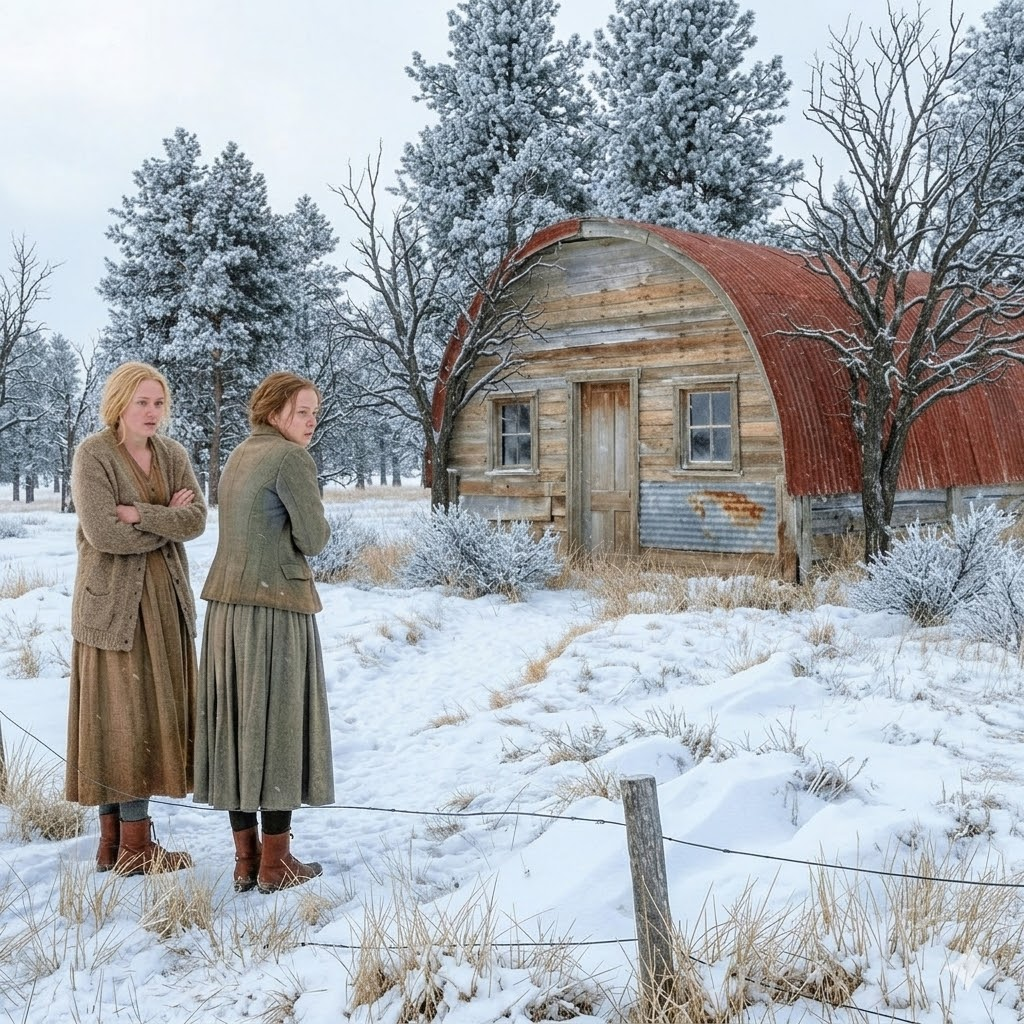
The church ladies tried to help. They offered to place the girls with different families “just until things improve.”
Hannah thanked them.
Lucy thanked them too.
But when the women left, the sisters sat in silence. They both understood what it meant.
Separate rooms. Separate lives.
A slow drifting apart.
One cold afternoon near the end of January, Mister Brennan called them to the counter. His face looked heavier than usual.
“An old trapper froze on the road last night,” he said quietly. “Name was Owen Pike.”
The girls listened.
“He had a shack out past Cedar Ridge. County’s putting the land up for back taxes.”
Hannah looked up.
“How much?”
“Forty dollars.”
The word landed in her chest like a stone.
Forty dollars was everything they had saved. Every coin wrapped in cloth and hidden inside their trunk.
Mister Brennan rubbed the back of his neck.
“His place ain’t much,” he added carefully. “Just a curved tin-roof shelter. No well. No road. Barely standing.”
That night the wind rattled the wooden boards of the store.
Lucy sat on the edge of the bunk, arms around her knees.
“If we stay here,” she whispered, “they’ll split us up.”
Hannah nodded.
She could already see it in her mind—Lucy in someone else’s kitchen washing dishes, herself sewing by a stranger’s window.
“And if we go there?” Lucy asked.
Hannah closed her eyes.
She imagined open land, endless wind, a roof that might not hold, and a door that might not shut.
Then she looked at her sister.
“We stay together,” she said.
The next morning they walked to the county office through ankle-deep snow.
The clerk showed them a faded map. One lonely square of land sat miles from town.
“Are you sure?” he asked.
Hannah signed the paper with their father’s last name.
Lucy stood beside her.
Outside, the sky stretched wide and pale above the frozen world.
They had chosen cold over separation.
They had chosen risk over disappearing.
But they did not yet understand what that choice would demand.
The walk to their land took most of the day.
They left before sunrise, dragging their trunk behind them on a borrowed sled. The winter sky was empty and pale, making the world feel larger and lonelier than ever.
Their breath turned white in the air.
By noon their legs burned.
Lucy’s palms bled where the rope cut into them.
“I’m fine,” she insisted when Hannah offered to stop.
They followed the landmarks the clerk had described—a split fence post, a crooked cottonwood tree, and the frozen bed of a dry creek.
When they finally saw the structure, Hannah felt her stomach drop.
The shack sat alone in the middle of the plain.
It looked like a bent loaf of bread.
The roof curved from one side to the other in a single sheet of rusted metal. The wooden walls bowed inward. Two tiny windows stared out across the empty land.
“That’s it?” Lucy asked.
“That’s it,” Hannah said.
The wind moved freely across the open prairie. There were no trees, no barns, no neighbors.
Only silence.
Hannah lifted the wooden plank that barred the door.
The hinges screamed when she pushed it open.
Inside, the cold felt like stone.
A beam of light slipped through a crack in the roof, illuminating dust drifting slowly in the air.
The room was larger than it looked from outside.
There was a dirt floor frozen solid as brick. Against the back wall stood a small iron stove with a crooked pipe pushing through the ceiling. A wooden bunk leaned to one side, and a rough table stood beside three empty crates.
Lucy shut the door behind them.
“It’s colder in here than outside,” she whispered.
Hannah ran a hand along the curved wooden ribs that supported the structure.
“It’s standing,” she said quietly.
“That counts for something.”
They went outside and searched the land.
At first there seemed to be nothing—only brittle grass and snow.
But farther east they discovered a shallow gulch where several old cottonwood trees lay fallen and dry.
Wood.
They worked until the light faded.
Lucy held branches steady while Hannah sawed through them with a rusty bow saw they had found inside one of the crates.
When Hannah’s arms gave out, Lucy took the saw.
When Lucy staggered, Hannah lifted the wood.
By nightfall a small pile of firewood leaned against the shack’s door.
Inside, Lucy cleaned the ashes from the stove while Hannah tightened the loose pipe joints with wire.
They tore pages from an old almanac to use as kindling.
Hannah struck the flint.
For a moment nothing happened.
Then a spark caught.
The paper flared.
The wood cracked softly.
Smoke curled upward before finally finding its way through the crooked pipe.
Slowly, uncertain waves of heat spread through the frozen room.
That night they slept fully dressed on the crooked bunk, pressed close together.
Outside, the wind clawed at the metal roof.
It groaned and shifted like something alive.
But the fire burned.
And the shelter held.
Morning light revealed just how much work remained.
Cold air slipped through cracks in the metal walls. The dirt floor was frozen solid. The roof sagged near the stove pipe.
Lucy shivered.
“This place wasn’t meant for winter.”
“No,” Hannah said.
“But we can change it.”
They studied the structure carefully.
The wooden ribs were strong. The shack faced south, catching what little sunlight winter offered.
“It has bones,” Hannah said.
Lucy pointed at the ground.
“Cold comes up from below.”
Hannah nodded.
“Then we stop it.”
They found a broken shovel outside and began chipping at the frozen soil.
The work was brutal.
Each strike sent painful vibrations up their arms.
But they carried the chunks of earth inside and placed them near the stove where the heat softened them.
Then they spread the dirt across the floor, pressing it flat with their boots.
Layer by layer, the ground grew thicker.
At night they sprinkled melted snow across the surface so it would freeze solid.
After four days the floor felt different—hard, steady, insulated.
The cold rising from below weakened.
Lucy then noticed the walls.
“They leak heat,” she said.
Thin cracks of daylight showed between the metal panels.
Lucy looked across the prairie.
“My granddad once talked about sod houses,” she said slowly. “People cut blocks of earth and stack them like bricks.”



Hannah stared at her.
“You think we could do that?”
Lucy shrugged.
“We don’t have anything else.”
So they began cutting sod.
Three lines with the shovel. A careful lift. A heavy block of grass and roots came free.
They carried each piece to the shack and stacked them along the outer walls.
One row.
Then another.
They packed loose soil between every gap.
Cut. Lift. Carry. Set. Pack.
Day after day.
By the end of the week the wind no longer whistled through the walls.
The stove’s heat stayed inside.
For the first time, the shack felt almost warm.
By early March the shelter had transformed.
The sod walls climbed halfway up the curved metal roof.
Inside, the bunk was stuffed with dried grass. They had sewn rough mattresses from old feed sacks.
It was not comfortable.
But it was warm.
Then one morning the sky changed.
The color shifted to dull iron.
A bitter wind arrived from the north.
Hannah was cutting sod when she saw it.
A wall of white moving across the horizon.
“Lucy!” she shouted.
Lucy stepped outside and froze.
A blizzard.
They had less than an hour.
They dragged every piece of firewood inside. Pots were filled with snow for water. Cracks were sealed with mud.
Then they barred the door.
The storm struck like a living thing.
Wind screamed across the curved roof. Snow slammed against the metal walls.
They fed the stove constantly.
The iron glowed red.
The world outside vanished.
For two days they lived by candlelight.
They slept in short shifts so the fire would never die.
On the third morning the wind finally stopped.
Hannah pushed against the door.
It would not move.
Snow had buried it.
They dug their way out through a narrow tunnel.
When Hannah finally broke through, sunlight flooded in.
The prairie had become a frozen ocean of snow.
Then Hannah saw something else.
Smoke rising toward town.
Dark smoke.
Too thick for a stove.
They packed food into a sack and began the long walk back.
The snow reached their thighs.
By the time they reached town, chaos filled the streets.
The church roof had collapsed during the storm.
The fallen stove inside had started a fire.
Now dozens of families had nowhere to go.
Night was approaching.
Hannah stepped forward.
“Our place is standing,” she said.
A tired man laughed.
“That tin shed?”
“It’s warm,” Lucy said firmly.
The town constable studied them.
Then he nodded.
“I’ll go with them.”
Soon a wagon carried children and elderly people.
Others followed on foot.
Hannah and Lucy led the way across the frozen prairie.
The journey lasted until dusk.
When the shelter finally appeared in the distance, many people stopped in surprise.
The crooked shack they remembered was gone.
Now thick sod walls wrapped around it.
Smoke rose steadily from the chimney.
Warm light glowed through the windows.
Hannah opened the door.
Heat rushed out into the cold air.
One by one, the townspeople stepped inside.
Families sat shoulder to shoulder.
Children slept under blankets.
The stove roared.
For three days the shelter became the town’s refuge.
When the roads were finally cleared, people returned home.
But they did not leave empty-handed.
They left gifts.
Flour.
Ham.
Candles.
Tools.
A blue quilt.
When the last wagon disappeared over the snowy rise, the prairie grew quiet again.
Lucy looked at Hannah.
“We could move back to town now,” she said.
Hannah studied the little house they had built with dirt, sweat, and stubborn hope.
It had held against the storm.
“I think I want to stay,” she said.
Lucy smiled.
“Me too.”
That spring they would dig a well.
They would build a chicken coop.
They would plant a garden where the sod had been cut.
The land would soften.
And so would their lives.
But that night they closed the door of their small shelter.
The fire burned steady.
The walls held the warmth.
And for the first time since they lost everything, Hannah and Lucy knew something important.
They had not disappeared.
They had built something.
And when the storm came, that small crooked house had become a refuge—not just for them, but for everyone.
Sometimes the strongest homes are not built with perfect wood or straight walls.
Sometimes they are built with courage.
And two people who refuse to face the cold alone.