By the time Verónica leaned toward my ten-year-old son and called him “sweetheart,” my fork was already trembling over my plate.
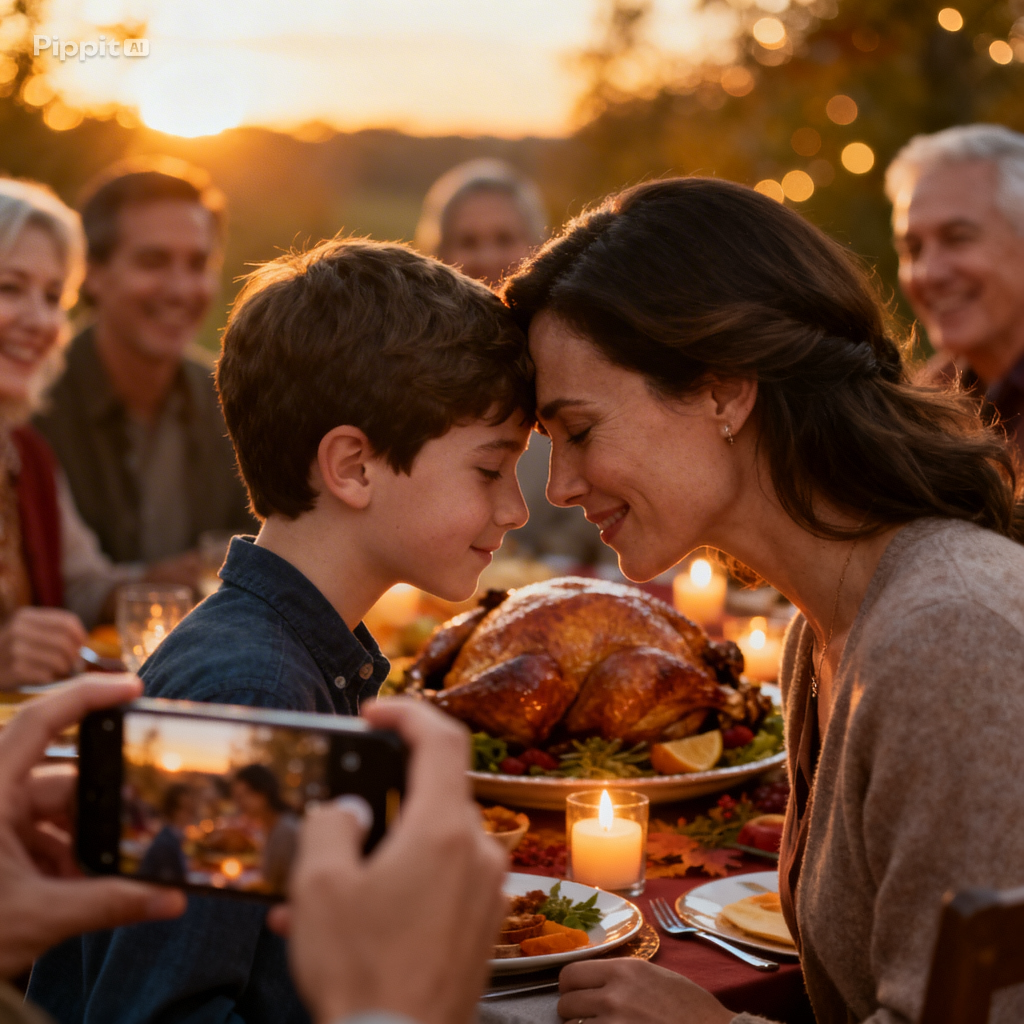
—Sweetheart —she said, loud enough for the whole table to hear—, the Thanksgiving turkey is for family.
And then she did it: she slid the turkey platter away from Mateo, as if he had tried to grab the centerpiece instead of dinner.
Someone let out an awkward giggle. One of my uncles gave a short, nervous laugh—the kind people make when they know they shouldn’t laugh, but don’t want to be the only one who doesn’t.
My mom lowered her eyes to her wine glass. My dad kept carving the turkey, pretending he hadn’t heard anything. As if, by not looking up, the moment wouldn’t exist.
Mateo froze with his plate halfway extended, his hand suspended in the air. His ears turned pink. He stared down at the tablecloth—the one with little orange leaves that my mom only brought out for “special occasions.”
He didn’t protest.
He didn’t say, “I am family.”
He simply pulled his plate back slowly, looked at the small, dry spoonful of mashed potatoes on it, and swallowed. I felt that heat behind my eyes and a knot in my chest, like someone had tightened a rope around my ribs.
My first impulse was to stand up, flip the table, smash the turkey against the wall, and scream until every person sitting there had to look at themselves.
Instead, I stayed very still.
Verónica laughed and moved the turkey platter closer to her own children.
—You can have more mashed potatoes, Mateo —she added, as if she were being generous—. You already had pizza at your dad’s house this week, didn’t you? You’re not missing out on anything.
Mateo nodded quickly.
—Yeah, it’s okay.
His voice came out small. Too small for ten years old.
I looked around the table, waiting for someone—anyone—to say something. My mom cleared her throat as if she was about to step in, but Verónica interrupted her with a bright, brittle smile.
—Oh, relax. It’s just a joke. He knows we love him.
That word—joke—did what it always does in my family: it took something cruel and tried to cover it with perfume.
People shifted in their chairs. Someone clinked their glass. The conversation moved on as if nothing had happened.
But it had.
Mateo kept staring at his plate as if he knew that if he looked up and met my eyes, everything would become real.
I pushed my chair back. The scrape against the tile floor was louder than I expected.
—Hey, champ —I said, standing up. My voice sounded calmer than I felt—. Grab your hoodie.
He blinked.
—Are we leaving?
—Yes. —I held out my hand. It was sweaty—. Let’s go.
At first, no one spoke. Then my dad finally looked up, the knife still suspended in the air.
—Lucía, we were just about to serve.
I didn’t look at him.
—Mateo —I repeated—. Your hoodie.
Verónica let out that sharp laugh I’ve known since we were girls—the laugh she always used when she found a way to turn us into the joke.
—Are you really going to leave over a little turkey?
I paused for a second before opening the door.
I looked at her for the first time since it had started.
—No —I replied calmly—. I’m leaving because of my son.
The house fell silent. The kind of silence that weighs more than any scream.
I took Mateo’s hand and we walked out. The November air in Guadalajara was cool, smelling of firewood and dry leaves. We walked to the car without speaking. When I closed the door, he was staring at his sneakers.
—Mom… it’s okay. I wasn’t that hungry.
That’s when something inside me broke a little.
I leaned over and gently lifted his chin.
—Listen to me carefully, Mateo. Never let anyone make you feel like less. You are enough. You are my family. Always.
His eyes filled with tears, but this time he didn’t look down.
That night we ordered tacos al pastor from a stand near Chapultepec. We sat at a little plastic table under yellow lights. He ordered double meat. I said yes. We laughed. We talked about his soccer tournament. We made plans.
And as I watched him eat happily, I made a decision.
Because what no one at that table knew was that for the past three years, I had been paying Verónica’s mortgage.
When her husband lost his job, it was “temporary.” When they piled up debt, it was “just until they got back on their feet.” I never mentioned it at family gatherings. I wasn’t looking for recognition. I just wanted them to be okay.



But that night I understood something: helping doesn’t mean allowing humiliation.
The following Monday, I called the bank.
—I want to cancel the automatic payments —I said firmly.
The representative asked if I was sure.
—Completely.
With that same money, I booked a trip.
The Bahamas.
First class. Oceanfront resort. Snorkeling. Four nights. Twenty-three thousand dollars in total.
I didn’t do it to show off. I did it because I could. Because I had worked hard. Because my son deserved memories bigger than a table where he was denied food.
The following week, I posted the photos.
Mateo smiling on the plane, oversized headphones on.
Us on the beach—white sand, turquoise water.
Him holding a starfish, his eyes shining brighter than I had ever seen.
My phone started buzzing almost immediately.
“How can you afford that?”
“Since when do you travel like that?”
“Didn’t you say you were tight this year?”
But the call I was expecting came twenty minutes later.
—Lucía —Verónica said, without greeting—. What’s going on? The bank called. The payment didn’t go through. Was there a mistake?
I adjusted myself on the lounge chair while Mateo built a sandcastle.
—It wasn’t a mistake.
Silence.
—What do you mean it wasn’t a mistake?
—I decided to pause the help.
Her breathing changed.
—But why? You’re going to get us into trouble!
I looked out at the sea, where my son was running happily.
—It’s simple, Vero. The turkey is for family, remember?
She didn’t yell. She didn’t insult me. She just went quiet.
—I have family too —I added softly—. And it starts with the boy you humiliated.
I hung up.
When we returned to Mexico, something had shifted.
My mom called me a few days later. Not to complain. To apologize.
—I should have said something —she confessed—. I’m sorry I stayed silent.
And for the first time, I believed her.
We were invited again for Christmas. I hesitated. But Mateo wanted to go.
When we walked into the house, the table was set just like always. But this time, my dad served Mateo first.
—For my grandson —he said firmly.
Verónica avoided my gaze. Her children greeted Mateo normally. There were no comments. No jokes.
Sometimes the hardest lessons are the only ones that change anything.
That night, as we drove home, Mateo took my hand.
—Mom.
—Yes?
—Thank you for leaving that day.
I smiled.
—Thank you for trusting me.
Because in the end, it wasn’t about the trip.
Not about the money.
Not about the turkey.
It was about teaching my son that respect isn’t something you beg for.
And that family isn’t the one who leaves your plate empty at the table…
but the one who stands up with you and builds a new one.