The air in Mexico City at eleven in the morning has that particular smell: a mixture of freshly roasted coffee from the cafes in Condesa and the aroma of damp earth from the gardens of Parque México. I was sitting on my usual bench, the one with the splintered wood and a perfect view of the fountain with the water jugs. At sixty-five, my body doesn’t respond as it once did, but my eyes… my eyes are still those of a bloodhound.
My name is Manuel. For thirty years, my office was the street and my language was evidence. I retired from the prosecutor’s office with a medal that now gathers dust in a drawer and arthritis in my right knee that reminds me of it with every change of weather. But there’s one thing retirement doesn’t take away: the ability to smell human decay before the first fly appears.
That morning, the sun shone gently. I was holding my stainless steel thermos, the same one that had accompanied me on eighteen-hour shifts, and watching the parade of people. Then I saw them.
He was a Golden Retriever, a magnificent animal, one of those that seem made of pure gold. He walked with that clumsy, honest joy that only dogs possess, wagging his tail with a rhythm that seemed to say the world was a wonderful place. Beside him, held by an expensive Italian leather leash, walked she.
We’ll call her ‘The Lady’. She was wearing a designer tracksuit that probably cost more than my first patrol car. Her sunglasses were so big they hid half her face, but they couldn’t hide the tension in her jaw. She walked with an artificial urgency, as if the park were an obstacle between her and something much more important.
They stopped near a balloon stand. A small boy, about four years old, burst out laughing when he saw the dog. The Golden, in a burst of affection, let out a bark. A short, vibrant bark, an invitation to play.
What happened next made me drop the thermos.
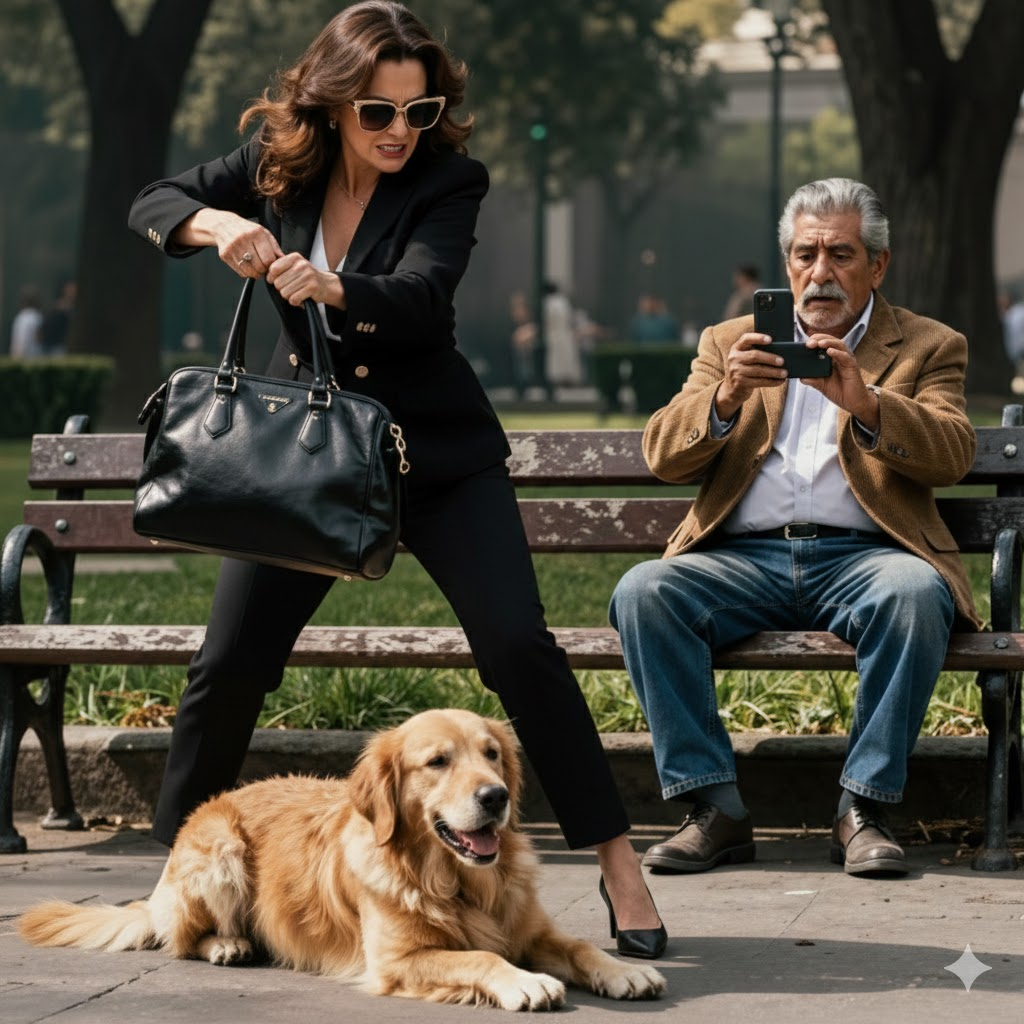
The woman didn’t scream. She didn’t scold her. She simply lifted her bag, a stiff, heavy piece of leather filled with who knows how many useless things, and brought it down with all her might on the animal’s snout.
The sound of the impact was sharp. A thud of leather against bone and flesh.
The dog didn’t bark again. It cowered, its legs faltered for a second, and it let out a whimper that pierced my ribs. It was a sound of pure betrayal. The animal lowered its head, its tail disappeared between its legs, and it lay motionless, trembling, staring at the cement floor as if searching for an explanation in the cracks.
“Shut up, you stupid animal!” she hissed, looking around with aristocratic paranoia. “You embarrass me.”
Nobody moved. People at nearby coffee tables looked down. Some frowned, others simply pretended their cell phone screens were the most interesting thing in the universe. In this country, we’ve learned that those with money usually also have an aggressive lawyer or a government connection, and nobody wants trouble over someone else’s dog.
But I’m not afraid of problems anymore. My fear died a long time ago, in the alleyways of Tepito and in the dimly lit offices of the Attorney General’s office.
I reached into the pocket of my corduroy jacket and pulled out my phone. It’s not the latest model, but it has a camera that doesn’t lie. I started recording.
The woman pulled out a silk handkerchief and dabbed an invisible stain on her purse, completely oblivious to the fact that the dog was still trembling. Max—I read the name on his gold tag as she walked past my bench—tried to lick her hand in a desperate act of forgiveness, but she pushed him away with her knee.
“Don’t touch me, you’re going to get my pants dirty,” she said with a disgust that made my stomach churn.
At that moment, a park officer, a young boy in a somewhat large uniform, approached timidly.
—Excuse me, miss… you can’t treat the animal like that. There are cameras and…
She stopped abruptly. She removed her sunglasses, revealing cold, calculating eyes, accustomed to giving orders that no one questions.
“Do you know who I am, boy?” she asked, with a calmness that was frightening. “My husband owns the construction company that remodeled this plaza. If I say one word, tomorrow you’ll be sweeping the streets on the outskirts of town. So turn around and keep walking.”
The officer swallowed. He looked at the dog, glanced at me for a brief second, and then lowered his head. That’s how the system works: the big fish eats the little fish, and money is the water they swim in.
She smiled, a smirk of bitter triumph, and put her glasses back on. She yanked hard on the leash, forcing the Golden to stand even though the animal seemed disoriented.
What she didn’t know was that I already had three minutes of video footage. I had the punch, I had the threat to the officer, and I had her face perfectly in focus.
I felt an old fire burning in my chest. That feeling you get when you have the suspect right where you want them, when you know their arrogance is the nail that will seal their own coffin.
I got up from the bench. My knee protested, but I ignored it. I started following her at a safe distance. I knew it wouldn’t end there. People like her never stop at the first instance of abuse; they need to reaffirm their power again and again to convince themselves they’re worth something.
I saw her walk into a luxury residential area, one of those where the guards look you up and down if you’re not in uniform. But I have an old badge, a gaze that doesn’t break, and a plan that doesn’t require permits.
“You’re going to learn, ‘Queen,'” I whispered to myself as I saved the video to the cloud. “You’re going to learn that in this world there are still some of us who are priceless.”
That night, while drinking a black coffee for dinner, I began to draft the report. Not for the police, because I know how those complaints end up gathering dust in drawers. The world has changed, and now the fiercest judgment doesn’t take place in the courts, but in the palm of the hand of millions of people.
But before I cast the first stone, I needed to know who she really was. And what I discovered while investigating her name was far worse than simple animal abuse. She was harboring a secret that was about to explode, and Max, the dog she beat, was the only remaining evidence of a much darker crime.
I stared at my computer screen, where the video was repeating over and over. The thud. The groan. The threat.
“Tomorrow will be a long day,” I said, feeling that the detective I once was was finally awake.
I stood up to go to bed, but something in the video caught my eye. In the background, behind her, a black SUV had stopped just as she hit the dog. An SUV with tinted windows that didn’t move until she left.
I wasn’t the only one watching her.
CHAPTER II
The coffee was lukewarm, almost cold, but I didn’t care. My eyes were glued to the computer screen in that dark corner of an internet café in the San Rafael neighborhood. I didn’t want to use my home internet connection; years in law enforcement taught me that even the smallest trace is a signature for someone who knows how to look. With a click, I started the video. I titled it simply: ‘The true face of Las Lomas: animal abuse and arrogance’.
Less than two hours passed before the algorithm did its work. In Mexico, the hunger for social justice is a fire that only needs a spark, and Regina—or “La Señora,” as I called her—was pure gasoline. By midday, the hashtag #LadyMaltrato was trending nationwide. The video showing her grabbing poor Max, humiliating the guard, and flaunting her connections was all over the country. The comments were an avalanche of hatred and demands for justice. “Take the dog away from her,” “Jail for that lady,” “Who’s her husband?”
I logged off and went outside. The air in Mexico City felt heavier than usual. I walked to a small restaurant to get something to eat, trying to keep my head down. The video was already playing on the television. The evening news anchor was speaking in that rehearsed tone of indignation, but the images didn’t lie. Regina’s facade of perfection was crumbling in front of millions of people. I felt a sense of satisfaction for a moment, but that feeling vanished as soon as I saw a black SUV slowly drive down the street. It was the same one from the park. They hadn’t left. They were looking for something, and that something was me.
Back at my apartment, a chill ran down my spine as I returned to my home. I began investigating Regina’s husband. His name was Arturo Mondragón, a powerful government contractor, the kind who builds bridges that collapse and amasses fortunes that never end. But what caught my attention wasn’t his money, but his enemies. Mondragón had cheated Grupo Galván in a multi-billion-dollar bid last year. The world of Mexico’s elite is a viper’s nest where everyone smiles while holding a knife to their back.
Suddenly, my personal phone, the one no one was supposed to have, started vibrating. It wasn’t a call, it was a text message. ‘We have the original video. We know who you are, Manuel. Come down to the parking lot if you want the dog to live through the night.’ My heart skipped a beat. How did they know my name? How did they have my number? The answer was obvious: someone with a lot of power or advanced technology had been tracking me since I left the park.
I got out of the car, hand on my hip, reaching for the familiar weight of my old Smith & Wesson, even though I knew that in this game, bullets are the last resort. In the building’s basement, the black SUV was waiting for me, engine running. The passenger window rolled down slowly. He wasn’t your average thug. He was a man in his fifties, wearing an impeccable gray suit, with eyes that had seen too many dead bodies.
“Get in, Manuel. Don’t waste our time,” he said in a soft, almost polite voice.
“I can hear them from here,” I replied, planting my feet on the wet concrete.
The man smiled, a joyless grimace. “We’re not Arturo Mondragón’s people, if that’s what you’re worried about. On the contrary, Arturo is a real pain in the neck for my bosses. Your video was a godsend. It’s put him in a very vulnerable position. The governor has already canceled his dinner party tomorrow, and his stock is plummeting. But we need more. We need you to testify that she threatened you with a gun, or that you saw something else in that house.”
“I don’t lie,” I said sharply. “What you saw is what it is. I just want the dog to be safe.”
“The dog…” the man let out a dry laugh. “Manuel, you’re a romantic. Regina doesn’t care about the dog, but now Max is proof of her cruelty. And her husband, Arturo, doesn’t leave any evidence unresolved. Right now, they’re arranging a ‘transfer’ to a supposed veterinary clinic in the State of Mexico. You and I both know Max isn’t going to any clinic. They’re going to euthanize him so the scandal doesn’t have a physical body to back it up.”
I felt a dull rage burning inside me. Regina wasn’t going to apologize; she was going to erase the problem. The man in the suit handed me a black card with no name, just a number.
“If you help us take down Arturo Mondragón with what you know about his connections, we’ll rescue the animal. If you decide to play the lone hero, tomorrow the video will be old news and the dog will be ashes. Think about it, officer. You have until midnight.”
The truck drove off, leaving a trail of smoke and an eerie silence. I hurried up to my apartment. I needed to move. My facade of a quiet retiree was over. If the Galván people knew where I lived, Arturo Mondragón’s people wouldn’t be long in showing up. And they wouldn’t be coming to chat.
I glanced out the window. A Mexico City police patrol car was parked on the corner, unusual for that hour on my street. They weren’t there to protect me. Arturo Mondragón had already made his moves. He had activated his contacts within the force to hunt down the ‘whistleblower.’ In Mexico, the uniform is sometimes just a disguise for the highest bidder.
I put on my leather jacket and grabbed a backpack with the essentials. I had to get to the Mondragón residence before they took Max. I knew it was crazy, a suicide mission for an old man with bad knees, but every time I closed my eyes I saw the terrified look on the Golden Retriever’s face in the park. He had no voice, and I was the only one who could scream for him.
The drive to Las Lomas was an exercise in evasion. I had to change taxis three times and walk through dark streets to avoid the security cameras. The city I once swore to protect now seemed like a hostile jungle. As I approached the mansion, the deployment was obvious. There were reporters at the front door, cameras, and lights, but I knew the service entrance through the back alley.
From the shadows of an old ash tree, I saw the movement. A white van, bearing the logo of a luxury veterinary clinic, was backing into the garage. Regina got out through the side door. She was no longer the elegant woman from the park; she looked distraught, her makeup smeared, a phone glued to her ear. She shouted orders, gesticulating furiously. Beside her, a tall, bald man, Arturo, maintained an icy calm that was more frightening than his wife’s shouts.
“Get him up here now!” I heard Regina shout despite the distance. “I never want to see that animal again in my life! Because of him, everyone hates me!”
Two men carried Max out. The dog didn’t even struggle; he walked with his tail between his legs, head down, as if he knew his fate was sealed. They put him in the back of the white pickup truck. My hand tightened around the black card the man in the suit had given me. If I called the Galváns, they would come, and this would turn into a battlefield. If I didn’t call, Max would die in less than an hour.
Suddenly, my phone buzzed again. This time it was a social media notification. Regina had just uploaded a video ‘apologizing’. She was crying on camera, saying that Max was sick and was being sent for special treatment, that the park video was a ‘misunderstanding’ brought on by stress. A perfect lie to appease the masses before getting rid of the dog.
I tried to approach the perimeter fence, but a security light detected me. The white light flooded the alley.
“Hey, you! Get out of here!” shouted a guard from the booth.
I pressed myself against the wall, my heart pounding in my ribs. My attempt to go unnoticed had failed. Just then, the white pickup truck started up, speeding off down the opposite alley. Arturo Mondragón saw me from a distance before going into his house. He didn’t recognize me as the man from the park, but his gaze sent a clear message: he owned this territory.
I stood alone in the darkness, watching the taillights of the truck carrying Max disappear. I knew time had run out. Old-school detective methods wouldn’t work here. I had to get my hands dirty. The gap between my former life and this chaos had become an abyss. I was no longer a retiree seeking justice; I was a man hunted by two powerful factions, with a dog sentenced to death and the reputation of one of the most powerful families in the country hanging in the balance.
I took out my phone and dialed the number on the black card.
“I accept,” I said as soon as they answered. “But I want Max alive. If the dog dies, I’ll disappear, and with the video goes all the information I have about Arturo.”
“Good choice, Manuel,” the soft voice replied. “I’ll see you at kilometer 34 on the road to Toluca. Don’t be late, or you’ll arrive for the funeral.”
I put my phone away and ran to my car, which I’d parked a few blocks away. I knew I was falling into a trap set by the Galváns, who were just using me as a pawn against Mondragón. But there was no other choice. The conflict was no longer about a video or a hashtag. It was an open war in the heart of the city, and I had just chosen my side in hell.
As I drove toward the city limits, I saw in the rearview mirror that the police patrol car was following me at a safe distance. Arturo wasn’t going to stand idly by. He had activated his official protection network. He was caught between a corporate mafia and a corrupt system. I accelerated the engine, feeling that the night was just beginning and that, before dawn, one of us wouldn’t be making it home.
CHAPTER III — MISSION: FIGHT AND FATAL ERROR
The chill of the Toluca highway seeped into me through the cracks of the black SUV like a bad omen. Beside me, the man in the suit—who I now knew was named Sergio and worked for the Galváns—checked a tablet with a coldness that made my stomach churn. I gripped the steering wheel of my own morale, feeling it crumble.
“We’ve almost got them, Manuel,” Sergio said, without taking his eyes off the red dots on the screen. “The Mondragón transport isn’t going to make it to the ‘humanitarian sacrifice’ clinic. My people have already blocked the turnoff to Valle de Bravo. You’re about to become a national hero, or at least the man who sank the next gubernatorial candidate.”
I didn’t want to be a hero. I just wanted to get that poor dog out of Regina’s clutches. I remembered Max, his terrified look in the video, and how power can crush a living being just to clean up a public image. But something didn’t add up. The Galváns weren’t spending all this money and risking their lives out of love for animals.
“What do you really want?” I asked, as I dodged a trailer that shone its headlights at us in the darkness of the wooded area.
Sergio let out a dry chuckle, the kind only those who no longer have a soul possess.
“We want the world to see how Mondragón gets rid of its problems. If the dog dies in a violent ‘escape’ provoked by its own bodyguards, Regina comes across as a psychopath and Arturo as a cold-blooded killer. It’s politics, Manuel. The dog is just the catalyst.”
I felt a void in my chest. They were using me. I thought we were going to rescue him, but they wanted a show. They wanted Max’s blood to stain Arturo’s shoes.
Suddenly, sirens blared behind us. Two state police patrol cars, the kind Mondragón has on his payroll, appeared like ghosts through the fog. Red and blue lights bounced off the pine trees, creating a psychedelic and terrifying scene. Sergio’s radio began to screech with distorted voices.
“Watch out! They’re armed,” someone shouted from the other side.
Fear, that old friend I hadn’t seen since my active duty days, settled in my throat. I remembered why I retired. A poorly planned operation, a miscalculation, and a civilian who ended up where he shouldn’t have been. I couldn’t let it happen again.
“Step on it, Manuel,” Sergio ordered, pulling a handgun from the glove compartment. “If they pull us over, we’re done for. And you even more so, since you already have an arrest warrant out for ‘trespassing and harassment’.”
Panic took over. Instead of braking and trying to think clearly, I floored the accelerator. The truck roared. I was fleeing the law to “save” a dog my own allies wanted to use as a political sacrifice. The delusion that I could control the chaos blinded me.
We spotted the Mondragóns’ white van about a hundred meters ahead. It was being escorted by a black sedan. My detective mind was racing. If I could get the sedan off the road, we could intercept the van.
“I’m going to hit them!” I shouted, more to convince myself than to warn Sergio.
“Do it!” he replied, getting a professional camera ready. The poor guy wanted to record the crash.
I maneuvered with a clumsiness born of desperation. I slammed into the side of the escort sedan. The screech of metal on metal was a hellish scream in the middle of the woods. I lost control for a second, the SUV fishtailed, but I managed to steady it. The sedan veered off the road, spinning into the undergrowth.
There was no fire, only the silence broken by the strained engine. But in that moment I knew I had crossed the line. I was no longer the detective seeking justice; I was a criminal causing an accident that could very well have been fatal.
We managed to block the white van. It stopped abruptly, skidding on the wet pavement. I got out of the truck before Sergio could say anything. The cold hit my face, but it was nothing compared to the cold I felt inside.
I ran to the back of the van. The driver, a skinny guy in a private security uniform, got out with his hands up, trembling.
“Open it! Open the damn door!” I yelled, showing him my old badge, the one that no longer had legal value but still commanded respect in the dark.
The man obeyed. As the doors opened, the smell of disinfectant and fear overwhelmed me. There was Max, in a cage that was far too small, sedated but awake, his eyes glazed over. He looked at me and let out a whimper that broke my heart.
“Let’s go, Max. I’ve got you now,” I whispered, trying to unlock the cage.
“Leave it there, Manuel,” Sergio’s voice sounded behind me, but it wasn’t a suggestion.
I turned around and saw him pointing his camera… and holding a small gun in his other hand. Behind him, two other men in black got out of a second van that had just arrived.
“The plan changed,” Sergio said with an icy smile. “People are really into the hashtag. We need something stronger. If the dog turns up dead here, with a gunshot wound that looks like it was inflicted by Mondragón’s bodyguards, Arturo will resign from his political career tomorrow.”
“You’re crazy,” I said, standing in front of the cage. “I didn’t come here for this.”
“You came here because you’re a nostalgic old man who believes in the justice of movies. But this is the State of Mexico, Manuel. Here, justice is a commodity that can be bought or manufactured. Get out of here.”
At that moment, the sirens of the patrol cars chasing us sounded much closer. Time stood still. I had the corrupt Mondragón police coming from one side and the Galván mercenaries wanting to kill the dog from the other.
I made the stupidest and bravest decision of my life. I grabbed a fire extinguisher that was hanging on the van’s wall and used it on Sergio and his men. The cloud of chemical powder blinded us all.
In the midst of the chaos, I hauled Max’s cage out as best I could. It weighed a ton, or perhaps it was the weight of my own guilt. I plunged into the woods, dragging the cage through the pines and wet earth.
I heard gunshots behind me. I didn’t know who was shooting at whom. Was the Galván family shooting at the police? Was the police shooting at Sergio? I only knew that I was the target of both.
I walked until my lungs burned from the cold and the altitude. I stopped in a small clearing, away from the road. I opened the cage and Max staggered out. He came up to me and licked my hand. I was safe, for now, but I was finished.
I took out my cell phone. It had no signal, but I saw the last notification before it died: ‘Arrest warrant issued against Manuel N. for kidnapping, serious injuries and links to organized crime’.



Arturo Mondragón had moved quickly. He had used the sedan crash to portray me as a dangerous madman working for the Galváns. Regina, from her mansion, was probably posting about how a ‘bitter ex-cop’ had stolen her beloved pet.
I was alone in the woods, with a drugged dog, hunted by the state and the political mafia I swore to fight. I had saved Max, but in doing so, I had given my enemies all the weapons they needed to destroy me.
I looked at my hands, stained with oil and blood from the crash. The silence of the forest was deafening. There was no going back. I had signed my own death warrant to save a life that, to the rest of the world, was worthless.
That wasn’t the worst part. The worst part was realizing, as I listened to the branches creaking in the distance, that someone had followed us. It wasn’t the police. It was a solitary figure walking with terrifying slowness among the trees.
—You thought you were very clever, Manuel—said a female voice that I would recognize anywhere.
It was Regina. She wasn’t at her mansion. She was there, wearing a fur coat that cost more than my house and holding a designer gun. Her gaze wasn’t one of fear, but of pure, distilled hatred.
“You wanted your moment of glory,” she hissed, moving closer. “But you’re just a nosy hick who messed with the wrong family. Now, give me the dog and maybe I’ll let the police find you alive.”
Max growled, a low, deep sound that vibrated in the cold air. I had nothing but my body to protect him. The fatal mistake wasn’t the crash, nor allying myself with the Galváns. It was believing that in this game someone had a heart.
The final judgment had begun in the darkness of La Marquesa, and I had no lawyer, no evidence, no way out.
CHAPTER IV
The cold in the wooded area near the highway to Toluca is nothing like the cold in the city. Here, the dampness seeps into your ribs and reminds you of every broken bone, every bad decision, and every year you wasted in the force.
I was there, crouched in the bushes, mud soaking through my pants, and poor Max was breathing with a difficulty that broke my heart. I had the dog half-sedated, covered with my old jacket, while the echo of sirens could be heard in the distance, a dance of blue and red lights bouncing off the fog.
Everything hurt. The crash had left me with a constant ringing in my left ear and a stabbing pain in my knee that screamed I wasn’t twenty anymore. But I couldn’t move. I was trapped between a rock and a hard place: on one side, the police that Arturo Mondragón already had on his payroll; on the other, Sergio Galván’s men, who were looking for me to silence me.
I heard the crackling of dry branches. They weren’t the footsteps of tactical boots, but rather erratic, heavy yet elegant steps. A voice I knew all too well broke the silence of the forest.
—I know you’re there, Manuel. Don’t be an idiot. This isn’t about a social media video anymore.
It was Regina Mondragón. The one and only #LadyAbuse was there, in the middle of nowhere, with a flashlight that cut through the fog like a knife. She wasn’t with the police. She was alone, or at least that’s what she wanted me to believe. She looked distraught, her makeup smeared and her fur coat stained with mud. She was no longer the untouchable woman from the news; she was a cornered beast.
“Go to hell, Regina,” I whispered, even though I knew she could hear me. My voice came out raspy, heavy with weariness.
“Give me the dog, Manuel. I’ll give you whatever you want. Money, a passport, a clean exit from the country. Arturo’s going crazy, and if he gets here before me, you won’t get out of this forest alive. Neither you nor that mangy animal.”
I laughed, or tried to, because I ended up coughing up blood.
—So much drama over a dog you kicked in front of half of Mexico? Don’t mess with me, Regina. I’m not new to this.
She stopped about five meters from where I was. She lowered her flashlight so as not to blind me, but her shadow was projected enormously against the pine trees. She looked small, vulnerable, but with a malice that dripped from her eyes.
“It’s not the dog, you idiot,” he said in a tone that chilled me to the bone. “It’s what’s inside him. Do you think Arturo would let just any old Golden Retriever run loose? Max has an implant. It’s not your average microchip, it’s a secure storage unit. Arturo’s a paranoid. He has the keys to the Cayman Islands accounts, the lists of payments to judges, the contracts for the shell construction companies… everything.”
I froze. The missing puzzle piece clicked into place with a sharp blow to my head. That’s why the Galváns wanted him as a “martyr.” They didn’t want to save the dog; they wanted the chip to blackmail Arturo or seize his empire. And the Mondragóns wanted him back to erase the traces of their own downfall.
“The dog is the safe, right?” I said, slowly sitting up, using a log for support. Max whimpered softly at my feet.
“It’s the key to our freedom. Or to our life imprisonment,” Regina replied, taking a step forward. “Give me the dog and I swear I’ll let you go. Arturo doesn’t need to know I saw you.”
At that moment, my phone vibrated in my pocket. It had two percent battery left. The signal was almost nonexistent, but the ‘Live’ icon on my social media app shone like a last glimmer of hope. I’d left the live stream running since the accident, hidden in my clothes.
I looked at Max. The dog opened his eyes, clouded by the sedative, and licked my hand. It was such a pure gesture, so alien to the rottenness of these people, that I felt a burning rage within me. These bastards had used a living being like a flesh-and-blood USB drive.
“You know what the bad thing about secrets is, Regina?” I said, pulling out my phone and pointing it directly at her face. The screen’s light illuminated her terrified expression. “They don’t exist anymore.”
“What are you doing? Get that mother down!” she shouted, covering her face.
“We’re live, Regina. About six thousand people are watching you confess that your husband is a white-collar criminal. And don’t worry about the chip, I already told everyone where to find it.”
The thing about the chip wasn’t true; I hadn’t posted it yet, but fear paralyzed her. She started shouting insults, calling me a starving wretch, saying her husband was going to throw me in the darkest prison in the country. And she was right. I knew this was the end of my freedom.
I heard the engines of the trucks approaching. The state police reinforcements, the real ones, not Arturo’s hitmen, were breaking through the perimeter. The woods filled with shouts and tactical orders.
“Drop the weapon! On the ground!” they shouted.
I didn’t have a weapon. I only had Max and my phone. I got down on my knees, with my hands up, but without letting go of the dog. Regina tried to run, but she tripped over a root and fell face-first into the mud, screaming like a madwoman that she was being kidnapped.
The police surrounded us. The glare from the lamps was blinding. I felt the weight of the law literally crashing down on me when two officers tackled me to the ground. They pressed my face into the damp earth, but my gaze remained fixed on Max.
“Watch out for the dog!” I managed to shout. “It has medical evidence! Don’t let the civilians take it!”
It was total chaos. I saw Arturo Mondragón get out of a black SUV, talking frantically on his cell phone, but it was too late. The reporters who had followed the patrol cars were broadcasting live. Regina’s video confessing everything was already a Twitter firestorm. The Mondragón name, their status, their power… everything was crumbling in real time before the national television cameras.
They handcuffed me. The cold metal reminded me of my time in the service, only now I was on the other side. I didn’t care. I watched as a police paramedic, a kind-looking young man, carefully carried Max away. The dog was safe. The truth was out.
As they were putting me in the back of the pickup truck, I saw Arturo Mondragón. His gaze met mine. The man who yesterday owned the city today looked like a defeated old man, surrounded by federales who no longer answered his calls. Regina was crying hysterically as they put the handcuffs on her.
The public judgment was relentless. On the way to the Public Prosecutor’s Office, I watched through the patrol car’s grille as people on the street stopped to look at their cell phones. The video from the woods, with Regina mired in the mud and the truth about the microchip, was the final verdict. They were no longer influential; they were exposed criminals.
I lost my home, my retirement, and my peace of mind. I knew years of legal battles awaited me because of the stolen vehicle and the chase. But as I closed my eyes in the cold seat of the patrol car, I could only think of one thing: Max wouldn’t have to endure another kick.
Justice in Mexico is sometimes a bad joke, but that night, for once, the truth outweighed money. I was going to jail, yes. But they were going to the hell of public opinion, from which you can’t escape even with all the gold in the world.
Silence returned to the forest, but the noise in the city was just beginning.
CHAPTER V
The smell of chlorine and dampness has become my new normal. They say you get used to everything, but it’s not true. You only learn to ignore the pain so you can keep breathing. Here, in this four-by-four cell, time doesn’t move, it drags like a wounded animal. But strangely, for the first time in my life, I’m in no hurry.
I spent three months behind bars. The formal charges were aggravated robbery, resisting arrest, and illegal possession of confidential information. One technicality after another, Arturo Mondragón’s lawyers hurled at me like stones to crush me. However, those stones never quite managed to crush me. Outside these walls, something I never expected happened: people started shouting my name. Not as the name of a bitter, retired detective, but as the name of someone who, for once, didn’t look the other way.
I look at my hands. They’re gnarled, more stained with age. But they no longer tremble. That trembling that accompanied me during my last years in the force, that chronic nervousness of knowing I was serving a rotten system, has disappeared. It’s the ultimate irony: I had to lose my physical freedom to find a peace I didn’t know existed.
The iron gate creaks. It’s the sound that marks my days.
“Vázquez, you have a visitor,” the guard says. He’s not one of the bad guys. He looks at me with a mixture of pity and respect. I suppose he saw the videos on social media too.
I walk down the gray corridor. My footsteps echo, a dry sound against the cement. In the visiting room, separated by thick, scratched glass, Ortega is waiting for me. He was my partner fifteen years ago, before I sank into alcoholism and he became a desk-bound bureaucrat. I’m surprised to see him here. He’s carrying a yellow envelope under his arm and wearing an expression I can’t quite decipher.
We sat down. I picked up the earpiece, that cold device that smells of other people’s sweat.
“You look terrible, Manuel,” Ortega says, trying for a smile that doesn’t come out.
—The prison diet doesn’t include caviar, Ortega. What did you come here for? I don’t think it was to remind me of my appearance.
He sighs and places the envelope on the table.
“Everything is falling apart, Manuel. The Mondragón empire is crumbling faster than analysts predicted. Arturo is under house arrest while awaiting trial for money laundering and ties to organized crime. Regina’s confession that you recorded… was the thread that unraveled the whole scheme. It not only brought her down because of the abuse and neglect; it also brought down the bank accounts that Arturo swore were invisible.”
I remain silent. I feel a cold satisfaction, nothing like fireworks. Just the feeling that a scale, after a long time tipped toward evil, has finally found its center.
“And her?” I ask. I mean Regina.
“Regina Mondragón has lost her mind,” Ortega replies with a sneer. “I’m not just talking about the legal one. Her lawyers are trying to plead insanity to avoid jail, but the public scrutiny is so fierce that no one dares to sign off on that assessment. They took everything from her. Her properties, her accounts, her status. Now she’s just a woman screaming at the walls in a private clinic while she awaits sentencing.”
“The Galváns must be celebrating,” I say, remembering Sergio and his ambition.
—Not really. The investigation expanded. It turns out that Max, or rather, the chip he was carrying, had data that also implicated the Galváns. They wanted the dog to destroy Arturo, but they didn’t count on you making the information public before handing it over. Sergio Galván is under federal investigation. Nobody gets out of this unscathed, Manuel. Nobody except you, technically.
—I’m in jail, Ortega. Don’t call me clean.
“You’re here, but half the country is paying for your defense. There’s a march planned for next Sunday. They’re demanding a presidential pardon. They say you’re a hero.”
The word “hero” tastes bitter to me. I didn’t want to be a hero. I just wanted a dog to stop being beaten. Everything else was the weight of inertia, the snowball that rolled down the mountain because I refused to stop it.
“I didn’t come here just to talk to you about politics,” Ortega says, his voice softening. “I know that’s all you really care about.”
I slide the yellow envelope through the slot under the glass. My fingers brush against the paper. It’s slightly wrinkled. I open it carefully, as if there were something fragile inside that could break in the prison air.
I take a series of photographs.
The first one takes my breath away. It’s a green landscape, a farm in the countryside, far from the glass skyscrapers and the hot asphalt of the city. And there he is.
Max.
He no longer wears that expensive leather collar with gold hardware that looked like a fancy rope. Now he wears a simple blue fabric collar. His fur looks shiny and clean. In the photo, he’s hopping around in the middle of an alfalfa field, ears back and tongue lolling out. There’s no trace of that paralyzing fear I saw in his eyes the first time I found him in the parking lot.
“He was adopted by a family who live near the border,” Ortega explains. “A retired couple of veterinarians. They have acres of open land. They don’t know about microchips, or politics, or money laundering schemes. They only know that the dog needed a home. They say that at first he would hide under the tables whenever someone raised their voice, but now… well, you can see the picture.”
I keep scrolling through the images. In one, Max is sleeping in front of a fireplace, stretched out at full length, taking up all the space, not even curling up into a ball for protection. In another, a little girl, about seven years old, is hugging him around the neck. Max’s eyes are closed, completely surrendered to that unconditional affection.
I feel a lump in my throat that prevents me from speaking. For years, as a detective, I saw the worst of humanity. I saw bodies torn apart by ambition and souls broken by indifference. I thought the world was just that: a cesspool where the strong trampled the weak. But seeing those photos, something inside me loosens.
“He’s free,” I whispered.
“He’s free, Manuel. Thanks to you,” Ortega replies. “The prosecution asked me to tell you that if you cooperate with the final details of the statement against Arturo, you’ll most likely be released on parole before Christmas. The judge is under a lot of public pressure. Nobody wants to be the man who left the man who saved the nation’s dog in jail.”
—I didn’t do it for the nation. I did it for him.
—I know. And that’s why it worked.
Ortega stands up. He places a hand on the glass, at shoulder height. I do the same on the other side. The coldness of the glass is the only thing separating us.
—Take care, old friend. You won’t be out of here for long.
I watch Ortega walk down the corridor. The guard approaches to escort me back to my cell. I tuck the photographs inside my shirt, against my skin, as if the warmth of those images could protect me from the cold of the walls.
Back in my cell, I sit on the bunk. The afternoon sun streams through the small barred window, casting long shadows on the floor. It’s a dim light, but enough to illuminate the last photograph, the one I decided to leave out of the envelope.
It’s a close-up of Max. He’s looking directly at the camera. His eyes no longer hold that cloud of pain. There’s a clarity in them, a nobility that no other human I know possesses. It reminds me of the first time I saw him, in that viral video that changed my life. Back then, Regina was kicking him, and he just lowered his head, accepting his fate like a silent martyr.
Now, his gaze tells me that the past is dead. That the kicks, the screams, the laboratories where they inserted that cursed chip, and the midnight chases are just shadows of another life.
I close my eyes and imagine the smell of damp grass, the sound of the wind through the trees, and the rapid beating of a heart racing with pure pleasure, not fear. I imagine myself walking through that same field someday. Perhaps not today, perhaps not tomorrow, but soon.
I’ve lost my home, my little reputation, and my peace of mind. I’ve spent entire nights shivering in this metal bed. But as I touch the photographic paper, I realize I’ve gained something I never had while I was free out there: integrity.
I have recovered my honor. Not the honor of medals or promotions in the police force, but the honor of knowing that, in the moment when the world tested me, I chose to be a man and not an accomplice.
Freedom isn’t the space you have to move around, but the absence of chains on your spirit. And I, despite being surrounded by steel bars, feel lighter than ever.
The guard walks down the corridor, jingling his key ring. The metallic clang no longer bothers me. It’s just background music to my thoughts. I look at Max’s picture one more time. He’s running. His paws barely touch the ground. He looks so fast, so full of life, I can almost feel the breeze he creates as he runs.
I smile. It’s a small, rusty smile, but a genuine one.
I know we’ll meet again someday. Maybe not in this life, maybe somewhere where there are no political classes, no microchips, no outstanding debts. But for now, it’s enough for me to know that he’s where he’s meant to be.
I lie down on the bunk and stare at the ceiling. The damp patches seem to form maps of places I haven’t yet visited. For the first time in months, I don’t need alcohol to sleep. For the first time in years, I don’t have nightmares about unsolved cases or victims I couldn’t save.
I fall asleep with the image of Max running free under a sun that never sets.
In the end, it wasn’t the detective who saved the dog. It was the dog who, with its silence and its pain, saved the detective from dying as nothing.
Justice is a strange path, and sometimes it leads us to dark places so we can see the light. But now I understand. No matter how many times you’re beaten or locked up, as long as you keep your eyes on what’s right, you’ll never truly be alone.
I am at peace.
END.