I stood beside Elena’s coffin, my hands icy and the knot in my throat so tight I could barely swallow. The funeral home smelled of expensive flowers and reheated coffee. Friends spoke in hushed voices, as if grief might shatter with a loud noise. I just stared at her name engraved on a plaque, trying to accept that the word “Elena” was no longer a “now,” but a “before.”
Then my phone vibrated in my pocket. On the screen appeared Lucía, my daughter. For a second, I thought she was calling to say she was coming, that she had understood how serious everything was. I answered in a thin thread of a voice.
“Dad, we’re already at Marcos’s birthday dinner,” she said, as if she were telling me they had found parking.
The noise of the funeral home faded, as if someone had shut a door inside my head.
“Your mother… is gone,” I whispered. “She’s not here anymore, Lucía.”
There was a brief, uncomfortable silence.
“Don’t start with your drama,” she snapped. “You know what Marcos is like with his family. I couldn’t make us look bad.”
I stared at the coffin, unable to connect that sentence with reality. I hung up without arguing, because dignity also runs out. Later, when the service ended, I returned to the apartment alone. The house still had Elena’s shape: a folded blanket on the couch, her cup in the sink, her perfume still clinging to the scarf on the coat rack. I didn’t cry. It hurt too much to cry.
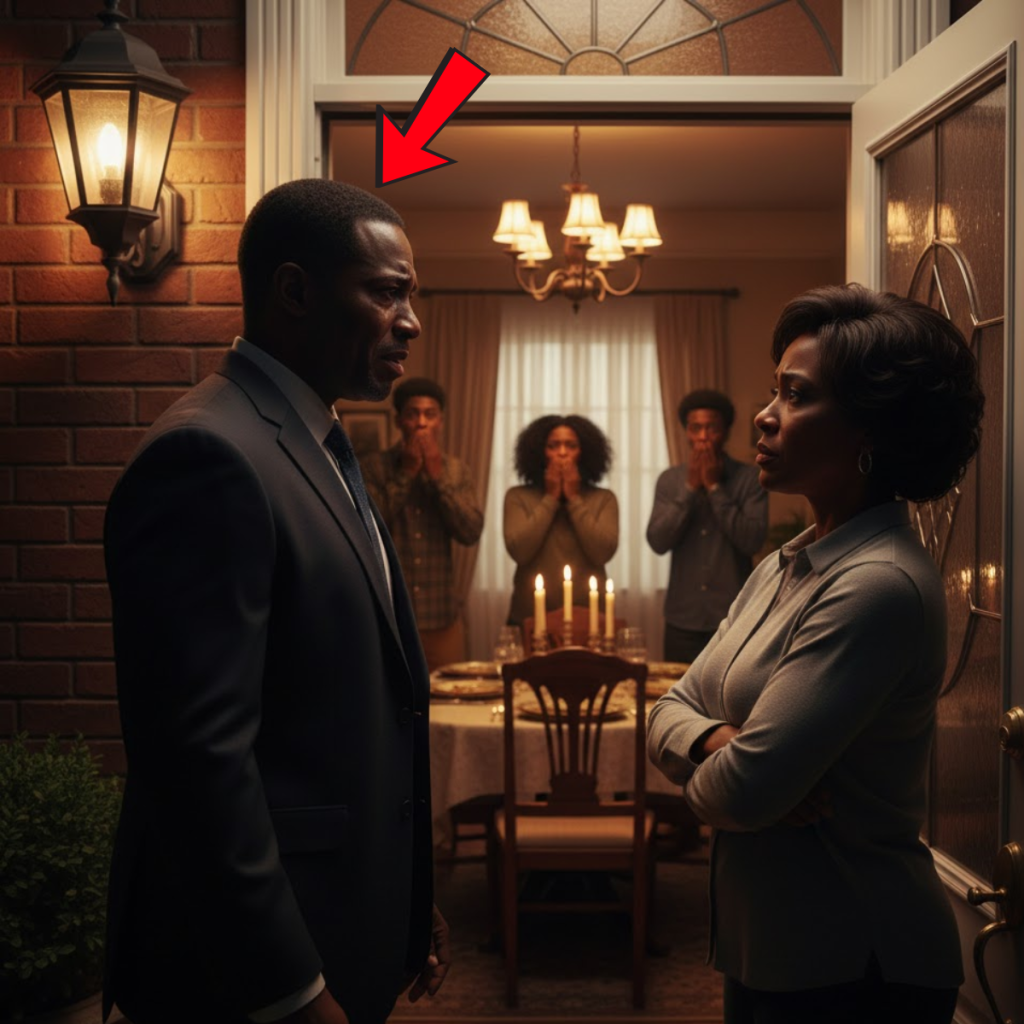
At ten-thirty, I heard keys in the lock. I opened the door and saw Lucía and Marcos, scented like a restaurant, wearing that light smile of people who think they’re safe.
“Couldn’t you really come?” I asked.
Lucía rolled her eyes. Marcos shrugged, looking down the hallway as if it belonged to him.
“Move,” he said, not even trying to hide his contempt.
I stood in front of the living room door. Not to command, but to demand respect. Lucía stepped closer, her gaze hardened.
“You don’t control me, Dad,” she hissed.
I wanted to respond, but the blow came first: a sharp, hard slap that turned my face and left a ringing in my ear. In the silence that followed, the only thing I thought was: Elena is no longer here to protect me… and I am no longer going to protect them from the consequences.
That night I didn’t go to bed. I sat at the kitchen table with the lamp on and the rest of the house in shadow, as if the world had decided not to look. My cheek hurt, yes, but what hurt more was the clarity: my daughter had crossed a line I never imagined she would. It wasn’t a teenage outburst; Lucía was thirty-two years old. And Marcos, with his smug smile, seemed delighted by the spectacle.
I opened the drawer where we kept important documents. There was the will, signed years earlier, when everything was different: Elena alive, Lucía still close, Sundays filled with paella and long conversations. In that document I left almost everything to my daughter, believing I was honoring Elena’s effort to build a family. Now, holding the paper in my hands, I felt the word “family” had warped.
The next morning, I made an appointment with the notary, Carmen Salvatierra, downtown. I told her what had happened without exaggeration or embellishment. She looked at me with a mixture of professionalism and compassion.
“You can modify it,” she said. “But it’s best to do so thoughtfully. And if you fear pressure, it’s wise to record that you are acting freely.”
I didn’t fear pressure; I feared becoming a man without a backbone by continuing to excuse them. I made a simple and firm decision. I would keep what the law required me to keep—the minimum portion that corresponded to her—but the rest would not be a reward for humiliating me. I created a legacy for a nursing scholarship in Elena’s name at the hospital where she had worked half her life. I left the apartment in usufruct to myself for as long as I lived, and when I was gone, it would pass to my nephew Álvaro, who had been the only one to stand by me without asking for anything. For Lucía, beyond the legal minimum, I left only something symbolic: her childhood photo album and her mother’s wedding ring, with a note: “Your mother loved you even when you did not know how to love her back.”
I didn’t do it out of revenge. I did it to set a boundary I myself needed. When I signed, I felt a strange relief, as if a piece of me that had been loose for months finally snapped into place.
Three days later, Lucía showed up without warning. She brought no flowers, no apologies. She brought urgency. Marcos stayed in the car, but his shadow came in with her.
“Dad, about the other day… well,” she said. “You were provoking.”



I looked at her for a long moment.
“Are you here to talk about your mother, or to secure your inheritance?”
Her face changed, as if I had ripped off her mask without touching it.
“What have you done?” she asked, no longer pretending.
I didn’t answer. I simply pointed to the door with a calm that wasn’t coldness, but exhaustion.
“When you’re ready to truly apologize, come back alone.”
The following weeks were a kind of new mourning, quieter but just as real. For Elena’s death, yes—but also for the Lucía I thought I knew. Sometimes I caught myself checking my phone, waiting for a message that never came. Other times I hated myself for still waiting. Grief is like that: it makes you negotiate with yourself even after you’ve made a decision.
One Friday afternoon, an unknown number called. It was Marcos. His tone was polite—too polite.
“Javier, we should talk like adults,” he said. “Lucía is very affected. This… the will… it’s creating tension.”
I laughed without joy.
“The tension was created by you at the funeral home,” I replied. “And finished in my house.”
“Don’t exaggerate. It was a moment. Besides, Lucía is your daughter.”
“Precisely why I won’t allow it.”
He hung up without saying goodbye. Two days later, I received a certified letter with a veiled threat of “legal action” to question my mental capacity when I signed. Carmen, the notary, had already anticipated that: she had recorded my lucidity, and my family doctor, who had known me for years, signed that I was in full possession of my faculties. It wasn’t a war; it was a boundary.
What I didn’t expect was that, a month later, Lucía would truly come alone. She arrived without makeup, with dark circles under her eyes, her gaze broken. She brought no demands—only shame.
“Dad…” she began. “I’ve thought a lot. The birthday dinner was… horrible. And the slap… I don’t know who I was in that moment.”
I didn’t rush to hug her. It would have come automatically, but I no longer wanted to live on autopilot. I sat down and offered her water. I let her speak until she ran out of excuses.
“Mom didn’t deserve that,” she finally said in a small voice. “And neither did you.”
I nodded.
“Forgiveness doesn’t erase things, Lucía. But it can begin something new… if there are boundaries.”
I explained, without dramatic details, that I had changed my will and why: not to punish her, but to make her understand that respect is not negotiable. She cried. Not over the money—or at least I wanted to believe that—but over the shock of reality. She asked to go with me to the hospital to see how Elena’s scholarship would be managed. I agreed, with one condition: therapy and distance from Marcos while she sorted out her life.
I don’t know if this story ends “well.” It ends real: with wounds, with decisions, with a door left half open—not wide open. And now I ask you, who have read this far: what would you have done in my place? If this moved you, tell me your thoughts and, if you wish, share it with someone who needs to remember that setting boundaries can also be a form of love.