My name is Lucía Ramírez, and for years I learned to measure the day by the sound of a door. When Javier, my stepfather, came home from work, he would drop his keys on the table as if they were a bell announcing his “show.” Sometimes he wouldn’t even take off his jacket: he would find any excuse—a homework mistake, a cup out of place, a delayed answer—and laugh, as if what came next were a game. My mother, María, would lower her gaze. She said she was tired, that he had a bad temper, that I should “not provoke him.” I convinced myself that if I were quieter, faster, more perfect, maybe he would get bored.
But he never got bored. Every blow was part of his entertainment. And the worst part wasn’t the pain; it was the certainty that no one was going to stop him. At school I hid the bruises with long sleeves and tight smiles. My friends talked about birthdays and weekend plans; I calculated routes to get home without running into him in the hallway. At night, the floor creaked and I counted to one hundred so I wouldn’t cry.
One autumn afternoon, Javier found my math notebook with a problem solved incorrectly. He threw it at my feet, called me useless, and pushed me against the wall. I felt a sharp crack, like a branch snapping. My left arm hung down, twisted in a way that wasn’t human. I screamed. My mother ran in and, for the first time in a long while, looked at him with fear. Javier shrugged and said, “Don’t be dramatic.”
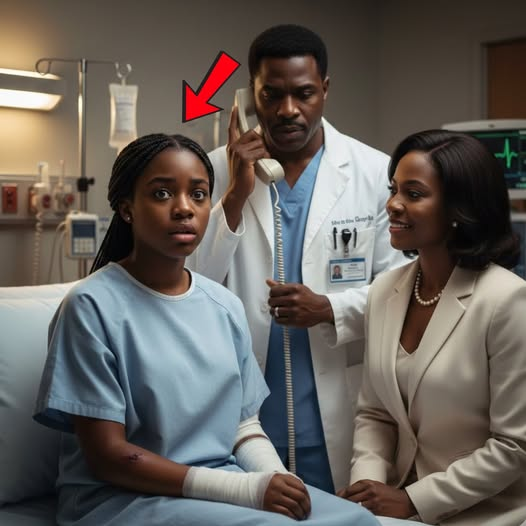
At the hospital, the air smelled of disinfectant and reheated coffee. A nurse took my blood pressure and I was trembling. When the doctor, Dr. Herrera, lifted my sleeve, his expression changed. My mother stepped forward quickly, her voice rehearsed: “She fell down the stairs, doctor. It was an accident.”
The doctor didn’t argue. He just looked into my eyes, as if asking me a question without words. Then he stepped out for a moment and, when he returned, he had a phone in his hand. He dialed and spoke in a low voice, but I managed to hear “emergency” and my last name. Then, from the hallway window, I saw blue lights reflected in the glass: the sirens were getting closer, and my mother, pale, squeezed my hand with a strength she had never used before to protect me.
The officers entered with firm steps but without shouting. One of them, a woman named Sergeant Vega, crouched down to my level and spoke slowly, as if the volume itself could break me. “Lucía, you’re safe here. We just want to understand what happened.” My mother tried to intervene, saying it was all a misunderstanding, that I was clumsy, that Javier would get angry if he were “accused” unfairly. Sergeant Vega didn’t push her aside violently; she simply asked that she be taken to another room.
Dr. Herrera returned with a social worker, Elena, who offered me water and a notebook. She told me I could write if speaking was too hard. I looked at my arm in its cast, heavy like evidence, and for the first time I thought that maybe my life didn’t have to stay the same. When Elena asked if someone had hurt me at home, I stayed silent. I had trained that silence for so many years that it clung to my tongue. But then I remembered Javier’s laughter, the way my mother repeated the same phrase over and over—“don’t provoke him”—as if the problem were my existence.
I nodded. It wasn’t a heroic confession; it was a small, almost invisible movement, but it changed everything. Elena didn’t pressure me. She explained that there were protocols, that my safety was the priority, that it wasn’t my fault. Sergeant Vega returned and asked my permission to photograph the cast and the old bruises the doctor had noted in my file. I felt ashamed, as if those marks were a dirty secret. She told me something I still remember: “The shame belongs to the one who causes harm, not the one who receives it.”



That night I didn’t go back home. They took me to a temporary shelter. The place smelled of detergent and had a strange calm, as if the silence didn’t hide threats. They gave me clean clothes and a blanket. I cried without making a sound, out of habit, until a caregiver told me that there I could cry loudly if I needed to. I didn’t know how.
The next day, I learned that Javier had been detained for questioning and that a restraining order had been requested. My mother called the shelter several times; some calls were pleas, others were reproaches. She said I was destroying the family. Elena helped me understand that the family had already been destroyed when violence became routine. In my first therapy session, a psychologist asked me to name a wish. It took me minutes to answer. Finally, I said, “I want to sleep without hearing keys.” And for the first time, that sentence sounded possible.
The following weeks became a calendar of appointments: forensic exams, interviews, hearings. I learned words that hadn’t existed in my world before, like “protective measures” and “child protection.” I also learned that justice is not a door that swings open all at once; it’s a long hallway where sometimes you get tired of walking. There were days when I doubted, especially when my mother showed up crying in a courtroom and told me Javier “was changing,” that everything had been an excess, that I should forgive so we could “start over.” I looked at her and understood something painful: she wasn’t defending my safety; she was defending her fear of being alone.
Elena accompanied me to testify. I didn’t have to look at Javier; speaking from behind a screen allowed me to breathe. I told what happened “almost every day,” how violence became a spectacle, how my silence was a survival strategy. I didn’t describe morbid details; it wasn’t necessary. Dr. Herrera and the medical reports completed what my voice couldn’t carry. When the judge issued the final restraining order and the process moved forward, I felt relief, but also a strange emptiness: I had lived on alert for so long that calm felt like a new language.
A few months later, I was placed with a foster family, Ana and Roberto, who treated me with a patience that at first seemed suspicious to me. They asked before touching my shoulder, let me choose whether I wanted to talk or not, celebrated my small achievements: finishing an exam, asking for help, saying “no” without apologizing. My mother started therapy on her own; I don’t know whether she did it for me or for herself, but during a supervised visit she told me, “I was wrong. I didn’t know how to protect you.” It wasn’t a complete repair, but it was the first honest sentence I had heard from her in years.
Today I am still healing. The cast is gone, but there are wounds you can’t see, and they heal with time, support, and truth. If I learned anything, it’s that one adult can make the difference: a doctor who observes, a teacher who asks, a neighbor who doesn’t look the other way.
And now I’m speaking to you: if this story moved you, tell me in the comments what signs you think are sometimes overlooked and what you would do to help without putting anyone at risk. If you ever went through something similar, share only what makes you feel safe. Would you leave a word, a piece of advice, or simply a “I’m here”?