ByGabrielFebruary 21, 2026News
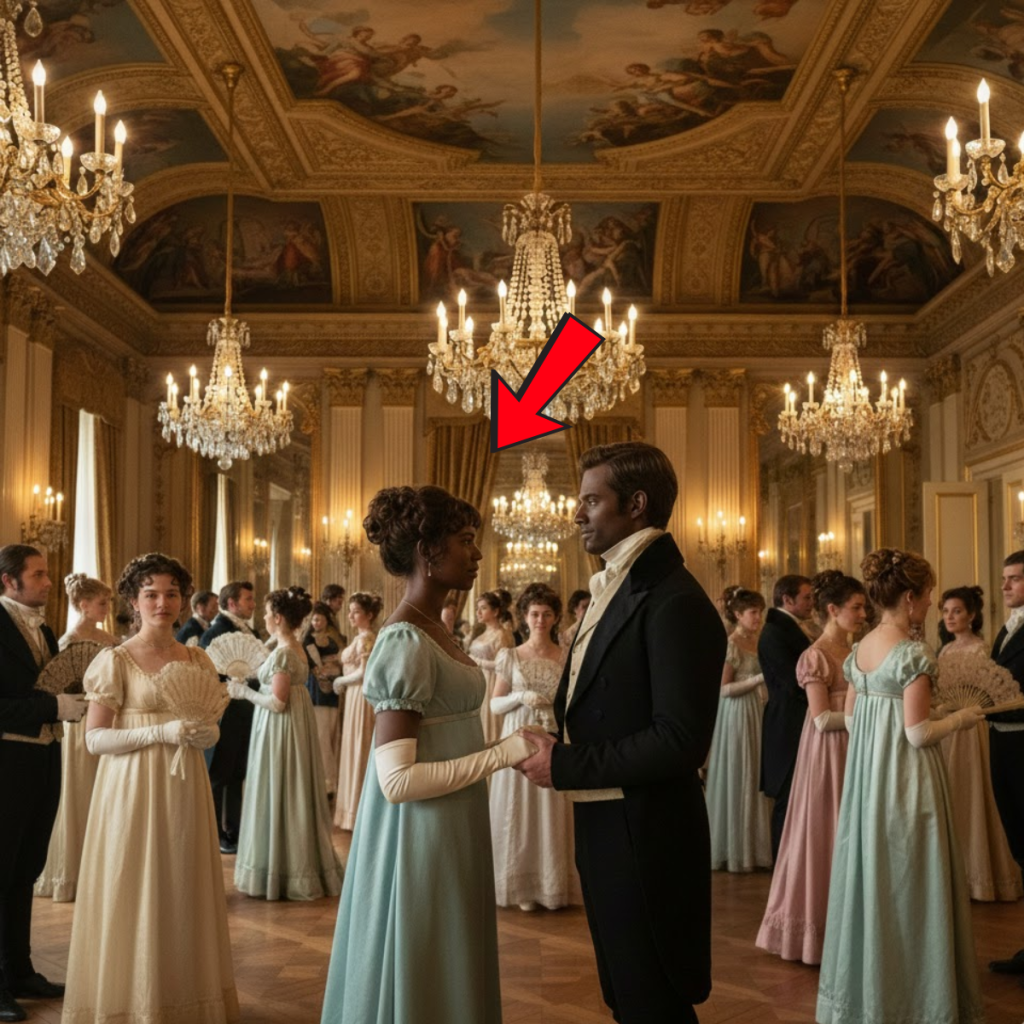
“They mocked the Duke who could not see… but when she invited him to dance, everyone lowered their gaze.”
The night of the great winter ball at the Palace of the Luján family had been announced for weeks as the event of the year in Mexico City. For days, seamstresses had embroidered sequins as if stitching stars; coachmen had polished metal fittings until they could see their own reflections; and the ladies had practiced their smiles in the mirror—those that seem sweet but weigh like judgment.
Carriages arrived one after another at the grand staircase, releasing ladies wrapped in silk and gentlemen in freshly pressed tailcoats. Inside, chandeliers poured warm gold over the tapestries, and the air mingled with expensive perfumes, candle wax, and fresh flowers. The orchestra tuned its violins while the murmur of conversation rose like foam.
Emilia Robles stepped down carefully, holding up the skirt of her pale blue dress. It was not new. Her mother, Doña Soledad, had remade it with patience: a hem here, an invisible stitch there, a ribbon to disguise the wear. It did not follow the latest Parisian fashion, but on Emilia it fell with quiet elegance, as if it did not care to compete.
Doña Soledad squeezed her hand before they entered.
“Remember, my daughter,” she whispered with the calm that only comes from having survived, “you don’t have to dazzle anyone. It is enough to be yourself.”
Emilia nodded, though she knew that in that world, to be young, without a dowry, and with an unremarkable surname was almost the same as being invisible. And yet, that night what hurt her most was not invisibility, but the presence of a man who, even surrounded by title and fame, seemed lonelier than she was.
She saw him at one end of the hall, beside one of the tall windows: Don Álvaro de Valcárcel, Duke of Valcárcel, a man of impeccable bearing and dangerous stillness. His upright figure stood out even while seated; dark, slightly wavy hair; firm profile; black attire cut to perfection, with an ivory waistcoat and discreet cravat. A polished wooden cane rested beside his chair. And his eyes—pale gray—looked without seeing.
Around him stretched a carefully maintained emptiness. The young ladies, laughing behind their fans, changed direction before getting too close. The gentlemen, correct in gesture, turned their gaze away as if it were impolite to acknowledge his presence. No one mocked him. No one pointed. But no one sat beside him. No one offered him a hand.
“They say he lost his sight years ago,” commented a blonde young woman, adjusting her glove. “A terrible fever. Since then, he hardly dances.”
“They say so many things,” another added softly. “That he became impossible. That nothing pleases him.”
Emilia felt a knot in her chest. “They say,” she thought. “They say,” as if a man’s life could be reduced to an elegant rumor.
The master of ceremonies announced the official beginning of the dances. A new waltz began, and the hall filled with movement: dresses spinning like flowers in the wind, measured steps, laughter, glances seeking one another. In the midst of that whirl, the Duke remained motionless, hands on his knees, listening.
Emilia could not take her eyes off him.
When the master indicated that unpartnered ladies could approach the center, Emilia felt her mother’s gaze from a discreet chair. Doña Soledad made no sign. She simply held her with her eyes, as if saying: “Whatever you decide, we will stand by it together.”
Emilia took a deep breath. The idea seemed madness: a girl of no importance inviting a duke. And yet what seemed most scandalous was something else—that no one, absolutely no one, was capable of breaking that wall.
Her feet began to move before her mind had fully decided. She crossed the hall feeling the impact of other people’s hearts in their stares: first curiosity, then confusion. She no longer heard the murmurs; she heard the rustle of her skirt, the music pushing her toward the corner.
She stopped a few steps from him.
“Your Excellency,” she said, careful that her voice would not tremble.
The Duke turned his face toward the sound with a precision that both chilled and moved her. His gray eyes searched the void with calm vigilance.
“Good evening,” he replied, his voice deep. “Forgive me… with whom do I have the honor?”
Emilia felt moisture in her palms beneath her gloves.
“Emilia Robles, Your Excellency.”
There was a brief silence in which it seemed the entire hall leaned in to listen. Emilia lifted her chin.
“I came to ask you…” she said, surprised at the courage she found, “if you would grant me the honor of this waltz.”
The instant she extended her hand, the murmur died as if someone had blown out a candle. Fans froze midair. Laughter cut short. The orchestra continued playing, but the entire hall anchored itself to that scene: a young woman in blue, with a steady gaze, offering her hand to the blind duke.
His hand remained motionless on his leg. He did not withdraw it, but neither did he take hers at once.
“Miss Robles,” he said at last, “you are aware that everyone is watching you.”
Emilia’s cheeks burned, but she did not withdraw her hand.
“I suppose so, Your Excellency,” she replied softly. “But I also know that all evening they have been watching you… and no one came near.”
Something—just something—shifted in the Duke’s face: not quite a smile, but a crack in the armor, a contained surprise.
“You are very frank.”
“Perhaps,” Emilia whispered. “And perhaps this is… unfair.”



Then, with a slow and deliberate gesture, he lifted his hand and placed it in Emilia’s palm. His touch was firm, secure, as if the darkness had not entirely robbed him of authority.
“If you are willing to endure their stares,” he said, “I grant you this waltz.”
He rose with an elegance that seemed to tighten the air. He took his cane for a moment, handed it to a servant, and straightened his shoulders, like a man recalling a former life. Emilia guided him to the center. The orchestra shifted into a slower, more melancholic melody, as if the hall itself were holding its breath.
“Describe the space,” he asked softly. “It has been a long time since I danced in a crowded hall.”
“To the right, there are couples,” Emilia whispered. “To the left, an empty circle… as if the hall opened for us. Behind us… many stares.”
“Naturally,” he replied with a thread of irony. “And in front?”
Emilia swallowed.
“In front is you, Your Excellency.”
The Duke released a slow breath, as if that simple phrase had pierced his armor. And they began to turn.
At first Emilia walked with extreme care, afraid of making him stumble. But she soon discovered he followed the rhythm with astonishing precision: the body’s memory, the exact step on each beat, his hand at her waist with respectful distance and perfect control. If someone had closed their eyes, they would have sworn both could see.
“You dance very well,” Emilia murmured.
“I used to dance,” he corrected gently. “Now I merely try not to step on my partner.”
“You haven’t stepped on me once.”
The murmuring returned—at first timid, then sharper: “She wants attention,” “She seeks pity,” “Without a dowry one must create a spectacle.” Emilia heard those phrases like pins pricking her skin, but she did not lower her head. The Duke, though he could not see faces, seemed to feel the weight.
“They speak of you,” he said serenely. “If you prefer, I can ask that you be escorted back to your seat.”
Emilia looked at him, knowing that more than a waltz was at stake.
“I did not come to flee at the first cruel comment,” she said. “I came because I would have been ashamed to remain seated pretending not to see you.”
Then the Duke truly smiled—small, sad, genuine.
“In that case,” he whispered, “allow me at least to share the burden of those stares.”
The melody reached its height, and a figure approached the edge of the floor: the hostess, Doña Beatriz de Luján, Marchioness of Luján. Her ivory dress seemed a contained wave. She did not interrupt the music, but her presence alone slowed several couples.
“Your Excellency,” she greeted with a perfect inclination. “What a pleasure to see you… participating.”
“Marchioness,” he replied. “Your ball is impeccable, as always.”
The Marchioness looked Emilia up and down with a courtesy so sharp it felt cold.
“And you, young lady?”
“Emilia Robles, ma’am,” Emilia answered. “It is an honor to be here.”
“Robles,” the Marchioness repeated, savoring the surname. “I do not recall your family.”
The Duke inclined his head slightly.
“Not everyone bears surnames that echo through salons, Marchioness. Sometimes the ear discovers pearls that the eye does not know how to recognize.”
Those words, soft as they were, formed a defense. Emilia felt warmth in her chest: it was not a cheap compliment, but a way of placing her at his side.
The Marchioness smiled a touch too much.
“Enjoy the waltz.”
She withdrew, and the air loosened. When the music ended, there was applause—restrained, but real. Emilia curtsied. The Duke, guided by habit and pride, responded with impeccable grace.
That night did not end there.