Everyone Feared the Tycoon’s Cruel Wife — Until the New Waitress Destroyed Her with a Single Sentence
She smiled.
It was a cold, barely perceptible smile as she watched young Thomas—a boy working double shifts to pay for college—remove his uniform through tears. His “crime” was unforgivable: his sleeve had brushed, just brushed, the air near her wine glass. For Victoria Ashford, that was enough to destroy someone’s livelihood.
For ten years, Victoria was not merely the wife of Lawrence Ashford, the tech magnate who owned half of Europe. She was a storm. A natural disaster that arrived with cruel punctuality every Friday at 8:00 p.m. at The Golden Rose.
Located in the heart of London, it was no ordinary restaurant. It was a temple of glass and silver, where a single dinner cost more than most people earned in a month. Yet not even luxury could hide the fear. When Victoria walked through the door, the air grew heavy. Waiters trembled. Managers broke into cold sweats. Guests lowered their voices. She had built an empire—not of money, but of terror.
No one dared challenge her.
Lawrence, her husband, walked beside her like a shadow—a defeated man trapped in a golden prison. Victoria reveled in her power, in her ability to humiliate someone publicly and watch the world continue to turn in her favor. She believed she was untouchable. She believed her money and her name protected her from everything, even the truth.
But fate has a very particular sense of humor.
Into that world of opulence and cruelty stepped Rachel Bennett.
Rachel didn’t belong there.
She was thirty-two years old and, until three months earlier, had been a brilliant investigative journalist for one of the city’s most prestigious newspapers. She was an expert at finding needles in haystacks, at connecting dots no one else could see. But budget cuts don’t care about talent, and overnight she found herself without a career, without money, and wearing a waitress uniform that scratched her neck—trying to remember which side the bread was served on.
Rachel observed.
It was what she did best.
She watched Victoria treat people like disposable trash. She saw the pain in her coworkers’ eyes. And something familiar ignited in her chest—the old flame of justice that had once driven her to journalism.
George, the senior waiter, warned her quietly,
“She’s a dragon, Rachel. Don’t get close. She breathes fire and burns everything she touches.”
What Victoria Ashford didn’t know—and what no one in that restaurant could imagine—was that Rachel was not a frightened waitress.
She was a woman who had spent years bringing down corrupt politicians and fraudulent businessmen.
Victoria thought she was looking at just another servant she could crush. She had no idea that, for the first time in her life, she was staring directly into her own ending.
The dragon was about to discover that this “waitress” held the only weapon capable of destroying her forever.
The opportunity arrived wrapped in crisis.
One Friday night, the waiter assigned to the Ashfords’ table suffered a panic attack before service. The manager—wearing the expression of a man sending a soldier on a suicide mission—pointed at Rachel.
“Bennett. You’ve got nerves of steel. Table twelve is yours.”
The restaurant was full. The murmur of London’s elite filled the room. Rachel approached the table with a calm she did not feel inside. She had memorized every detail of Victoria’s profile:
Still water.
No ice.
A lime slice thin as paper.
Sourdough bread only. Nothing else.
Any deviation would be fatal.
“Good evening, Mr. and Mrs. Ashford,” Rachel said steadily.
Victoria didn’t even look up from the menu. Her icy blue eyes swept over Rachel as if she were a badly placed piece of furniture.
“Water. Lime. And quickly.”
The service went smoothly—until the soup.
It was French onion soup, the house specialty. Rachel brought it straight from the kitchen; the cheese was perfectly gratinéed, and steam rose visibly from the bowl. She placed it gently in front of Victoria.
Victoria stared at the dish.
Then at Rachel.
She picked up her spoon, dipped it into the steaming broth, lifted it halfway—
And stopped.
“It’s cold,” Victoria announced.
Her voice was not a whisper. It was projected, meant for nearby tables to hear.
Rachel blinked. Steam continued to rise from the bowl, dancing in front of the woman’s face.
“I’m sorry, Mrs. Ashford, but it just came out of the—”
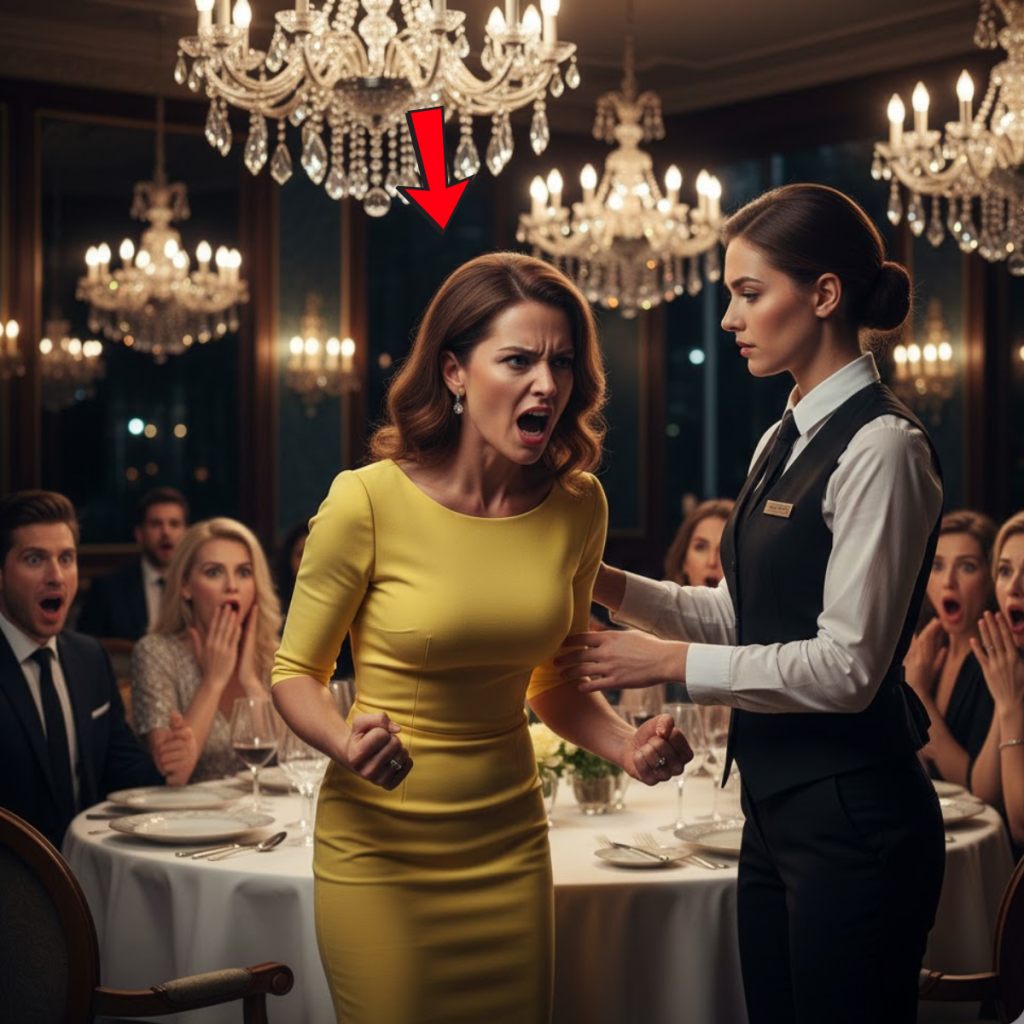
“I said it’s cold,” Victoria snapped, slamming the spoon against the table. The metallic sound silenced the restaurant.
“It’s inedible. Is it really so difficult to get hot soup in this establishment? Or is your incompetence truly limitless?”
Lawrence sighed, staring into his wineglass.
“Victoria, please… you can see the steam—”
“It’s not the soup, Lawrence!” she shot back. “It’s standards. This girl clearly doesn’t understand where she is.”
Victoria turned her face toward Rachel, expecting fear. She expected trembling apologies, tears, panic. That was what fed her.
But Rachel did something no one had ever done before.
She didn’t apologize.
She didn’t tremble.
She simply looked at her.
Rachel switched into investigator mode, analyzing the situation coldly. Victoria wasn’t angry about the food. She was performing. It was theater. And like all bad actresses, she was overacting to hide deep insecurity.
“I understand perfectly, Mrs. Ashford,” Rachel said calmly, her tone so composed it unsettled Victoria. “I’ll remove the dish immediately and speak with the chef. Thank you for your feedback.”
Rachel removed the plate with elegance and walked back to the kitchen.
There was no drama.
No pleading.
No humiliation.
Victoria sat with her mouth slightly open, frustrated. Her prey hadn’t screamed.
That night, Rachel couldn’t sleep. The image of Victoria’s casual cruelty spun in her mind.
“Bullies always hide something,” her journalism mentor had once told her. “The taller the façade, the deeper the foundation of lies.”
Rachel opened her old laptop and began to investigate.
First, she searched Victoria Ashford. Hundreds of photos appeared—charity galas, flawless elegance, perfect posture.
Then she searched her maiden name: Victoria Sterling, supposedly from a wealthy family in Bath.
Nothing.
It was strange. In the digital age, no one is a ghost. There were no school records, no childhood photos, no local newspaper mentions in Bath.
Victoria Sterling didn’t exist before ten years ago—just before she married Lawrence.
It was as if she had been born fully grown, rich, and cruel.
Rachel felt the familiar thrill of the hunt.
She switched tactics.
Using a reverse image search, she uploaded an old engagement party photo of Victoria. Hours passed filtering useless results until, on page twelve of Google, she found a broken link from a defunct talent agency in Manchester.
Rachel’s heart skipped.
She clicked.
The page loaded slowly—but there it was.
A grainy photo from the early 2000s.
The girl had poorly bleached platinum-blonde hair, heavy makeup, and a cheap leather jacket. But the bone structure was unmistakable.
That sharp jaw.
That contemptuous stare.
The caption didn’t read Victoria Sterling.
It read: Vicki Brightwell.
Rachel typed the new name.
Suddenly, the floodgates opened.
Vicki Brightwell—contestant on a forgotten reality TV show called Motorway Dreams. The show followed promotional models on racing circuits, infamous for their fights, vulgar language, and desperate hunger for fame.
Rachel found a video on an old fan forum. Her hands shook as she pressed play.
On screen appeared a younger, cruder version of the elegant Mrs. Ashford—shouting in a thick working-class Manchester accent, insulting another girl over borrowed lipstick.
But the best part came at the end.
The video showed the season finale—a beauty contest at the racetrack.



Vicki didn’t win.
Her reaction was legendary.
She had a complete meltdown—crying, screaming, throwing a plastic tiara to the ground, cursing the judges, the audience, and the cameras. Five straight minutes of vulgarity and total loss of control.
Rachel leaned back in her chair, exhausted but triumphant.
Victoria Ashford—the queen of elegance, the woman who fired people for “lack of class”—was really Vicki, a reality-show scandal who had fled her past and reinvented herself.
Her cruelty wasn’t superiority.
It was panic.
She tried to destroy anyone who reminded her—even slightly—of the ordinary girl she once was.
Rachel had the dynamite.
All that remained was to light the fuse.
Three weeks later, Victoria returned to The Golden Rose. This time, she came alone. Lawrence had stayed home—perhaps tired of the scenes.
Victoria wore a severe black suit and walked with the determination of someone hunting blood.
She sat at her usual table and beckoned Rachel with a single finger.
The manager tried to intervene, but Rachel made a subtle gesture. Let me handle it.
Rachel approached.
“Good evening, Mrs. Ashford.”
Victoria didn’t respond. She pointed at the chair across from her.
“Sit.”
“I’m working, ma’am, I can’t—”
“Sit,” Victoria hissed, “or I’ll buy this place tomorrow, turn it into a parking lot, and fire you personally.”
Rachel sat, back straight.
Victoria leaned forward, her eyes gleaming with malice.
“I don’t know who you think you are with that calm little attitude. I had people investigate you. I know you failed as a journalist. I know you’re in debt. I know you live in a falling-apart apartment. You are nobody.”
She smiled cruelly.
“I’ll make sure you never work in London again. I’ll call every restaurant. I’ll tell them you’re a thief, unstable. I’ll crush you, Rachel—until there’s nothing left.”
The restaurant watched in silence. This was usually the moment the victim broke.
But Rachel leaned forward too, her calm freezing Victoria’s blood.
“You’re right about one thing,” Rachel said softly. “I am an investigator. And I’m very, very good at my job.”
Victoria’s smile faltered.
“I know you’re not Victoria Sterling from Bath,” Rachel continued quietly, her voice low but lethal. “I know you’re Vicki Brightwell from Manchester.”
The color drained from Victoria’s face instantly, as if a switch had been flipped.
“That’s a lie…” she stammered, her refined accent slipping for a second.
“I know about Motorway Dreams,” Rachel pressed on. “The racetrack circuit. And the final episode. You know—the one where you threw the tiara and screamed obscenities at the camera for five straight minutes because you placed third.”
Victoria was frozen.
Her worst nightmare—the ghost she had spent millions burying—was sitting in front of her wearing a waitress uniform.
“I have the video, Vicki,” Rachel said, half-lying (she had the link, which was just as dangerous). “And here’s the deal.”
“You’re going to stand up. You’re going to walk out that door. And you will never—ever—set foot in this restaurant again. You will never humiliate a waiter again. Not here. Not anywhere.”
“Because if I hear even one rumor that you’ve mistreated someone, I’ll send that video to every newspaper, every gossip blog, and every ‘high society’ friend you have.”
Rachel paused, letting reality sink in.
“I wonder what your charity friends would think when they see elegant Victoria screaming like a lunatic in a Manchester parking lot.”
Victoria Ashford—the woman who had terrorized London—collapsed inward.
The mask was gone.
There was no powerful billionaire in the chair anymore.
Only a frightened girl who had been exposed.
Without a word, Victoria stood up. Her legs trembled. She didn’t look at anyone. She grabbed her handbag like a shield and walked toward the exit—not with a queen’s stride, but with the haste of someone fleeing.
When the door closed behind her, the silence lingered.
Then, from the kitchen, a timid clap.
Then another.
George, behind the bar, nodded at Rachel with deep respect.
Rachel stood, smoothed her apron, and picked up her water pitcher.
“Table four needs a refill,” she said calmly.
The legend of that night spread across London.
No one knew exactly what had been said at that table—but everyone knew the result.
The tyranny was over.
Victoria Ashford withdrew from public life, locking herself inside her mansion, haunted by a past she could no longer outrun.
But the story didn’t end there.
Six months later, Rachel received an unexpected call.
It was Lawrence Ashford.
“Miss Bennett,” he said, his voice tired but strangely lighter. “I wanted to thank you.”
“For what, Mr. Ashford?”
“For having the courage I never did. We’re getting divorced. I knew who she was. I knew what she did. But I was too much of a coward to stop her. You taught me that dignity has a price—and it’s worth paying.”
Rachel realized she had done far more than save her job.
Soon after, a regular customer—impressed by Rachel’s composure that night—offered her a position at his private investigation firm.
Rachel stopped serving tables, but she never forgot the lesson of The Golden Rose.
She learned that power isn’t money, expensive suits, or fake surnames.
True power lies in integrity.
She learned that most “monsters” we meet in life—abusive bosses, cruel neighbors, toxic family members—are simply frightened people hiding behind masks.
They live off fear.
They feed on silence.
And as Rachel proved that night, all it takes to break the spell is one person—one person brave enough to look the monster in the eyes, refuse to bow their head, and say firmly:
“Enough. I know who you are.”
Victoria had millions.
But Rachel had the truth.
And in the end, the truth is always the most powerful weapon of all.