Rain pounded relentlessly against the floor-to-ceiling windows of the penthouse in Polanco, one of Mexico City’s most exclusive neighborhoods. From up there, the city lights looked like distant stars—cold, unreachable. Gustavo Herrera, thirty-five years old, gazed out over the city with a glass of wine in his hand that he didn’t even want to drink. His reflection in the glass returned the image of success: an impeccable Italian suit, a watch worth as much as a small house, and a loneliness no bank statement could ever fill.
Gustavo had spent the last decade building an empire in the construction industry. He had the respect of his partners, the admiration of his employees, and the envy of his competitors. Yet when he arrived home, silence was his only companion. The walls, decorated with business awards and modern art, lacked the warmth of family photographs. His mother had died two years earlier, taking with her the last trace of unconditional love he had ever known. Since then, his relationships had been hollow transactions—women dazzled by the surname “Herrera” and an unlimited credit card, but blind to the man who, in secret, visited hospitals and orphanages searching for meaning in his fortune.
“What’s the point of all this?” he whispered to the emptiness, setting the glass on a marble table. “Who am I building this for if I have no one to share it with?” That October night, the cold in his chest was sharper than the chill outside.
Several kilometers away, in a damp, poorly lit room in the Doctores neighborhood, the atmosphere was not one of loneliness, but of pure anguish. María Isabel, just twenty-four years old, rocked Santiago in her arms—her six-month-old baby. His cry was weak and hoarse, the kind that breaks a mother’s heart because she knows it’s not out of whim, but out of need.
María Isabel looked at the can of formula on the nightstand. It was empty. Completely empty. She shook the container with the absurd hope that a little powder might still cling to the bottom, but only the metallic sound of emptiness answered her. She had lost her job at the grocery store the week before for missing work to care for Santiago when he had a fever. The baby’s father had vanished the moment he saw the positive pregnancy test. She was alone.
“It’s okay, my love… it will pass,” she whispered, tears streaming down her cheeks, mixing with the cold sweat of desperation.
The pediatrician at the health clinic had been clear: Santiago needed a special formula to gain weight. A formula that cost what she used to earn in three days. María Isabel checked her wallet—thirty pesos and a few coins. Not enough even for the cheapest milk, much less the special one.
Pride is a luxury the poor sometimes can’t afford, but María Isabel had clung to it as her last possession. Still, seeing her son suck on his own fist in search of food shattered her defenses. She remembered a crumpled piece of paper at the bottom of her bag. A neighbor had given her the number of a woman who supposedly lent money or helped single mothers. “Only in emergencies,” she had said.
Her hands trembled uncontrollably under the dim light of the single bulb. Santiago’s hunger was an hourglass running out. She dialed the number on her old phone with its cracked screen. Her fingers—betrayed by nerves and exhaustion—slipped on the keypad. One digit. Just one digit wrong.
She typed with her soul in her throat:
“Sorry to bother you, I’m desperate. My baby needs special formula and I have no money. I’m a working mother, I swear I’ll pay you back. I just need 200 pesos so my son doesn’t go hungry today. Please.”
She pressed send and closed her eyes, feeling a mix of nausea and hope.
On the other side of the city, Gustavo’s phone vibrated on the marble table. He frowned. At that hour? A problem at the construction site? A banking emergency? He unlocked the screen and read the message. Once. Twice.
It wasn’t a Nigerian scam or a generic message. The spelling mistakes, the rawness of the request, the timing—everything screamed painful truth. Gustavo felt a chill that had nothing to do with the air conditioning. He could ignore it. He could block the number and go to sleep on his Egyptian cotton sheets. But the image of a crying baby lodged itself in his mind.
He stood up abruptly. He didn’t know who that woman was or where she was, but he knew that night fate had just knocked on his door disguised as a wrong number. What Gustavo didn’t know was that by answering that call, he wouldn’t just save a child that night—he was about to walk straight into an emotional hurricane that would test his prejudices, crack his armored heart, and change his life forever.
Gustavo didn’t reply to the message. He knew words don’t fill stomachs. Instead, he used the resources his position allowed. With one call to a private security contact, he traced the approximate location of the phone number. Doctores neighborhood—a tough, honest area battered by life. It confirmed his suspicion: this wasn’t a scam ring operating out of a call center, but a signal coming from a tenement building.
Without thinking twice, he went down to the garage. He walked past the Mercedes and the sports car; that night he didn’t need status—he needed usefulness. He got into his pickup truck, the one he used to inspect difficult terrain. Before leaving Polanco, he stopped at an all-night pharmacy. He didn’t buy one can of formula. He bought ten. And diapers. And wipes. And basic medicines. He filled the back seat with everything the clerk recommended for a six-month-old baby.
The drive was a journey between two worlds. From wide, tree-lined avenues to narrow streets full of potholes and stray dogs. When he reached the address, the sky was beginning to turn pale violet. Dawn was near, but the darkness on that street seemed to resist leaving.
He found the rusted metal door and knocked with his knuckles. Three firm knocks.
Inside, María Isabel startled. No one knocked at her door at 5:00 a.m. unless it meant trouble—debt collectors, the landlord, or worse. She hugged Santiago tightly; exhausted from crying, he slept fitfully.
“Who is it?” she asked with a trembling voice, keeping the safety chain on.
“Good morning. My name is Gustavo,” said the voice on the other side—deep, calm, steady. “I received your message last night. I think you dialed the wrong number, but… I brought something for the baby.”
María Isabel’s heart stopped for a moment. Wrong number? Shame struck her like a physical slap. She had begged a stranger for money. But then Santiago’s reality took over. She opened the door just a crack.
What she saw confused her. She had expected perhaps a neighbor or someone from the area. Instead, there stood a tall man dressed simply but in clothes she recognized from magazines. His green eyes didn’t look at her with pity or curiosity. They looked at her with genuine concern—almost urgency.
Gustavo saw the young mother. Dark circles under her eyes, messy hair, a worn T-shirt—but she held her baby with fierce dignity. And he saw the room: clean, obsessively tidy, yet screaming poverty in every corner.
“May I?” Gustavo gestured to the bags in his hands.
María Isabel opened the door, defeated.
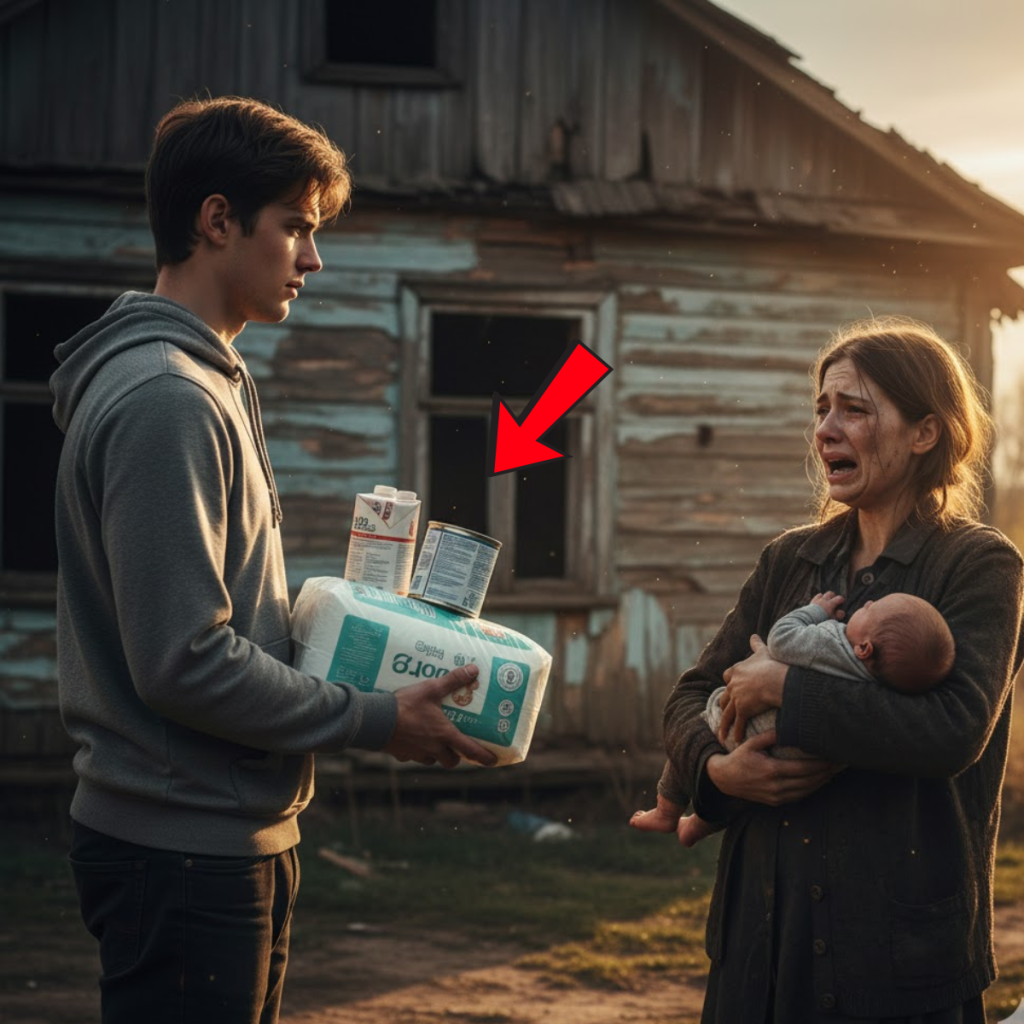
Gustavo stepped inside, and the small room seemed to shrink around him. Without many words, he began placing the cans of premium formula on the small wooden table.
“This is the best brand,” he said, breaking the uncomfortable silence. “And I brought size 3 diapers—I hope they fit.”
María Isabel stared at the cans as if they were gold bars. That formula cost a fortune.
“Sir… I… I can’t pay for this,” she said, lowering her gaze as tears of humiliation burned her eyes. “I only asked to borrow 200 pesos. This is… it’s too much. I’m not a beggar.”
“I know,” Gustavo interrupted gently, stepping closer but keeping his distance. “No one who wakes up at five in the morning to care for her child with this much love is a beggar. She’s a mother. And today, my money is more useful here than in my bank account.”
He prepared the first bottle himself, silently asking permission with his eyes to use the kitchen. María Isabel watched his hands—large, well cared for, but capable. When he handed her the warm bottle and Santiago began to drink desperately, a sacred silence filled the room. The sound of the baby feeding was the only music that mattered.
Gustavo stayed a few minutes longer, watching. For the first time in years, the emptiness in his chest disappeared. He hadn’t closed a million-dollar deal or won an award. He had simply watched a baby stop crying—and that was worth more than all his buildings.



“I have to go to work,” Gustavo said, leaving a card on the table. “If you need anything else, that’s my real number. Don’t hesitate.”
María Isabel tried to say thank you, but her voice broke. She only nodded.
The days that followed were strange. Gustavo didn’t disappear. He returned three days later “because he was in the area.” He brought fruit. The next week, toys. He didn’t overstep or buy her affection. He was simply there.
They began to talk—first at the doorway, then sitting in the small neighborhood park. She was defensive, waiting for the moment he would ask for something in return. He was patient, dismantling brick by brick the wall she had built around her heart.
María Isabel discovered that the “millionaire” had grown up without a father, that his mother had been a seamstress, and that he hated the loneliness of his penthouse. Gustavo discovered that María Isabel was intelligent, dreamed of finishing high school, had a laugh that lit up the afternoon, and loved Santiago with a strength that both intimidated and fascinated him.
But the difference between their worlds was still there, unspoken.
The breaking point came one stormy night, a month later. Santiago was burning with fever—39.5°C. Febrile seizures. Terrified, María Isabel ran through the rain looking for a taxi that wouldn’t stop in that neighborhood at night. She called Gustavo.
He arrived in fifteen minutes, breaking every speed limit. He saw her soaked, crying on the sidewalk with the burning bundle in her arms. He got out of the car, lifted both her and the baby, and drove to the most exclusive private hospital in the city.
In the waiting room, while doctors stabilized Santiago, María Isabel looked at herself—wet clothes, old shoes, surrounded by sterile luxury. She felt small, unworthy.
“I don’t belong here, Gustavo,” she sobbed. “Look at me. And look at you. This is a mistake. You’re playing house, and I’m living a nightmare. When Santiago gets better, you have to leave. I can’t keep owing you my life.”
Gustavo took her by the shoulders, forcing her to look at him. His green eyes burned.
“Do you think I’m doing this out of charity?” he said intensely. “Do you think I cancel meetings to sit in a park in Doctores out of pity?”
“Then why?” she shouted. “You have nothing to gain from us!”
“Because you gave me my life back,” he confessed, his voice dropping, eyes wet. “Before that message, I was a ghost in an expensive suit. You made me feel alive. This isn’t a debt, Isabel. It’s love. I’m in love with you. And I love that child as if he were my own blood.”
The silence returned—but this time it wasn’t uncomfortable. It was electric. María Isabel saw, for the first time, not the millionaire, but the man—the man who needed to be loved as much as she needed to be protected.
Santiago recovered. And with him, the relationship flourished—not in the shadows of charity, but in the light of emotional equality. She returned to her studies with his support but insisted on working part-time. Gustavo learned to change diapers and survive on little sleep.
Six months after the mistaken message, Gustavo took María Isabel to Chapultepec Forest. Santiago was already crawling, laughing as he chased pigeons. They sat on a bench beneath the shade of centuries-old ahuehuete trees.
Gustavo pulled out a small blue velvet box. Not an ostentatious ring, but a delicate, elegant one.
“María Isabel,” he said, kneeling without caring about dirtying his designer pants. “I promise you’ll never again have to send a message asking for help. I promise Santiago will never know hunger. But above all, I promise I will never be alone again if you agree to wake up with me every day. Will you marry this man who was lucky enough to receive the wrong number?”
María Isabel cried—but this time, they were tears that cleansed the soul.
“Yes,” she replied, embracing him. “A million times yes.”
The wedding wasn’t the social event the magazines expected. It took place in a small church in the Roma neighborhood. Only true friends and close family attended. Santiago, dressed in a tiny tuxedo, carried the rings—though he tried to eat one halfway down the aisle, making everyone laugh.
When the priest declared them husband and wife and Gustavo kissed María Isabel, there was no polite applause. There was a real ovation—from people witnessing a miracle.
They moved into a new house. Not the cold penthouse, but a home with a garden, swings, and life. Gustavo legally adopted Santiago before the wedding, giving him his last name and, more importantly, a present father.
A year later, happiness multiplied.
It was a sunny Sunday. The smell of grilled meat filled the garden. Gustavo stood by the grill, laughing as Santiago tried to kick a soccer ball. From the terrace, María Isabel watched them with a peaceful smile, rocking little Isabella—four months old, the newest member of the family—in her arms.
Isabella had her father’s green eyes and her mother’s determination.
Gustavo looked up and met his wife’s gaze. In that silent exchange, they said everything. They remembered the rainy night, the desperate message, the fear and the loneliness.
Sometimes, María Isabel thought, God writes straight with crooked lines. A trembling finger had pressed the wrong digit—an infinitesimal error in the universe of data. But that mistake had connected two opposite and complementary needs: the need for help and the need to give.
“Dad, goal!” Santiago shouted, pulling Gustavo out of his thoughts.
Gustavo ran to lift his son onto his shoulders, spinning until they were dizzy, while their laughter rose into the blue sky.
María Isabel kissed her daughter’s forehead and whispered, “Never forget, my girl, that miracles exist. Sometimes they come in the form of angels, and sometimes they come in the form of a mistaken text message.”
Life wasn’t perfect—there were still challenges, bad days, and arguments. But there was no more emptiness. No more hunger. Only a family that had found each other in the chaos of the world and chosen never to let go. And so, between laughter and diapers, the millionaire and the brave mother wrote the happy ending they both deserved, proving that true love knows nothing of zip codes or bank accounts—only of hearts willing to save each other.