The wind howled like a wounded beast through the deserted streets of Oak Haven, hurling fists of icy snow against the glass of the small restaurant “El Corazón.” Inside, the contrast was heartbreaking. The air smelled of toasted cumin, dried chilies, and the warmth of a Mexican home—but the silence weighed heavier than concrete. There was no laughter, no clinking cutlery, no life. There was only Carlos, elbows resting on the polished wooden counter, staring fixedly at a white envelope lying before him like a death sentence.
The red stamp screamed: “Final Notice.”
Carlos ran a calloused hand over his face, feeling years of exhaustion settle into his eyelids. That restaurant wasn’t just a business; it was his grandmother’s dream—a heritage of flavors brought from Michoacán, a piece of sunshine in that cold northern town. But the economy had been brutal, the winter merciless, and the tourists had disappeared. He glanced at the wall clock: almost nine at night. Three days left before eviction. Seventy-two hours to lose everything.
“This is the end,” he whispered, a knot tightening in his throat until he could barely breathe.
That’s when he saw the silhouette.
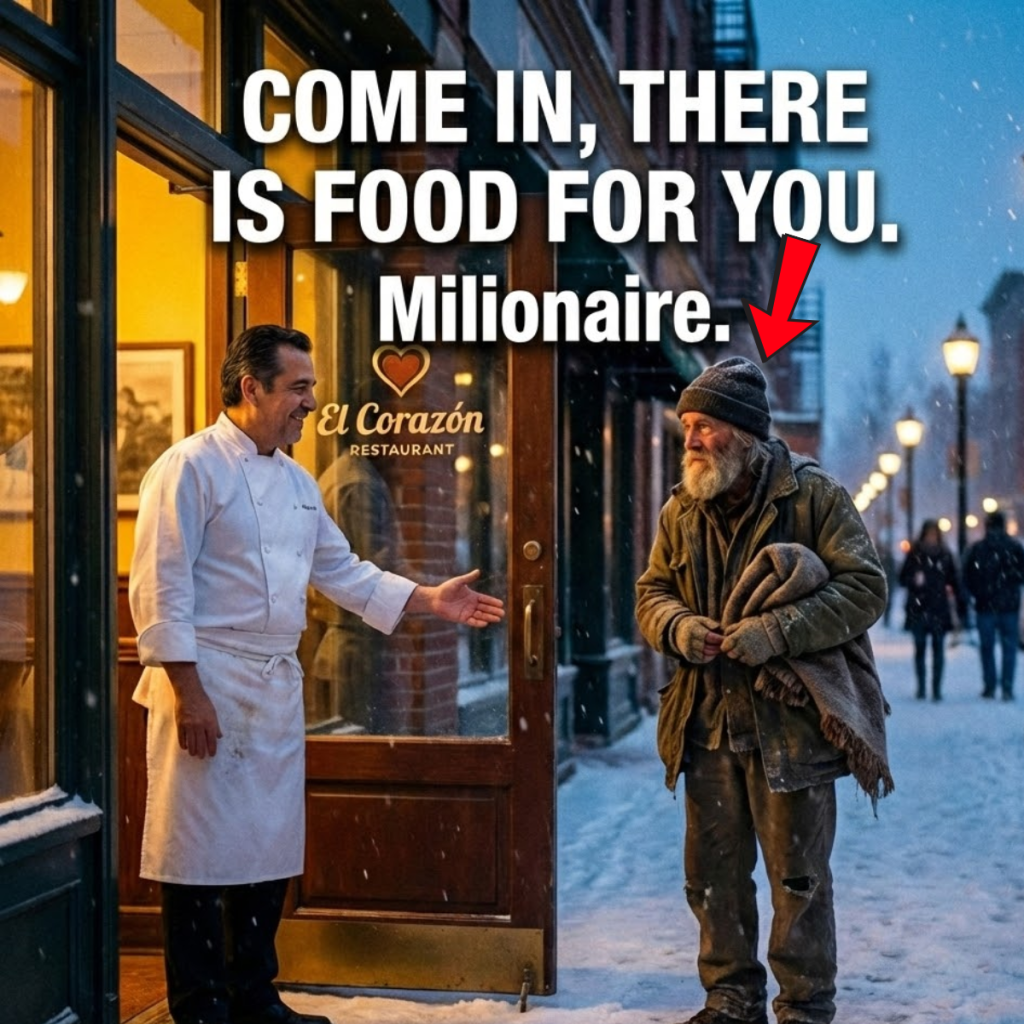
Outside, hunched against a streetlamp, struggling to remain standing against the fury of the storm, was an old man. He looked spectral—visibly trembling, wrapped in a tattered wool coat that let the cold seep through, and a scarf that had seen better days. Any other shop owner would have turned off the lights, pretending not to see someone else’s misery to protect their own fragile bubble. But Carlos’s heart didn’t work that way. He didn’t see a problem; he saw a human being.
Without thinking twice, Carlos walked to the entrance and opened the heavy door. The bell rang—cheerful and painfully out of place in the sad night. A blast of arctic air flooded the room, but the cook’s smile was warm enough to defy winter.
“Hey, friend!” Carlos shouted over the roar of the wind. “You’re going to turn into an ice statue out there. Please, come in.”
The old man, Samuel, looked up. His face was etched with deep lines of time, his gray beard unkempt. His eyes, however, held an instinctive caution. He took a step back, clinging to the little he still had: his dignity.
“I don’t have a single cent, son,” Samuel said in a hoarse but steady voice. “I was just admiring the warmth through the glass. I don’t want to be a bother.”
Carlos opened the door wider, holding it firmly.
“The warmth is free—and tonight, so is the food. No one should go hungry on a night like this. Come on. This is your home.”
There was a moment of silence, a mutual assessment. Samuel, long accustomed to being invisible to society, saw something in Carlos’s eyes he hadn’t seen in years: genuine respect. He brushed the snow from his worn boots and stepped inside.
Carlos guided him to the best table—the one beside the radiator—and rushed into the kitchen.
“I’m going to make my specialty,” he called from the back. “Aztec soup. My mother used to say it could bring even the dead back to life.”
As Carlos sliced avocado and fried tortilla strips, the restaurant phone rang—shrill and merciless. It was the bank. Carlos froze, knife in hand. He looked at the ringing phone, then at the old man warming his hands in the dining room. He let it ring until it stopped. If this was going to be his last service, it would be the best of his life.
When he set the steaming bowl in front of Samuel, the aroma of roasted tomato, pasilla chili, and epazote filled the space. The old man didn’t eat with the desperation of someone starving, but with the reverence of a king. He savored each spoonful, eyes closed.
“This…” Samuel said, his voice breaking, “…this tastes like memories. It’s the best thing I’ve eaten in years. You have the hands of a master, son—but your eyes tell a sad story. Why is a place with this kind of magic empty on a Friday night?”
The stranger’s honesty disarmed Carlos. He sat across from him and sighed.
“Winter’s been cruel. The debts piled up. I have until Monday to pay three months’ rent, or they’ll auction everything off—the pots, the tables, my grandmother’s memories… all of it will disappear.”
Samuel listened in silence, his expression unreadable, blue eyes fixed on the young cook. But what Carlos didn’t know at that moment—while confessing his defeat to a homeless man—was that this bowl of soup hadn’t just fed a man. It had set an invisible, powerful mechanism in motion—one that would shake the foundations of his life and the entire city within just seventy-two hours.
The front door burst open violently, making the bell ring like a panic alarm. A gust of snow swept in, followed by an imposing figure: Mr. Vans, the building’s owner. He wore an outrageously expensive cashmere coat and Italian shoes that looked insulting against the dirty snow.
“Carlos!” Vans barked, his voice echoing through the empty room. “I saw the lights on. I thought you were working to get my money—not running a charity.”
Vans stopped short when he saw Samuel. His face twisted into a look of pure disgust.
“What’s this? Now you’re turning my property into a shelter for vagrants? Get this trash out of here immediately! It devalues the building.”
Carlos shot to his feet, body tense, blood boiling. He stepped between the millionaire and the old man.
“Good evening, Mr. Vans. He’s my customer. Show some respect.”
Vans let out a dry, cruel laugh and walked to the table, invading Samuel’s personal space. Samuel continued eating his soup with unsettling calm.
“Customer? Is he going to pay? You’re three months behind, Carlos. I give you leniency, and you repay me by bringing rats into my building?”
“As long as I’m the tenant, I decide who comes in,” Carlos said, his voice low but shaking with anger. “You’ll have your money—or the keys—first thing Monday morning. But right now, let my guest finish his meal in peace.”
The silence that followed was thick with restrained violence. Vans looked at Carlos, then at Samuel, and finally spat his words:
“Monday morning, Carlos. If the money isn’t on my desk by nine, the police will throw you out by force. And take the trash with you.”
Vans stormed out, slamming the door so hard the windows rattled. Carlos collapsed into a chair, burying his face in his hands. He had sealed his fate out of pride.
“You confronted a powerful man because of a useless old fool,” Samuel said gently, setting down his spoon. “Why? That could have cost you the little goodwill he had left.”
Carlos lifted his head, eyes glassy.
“Dignity has no price, my friend. He can take my restaurant, but he can’t take who I am. If I lose everything on Monday, at least tonight I served a good meal to someone who deserved it.”
Samuel nodded slowly. He reached into the inner pocket of his tattered coat, feeling for something. Before leaving, he took a paper napkin and wrote a sentence with a stub of pencil.
“You gave me warmth when the world gave me ice, Carlos,” Samuel said as he stood. His posture had changed—no longer fragile, but strangely upright. “Keep this.”
He handed Carlos the napkin and vanished into the storm as mysteriously as he had arrived. Carlos read the shaky handwriting:
“True value isn’t in the pocket, but on the plate.”
Carlos smiled sadly. It was a beautiful sentiment—but pretty words didn’t pay the bank.
The weekend passed like a blurred nightmare. Carlos packed his family photos, his spices, his entire life into cardboard boxes. Monday arrived—gray, cold, merciless.
At exactly nine o’clock, the door opened. Not a customer. Mr. Vans, accompanied by two burly men and a court officer.
“Time’s up, Carlos,” Vans said with a triumphant smile. “The money or the street. Your choice.”
“I need more time, please…” Carlos begged, his stomach churning.
“Not one more minute! Get his things out—now!”
The men advanced, knocking a stack of boxes to the floor. The sound of shattering ceramics rang like a gunshot through Carlos’s heart. But before they could take another step, a different sound stopped everyone.



A low, powerful purr of a high-performance engine.
All eyes turned to the front window. A long, gleaming black limousine pulled up directly in front of El Corazón, blocking the view of the dirty street. The chauffeur stepped out and opened the rear door. A man emerged, dressed in an immaculate wool suit, polished shoes, and an elegant overcoat. He walked toward the restaurant with an authority that made the air feel heavier.
When he entered, silence fell.
Carlos blinked, confused. The face was familiar—neatly trimmed beard, clean skin, the scent of sandalwood and success. But the eyes… those sharp, intelligent eyes were unmistakable.
“Sam… Samuel?” Carlos stammered.
Mr. Vans went pale, stumbling backward into a table.
“M-Mr. Samuel Sterling? Owner of Sterling Real Estate Group? What are you doing in this dump?”
Samuel ignored Vans completely. He walked up to Carlos and extended his hand.
“Good morning, Carlos. I’ve come to pay for my soup. I believe the bill was still outstanding.”
Then he slowly turned toward Vans. Samuel’s gaze was no longer that of the defeated old man from Friday night—it was that of a lion staring at a hyena.
“And I’ve also come to discuss how my properties are being managed in this city. It seems I have an administrator who treats my favorite tenants very poorly.”
The revelation struck the room like lightning. The homeless man Carlos had fed owned half the city—including the very building they were standing in.
“Mr. Sterling, I was just following protocol…” Vans stammered, sweating. “We need to maintain standards—”
“Standards?” Samuel interrupted coldly. “You looked at this place and saw red numbers. I looked and saw the only establishment within three blocks that kept humanity alive during a storm.”
Samuel snatched the eviction notice from Vans’s hand, tore it into pieces, and tossed them into the air like confetti.
“You’re fired, Vans. And I suggest you leave my city before I decide to audit the rest of your management.”
Vans fled in humiliation, leaving the door open to air that now felt like freedom.
Carlos leaned on a chair to keep from collapsing.
“Mr. Sterling… you saved my life. But I can’t accept charity. I’ll pay every cent.”
“This isn’t charity, Carlos—it’s an investment,” Samuel smiled. “Last night, I was testing the soul of this city. You were the only one who passed. The debt is forgiven. I’ll fund a complete renovation of the restaurant—on one condition: that you never change who you are. That this door remains open to anyone who’s hungry, whether they have money or not.”
Carlos accepted through tears, promising that El Corazón would always live up to its name.
Months later, that promise was tested.
After a spectacular renovation, the night of the grand reopening arrived—Christmas Eve. Everything was ready to welcome the city’s elite, but a new storm—the Storm of the Century—hit Oak Haven. Roads closed. VIP guests canceled. Power went out across the city.
Carlos looked at his beautiful, empty restaurant, lit only by the emergency generator. He thought he had failed again. Then he looked outside—cars stuck in the snow, families freezing inside them, homeless people searching for shelter. He looked at Samuel, who nodded silently.
“Open the doors,” Carlos ordered his staff. “Let everyone in.”
That night, the luxury restaurant became a refuge. The expensive wooden floors filled with melting snow. Filet mignon and fine wine were served to mechanics, single mothers, elderly homeless men. And in the middle of the chaos, the door opened once more.
A man entered, covered in snow, trembling, his luxury car broken down outside.
It was Mr. Vans.
The room fell silent. Vans lowered his head, expecting to be thrown out—humiliated by fate’s cruel irony. But Carlos approached him with a bowl of hot soup.
“It’s cold out there, Vans,” Carlos said, offering the bowl. “Sit down. No one eats alone on Christmas in my house.”
Vans took the bowl with trembling hands—and broke down crying.
The story of the “Miracle Dinner” didn’t make the business pages, but it did make national news. Images of billionaire Samuel Sterling serving tables and Carlos feeding his former enemy went viral. When the snow melted, the line to enter El Corazón wrapped around the block. People didn’t come just for the food—they came to support a place with a soul.
Ten years later, the restaurant was still full. Carlos, gray at the temples now, walked toward a special table by the window. A bronze plaque read:
“Reserved: For those who hunger for food and for hope.”
That table was always available for anyone who couldn’t pay.
The door opened and Samuel entered—much older now, leaning on a cane. Carlos rushed to hug him. They sat at their usual table, and Carlos served two bowls of Aztec Soup.
“It was worth it, wasn’t it?” Samuel asked, looking at the restaurant filled with life, laughter, and warmth.
Carlos looked at his friend, then at the reserved table where a young traveler was eating for free with dignity, and finally at his own heart—fuller than ever.
“Every cent, my old friend,” Carlos replied with a smile. “Every cent.”
And outside, the snow fell softly—no longer a threat, but a blanket of peace over the one place where winter never managed to enter.