She pressed her thin coat tightly against her chest.
Her fingers were numb.
Her empty stomach burned from the inside.
And her eyes… those eyes held that strange color that appears only in those who have asked for help too many times and watched it never come.
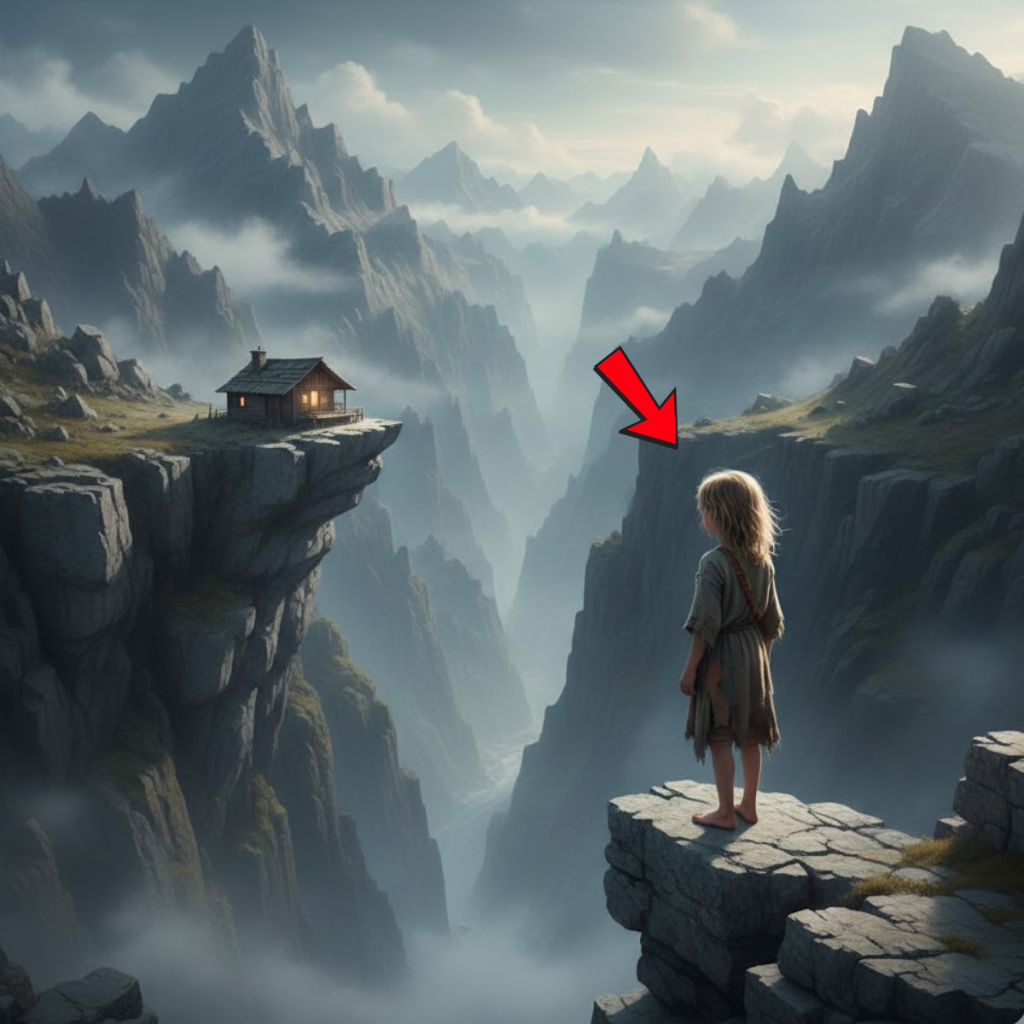
In the village, they said that up there, a house existed.
A house no one visited.
A house that did not want visitors.
But for an orphan girl, the idea of a door—any door—was already a miracle.
And also a trap.
With her feet sinking into wet leaves and mud, she climbed.
She was going to touch the untouchable.
She was going to enter a place adults did not dare even look at.
And what waited there would not only change her life.
It would change the way you understand loneliness, hunger… and hope when it arrives too late.
The climb felt endless.
Each step cracked over damp branches, as if the path complained about her presence.
At times, she would have sworn something was following her.
She stopped.
Held her breath.
Silence.
Only her heart pounding like a frightened bird trapped in a hand.
She kept going because fear was not the worst thing.
The worst thing was returning to nothing.
And that was where she had already come from.
When the house appeared, it was nothing like in fairy tales.
There was no warm light, no smoke rising from a chimney.
It was a dark cutout among the trees—crooked, still—
as if the mountain had half swallowed it and left the rest only to frighten.
The door was too tall for a child.
It bore deep scratches, like claw marks.
She raised her hand to knock…
and froze.
From inside, something could be heard dragging itself.
Slow.
Heavy.
Then, a single knock.
Toc.
As if someone had pressed their forehead against the wood on the other side, listening to her breathing.
And then she felt something even stranger.
It wasn’t someone waiting for her.
It was the house.
As if it were awake.
Watching her.
Choosing her.
She should have run.
But hunger pushes courage forward.
And loneliness pushes even harder.
She placed her palm against the door.
The wood was warm.
Warm like living skin.
“Please,” she whispered.
The lock turned by itself.
Slow.
Metallic.
Come in.
The door opened just a little.
The air that escaped smelled of soup.
Real soup.
The smell of home.
The smell of a childhood she could barely remember.
And that was the cruelest blow.
Because hope, when it comes late, hurts like a cut.
Inside, the darkness was thick, like old velvet.
But at the back there was a trembling light—a candle fighting against the mountain.
The floorboards creaked beneath her feet.
And immediately she knew she was no longer alone.
Not because she saw anyone.
But because the silence was listening.
The door closed behind her without a bang.
With an almost polite gentleness.
“Hello…” she said.
From somewhere in a corner came the dragging sound again.
And another toc.
Marking the rhythm of her fear.
The house revealed itself in pieces:
a chair too large,
a table scarred by knives,
a wall covered in carved lines… countless.
And then she saw it.
A pot over the fire.
Real fire.
Soup bubbling.
But no one was tending it.
Hunger blurred her vision.
She stepped closer… and the ladle lifted itself.
“Don’t eat yet,” a voice whispered.



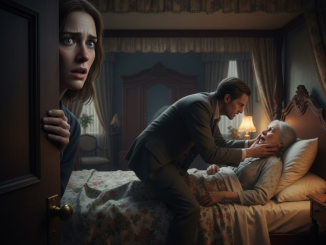
In the shadows, an old woman.
Not a monster.
Worse.
Someone real.
She looked at the girl with fear… and relief.
“That soup isn’t to take away your hunger,” she said.
“It’s so you won’t remember.”
“Remember what?”
The old woman smiled wearily.
“Your name.”
The fire crackled louder.
And on the wall, among the marks, there was a new one.
Fresh.
As if carved that very day.
As if the house had known she was coming.
The old woman drew a circle of salt.
Tied a red cloth around the girl’s wrist.
“This doesn’t protect you,” she murmured.
“It tells me how much time you have left.”
Then came the first удар.
Not on the door.
On the roof.
Thum.
“If you hear it,” the old woman whispered,
“it has already found you.”
The voice came from the window.
First crying like a lost child.
Then laughing.
Then… saying her name.
With the exact voice of her mother.
The orphan’s body wanted to obey.
“That isn’t a child,” said the old woman, crying silently.
“It calls you with what you lack the most.”
The mountain had decided it wanted her.
“The house is not a refuge,” the old woman confessed.
“It’s a cage.
And I am its key.”
When dawn came, only one of the two would still exist.
The old woman left without opening the door.
As if crossing a threshold only she could afford.
“When the sun touches the first nail on the roof, run,” she ordered.
The wailing outside stopped abruptly.
Silence.
“My love… it’s over now,” the voice whispered one last time.
The girl clutched the red cloth.
The photograph.
And answered with a small courage—but a real one:
“You don’t call me with my pain.”
When she came out, the house was gone.
Only fog.
Only trees.
But she carried something new in her chest.
Not hope.
Something stronger.
The memory of having been protected.
The memory that someone had spoken her name…
without asking anything in return.
And from that night on,
when silence touches wood,
she knows what to answer.