The wind blew with dry fury, lifting whirlwinds of dust that lashed Clara’s face as if the earth itself were warning her of the pain to come. But nothing burned as fiercely as the words that had just come from the mouth of the man she had loved for eight years.
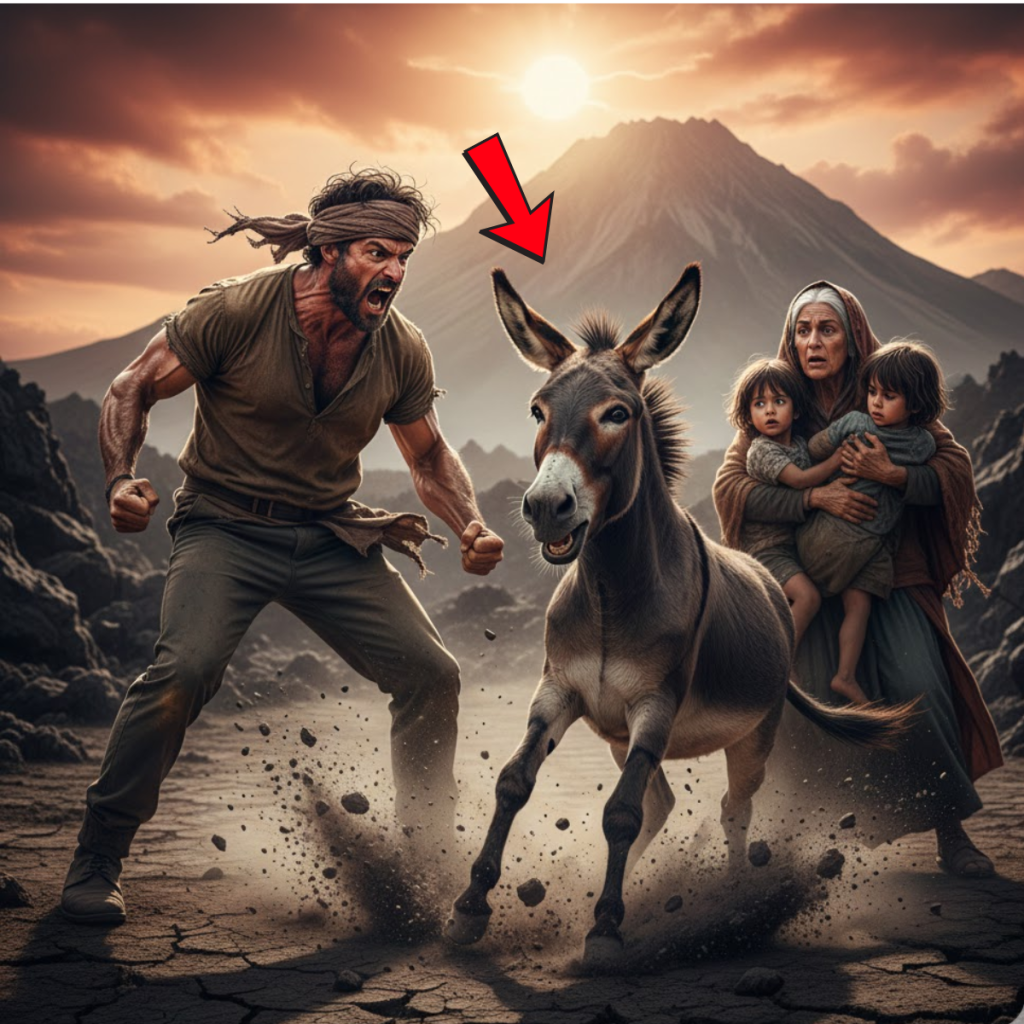
“Get out of my sight! You’re as useless as that old, lame donkey,” Rogelio bellowed, hurling a suitcase of worn-out clothes onto the cracked ground.
Clara dropped to her knees—not out of weakness, but out of desperation. Clinging to his legs, with little Mateo, six, and Sofía, four, hiding behind her skirt, she begged him. She begged not for herself, but for them.
“Rogelio, for God’s sake, we have nowhere to go. The children—”
“I’m sick of you!” he cut her off, his eyes bloodshot with alcohol and contempt. “I’m leaving for the city. I’ve got a real woman there—one with money, not one who smells like onions and dirt like you.”
Clara’s heart shattered into a thousand pieces. So it was true. The cantina owner—the woman who always looked down on her at Mass. Rogelio had gambled away even his dignity, in cards and in another woman’s bed.
“The house… it’s your parents’ inheritance,” Clara tried, her voice breaking.
“It’s not mine anymore. I lost it last night in a poker game to the foreman of the neighboring ranch. You have twenty-four hours to get out before they come kick you out.”
Rogelio climbed into the red pickup. Clara ran after him, trying to grab the window.
“At least leave us the truck! Sofía can’t walk all the way to town!”
“Get away, you crazy woman!” he shouted, speeding up. “You want something? Fine! There’s your inheritance.”
He pointed toward the barn, where Baltazar—the family donkey—stuck out his gray, patchy head. The animal had a twisted leg from a bad injury that never healed.
“That donkey is just like you: old, stubborn, and useless. Load him up with your rags and get lost in the desert.”
Wrapped in a cloud of toxic dust and cruel laughter, the father of her children drove away. Clara stood there, swallowing dirt and tears, holding two children who didn’t understand why their world had collapsed in five minutes. Baltazar limped over and gently nudged her shoulder with his muzzle, as if to say, I’m here.
Clara looked toward the horizon. To the north lay the town—shame, mockery. To the south stretched the Pedregal: a dead land of volcanic stone where people said not even snakes survived. But the donkey, stubbornly, turned his head south. Clara felt a chill. She had no money, no house, no husband. Only a lame donkey and two mouths to feed.
“Let’s go,” she whispered, making a decision that felt suicidal. “Let’s go south.”
And now what will happen? An abandoned mother with her two small children and a lame donkey ventures into the cruelest desert of the Pedregal, where the land seems dead and the sun shows no mercy. Will they survive? What secret does that barren land hold that Rogelio never imagined? Or is the “useless” donkey about to reveal a treasure that will change everything forever? Don’t miss Part 2… because sometimes, what looks like the end is only the beginning of an epic victory.
What Clara didn’t know as she took that first step into the hell of stones was that her husband was not sending her to her death. Without realizing it, he was pushing her straight toward the greatest and most valuable secret that land had hidden for centuries—a secret about to change her destiny, but one that would also bring back the demons of the past, ready to spill blood rather than let her be happy.
The journey through the Pedregal was a true ordeal under a merciless sun. The ground there wasn’t earth; it was blades of black rock that cut through soles and spirits alike. Baltazar, despite his limp, carried the children in turns, breathing hard but never stopping. It was as if the animal knew something Clara didn’t.
On the third day, the water ran out. Sofía’s lips were cracked, and Mateo cried silently, without tears. Clara collapsed beneath the meager shade of a dry mesquite.
“Forgive me,” she sobbed, holding her children. “I failed you. Mommy failed you.”
They were trapped in a dead end: a deep ravine surrounded by stone walls. It was the end. Then a rhythmic sound broke the silence. Thud, thud, thud.
Baltazar wasn’t resting. The donkey was in a corner, frantically pounding the ground with his good leg. He dug desperately, snorting, insisting. Clara stood with her last strength.
“What are you doing, old friend?” she murmured.
The donkey looked at her and let out a sharp bray. Clara approached and saw that the soil he had uncovered wasn’t gray—it was dark. Damp. She dropped to her knees and began digging with her hands, breaking her nails, ignoring the pain. And then the miracle sprang forth: a thin stream of murky, brown—but blessed—water.
“Water! Children, water!”
They filtered it through her shawl. They drank as if it were nectar from the gods. Baltazar had found an underground spring, a vein of life in the midst of death. And not only that. Once their thirst was quenched and they looked around with new eyes, Clara saw ruins: walls of volcanic stone that had once been a house. And around it, hundreds of dry trees, twisted like gray skeletons.
“A castle,” Mateo said with a child’s innocence.
“Yes, my love. Our castle,” Clara replied, feeling a strange energy run down her spine.
That night they slept protected by the walls. The next day, searching for firewood, Clara tried to break a branch from one of those “dead” trees. It didn’t crack; it bent. She took out an old knife and cut into the bark. Beneath the lifeless gray shone a deep, moist green.
Her grandfather had told her about them. Olive trees. The immortal trees. They could sleep for a hundred years and awaken with a single loving touch.
“They’re alive,” Clara whispered—and felt that she was alive too.
Over the following months, the “useless” woman became a warrior. With bleeding hands, she pruned, cleared, and cared for that forgotten grove. Baltazar carried fertilizer and water. The children removed pests. And the grateful land responded with an explosion of life. The trees bloomed and bore olives, black and gleaming like obsidian.
Clara had no machinery, so she ground the olives with river stones, as the ancestors once did. The result wasn’t ordinary oil. It was a dense, emerald-colored liquid with the intoxicating aroma of fresh grass and sun. She went down to the town in fear with twenty improvised bottles. She returned with her pockets full of money and the certainty that she had found green gold.
But happiness always seemed to have a price. Word of the “woman with the miracle donkey” reached Rogelio—dirty, drunk, and ruined. Greed lit up his eyes.
One afternoon, while Clara was working with Gabriel—the true owner of the land, a young chef who had arrived following his grandfather’s maps and stayed, amazed by Clara’s work—hell broke loose. Rogelio appeared at the entrance, a knife gleaming in his hand.
“Well, well! So this is where you’re hiding my money,” he slurred.



Gabriel tried to intervene, but Rogelio was crazed with jealousy and alcohol. With one blow, he knocked over the table holding weeks of production. Bottles shattered. Oil spilled onto the earth.
“That’s for teaching you who’s in charge!” Rogelio shouted. “And I’m taking the only thing here that’s worth anything.”
He untied Baltazar. The donkey resisted, but Rogelio beat him brutally and dragged him downhill.
“I’m selling him to the slaughterhouse!”
Clara felt like she was dying. Gabriel, jaw clenched, lifted her from the ground.
“Get in the jeep. We’re not letting this happen.”
The chase was frantic. They reached the municipal slaughterhouse just as Rogelio closed the deal with the butcher. Baltazar was tied to a rusted truck, wearing the sad look of one saying goodbye to life.
“Let him go!” Clara screamed, jumping out of the jeep.
“Get lost, crazy woman! I already sold him,” Rogelio sneered.
The butcher advanced toward Gabriel with a hook raised, and Rogelio pulled out his knife. They were going to lose. But they forgot one detail: Baltazar was no longer the old donkey Rogelio had abandoned. Months of good food, clean water, and love had restored his strength. And donkeys remember.
Seeing Clara in danger, Baltazar snapped the rope with a violent jerk. He didn’t flee. He charged. He slammed into Rogelio from behind with the force of a train. The dry blow sent the man face-first into a puddle of mud and blood. The butcher, distracted, was shoved aside by Gabriel.
“Run, Clara!”
They escaped through the alleys, the donkey trotting freely beside them, leaving a humiliated Rogelio behind in the filth.
That night, under a bridge, Clara hugged her donkey and knew she had won a battle—but the final war was still to come.
The thirty-day deadline given by a corrupt foreman known as “El Turco” to evict them arrived at dawn. Rogelio, furious and humiliated, allied himself with him. At sunrise, the ground trembled. It wasn’t an earthquake. It was bulldozers. Yellow machines advanced to crush the stone house and rip out the centuries-old olive trees. Rogelio led the way, fake papers in hand and a sadistic smile.
“Knock it all down!” El Turco ordered.
Clara stood in front of the largest machine. Alone. Small before the steel monster.
“You’ll have to run me over!” she shouted, her voice making the operator hesitate.
“Step on it!” Rogelio roared. “She’s my wife and I give permission!”
The mechanical shovel rose. Mateo and Sofía screamed from the house. It seemed like the end. Then Gabriel stepped forward, pulling out a phone and a leather folder.
“Stop!” His voice rang with authority. “I’m Gabriel Villalobos. Majority owner of the construction company.”
Absolute silence. El Turco turned pale. The Villalobos name belonged to the owners of everything.
“You’re fired for theft and forgery,” Gabriel said calmly, lethally. “And you,” he pointed at Rogelio, “the police are on their way for attempted murder and animal abuse.”
Sirens from the National Guard flooded the valley. Cornered, Rogelio threw himself at Clara’s feet.
“Clarita, my love, tell them it’s a mistake. I’m your husband, the father of your children. Don’t let them take me.”
Clara looked down at him. She no longer saw the man who once terrified her. She saw a pathetic stranger.
“My husband died the day he abandoned us in the desert,” she said coldly. “Take him away.”
As the patrol cars hauled the villains off, Gabriel pulled out an old document.
“My grandfather left a clause,” he explained to Clara, eyes shining. “The land belongs to whoever makes it productive. Legally, Clara, Hacienda La Candelaria is yours.”
Clara fell to her knees and kissed the ground—the same ground that had wounded her now crowned her.
Two years passed. The Pedregal was no longer a gray desert. It was a green paradise. The oil El Milagro de Baltazar won international awards. Clara, now a respected businesswoman, walked confidently among her olive trees. She had created a cooperative to provide work for single mothers from the town. Baltazar, old and spoiled, napped in a luxury stable, the beloved mascot of all. Gabriel and Clara had formed a true home—without shouting, only laughter and the smell of hot food.
One afternoon, Clara had to go into town. Near the bus terminal, she saw a beggar sitting on the curb—dirty, holding a bottle of cheap liquor. It was Rogelio, unrecognizable, consumed by his demons. When he saw her step out of her new truck, dressed with elegance and dignity, he looked up. Their eyes met. He opened his mouth to say something, but shame closed his throat. He lowered his head, hiding between his knees.
Clara stopped. She could have spat on him. She could have insulted him. But her heart was so full of peace that there was no room for hate. She took a bill from her purse and gently dropped it into the beggar’s cap.
“May God forgive you, Rogelio,” she murmured, “because thanks to you letting me go, I learned how to fly.”
She turned around and walked toward her future, leaving behind forever the shadow that once made her believe she was worth nothing. Because Clara had learned the most important lesson of all: sometimes life has to break you, grind you, and press you like an olive, to draw out the purest and most valuable essence you carry inside.