In San Isidro de la Sierra, a dusty little town clinging to the mountains of the Sierra Madre—one of those places where the wind carries the names of the dead and the sun burns as if it were angry—people had a habit as constant as the ringing of the church bell: pointing uphill and murmuring with pity and disdain.
“Look… that’s where the crazy cave woman lives,” they’d say in the small shop or the cantina, between swallows of lukewarm mezcal. “She doesn’t even have a place to die. Lives like an animal in that hole.”
And every time Rosa came down to town with her small ixtle basket full of herbs, she heard the same thing: the same whispers, the same sideways glances. She never answered with shouting or anger. She simply lifted her light brown eyes—so rare in those lands they seemed almost from another world—smiled faintly, and kept walking, as if the cruel words stuck to the dust on the boots of those who spoke them.
Because to Rosa, that cave the town called shame was something else entirely: freedom. A peace she had never known before.
She had arrived in those mountains almost three years earlier, her black hair hidden beneath an old, worn rebozo, carrying a past that tightened her chest like a wire knot. She had no money, no family, no last name that meant anything in a place where you are measured by what you own. She had only the clothes on her back—and an iron stubbornness: never give up.
It was during a walk—one of those you take to stop thinking, but end up thinking even more—that she saw it among the rocks: the dark mouth of a cave. She entered carefully, expecting snakes or bats, and instead found a wide, dry space, protected from the wind. At the back, a crack in the stone let a thin thread of pure water drip down, like a secret whispered by the earth.
To anyone else, it was unworthy. To Rosa, it was a treasure.
She spent weeks turning it into a home: dragging stones to make divisions, gathering dry leaves and grass for a bed, setting aside a corner for a fire pit. Over time, she collected things others had thrown away: a cracked mirror, a cup without a handle, a patched little blanket, colorful pebbles she gathered as if they were coins. Each object was a small victory.
Then came the routine. She woke with the first ray of sunlight slipping through the entrance, lit a small fire, and went out to gather plants on the hillsides: Mexican arnica for bruises, wormwood for the stomach, mullein for coughs, wild chamomile for the nerves, hierba santa whenever she found it. Her grandmother, a healer with steady hands and ancient prayers, had taught her which herbs calmed fever, which eased pain, which closed wounds.
The herbs became her currency. Some people, though they looked at her strangely, came to her when the town’s pharmacist could no longer perform miracles.
“I don’t have money to pay,” they’d say, ashamed.
“I don’t want cash,” Rosa replied. “Bring me some corn, beans, or whatever you can.”
That was all.
What the town didn’t understand—and perhaps what bothered them most—was that Rosa was not unhappy. She wasn’t waiting for anyone to rescue her. In her cave, she didn’t have to bow her head, pretend, or ask permission to exist. She sang when she was happy. She cried when she needed to. And she slept without fear of a knock on the door.
Still, the words hurt. There were nights when she lay on the dry leaves and let silent tears fall, wondering why people were so cruel to those who were different. She had never stolen, never harmed anyone. Her “crime” was being poor… and not apologizing for staying alive.
One October evening, Rosa noticed something that stole her breath. The sky, which had dawned clear, was turning into a heavy black mass moving fast. The wind began to blow with unnatural force, bending the pines as if forcing them to pray.
Rosa knew nature the way one knows a large animal: by its signs.
And this… this was no ordinary storm. It was a hurricane, coming with everything it had.
She reinforced the cave entrance by piling stones, gathered her most valuable belongings, and stared down at the town from above, a hollow ache of worry in her chest. She wanted to go down and warn them—to tell them to shut their windows, to seek shelter, not to wait and “see if it passes.” But she imagined the laughter, the eye rolls.
“The crazy woman is exaggerating. Yeah, right.”
So she waited, her stomach knotted, hoping she was wrong.
She wasn’t.
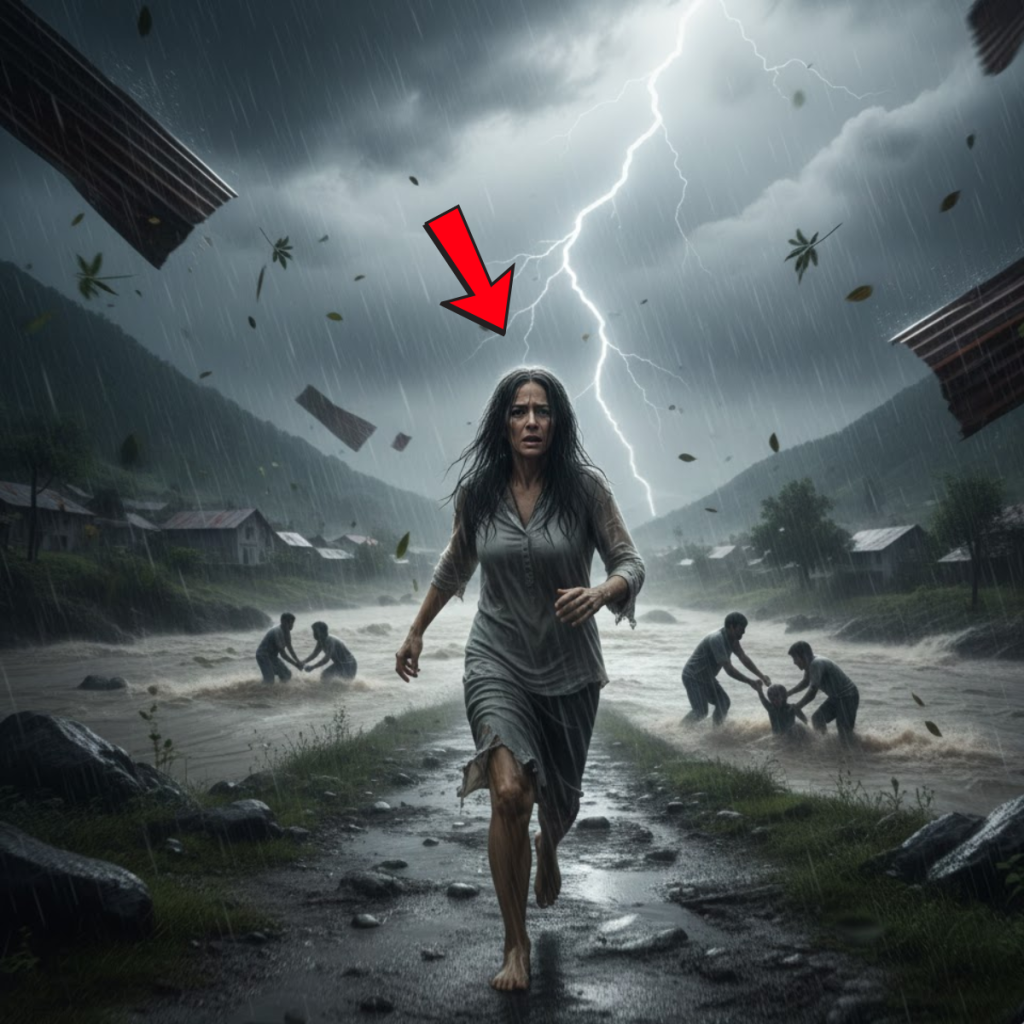
The hurricane struck San Isidro as if the sky had shattered into pieces. Within minutes, the wind became a beast—ripping branches apart, lifting dust and turning it into mud with rain that felt like a waterfall from hell. Lightning sliced through the air every few seconds, illuminating scenes of terror: roofs flying off, power poles collapsing, windows exploding. People ran without direction, screaming names, clutching children, shielding their heads with whatever they could.
Rosa watched from the mountains, her throat tight.
Then she saw them.
Five figures in the middle of the chaos, trapped between the main street and the stream that was beginning to overflow like a raging river. An elderly man staggered as if his legs were made of rags. A woman clutched two small children to her chest, crying. A young man tried to keep them together, but the wind shoved them around like dry leaves.
A sheet of metal torn from a roof whizzed past them. The older man fell. The others bent down to lift him, losing precious seconds.
Rosa felt her blood turn cold.
If they didn’t find shelter now, they wouldn’t survive.
And then she did the unthinkable.
She left the cave.
She ran downhill toward the chaos while everyone below ran to save themselves.
The descent was a war against the hurricane. The wind shoved her sideways; the rain struck her face like stones. More than once, she had to grab a rock to keep from rolling. Branches and metal sheets flew so close she could feel the force of the air.
But Rosa did not stop.
When she finally reached the group, they were on the edge of panic.
“Come with me!” she shouted over the roar. “I know a safe place!”
The young man looked at her with distrust, recognizing on her face the label the town had given her.
“You… the cave woman?”
Before he could say more, a gust tore a piece of roof loose and slammed it against a wall with a crash. The doubt vanished.
“Let’s go!” he said, almost pleading.
Rosa moved to the elderly man and lifted him under the arm.
“Don’t let go, friend,” she ordered. “One step at a time.”
“I’m… Don Guadalupe Vargas,” the old man managed to say, soaked. “I can’t…”
Rosa looked him straight in the eye.
“Yes, you can. Because you’re still here.”
The woman held her children tighter.
“I’m Carmen,” she sobbed. “My kids…”
“They’re going up,” Rosa said. “I’ll get them there.”
And the young man clenched his teeth and took the other side of Don Guadalupe.
“My name is Juan,” he shouted. “Tell me what to do.”
The climb was worse. Now it wasn’t just about surviving herself—it was carrying others’ fear, supporting exhausted bodies, pushing when legs gave out. Don Guadalupe slipped, and Juan and Rosa carried him at times. Carmen climbed with a child in each arm: Lupita, six, and Pedrito, four—soaked, trembling.
Rosa led the way.
“Don’t separate!” she kept shouting. “Step where I step!”
At one point, a rock came loose and Don Guadalupe nearly fell. Rosa lunged and caught him before he plunged into the void.
“Why… why are you doing this?” he gasped. “We… we…”
Rosa cut him off.
“We’ll talk later. Breathe!”
They reached the cave entrance like people stepping into another world. Inside, the wind was a distant whisper. There was no rain. The temperature was gentle. The five collapsed onto the ground, crying, laughing, shaking all at once.
Rosa lit the fire with quick hands, as if she had done it all her life—because she had. She gave them water from the spring, wrapped the children in old hides and blankets, and began treating wounds with arnica and hierba santa.
Their eyes followed her—gratitude, shock… and shame mixed together.
Don Guadalupe spoke first, his voice breaking.



“You saved us… and I was one of the ones who…” He swallowed. “I was one of the ones who shut the door on you.”
Rosa shook her head gently.
“I didn’t save people who despised me,” she said. “I saved human beings who were about to die.”
The words struck harder than lightning.
Carmen covered her face.
“I spoke badly about you,” she confessed through sobs. “I said… I said you were crazy.”
Rosa took her hands.
“Hate is exhausting,” she whispered. “And I need my energy to survive… and to heal.”
Juan, soaked and with a split lip, stared at her as if seeing her for the first time.
“How did you learn all this?” he asked.
Rosa was silent for a moment. The flames crackled.
“My grandmother taught me,” she said at last. “And life did too. It teaches with blows—but it teaches.”
That long night, while the world outside fell apart, they discovered that the “crazy woman” had a home more orderly than many in the town. That her solitude was not abandonment, but refuge. That her calm was not strangeness, but strength.
When the hurricane finally eased and dawn painted the cave entrance gray, they stepped outside.
The town was wounded: collapsed houses, shattered roofs, streets full of debris. But there were survivors—people emerging from basements, barns, any place that had protected them.
Don Guadalupe swallowed hard, eyes red.
“We’re going to help,” he said.
Before leaving, he turned to Rosa.
“What you did… can’t be paid with corn or beans. I swear to you—this will change things.”
Carmen hugged Rosa tightly. Lupita and Pedrito clung to her too, warm, as if their bodies understood that safety lived there.
Juan lingered last at the entrance, the wind now calm.
“I repeated what I heard,” he admitted. “I never stopped to ask if it was true. Forgive me.”
Rosa felt something old, something broken inside her, loosen.
“As long as you don’t repeat it again,” she said, “that’s enough.”
In the weeks that followed, San Isidro rebuilt itself with hammers and wounded hands. And without Rosa seeking it, her story spread through the town like fire through dry grass.
“She pulled us out of hell.”
“She healed my child when no one else could.”
“She never asked for anything.”
The “crazy woman” began to change names on people’s lips.
A month later, Rosa saw figures approaching along the path. They weren’t desperate like that night. They were steady. They carried bundles, tools… and serious faces.
It was Don Guadalupe, with Juan and Carmen.
“We’ve talked a lot,” Don Guadalupe began. “And we realized something: you didn’t lack a roof. We lacked shame.”
Juan lifted his eyes.
“We pooled money. From many people. And we bought a small piece of land.”
Carmen smiled nervously.
“Not to take your cave away. So you can choose. So you have a place… if you want.”
Rosa blinked, confused.
“What… what are you saying?”
Don Guadalupe took a deep breath.
“That we’re going to build you a small house, near the stream. With a kitchen for your herbs and a warm room for winter. And if you don’t want to live there… at least it will be yours. No one can take it from you.”
Rosa lost her voice. Tears slid down before she could hide them.
“I… I only did what anyone would…”
“No,” Carmen said softly. “You ran toward danger while everyone else ran away. Not just anyone does that.”
The little house took weeks. It was simple: solid wood, a roof that didn’t leak, windows that let the sun in. A wood stove. Space to dry plants. A large table for preparing poultices. And outside, land to plant.
The day Rosa received the keys—an old keychain, but real—the whole town showed up. Some brought gifts: pots, blankets, a bench, a lamp. Others brought only a “thank you” that cost them effort, but they said it.
Children who once weren’t allowed near her now surrounded her, asking her to tell stories of the mountains. She looked at them and thought, with a sweet knot in her chest, that sometimes a hurricane doesn’t just tear down roofs… it tears down prejudices.
That night, sitting on the porch of her new home, Rosa looked at the stars as if they were new.
Don Guadalupe arrived with a bottle of mezcal and sat beside her in silence for a while.
“All my life I thought success was owning property and being respected,” he finally said. “But that night… you taught me something else. Peace. Courage. Decency.”
Rosa smiled gently.
“I lost everything once,” she replied. “And I thought it was the end. But it turned out to be the beginning… of finding myself.”
They sat quietly, listening to the distant song of a coyote and the murmur of the stream.
And in the end, when the cold settled in, Rosa stood up, looked toward the mountain and then toward her new home.
It wasn’t that the cave had stopped being her refuge. It was still part of her—her first home, her proof that she could survive.
But now she had something she never expected to find in San Isidro de la Sierra:
A community that finally saw her.
And every time the sky began to darken and the wind announced a storm, Rosa opened her door without hesitation.
Because the “crazy cave woman” was never crazy.
She was only alone…
until life forced the town to learn, in the hardest way possible, that true wealth lies not in what one has, but in what one is capable of giving.