The sun of San Isidro del Valle did not warm—it punished.
It beat down mercilessly on the dirt road, lifting a fine dust that crept into the eyes, the throat… and the soul. That old dust seemed made of years of neglect, of injustices no one ever bothered to sweep away.
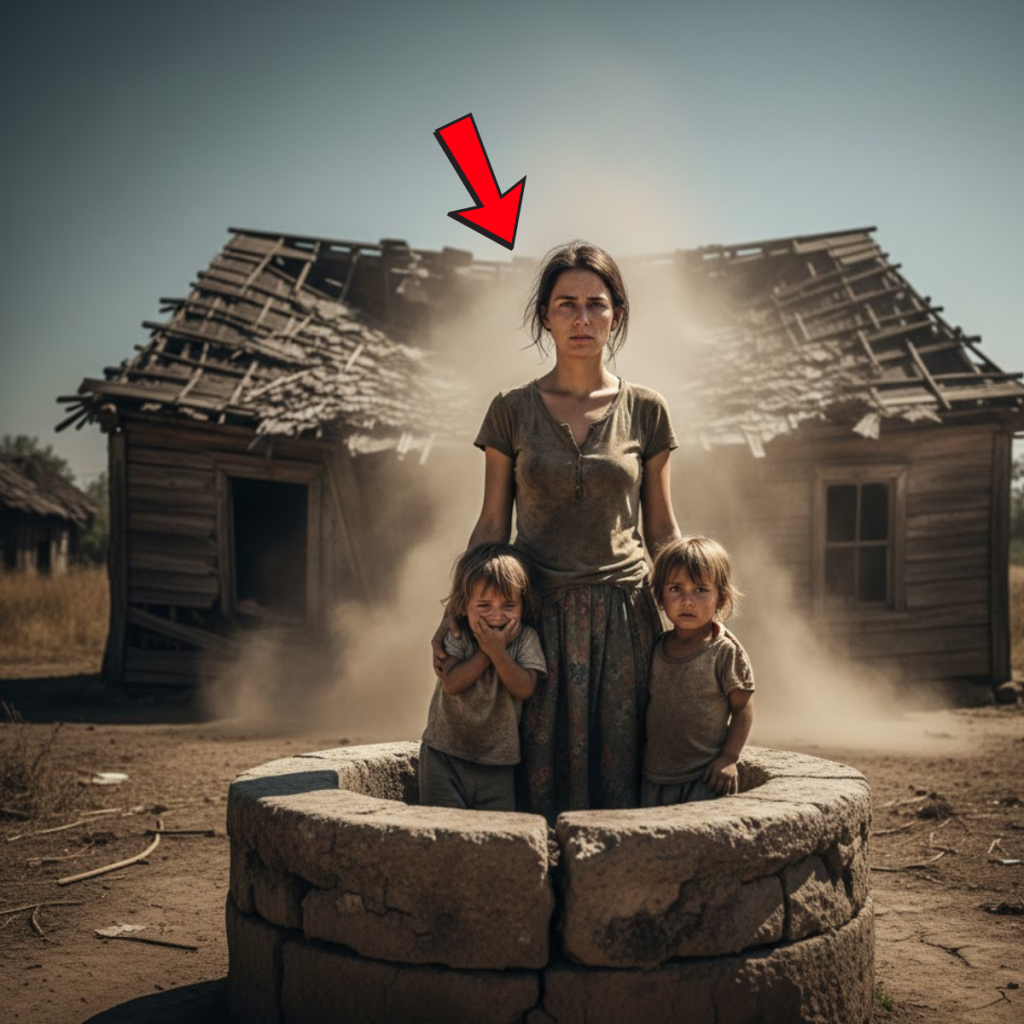
There stood Raquel Cortés Montemayor, twenty-nine years old, widowed for two.
Standing. Without shade. Without a home.
At her feet, three black garbage bags. Inside them fit everything she had left of her life: her children’s worn clothes, a Bible underlined in her mother’s trembling handwriting, and a yellowed wedding photograph in which she smiled beside David Cortés Herrera, her husband—killed in a ranch accident the town soon forgot… as the poor are forgotten.
Clinging to her legs was Emma, four years old. She didn’t cry loudly. She cried inward, her face buried in her mother’s denim skirt, as if the world were too cruel to face head-on.
Beside her stood Tomás, six years old, fists clenched. He wanted to be a man. He wanted to protect. But his large, dark eyes revealed the pure fear of a child whose ground is ripped away without explanation.
The eviction was quick. Cold. Soulless.
At dawn, a lawyer from the capital arrived—sweating inside his cheap suit—and two municipal police officers who couldn’t bring themselves to look at the children. The papers were “clear,” they said.
The house had never legally belonged to David.
Years earlier, he had been the victim of a real estate scam.
The “true owners” were claiming it.
Twenty minutes.
Just twenty minutes to take what was essential.
After that, the locks were changed. As if a life could be locked away.
And standing before Raquel, sheltered by a lace parasol held by an employee, was Doña Beatriz Montemayor, widow of Aguilar, sixty-five years old.
The moral, economic, and political owner of San Isidro.
Ash-blonde hair perfectly arranged. A light linen suit. A cane with a silver handle.
Around her, her court: ranchers’ wives, politicians’ wives, expensive perfumes, and smiles that smelled of contempt.
“Poor thing…” Beatriz said, advancing slowly, her heels sounding like a sentence being passed. “She’s left with nothing. Absolutely nothing.
Who would have thought it? David Cortés’s widow, so proud… ending up like this.”
Raquel felt her blood boil in her ears. She wanted to scream. She wanted to throw the bags to the ground. But Emma and Tomás clung to her.
She couldn’t break. Not today.
“Doña Beatriz… please,” she murmured. “We’re not asking for charity. We’re just waiting for the bus.”
Beatriz let out a soft, poisonous laugh.
“Leave? And where would you go, child?” she asked. “You have no parents. No money. And your husband didn’t even leave enough for a burial.
Are you going to take those children to sleep under the bridge by the dry creek? They say coyotes come down at night…”
Emma sobbed harder.
Tomás clenched his teeth.
Beatriz lowered her voice theatrically so everyone could hear:
“Christian charity is a duty. We can’t allow these poor devils to die of sunstroke on my street. It would look very bad for the town.”
“You are a saint, Doña Beatriz,” said the mayor’s wife.
“I know,” Beatriz replied shamelessly.
“Raquel… I have a property at the back of the Hacienda. Next to the hills. An old, rustic, abandoned cabin.
I offer it to you. Free of charge.
So you and your children won’t be a nuisance around here.”
Raquel lifted her gaze. Hope wrestled with instinct.
“A house…?”
“A shack,” Beatriz corrected. “Don’t get excited. It has a roof. That’s more than you have now.”
The laughter was soft. Cruel. Like knives wrapped in velvet.
Raquel looked at Emma. Looked at Tomás.
If she refused, social services would take them away.
If she accepted, at least they would sleep under a roof.
“I accept,” she finally said, chin held high. “Thank you. May God repay you.”
Beatriz let out a short laugh.
“God already paid me, dear.”
The journey was a slow humiliation.
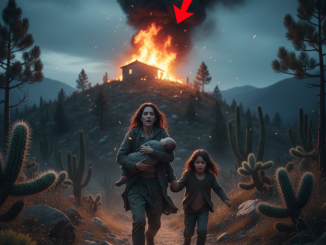
Beatriz drove ahead in her air-conditioned truck, deliberately slow, forcing them to walk behind under the sun. They passed perfect gardens, stone fountains, the Big House. Then, little by little, abandonment: dirt roads, twisted mesquite trees, dry brush.
The truck stopped.
“We’re here.”
It wasn’t a cabin.
It was a wooden corpse.
A broken roof. A hanging door. Windows without glass.
Forgetfulness made into a house.
Laughter burst out.
“This is what there is,” Beatriz said. “If you don’t like it, the bridge is still free.
But remember: children need a roof.
And this… technically… is a roof.”
Raquel felt something break inside her.
And at the same time, something was born.
“We’ll stay,” she said.
That night, as the wind whistled through the broken boards, Raquel didn’t sleep.
She didn’t yet know that beneath that ruin…
the earth was about to give her back her name.



But that night, inside that shack they called humiliation, Raquel would find something that would change her destiny… and destroy the most powerful surname in San Isidro.
Part 2…
That night, when the sun finally surrendered and the hills were wrapped in a harsh silence, Raquel lit a candle inside the shack. The flame trembled, like her. The air smelled of old wood, of abandonment, of stories no one wanted to hear.
She swept the floor with a broken broom, pushing aside dust, cobwebs, and dry leaves. Every corner seemed to carry an ancient sadness. When she moved a loose board, something struck the floor with a hollow sound.
Raquel froze.
She knelt.
With trembling hands, she pulled out a small package wrapped in yellowed cloth, tied with a ribbon faded by time. Her heart began to pound, as if it recognized what her eyes did not yet understand.
Inside were letters.
Old letters. Written in a firm, loving hand.
“To my beloved Elena.”
“With love, David.”
The name struck her like lightning.
Elena Montemayor de Cortés.
Her mother.
Her vision blurred. She read one letter. Then another. And another. Every line was a confession, an open wound, a truth deliberately buried.
The revelation fell with the weight of wet earth:
Elena was no nobody.
She was the disowned daughter of Doña Beatriz Montemayor.
Expelled for loving the wrong man.
Silenced to protect a surname.
Don Anselmo Montemayor had secretly tried to repair the family’s sin: a hidden donation, five hectares registered under the name La Joya.
The shack was not a punishment.
It was the origin.
The cradle.
The denied inheritance.
Raquel pressed the letters to her chest and cried in silence. Not from pain. From awakening.
From that night on, she swore never to run again.
The following days were harsh. She worked on her knees, under the sun, among thorns and contemptuous stares. She was humiliated. Ignored. Pointed at. But she endured.
When Emma fell ill, she remembered her mother’s words in those letters. She searched the hills. Found plants. Roots. Leaves that Elena had planted decades earlier. She prepared infusions, ointments, ancient remedies.
Emma recovered.
Then another child.
Then an old woman.
And more people came.
The shack, once a corpse, began to breathe. It filled with voices, with hope, with gratitude. Where there had been mockery, respect was born.
One day, while reinforcing the floor, Raquel found a buried iron box. Inside: birth certificates, property deeds, a will signed, dated, and sealed. Irrefutable proof.
She did not hesitate.
She hired Attorney Saúl Benítez Ramírez and filed the lawsuit.
Doña Beatriz responded as she had always lived: with hatred. There were threats, attempts at intimidation, dirty rumors, even a complaint filed with social services. But this time, the land spoke louder than money.
The DNA test was clear. Brutal. Final.
99.99%.
Raquel was her granddaughter.
The town trembled. The Montemayor surname fell from grace. Doña Beatriz ended up under house arrest, surrounded not by admirers, but by silence and shame.
One night, ill and unable to breathe, it was Raquel who crossed the gates of the Hacienda with a bottle of remedies.
She saved her.
“Forgive me…” Beatriz whispered, defeated.
The years passed.
The Hacienda became the Elena Montemayor Integrative Medicine Center.
The shack became a museum.
Raquel became a guide and leader of her community.
From the porch, surrounded by gardens and children playing, Raquel looked at the land and murmured, peace in her voice:
“They gave me ruin to humiliate me…
but the earth gave me back my name.”