The flight from Barcelona to Madrid was supposed to be a quick formality, barely a couple of hours in the air, but for Alejandro Martínez it had turned into the most agonizing eternity of his life. At forty years old, Alejandro had everything: he was the CEO of one of Spain’s most important tech companies, his bank account had more zeros than he could spend in ten lifetimes, and his name opened doors anywhere in the world. Yet up there, at 30,000 feet, trapped in a first-class seat that suddenly felt like a leather prison, Alejandro felt like the poorest and most miserable man on the planet.
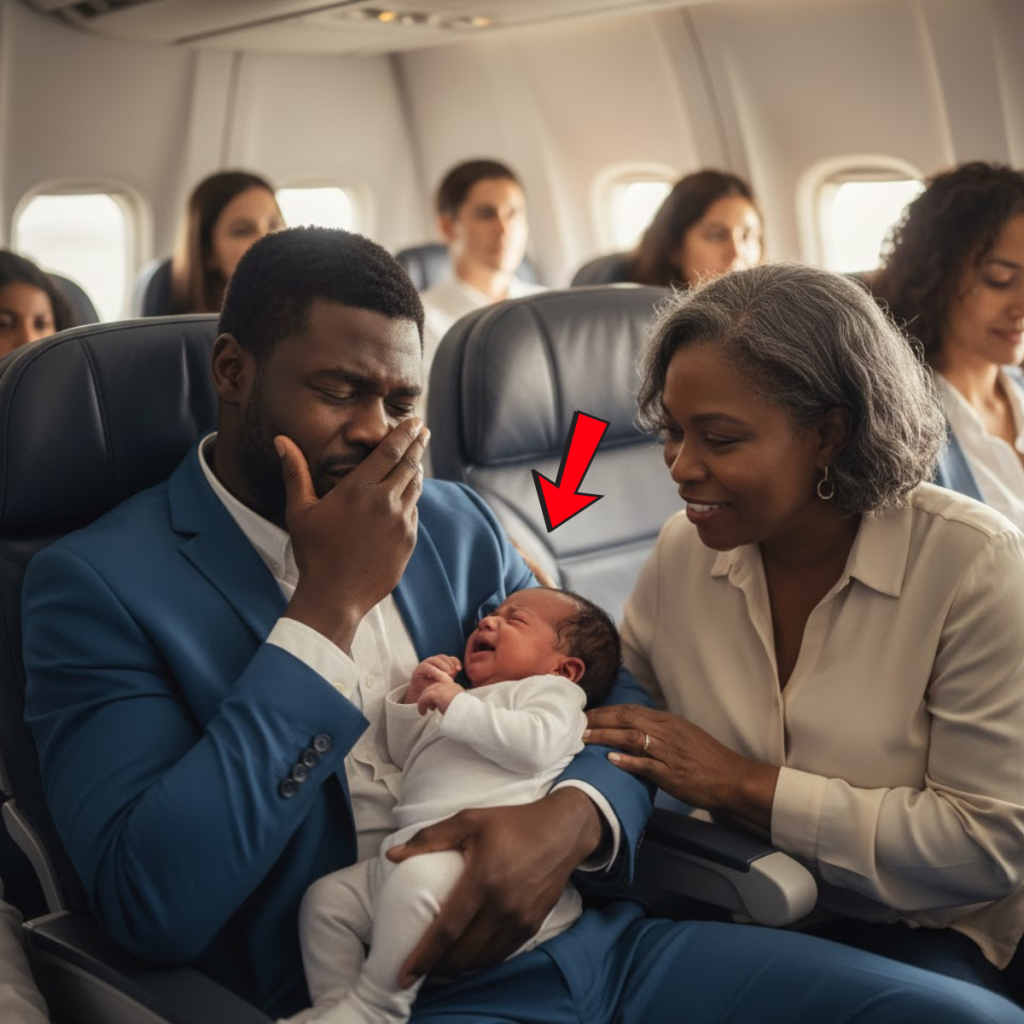
In his arms, little Diego—his barely three-month-old son—was crying. It wasn’t a normal cry, the kind that asks for food or a diaper change. It was a piercing, continuous scream, a lament that seemed to rise from a deep pain Alejandro didn’t know how to heal. The baby hadn’t stopped for two hours. Alejandro, dressed in a €5,000 suit now soaked in cold sweat, had tried everything the nannies and parenting books suggested: the bottle, the pacifier, walking him up and down the aisle, rocking him rhythmically. Nothing worked.
The first-class passengers—businessmen and women who usually greeted him with respect—now shot him looks like daggers. He could see the poorly concealed annoyance in their eyes, the silent judgment: “How can he run a multimillion-euro company if he can’t control his own child?” But what hurt Alejandro the most wasn’t their judgment—it was his own. Every tear Diego shed was a reminder of his failure, and worse still, a reminder of Patricia’s absence. His wife had died during childbirth, leaving him alone with this tiny being who seemed to reject him. Alejandro felt the baby’s crying was an accusation: “You’re not her. You don’t know how to love me.”
Meanwhile, a few rows back, beyond the curtain that separated the luxury of first class from economy, Carmen García watched the scene unfold. Carmen was twenty-eight years old, but her eyes carried the exhaustion of someone who had lived twice that long. In her lap slept Lucía, her two-year-old daughter—a miracle of calm amid the sonic chaos of the cabin. Carmen wore no expensive suits; she had on worn jeans and a simple T-shirt. She had no millions either—only the last few euros left in her pocket after paying for tickets to Madrid, where she hoped to find work cleaning houses or caring for children after her husband had left her for another woman.
Carmen heard Diego’s crying and felt no irritation. She felt a physical stab in her chest. It was instinct—that invisible connection that binds mothers to any suffering child. Through the curtain, she watched the elegant man unravel. She saw his trembling hands, his rigid posture. Alejandro held the baby as if he were a ticking bomb or a fragile glass object—with fear, with technique, but without soul.
The crying intensified. The flight attendants, overwhelmed, exchanged helpless glances, unsure what else to do. The atmosphere became suffocating. Alejandro, on the verge of a nervous collapse, sank into his seat, closed his eyes, and wished he could disappear.
That was when Carmen couldn’t stand it anymore. She carefully unfastened her seatbelt so as not to wake Lucía, stood up, and walked toward the curtain. A flight attendant tried to stop her.
“Ma’am, you can’t go into first class.”
But Carmen didn’t even look at her. Her eyes were fixed on Alejandro and the small bundle screaming in his arms.
“Let me try,” Carmen said. Her voice wasn’t loud, but it carried the firmness of steel.
Alejandro looked up. He met a pair of dark eyes that didn’t look at him with pity, nor annoyance, nor the admiration he was used to. They looked at him with a deep, human, devastating understanding. In that moment, Alejandro didn’t know why, but he felt this unknown woman was his only lifeline in the middle of the wreck. He didn’t know that this simple gesture—this crossing of gazes in an airplane aisle—was about to trigger a chain of events that would rewrite the destiny of everyone present. He didn’t know he was about to place the most valuable thing in his life into the hands of a stranger.
Overcome by desperation, Alejandro nodded slightly and handed her the baby with trembling hands. The contact was brief but electric. Carmen took Diego with a confidence that left Alejandro breathless. There was no hesitation, no stiffness. She didn’t hold the baby away from her body to inspect him; she pulled him immediately against her chest—fabric to skin, heart to heart.
What happened next felt like witnessing ancient magic. Carmen didn’t start shaking him frantically. She simply stayed still for a second, breathing deeply, transmitting her own calm to the tense little body. Then she began to move. It wasn’t the mechanical rocking Alejandro had tried; it was organic, fluid, like the rhythm of ocean tides.
And then she began to sing.
It wasn’t a generic children’s song. It was an old lullaby, an Andalusian melody about moons and olive trees, sung with a voice both rough and sweet. Carmen whispered into Diego’s ear, ignoring the executives in suits, ignoring the luxury of the cabin, ignoring the entire world. Only she and the child’s pain existed.
Little by little, the miracle happened. Diego’s piercing scream broke into uneven sobs. His clenched fists, white with tension, slowly relaxed. His legs, which had been kicking the air, went still. Alejandro watched as if he were witnessing an angel. For the first time in months, he saw his son’s face without the red mask of crying. Diego opened his eyes—those large, dark eyes that reminded him so much of Patricia—and gazed at Carmen.
“Shh… it’s over now, my love, it’s over…” she whispered, stroking his back with slow, confident circles.
Five minutes. That was all it took Carmen to accomplish what Alejandro hadn’t been able to do in months. Diego let out a deep sigh—a sound that vibrated through the stunned silence of first class—and closed his eyes, falling into a deep, restorative sleep.
Alejandro collapsed into his seat, tears welling up in his own eyes. Shame and relief battled inside him. When the plane landed in Barajas, Diego was still sleeping peacefully in Carmen’s arms.
As they disembarked, Alejandro knew he couldn’t let this woman go. It wasn’t a rational business decision—it was a vital necessity. He waited for her at baggage claim. Carmen walked toward him holding Lucía’s hand, pulling an old suitcase that had seen better days.
“Please, wait,” Alejandro stepped into her path, slightly out of breath.
Carmen stopped, instinctively shielding her daughter. “Sir, I’m in a hurry. The baby is fine now.”
“No, it’s not just that.” Alejandro searched for the right words, but only the truth came out. “You have something… something my son needs. Something I don’t have.”
There, in the middle of the bustling airport, Alejandro made the most outrageous proposal of his life. He offered her a job—not as just another nanny, but as the person in charge of Diego. He offered a salary Carmen couldn’t earn in five years of cleaning, housing in his home for her and Lucía, and the promise of stability.
Carmen looked at him with distrust. Life had taught her that offers too good to be true usually carried a hidden price. “Sir, I have a daughter. I can’t move into a stranger’s house.”
“Bring your daughter. My house is enormous—too big for just the two of us. Please. Just one month as a trial. If you’re not comfortable, I’ll pay you three months’ salary and you can leave. But Diego…” Alejandro’s voice broke. “Diego needs you.”
Carmen looked at little Lucía, who was curiously watching the baby sleeping in the luxury stroller. She thought about the shabby boardinghouse they were headed to, about the uncertainty of tomorrow. Then she looked at Alejandro and saw the raw honesty of a desperate father. She agreed.



Arriving at Alejandro’s mansion in La Moraleja was a clash of worlds. The house was a masterpiece of modern architecture—glass, steel, white marble. It was impressive, yes, but cold as an operating room. There were no toys on the floor, no family photos, no life. It was a mausoleum devoted to the memory of a perfect life that had shattered.
The first days were tense. Carmen felt like an intruder in that palace. But little by little, the magic that had worked on the plane began to spread through the house. Carmen didn’t just care for Diego—she cared for the atmosphere. She opened curtains that were always closed to let sunlight in. She filled the once-spotless, empty kitchen with the smells of sautéed onions, spices, and home.
Lucía, with the innocence of her two years, became the catalyst. To her, Alejandro wasn’t the intimidating CEO—he was simply “the tall man.” One day, while Alejandro tried to work in his office, Lucía ran in chasing a ball. She stopped in front of the solid mahogany desk and looked at him.
“Wanna play?” she asked, holding out the ball.
Alejandro, who hadn’t played anything in years, looked at the ball and then at the little girl. He climbed down from his ivory tower, sat on the Persian rug, and rolled the ball back.
That was the beginning of the change.
Months later, the mansion was unrecognizable. Toys were scattered across the designer living room. Laughter echoed through the hallways. And there was something more—a family being forged without blood ties.
Alejandro began coming home early. Corporate mergers mattered less to him now; what mattered was making it home in time for Diego’s bath. He learned from Carmen. He watched her with an attention he had never given any financial report. He learned how to hold his son, how to understand his sounds, how to lose the fear of breaking him. And as he learned to be a father, he began to feel something deep for the teacher.
It wasn’t a movie-style lightning strike. It was a slow-cooked love, like Carmen’s stews. He fell in love with her strength, with the way she tied her hair when she was focused, with how she treated Lucía and Diego with the same devotion. He fell in love with the woman who had rescued his son and, without knowing it, had rescued him too.
Carmen, for her part, saw a man shedding his armor. She saw tenderness beneath the expensive suit, vulnerability that only surfaced when he thought no one was watching.
The defining moment came one autumn afternoon, nearly a year after that flight. They were in the garden, dry leaves covering the grass. Carmen sat on a bench watching Lucía and Diego—now crawling quickly—play among the leaves. Alejandro sat beside her. There was a comfortable silence, the kind shared only with someone who knows your soul.
“The contract is over,” Alejandro said softly.
Carmen felt her heart drop. The trial year had flown by. “Yes… I guess I need to start looking for a place,” she replied, trying to keep her voice steady.
Alejandro turned toward her and took her hand. Their fingers intertwined naturally. “No. The nanny contract is over because I no longer want you as my employee. Carmen, this house was dead before you came. I was dead. You gave us life back.”
He took a deep breath, letting his walls fall. “I don’t want you to leave. I don’t want this to be a job. I want this to be our life. I love you, Carmen. And I think… I think Diego and Lucía are already siblings in everything but paperwork.”
Tears streamed down Carmen’s face—not from sadness, but from a joy long contained. “I love you too, Alejandro.”
The kiss that followed wasn’t passionate or frantic. It was a kiss of arrival, of finding harbor after the storm. It sealed a silent pact they had begun writing at 30,000 feet.
Two years later, the courtroom was filled with light. The judge, an older man with glasses, reviewed the papers with a smile. “I rarely see cases like this,” he said, removing his glasses. “Usually, we deal with disputes and separations. But this… this is the construction of something new.”
Alejandro signed the adoption papers for Lucía. Carmen signed the adoption papers for Diego. In that moment, ink made official what the heart had known for a long time.
As they left the courthouse, Diego—now running and talking—grabbed Alejandro’s hand.
“Daddy, look!” he pointed at a plane crossing the blue Madrid sky.
Alejandro looked up, squeezing his son’s hand and wrapping his other arm around the shoulders of his wife, Carmen. He smiled. He thought of that fateful day—the desperate crying, the helplessness. He thought of how life sometimes disguises its greatest gifts as unsolvable problems.
“Yes, son,” Alejandro replied, looking at Carmen with infinite love. “That’s a plane. That’s where our life really began.”
The story of the Martínez family became a legend among their friends—not because they were rich, but because they were living proof that family isn’t defined by DNA, but by who stays by your side when you can’t stop crying. They taught that sometimes true love appears when you have the courage to admit you need help, and the generosity to offer it to a stranger without expecting anything in return.
Because in the end, the strongest bonds aren’t those of blood, but those of the heart that chooses to love, day after day, against all odds.