CHAPTER 1: ECHOES ON COLD MARBLE
The heat of Monterrey forgives no one—not even the dead. Outside, the August sun beat mercilessly against the pavement, melting shoe soles and evaporating patience. But inside the Parish of Our Lady of Fatima, the air conditioning was turned so high it pierced straight through to the bones. Or maybe it wasn’t the air. Maybe it was the absolute coldness with which I was received the moment I crossed those massive carved wooden doors.
The sound of my heels echoed across the pristine marble—clack, clack, clack—a hollow rhythm that announced my arrival like an intruder at a royal ball. I lowered my gaze, smoothing the fabric of my black dress with trembling hands. It wasn’t a designer dress. It wasn’t from the latest Paris season like the ones my cousins were surely wearing. It was a simple, dignified dress, bought at a small boutique in Colonia Roma before I took the first flight back north. But here, in San Pedro Garza García, simplicity is interpreted as failure.
“Look at her… the nerve,” I heard a hiss to my left.
I didn’t need to turn around. I knew that venomous tone well—that blend of fake outrage and morbid pleasure. It was my Aunt Patricia. The same woman who crossed herself devoutly every Sunday, yet possessed a tongue sharp enough to skin anyone who didn’t fit her idea of “proper people.”
“She only came because she thinks she’ll get some money,” another voice replied—probably Aunt Gertrudis—in a whisper meant to be discreet but that crashed into my ears like a scream. “Poor thing, she doesn’t know Ricardo didn’t even remember her anymore.”
I felt the urge to turn around, to scream at them to shut up, to tell them that the man lying in the mahogany coffin at the front was my father. My dad. The man who taught me to ride a bike in Rufino Tamayo Park, who bought me my first watercolor set when I was five—before business and ambition swallowed him whole.
But I swallowed my anger. I clenched my jaw until it hurt and kept walking, my eyes fixed on the altar, trying to make myself invisible.
My name is Lía Mier. I am 29 years old, and to the three hundred people sitting in that church, I am the family failure. The one who “lost her way.” The one who traded stock shares and real estate developments for oil-stained canvases and a small apartment in Mexico City.
My father, Don Ricardo Mier, wasn’t just a man—he was an institution. The founder of “Constructora Mier y Asociados,” responsible for half the skyline of Valle Oriente. His death had shaken Monterrey’s elite. Politicians, businessmen, media owners—people whose last names opened armored doors—were all there. And in the middle of all that power, there I was, feeling like a scared little girl.
I searched for a seat. The front rows were reserved for “immediate family.” Golden plaques marked the pews. And there she was.
Vanessa.
My older sister wasn’t merely sitting—she was presiding. Even from behind, her posture was perfect, rigid, flawless. She wore a wide-brimmed black hat that partially concealed her face, and a dress that screamed money and mourning in equal measure. Beside her was the empty space meant for my father, and on the other side, Licenciado Carrillo, the family lawyer.
My eyes scanned the bench. Uncle Leonel was there in his charcoal-gray suit, checking his watch as if the funeral were a meeting dragging on too long. My cousins—the “juniors”—with perfect hair and sockless loafers. There wasn’t a single seat saved for me. Not one.
I stopped halfway down the aisle. The realization hit me in the stomach: I am not family to them. I am an inconvenient guest.
An usher approached, a young man with a hurried expression. “Miss, the mass is about to begin, please take a seat,” he whispered, pointing toward the back rows, near the exit, where distant employees and curious onlookers sat.
Humiliation burned my cheeks. I was about to move back, to accept my defeat, when something inside me rebelled. No. I wasn’t going to sit in the last row at my own father’s funeral.
I lifted my chin, ignored the usher, and walked forward. Not to the first row—I wasn’t going to cause a scene—but I found a small gap in the third row, at the very end, next to a stone column. I slipped into it, alone, isolated by the church’s own architecture.
From there, I could see Vanessa’s profile. She was dry. No tears. No trembling shoulders. She was “in character.” She had always been the perfect daughter—the one who studied Business at Tec, earned a master’s abroad, returned to become Dad’s right hand. She organized Christmas dinners, chose gifts for partners, controlled the Mier family narrative with an iron fist.
When the priest began the liturgy, the words washed over me. My mind wandered to the last time I’d seen my father, three years earlier. A shouting match in his office.
“You’re not going to throw your life away painting scribbles, Lía!” he yelled, slamming his hand on the mahogany desk.
“This last name carries weight! You have a responsibility!”
“It’s your responsibility, Dad, not mine! I don’t want to build buildings—I want to build something with a soul!”
I left that same night. And though I called, though I wrote, he never answered. Or so I thought.
The coffin was closed now. The answers were sealed with it.
“And now,” the priest announced, “his daughter Vanessa will say a few words.”
The church fell into absolute silence. Vanessa stood with practiced elegance, walked to the lectern, adjusted the microphone, paused dramatically, and began.
“My father… Don Ricardo Mier… was a man of unshakable principles,” she said, her voice firm, with the perfect crack of controlled emotion. “He built this empire not with cement and steel, but with loyalty.”
She paused, her gaze sweeping the room. For a microsecond, I swear it stopped on me—cold, empty.
“My father valued those who stayed,” she continued, each word a stone thrown at my chest. “He believed love is proven through presence, through hard work, through standing firm when things get difficult. Not with empty words from afar.”
My blood ran cold. She was doing it. Attacking me publicly, at his funeral.
She finished her speech to soft applause. In San Pedro, success and power are applauded—even in death.
The mass ended. The coffin passed by me. I touched the cold wood with my fingertips.
“Forgive me, Dad,” I whispered.
No one comforted me.
As I stepped outside, I overheard my cousin laugh.
“Did you see Lía’s shoes? How embarrassing.”
“Tomorrow she’ll find out she gets nothing.”
Tomorrow. The reading of the will.
I straightened my back. I wasn’t leaving. If they wanted to humiliate me, they’d have to do it to my face.
But I had no idea what awaited me.
CHAPTER 2: THE RECEPTION OF MASKS



The parish hall looked less like a place of mourning and more like a five-star hotel lobby during a convention of wealthy, beautiful people. Waiters with silver trays, imported flowers, hushed negotiations. In Monterrey, even death is networking.
Vanessa cornered me by the coffee table.
“You always run, Lía,” she said sweetly.
“I came to honor Dad,” I replied.
She laughed softly. “Family? You stopped being family the day you chose your little paintings over us.”
She accused me of abandoning him during cancer. Of not calling on his last birthday.
“That’s a lie!” I cried. “I called ten times!”
She leaned in. “He died knowing you didn’t care.”
My heart shattered.
“Go home,” she whispered. “Tomorrow’s will reading will be humiliating.”
“I’ll be there,” I said.
Her smile turned predatory. “Don’t say I didn’t warn you.”
That night, I cried in a hotel room, calling my best friend Maya.
“Go,” she said firmly. “Not for the money. For your dignity.”
She was right.
CHAPTER 3: THE BOARDROOM AND THE EMPTY CHAIR
The next morning, the sky over Monterrey was bruised with low gray clouds.
I dressed simply. No jewelry. No armor. Just myself.
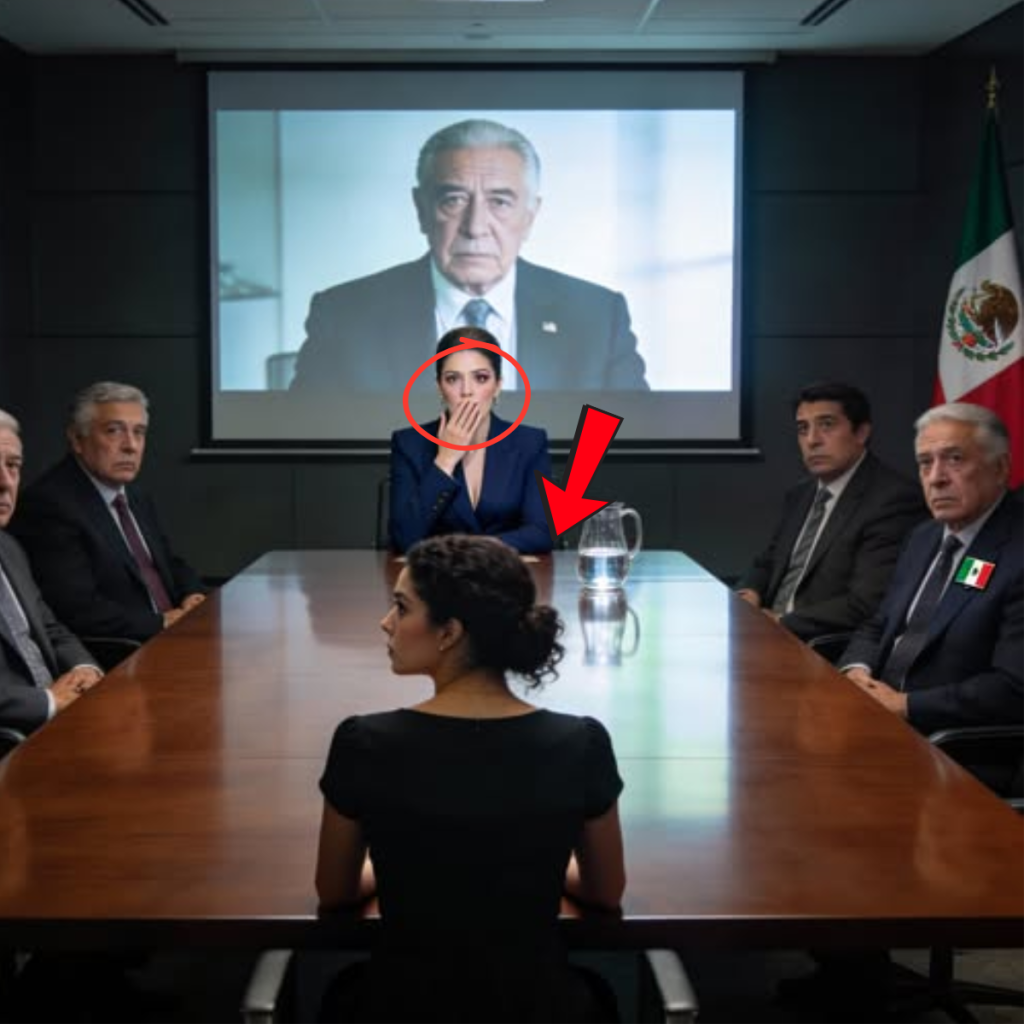
The law firm tower loomed over Valle Oriente. When I entered the boardroom, everyone fell silent.
Vanessa sat at the head of the table like a queen.
The only empty chair was at the far end. Exile.
Then Licenciado Carrillo entered—with a USB.
“Before the will,” he said calmly, “there is something you must all see.”
The video played.
My father appeared on the screen.
“Lía,” he said softly. “I was wrong.”
He revealed the truth.
The hidden drawer.
The unopened letters.
My letters.
Vanessa screamed. Denied. Collapsed.
“My daughter tried to reach me,” my father said. “And someone made sure I never knew.”
All eyes turned to Vanessa.
“I am proud of you, Lía,” he said.
I broke down.
“I rewrote my will,” he continued. “And now, the terms…”
The room held its breath.
Everything was about to change.