PART 1
CHAPTER 1: THE WINTER OF BROKEN SOULS
The wind didn’t blow that night—it howled.
A sharp, endless wail, as if La Llorona herself were roaming the frozen dirt streets of our neighborhood, searching for someone to drag away with her icy claws. Here in the north, when winter decides to bite, it gives no warning—it sinks its teeth in until you feel your bones are about to shatter.
The wall clock, an old plastic thing my mother had won years ago in a church raffle, read 3:47 a.m. Its ticking was the only sound competing with the roar of the wind outside.
Tick. Tock. Tick. Tock.
Each second meant less gas left in the tank—and one second closer to a dawn that would bring no hope, only debt collectors.
I was sitting at the kitchen table.
The wood was splintered, covered by a faded floral plastic tablecloth worn thin from years of bleach and scrubbing. My hands—dark, dry, cracked with tiny cuts from cold and hard labor—shook uncontrollably. I couldn’t tell if it was the freezing temperature or the panic crawling up my throat like bitter vomit.
Spread out before me, like crumbs of a life falling apart, were my last resources. I counted the money again, though I already knew the total by heart.
One wrinkled hundred-peso bill, soft from use.
One fifty with a torn corner.
Three ten-peso coins, two fives, and a handful of one-peso and fifty-cent coins.
“One hundred eighty-seven pesos and fifty cents,” I whispered, my breath forming a small white cloud in the icy kitchen air.
That was the price of my peace of mind.
That was all that stood between my two-year-old son Mateo and hunger.
That was everything left after the world had chewed me up and spit me out.
I rubbed my face with my hands, my skin tight and exhausted. At thirty-two, I felt ancient. The dark circles under my eyes were deep and purple—silent witnesses to sleepless nights worrying about the electricity being cut off, or Don Anselmo, the landlord, showing up again to yell at me in front of the neighbors over the overdue rent.
A violent gust of wind slammed into the house. The metal roof sheets rattled as if they might fly off toward the border. I flinched instinctively and looked toward the corner where I had made a “nest” for Mateo.
The bedroom heater had broken two weeks earlier—and fixing that piece of junk cost what I earned in a month scrubbing floors—so I had moved my son’s mattress into the kitchen. It was the only place where I could keep the stove pilots lit for a little warmth, even though I knew it was dangerous.
But what choice did I have? Let my child freeze in his crib?
Mateo slept, unaware of the disaster our life had become. Curled into a ball under three wool blankets that smelled of mothballs and dampness, only his little nose and a lock of black hair peeked out. His breathing was soft and steady—a small miracle in the middle of the storm.
Watching him broke my heart in two.
He trusted me.
In his innocence, he believed his mother could fix everything. That she was a superhero who chased away cold and hunger.
“If only you knew, my love…” I whispered into the frozen air.
“If you knew your mommy doesn’t even have money to buy you milk tomorrow.”
Guilt crushed my chest. The loneliness in that house was so thick it felt tangible.
“Why, Jerónimo?” I asked the empty chair across from me.
“Why did you have to be such a coward?”
Jerónimo. My ex-husband.
The man who swore eternal love to me at the altar of Saint Jude’s parish. The man who promised to take care of us.
He left eight months ago.
“I’m going to look for work on the other side,” he told me with that crooked smile I once loved.
“I’ll send dollars, you’ll see. We’ll get out of poverty.”
Lies.
Drunk promises.
He didn’t go north. He went to Monterrey—with a twenty-year-old waitress he met at the cantina where he wasted what little he earned. He forgot he had a son who needed diapers, food, and a father.
No calls.
No messages.
Not a single peso.
I stood up, my feet feeling like ice blocks inside my worn-out slippers, and pulled back the curtain a little. Outside, the street was unrecognizable. Snow—so rare and beautiful in movies—was a curse here. It fell thick and heavy, erasing sidewalks, covering trash and potholes, turning our poor neighborhood into a silent ghostland.
Not a soul passed by.
Not even the stray dogs dared go out.
My phone vibrated on the table, making me jump. My heart raced. Messages at this hour were never good news. Maybe a family emergency—or worse, the Coppel collectors who had started harassing me nonstop.
I grabbed the phone with shaking hands.
A WhatsApp message.
From Mrs. Rivas, the owner of the big house in San Pedro where I cleaned three times a week.
The words stabbed me like knives:
“Lucía, good evening. Sorry for the late hour, but I wanted to let you know not to come tomorrow. My husband and I discussed it and decided to find someone else. Yesterday it was very uncomfortable when you brought the child. He cried a lot and you couldn’t focus on cleaning. We need someone without distractions. Come next week to pick up pay for the days you worked. God bless.”
God bless.
So easy to write when your pantry is full and the heater is on.
Hot tears streamed down my frozen cheeks. That was my last steady job—the third one I’d lost in two months.
“Distractions.”
That’s what she called my son.
“What am I going to do?” I sobbed silently.
“What am I going to do, Virgin Mary?”
I collapsed back into the chair. Despair is a dark animal—it eats hope first, then the will to live. Everything around me screamed failure.
My mother—Doña Chuy—had died three years earlier. She was my rock. She would have known what to do. She would have brewed cinnamon tea, rubbed my back, and said, “Don’t lose heart, mija. God squeezes, but He doesn’t strangle.”
But she was gone.
And God… God seemed very busy strangling other people, because He already had me turning purple.



I closed my eyes and remembered her kitchen.
It smelled of cumin, toasted chilies, garlic, chocolate.
She could turn three humble ingredients into a feast.
“The secret isn’t how much money you spend,” she used to say.
“The secret is in your hands and your heart.”
I opened my eyes and looked at the cupboard. On the top shelf sat an old shoebox wrapped in Christmas paper. Inside were her recipes—the only inheritance she left me.
I pulled out the card for “Mama Chuy’s Fried Chicken.”
The ingredients stared back at me.
A crazy thought sparked.
“I have flour,” I murmured.
“I have oil. I still have lard.”
I looked at the money on the table.
“What if I sell food?”
Tomorrow, I decided.
If I failed… at least we would eat like kings one last time.
Then the wind howled again—and the light flickered.
That’s when I heard it.
Not the wind.
Not the house.
A deep, mechanical sound approaching fast.
Brum… brum… BRUM…
My blood froze.
I turned off the light and crawled to the window.
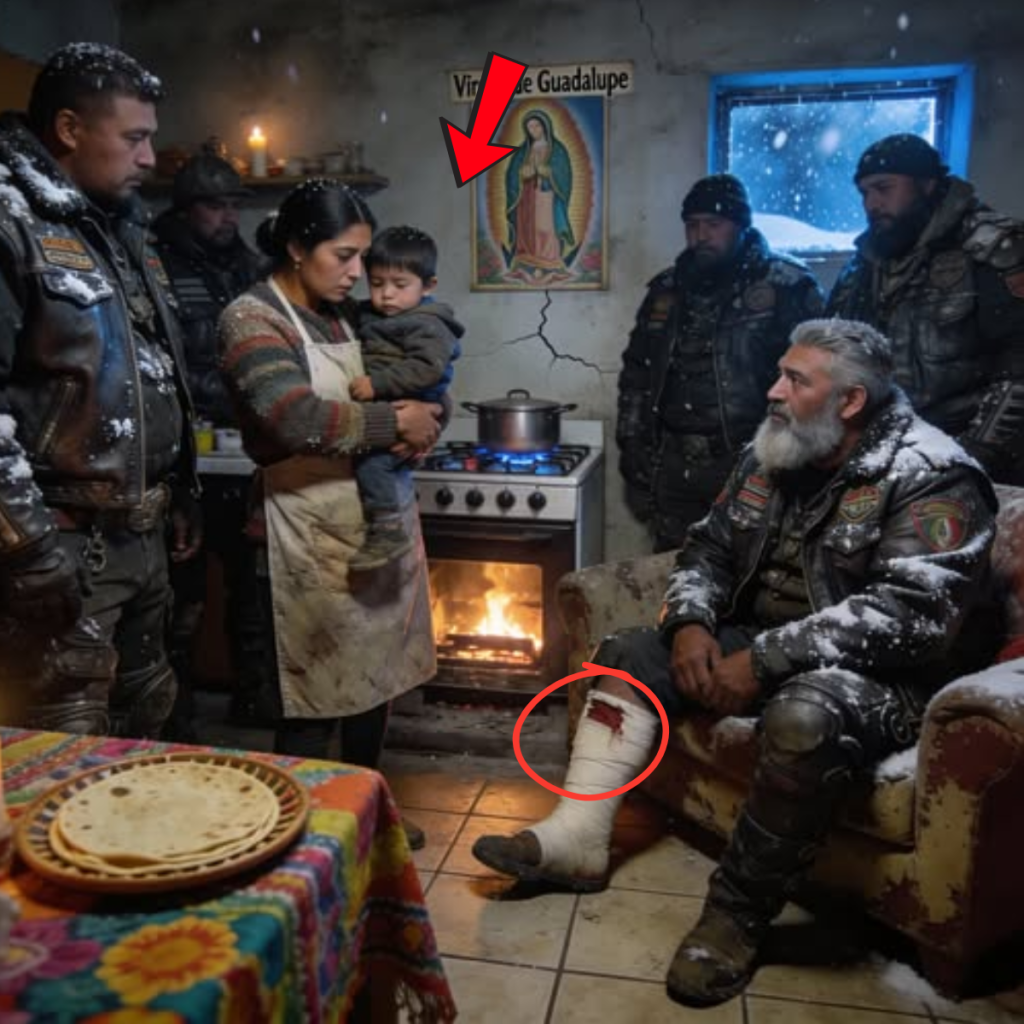
And then I saw them.
Lights. Dozens of headlights slicing through the snow.
“Holy Mother of God…” I whispered.
Motorcycles.
Huge. Black. Loud.
They stopped right in front of my house.
BANG. BANG. BANG.
Three hard knocks on the door.
Mateo woke up screaming.
“WE KNOW SOMEONE’S INSIDE!” a voice shouted.
Then—desperation.
“Please! We have a wounded man! We’re freezing!”
I hesitated.
But my mother’s voice echoed in my mind:
Help the traveler…
I unlocked the door.
And with a metallic click that echoed through the house, my life changed forever.