Rain lashed against the large windows of San Rafael Hospital with an almost rhythmic insistence, a gray and monotonous melody that seemed to have settled permanently into Patricia’s life. For three years, the sun had stopped shining for her—exactly the same amount of time her husband, Fernando, had lain confined to that bed in the presidential suite, connected to a symphony of machines that breathed and beat for him. The room smelled of lavender and disinfectant, a blend meant to hide the metallic scent of despair. Patricia, seated in the same blue velvet armchair where she had spent more than a thousand nights, watched her husband’s chest rise and fall mechanically. The doctors—renowned figures in white coats with solemn faces—had already exhausted their repertoire of comfort.
“Persistent vegetative state,” they said.
“It’s time to let him go,” they suggested, with the false compassion only those who are not losing half their soul can muster.
But Patricia couldn’t.
It wasn’t just stubbornness; it was a silent promise she had made at the grave of her little Camila, her five-year-old daughter who had died in the same accident that left Fernando trapped in that abyss of silence. That fatal day, the luxury car they were traveling in had veered off the road for no apparent reason, taking Camila’s laughter and Fernando’s consciousness with it. Patricia, who hadn’t gone with them because of a sudden flu, had been left alone in a mansion far too large, surrounded by echoes and shadows. Now, her only routine was this endless vigil, guarding her husband’s inert body as if her mere presence could serve as an anchor, preventing him from fully crossing to the other side.
But the vultures were already circling.
The door opened without a knock, and Javier and Marcela entered—Fernando’s cousin and his wife. Javier wore an impeccable Italian suit worth more than what an average family earned in a year, and Marcela’s jewelry clinked with an obscene cheerfulness in that place of pain. They had assumed “temporary” control of Fernando’s companies, a construction empire they now ran as their personal fiefdom.
“Patricia, dear,” Marcela said, stepping closer with a smile that never reached her cold eyes. “Enough is enough. Dr. Hernández says there’s no significant brain activity. You’re wasting a fortune keeping… this.”
She referred to Fernando as “this,” as if he were a broken piece of furniture. Patricia felt a stab of anger, but she was too tired to fight.
“I’m not disconnecting him, Marcela. Not today.”
“If not today, then tomorrow,” Javier interrupted, glancing impatiently at his watch. “The shareholders are nervous. We need to declare total incapacity to restructure the board. You can’t keep clinging to a ghost, Patricia. For everyone’s sake, let him die.”
The words hung in the air, heavy and toxic. Javier stepped closer to the bed, looking at his cousin with an expression Patricia couldn’t fully decipher—but it sent a chill down her spine. There was something in Javier’s gaze, a mixture of triumph and hidden fear.
“Get out,” Patricia whispered, her voice trembling but firm.
When they left, trailing expensive perfume and bad intentions behind them, Patricia buried her face in her hands and cried. She cried for Camila, cried for Fernando, and cried for her own loneliness.
“Give me a sign, my love,” she begged the silence. “Just one sign that you’re still there, or I swear I’ll give up.”
At that moment, beneath the crash of distant thunder, the door opened again. But this time, it wasn’t wolves dressed in silk who entered. A small girl came in, soaked from the rain, wearing a pink sweater two sizes too big and worn canvas shoes. She hugged an old rag doll to her chest, and her eyes—large and dark as the night—looked at Patricia with a mix of fear and determination.
No one knew then that this fragile little girl, light as a leaf in the wind, carried in her damp pockets the storm that was about to shatter the lies upon which that tragedy had been built.
Patricia stood up, quickly wiping away her tears, confused by the apparition.
“Who are you, sweetheart? Are you lost?” she asked gently.
The girl didn’t step back. She took one step forward, leaving wet footprints on the immaculate floor.
“I’m not lost,” she said in a clear voice. “My name is Valentina. My mom told me to come. She said the man who’s sleeping needs to wake up because he has many things to tell.”
Patricia felt her heart skip.
“Your mom? Who is your mom?”
“My mom’s name was Esperanza. She worked in your big house, the one with the rose garden,” Valentina replied.
Esperanza. The name struck Patricia like a hammer. Esperanza had been a loyal, gentle housekeeper who had worked for them for years. She had left suddenly a few weeks before the accident, claiming personal problems, and Patricia had never heard from her again. Learning that she had died brought a fresh wave of grief.
“And where is your mom now, Valentina?” Patricia asked softly.
“She’s in heaven, with little Camila,” the girl said with disarming simplicity. “Before she left, Mommy told me that if I ever ended up alone, I should come look for Mr. Fernando. She said he would take care of me, and that I had to take care of him too.”
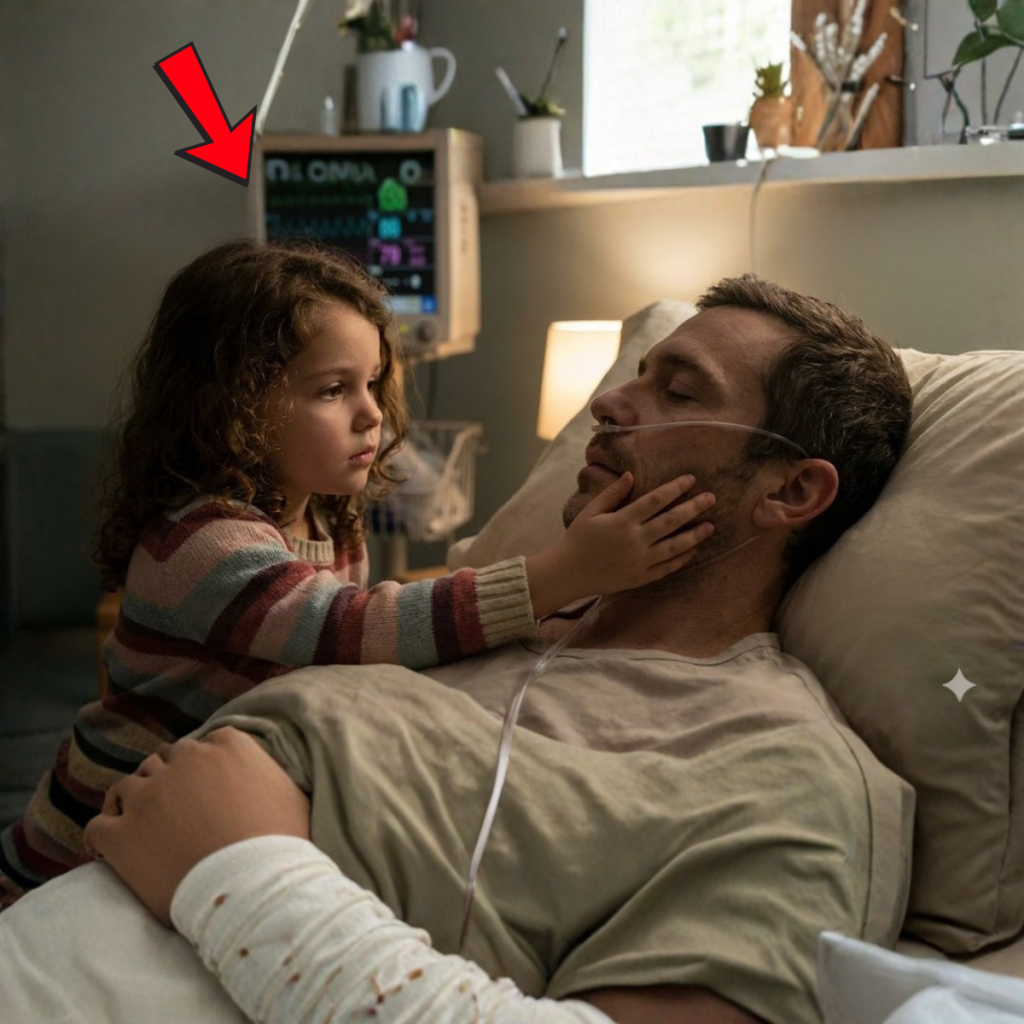
Valentina walked up to the bed, ignoring the cables and monitors. With infinite tenderness, she placed her small, rain-cold hand over Fernando’s large, motionless one.
“Hello, Mr. Fernando,” the girl whispered. “I’m Valentina. Mommy says it’s time to stop playing hide-and-seek. Camila says she really likes the garden upstairs, but that you still have to stay here.”
What happened next defied all medical and scientific logic. The moment Valentina spoke Camila’s name, the heart monitor—steady and monotonous for three years—began to accelerate. A faster, more urgent beeping filled the room. Patricia rushed to the bed.
“Fernando!”
Fernando’s fingers, wasted by years of inactivity, twitched. It was slight, almost imperceptible, but to Patricia it was like watching a mountain move. Then a single, heavy tear rolled down the cheek of the man in the coma.
Dr. Hernández burst into the room, alerted by the nurses monitoring the central screens. When he saw the scene, he froze. He checked Fernando’s pupils, studied the charts, and for the first time in three years, his professional composure collapsed into pure astonishment.
“This is… impossible,” he murmured. “He’s responding to auditory and tactile stimuli. His brain is lighting up like a city getting its power back.”
Patricia looked at Valentina, who simply smiled as she stroked Fernando’s hand.
“I told you he could hear me,” the girl said.
That night, Patricia refused to let Valentina be sent to any orphanage. The girl slept on the sofa in the suite, clutching her doll. While she slept, Patricia noticed a shoebox tied with string sticking out of Valentina’s old backpack. Driven by curiosity and a strange intuition, she opened it. Inside weren’t toys, but letters—letters written by Esperanza, dated just days before the accident.
With trembling hands, Patricia began to read. And with every line, grief turned to horror, and horror to burning fury.
“Mrs. Patricia,” Esperanza’s uneven handwriting read, “if you are reading this, something terrible has happened to me. I’m afraid. A few days ago, I overheard Mr. Javier talking on the phone in the study. He didn’t see me, but I heard him. He was talking about Mr. Fernando’s brakes. He said ‘the accident’ had to look natural on the curve of the old road. He said that with Fernando and the little girl out of the way, everything would be his. I tried to tell Mr. Fernando, but Javier threatened me. He said that if I opened my mouth, he would kill my Valentina. That’s why I ran away. But I can’t live with this secret. If anything happens to you, please forgive my cowardice and protect my daughter.”
Patricia let the letter fall. It hadn’t been an accident. Her daughter Camila’s death hadn’t been fate. It had been murder—planned by her husband’s own blood, by Javier and Marcela’s greed.
She looked at her husband fighting his way back to life, and at little Valentina sleeping—the daughter of the woman who had tried to save them. In that moment, the Patricia who had cried for three years died, and a wounded lioness willing to do anything was born.
The days that followed were a silent battle. Fernando improved rapidly. He opened his eyes, followed movement, and squeezed Patricia’s hand. Valentina became his best medicine; she spoke to him for hours, read him stories, and combed his graying hair.
But Javier and Marcela weren’t stupid. They noticed the girl’s presence and the miraculous recovery. Fear crept into their eyes. If Fernando woke up and remembered… if Esperanza had told him something before fleeing… their empire of lies would collapse.



They tried to ban Valentina from visiting. “It’s unhygienic,” they claimed. “She agitates the patient.” Patricia stood firm, like a steel wall. But she knew time was running out. Javier was rushing legal procedures to declare Fernando incompetent before he could speak.
On the day of reckoning, the sky seemed ready to fall on the hospital. A violent storm shook the city, making the hallway lights flicker. Javier and Marcela stormed into the room accompanied by a corrupt notary and two private security guards.
“The circus is over, Patricia,” Javier said, locking the door. “You’re going to sign these papers transferring Fernando’s medical and legal guardianship to me. Now.”
“I’m not signing anything, murderer,” Patricia spat, standing between them and the bed.
Javier’s face twisted with rage.
“You think you know something? You have no proof. You’re a crazy widow hallucinating conspiracies. Sign!”
Marcela noticed Valentina cowering in a corner.
“It’s because of that brat, isn’t it?” she hissed. “She’s been filling your head. We should have sent her away when we had the chance.”
Javier lunged at Patricia, grabbing her arm violently to force the pen into her hand. Valentina overcame her fear, ran forward, and bit Javier’s hand.
“Let her go!” the girl screamed.
“Filthy rat!” Javier roared, raising his hand to strike her.
The blow never landed.
A deep, guttural voice—heavy with an authority that seemed to rise from beyond the grave—froze the room.
“Don’t… touch… her.”
Everyone turned. Fernando had sat up in bed. He had ripped out his IV, blood dripping onto the white sheets, but he didn’t seem to care. His eyes, once empty, now burned with terrible fire, fixed on his cousin.
“Fernando…” Javier stammered, backing away, pale as death. “You’re… you can’t…”
“I… remember… everything,” Fernando said. His voice was rough, like stones grinding together, but each word fell like a death sentence. “I remember… the argument before we left. I remember… you insisting I take the blue car. I remember… the brakes failing. I remember… my daughter screaming your name before she died.”
Marcela began to sob hysterically, backing toward the door.
“It was Javier’s idea! I didn’t want to!” she screamed, betraying her husband instantly.
Cornered and desperate, Javier searched for an escape, but at that moment the door was kicked open. Patricia had not been idle; she had sent Esperanza’s letters and the security camera recordings—showing Javier falsifying documents—to the police and the prosecutor’s office that very morning.
Uniformed officers entered with weapons drawn.
“Javier Ramírez, you are under arrest for the attempted murder of Fernando Ramírez and the murder of Camila Ramírez,” an officer announced.
As they handcuffed Javier, who screamed curses and threats, and Marcela, who crawled on the floor begging for mercy, Fernando didn’t look at his tormentors. He turned to Patricia and Valentina. He extended his trembling arms, and both ran to him.
“Forgive me for not being awake to protect you,” Fernando sobbed, holding the girl who had given him back his life and the woman who had never left him.
“You’re here now, Daddy Fernando,” Valentina said, wiping his tears with her small fingers. “Mom Esperanza said love always wakes us up in time.”
Six months later, the mansion was filled with light. Heavy curtains were gone, and the once-neglected garden bloomed with exuberant life. Fernando, still in a wheelchair but regaining mobility day by day, sat under the shade of an oak tree. Beside him, Patricia read a book, serenity on her face making her look ten years younger.
Running across the lawn, chasing a golden puppy, was Valentina. She no longer wore old clothes or broken shoes. She wore a yellow dress glowing in the sunlight. That morning, the judge had signed the final adoption papers.
Valentina Ramírez—heiress not to a fortune, but to a love that had survived death.
Fernando called her. She left the puppy and ran to him, climbing onto his lap.
“Do you know what day it is today?” Fernando asked.
“The day we became a family forever,” she replied.
“That’s every day, my love. But today I want to give you something.”
Fernando pulled a locket from his pocket. Inside was a small photo of Camila on one side, and Esperanza on the other.
“They are our guardian angels,” Fernando said, his voice breaking. “They brought us together. You saved me, Valentina. You didn’t just wake me from a coma—you woke me from a life where only work and money mattered. You taught me that family isn’t just blood; it’s loyalty and love.”
Valentina kissed her mother’s photo, then hugged Fernando.
“I love you, Dad.”
Years later, the auditorium of the National University’s Faculty of Medicine was packed. Camera flashes lit the stage. A young woman—beautiful, intelligent, and kind-eyed—adjusted her graduation cap before stepping up to the microphone. She was the top of her class.
In the front row, an older man walking with a cane but standing tall and proud held his wife’s hand. Fernando and Patricia watched their daughter, Dr. Valentina Ramírez.
“When I was a child,” Valentina began, her voice resonating through the silent hall, “I learned that medicine has limits. Doctors said my father would never wake up. Science said it was impossible. But I also learned that there is a force more powerful than any drug or surgery—a force capable of defying death and rewriting destiny.”
She paused, looking straight into Fernando’s eyes.
“That force is faith. It is unconditional love. One day, I walked into a hospital room with nothing but a doll and my mother’s hope, and I witnessed a miracle. Today, I promise to wear this white coat not only to heal bodies, but to listen to souls. Because sometimes, all a heart needs to beat again is knowing that someone is waiting on the other side, ready to hold your hand in the rain.”
The applause was thunderous, shaking the walls. But for Fernando, the most beautiful sound wasn’t the clapping—it was the memory of a child’s voice in the middle of a storm, saying, “Hello, Mr. Fernando,” and reminding him that as long as someone loves us, it’s never too late to wake up and live again.